Interesting Things with JC #1752:
"The Blind Man"
A blind man’s eyes are touched, and he begins to see people, but they look like trees walking around. His eyes are touched again, and his vision becomes clear, leaving a moment when what he sees is real but incomplete.
Curriculum - Episode Anchor
Episode Title: The Blind Man
Episode Number: 1752
Host: JC
Audience: Grades 9–12, introductory college, homeschool, lifelong learners
Subject Area: English Language Arts, psychology, critical thinking, ethics, information literacy
Lesson Overview
Learning Objectives: By the end of the lesson, students will be able to:
Explain how the episode uses partial sight as a metaphor for incomplete understanding.
Distinguish observation, interpretation, judgment, and conclusion using evidence from the transcript.
Analyze how new information can refine an earlier conclusion without necessarily making every earlier observation false.
Apply deliberate reconsideration to a real-world situation involving people, arguments, events, or information.
Essential Question: How can we recognize when what we know is accurate but incomplete?
Success Criteria: Students can identify the episode’s central idea, cite specific evidence, explain the danger of premature certainty, and demonstrate how additional evidence can refine a conclusion.
Student Relevance Statement: Students constantly make judgments from limited information—in conversations, schoolwork, relationships, news, social media, and everyday decisions. Recognizing incomplete understanding can improve reasoning and communication.
Real-World Connection: Research on first impressions demonstrates that people can form judgments rapidly and that additional information can change or complicate those impressions. The lesson develops habits of checking evidence before treating an initial interpretation as a complete conclusion.
Workforce Reality: In professional settings, responsible judgment requires distinguishing what is known from what is assumed. Employees in fields such as healthcare, skilled trades, business, journalism, science, technology, and public service must often revise decisions as better information becomes available.
Key Vocabulary
Perception(per-SEP-shun) — the process of noticing and interpreting information through the senses or mind.
Partial understanding(PAR-shul un-der-STAN-ding) — knowledge that captures some aspects of a subject while leaving important information unknown.
Inference(IN-fer-ens) — a conclusion reached from evidence and reasoning rather than direct observation alone.
Assumption(uh-SUMP-shun) — something accepted as true without complete proof.
Judgment(JUHJ-ment) — an evaluation or conclusion formed after considering, or sometimes insufficiently considering, information.
Evidence(EV-i-dens) — information used to support or challenge a conclusion.
Certainty(SUR-tun-tee) — confidence that something is true or correct.
Reassessment(ree-uh-SESS-ment) — examining a conclusion again in light of additional information or evidence.
Narrative Core
Open: A blind man begins to see, but his first view of the world is incomplete: people appear to him like walking trees.
Info: His partial vision provides the episode’s central comparison. A person can possess genuine information while still lacking enough information to understand something accurately.
Details: The episode applies this idea to first impressions, arguments, events, and long-held beliefs. The critical distinction is between seeing something incorrectly and seeing only part of it.
Reflection: Intellectual discipline requires noticing when evidence is incomplete, resisting premature certainty, and remaining willing to reassess a conclusion when additional information becomes available.
Closing: These are interesting things, with JC.
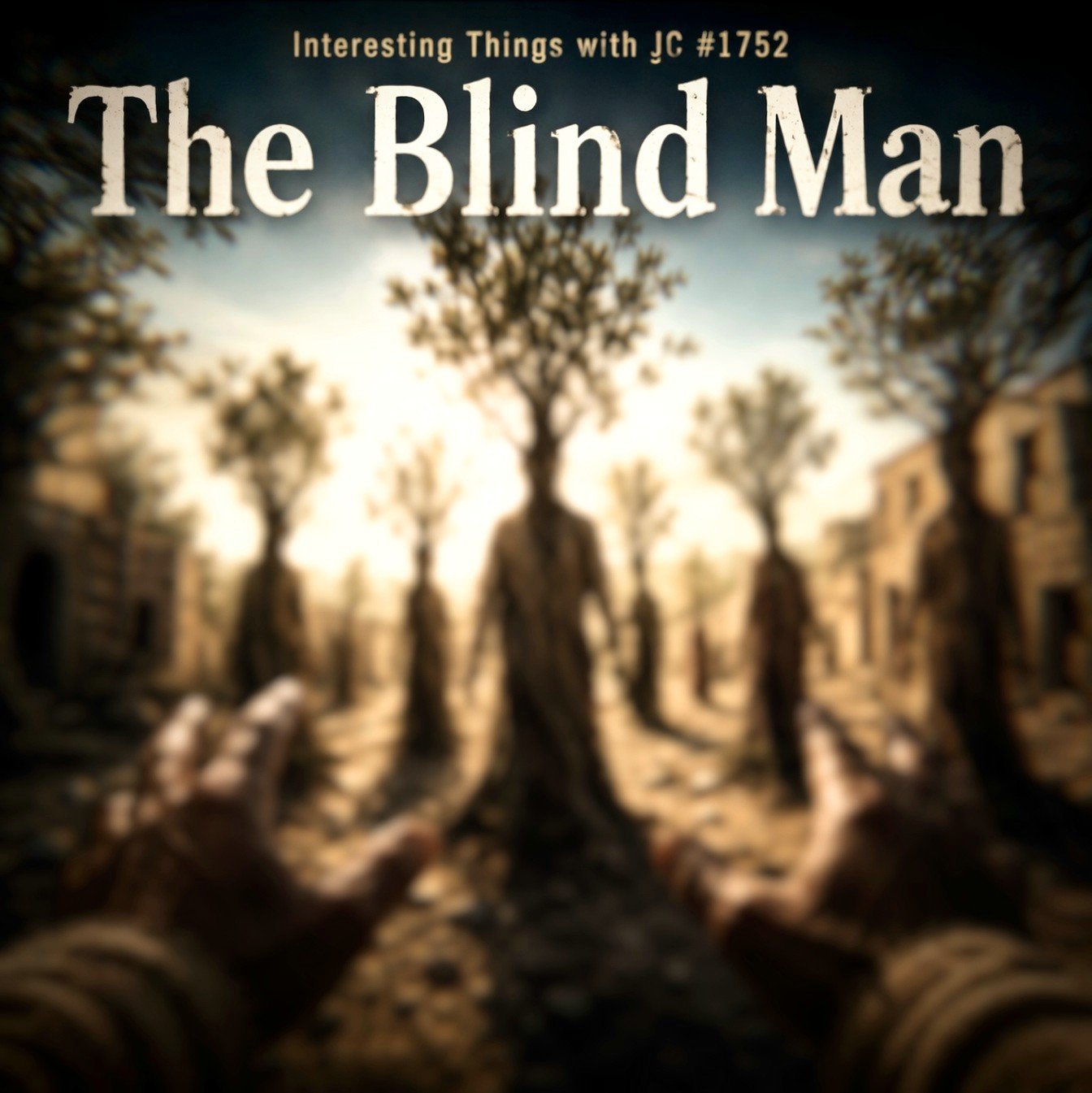
Blurred first-person view of several human figures who appear tree-like, standing along a village road. Outstretched hands are visible in the foreground, emphasizing impaired or incomplete vision. Text at the top reads, “Interesting Things with JC #1752” and “The Blind Man.”
Transcript
Interesting Things with JC #1752:
The Blind Man
A blind man is brought by people who want to help him. Another man takes him by the hand and leads him outside the village. Once they’re alone, he touches the blind man’s eyes and asks, “Do you see anything?”
The man looks up. He can see people, but something is wrong. They look like trees walking around.
His eyes are touched again, and this time his vision clears. He can see everything around him.
That moment between blindness and clear sight is something most of us know. We see enough of something to think we understand it.
We meet someone and form an opinion. We hear part of an argument and decide which side is right. We learn a little and become confident we know the rest. The problem isn’t always that what we see is wrong. Sometimes it’s simply incomplete.
That blind man really could see people. But he recognized that something wasn’t right. People shouldn’t look like walking trees.
Partial understanding can feel a lot like certainty. Once we have enough information to make the world recognizable, it becomes easy to stop looking.
We do it with people most of all. A first impression becomes a judgment. One mistake becomes someone’s character. Yet every person has a life extending beyond the part we happen to see.
New information doesn’t always mean everything we understood before was false. Sometimes it brings more of the picture into focus.
The blind man had one advantage we don’t always have. He knew his vision wasn’t clear.
That’s worth remembering when we’re certain about another person, an argument, an event, or something we’ve believed for years. What we see may be real, but that doesn’t guarantee we’re seeing the whole picture.
Sometimes understanding more begins with recognizing there may still be something left to see.
These are interesting things, with JC.
Student Worksheet
Comprehension — Understand What Happened
Question 1 — Initial Vision
What does the blind man see after his eyes are touched the first time?
Expected Output: 1–2 complete sentences.
Skill: Recall and comprehension.
Question 2 — Change in Vision
What changes after the man’s eyes are touched again?
Expected Output: 1–2 complete sentences.
Skill: Sequence and comprehension.
Question 3 — Partial Understanding
According to the episode, why can partial understanding feel like certainty?
Expected Output: 2–3 complete sentences.
Skill: Central-idea comprehension.
Question 4 — Recognizing the Problem
What advantage does the narrator say the blind man had that people do not always have?
Expected Output: 1–2 complete sentences.
Skill: Interpretation and comprehension.
Analysis — Examine the Central Idea
Question 5 — False vs. Incomplete
Explain the difference between information being wrong and information being incomplete.
Evidence Requirement: Use the blind man’s first experience of seeing as evidence.
Expected Output: 3–5 complete sentences.
Skill: Evidence-based reasoning.
Question 6 — The Walking Trees
Why is the description of people looking like “trees walking around” effective in communicating the episode’s central idea?
Evidence Requirement: Connect the image directly to partial understanding.
Expected Output: 3–5 complete sentences.
Skill: Metaphor and textual analysis.
Question 7 — First Impressions
The episode states that a first impression can become a judgment. Explain the reasoning problem that can occur when this happens.
Evidence Requirement: Identify what might be known and what might only be assumed.
Expected Output: 3–5 complete sentences.
Skill: Inference, evidence evaluation, and critical thinking.
Question 8 — Follow the Reasoning
Create a realistic example showing how an initial observation could develop into a judgment and later be reconsidered.
Use This Sequence:
Observation: What was directly seen, heard, read, or otherwise established?
Inference: What did the person think the observation might mean?
Judgment: What broader conclusion did the person reach?
New Information: What additional evidence became available?
Reassessment: Should the original judgment be maintained, modified, or rejected? Explain why.
Expected Output: Complete all five stages with at least one sentence per stage.
Skill: Application, reasoning, and reassessment.
Reflection — Apply the Idea
Prompt — What Might Be Missing?
Think of a nonprivate situation in school, work, media, history, or everyday decision-making where someone could reach a conclusion without having the complete picture.
Your Response Should:
Identify the initial conclusion.
Explain what information supports it.
Identify what remains unknown.
State one question that could uncover additional information.
Explain how the answer might affect the original conclusion.
Expected Output: One developed paragraph of approximately 5–7 sentences.
Skill: Reflection, information literacy, and responsible decision-making.
Difficulty Scaling
Level 1 — Developing
Complete Questions 1–5 and the Reflection Prompt.
Use evidence directly from the transcript.
Optional Sentence Frames:
“The episode shows that ___.”
“We know ___ because ___.”
“This information is incomplete because ___.”
“Before reaching a conclusion, I would want to know ___.”
Level 2 — Grade-Level
Complete Questions 1–8 and the Reflection Prompt.
Support analytical answers with specific evidence from the transcript.
Clearly distinguish observations from inferences and assumptions.
Level 3 — Advanced / Introductory College
Complete all worksheet tasks.
Then address the following challenge:
Challenge: Sometimes people must make decisions before they have complete information. When might that be necessary?
Analysis Requirement: Explain how someone can make a reasonable provisional decision while still acknowledging uncertainty.
Expected Output: One additional paragraph of approximately 5–7 sentences.
Student Output Expectations
Comprehension Questions 1–4
Answer in complete sentences.
Demonstrate accurate understanding of the episode.
Analysis Questions 5–7
Write 3–5 sentences for each response.
Use evidence or accurate paraphrases from the transcript.
Explain reasoning rather than simply stating an opinion.
Reasoning Question 8
Complete all five stages: Observation → Inference → Judgment → New Information → Reassessment.
Make the relationship between each stage clear.
Reflection
Write one developed paragraph.
Apply the episode’s idea to a new situation rather than merely retelling the story.
Quality Standard
Strong work consistently distinguishes what is known → what is inferred → what remains unknown → what additional evidence is needed → what conclusion is justified.
Academic Integrity Guidance
Your Reasoning: Responses should demonstrate your own analysis of the episode.
Transcript Evidence: You may quote briefly or paraphrase the supplied transcript when supporting an answer.
Outside Information: If outside information is used for the advanced challenge, identify the source rather than presenting the information as your own.
Use of Assistance: Any permitted assistance should support your thinking rather than replace the reasoning required by the assignment.
Final Check: Before submitting, ask: Does my conclusion go beyond what my evidence actually supports?
Teacher Guide
Quick Start
Teacher Goal: Help students recognize the difference between having some accurate information and having enough information to justify a conclusion.
Lesson Sequence: Podcast → initial response → vocabulary → analysis → discussion → assessment → exit ticket.
Primary Skill: Evidence-based reasoning.
Teacher Emphasis: Keep returning students to one question: What do we actually know, and what have we added through interpretation?
Pacing Guide — Audio First
0–5 Minutes — Podcast
Play the episode before providing interpretation.
Ask students to listen for the moment when the blind man realizes his vision is incomplete.
5–10 Minutes — Bell Ringer & Vocabulary
Students respond independently to the bell ringer.
Briefly review vocabulary needed for analysis.
10–22 Minutes — Student Worksheet
Begin with comprehension.
Move into evidence, inference, and analysis questions.
22–35 Minutes — Discussion
Compare student interpretations.
Require students to distinguish evidence from assumption.
35–45 Minutes — Assessment
Students complete the open-ended assessment or quiz.
Final 3–5 Minutes — Exit Ticket
Students identify a practical question they can use when evaluating an incomplete conclusion.
Bell Ringer
Prompt: What is the difference between saying, “I saw something” and saying, “I understand what I saw”?
Expected Output: 2–3 complete sentences.
Purpose: Introduces the distinction between observation and interpretation before formal discussion.
Teacher Check: Look for recognition that observing something does not automatically explain its meaning.
Audio Guidance
Before Listening:
Do not explain the episode’s message in advance.
Give students one listening question: When does the blind man realize that what he sees is incomplete?
During Listening:
Students record one detail that seems important to the episode’s message.
Encourage listening rather than extensive note-taking.
After Listening:
Ask students to state the central idea in one sentence.
Have students identify the evidence that led them to that interpretation.
Optional Second Listen:
Students identify one sentence connecting the blind man’s experience to everyday judgment.
Audio Fallback
If Audio Is Unavailable:
Read the supplied transcript aloud or assign a silent reading.
Preserve the same listening question as a reading question.
Continue with the same worksheet, discussion, and assessment sequence.
Instructional Goal: The lesson remains fully usable without access to the podcast recording.
Time on Task
Standard Lesson: 45–50 minutes.
Condensed Lesson: Approximately 30 minutes.
Extended Lesson: 70–90 minutes.
Independent/Homeschool: Approximately 45 minutes, with discussion prompts converted to written reflection where necessary.
Materials
Episode audio or supplied transcript.
Student Worksheet.
Paper or digital response document.
Board or display for modeling evidence and inference.
Optional highlighters for marking observations, assumptions, and conclusions.
Vocabulary Preparation
Priority Terms: perception, partial understanding, inference, assumption, judgment, evidence, certainty, reassessment.
Strategy:
Introduce terms before the main analysis.
Ask students to sort them into gathering information and interpreting information.
Discuss terms that could reasonably fit both categories.
Teacher Check: Students should be able to explain the difference between evidence, inference, and assumption before beginning the deeper analysis.
Common Misconceptions
Misconception 1: If a conclusion changes, the original information must have been false.
Correction: Information can be accurate but incomplete.
Misconception 2: The episode argues that first impressions are always wrong.
Correction: The issue is whether limited information supports a broader judgment.
Misconception 3: Uncertainty means refusing to make decisions.
Correction: A responsible decision can acknowledge incomplete information and its limitations.
Misconception 4: An inference is the same thing as an observation.
Correction: An observation identifies what was directly noticed; an inference interprets what that observation might mean.
Misconception 5: Reconsidering a conclusion shows weak reasoning.
Correction: Revising a conclusion when evidence changes can demonstrate stronger reasoning.
Discussion Prompts
Prompt 1 — Recognizing Uncertainty
Why might recognizing that you do not have the whole picture be more difficult than reaching a quick conclusion?
Skill: Metacognition and critical thinking.
Prompt 2 — Evidence vs. Assumption
How can someone distinguish a reasonable inference from an unsupported assumption?
Skill: Evidence evaluation.
Prompt 3 — Revising Conclusions
When should new evidence modify a conclusion rather than completely replace it?
Skill: Reasoning and adaptability.
Prompt 4 — Responsibility
What responsibility does a person have when making a judgment that could affect someone else?
Skill: Decision-making and professional judgment.
Formative Checkpoints
Checkpoint 1 — After Audio
Task: State the central idea in one sentence.
Look For: Recognition of incomplete understanding rather than simply blindness or eyesight.
Checkpoint 2 — During Worksheet
Task: Identify one observation and one inference from the episode.
Look For: A clear distinction between what occurred and what it means.
Checkpoint 3 — During Discussion
Task: Support a conclusion with evidence.
Look For: Students explaining why evidence supports the conclusion.
Checkpoint 4 — Before Assessment
Task: Name one reason a conclusion might need reassessment.
Look For: New evidence, missing information, mistaken assumptions, or an alternative interpretation.
Differentiation
Developing Learners:
Provide sentence frames: “The evidence shows ___, but it does not establish ___.”
Allow students to label examples as observation, inference, or assumption before writing explanations.
Reduce the number of examples without reducing the reasoning requirement.
Grade-Level Learners:
Require complete responses supported by transcript evidence.
Ask students to explain relationships among evidence, inference, and conclusion.
Advanced / Introductory College Learners:
Require students to address a counterargument.
Ask when acting on incomplete information may be necessary.
Require students to explain how uncertainty should be communicated when a decision still must be made.
Assessment Differentiation
Written Option: Complete the assessment in paragraph form.
Oral Option: Provide a structured verbal response addressing the same required components.
Graphic Organizer Option: Use Known → Inferred → Unknown → Additional Evidence → Revised Conclusion.
Non-Negotiable Skill: Regardless of format, students must distinguish evidence from inference and explain their reasoning.
Time Flexibility
30-Minute Version:
Podcast.
Bell ringer.
Worksheet Questions 1, 3, 5, and 7.
Brief discussion.
Exit ticket.
45–50-Minute Version:
Complete standard lesson sequence.
70–90-Minute Version:
Complete lesson.
Add the advanced counterargument task.
Add a real-world evidence-analysis scenario.
Conduct extended discussion or written application.
Substitute Readiness
Step 1: Play the podcast or read the transcript.
Step 2: Assign the bell ringer.
Step 3: Students complete the worksheet independently.
Step 4: Discuss Prompts 1–3 as time allows.
Step 5: Administer the quiz or assessment.
Step 6: Complete the exit ticket.
Teacher Preparation Required: Minimal; all necessary instructional content is contained in the episode, transcript, worksheet, and guide.
Engagement Strategy
Activity: Progressive Evidence Challenge.
Round 1: Give students limited information about an ambiguous situation.
Round 2: Students record an initial conclusion and the evidence supporting it.
Round 3: Reveal additional information.
Round 4: Students choose to maintain, modify, or reject their original conclusion.
Final Reflection: Students explain exactly which new information affected their reasoning.
Purpose: Makes the episode’s concept of partial understanding observable through students’ own decision-making.
Extensions
Media / Information Literacy: Analyze a headline or claim and identify what can and cannot be concluded from the information provided.
Science: Examine how an explanation can change as additional evidence becomes available.
History: Compare accounts of the same event and identify differences in available evidence or perspective.
Workplace: Analyze a situation in which an employee or supervisor must make a decision before all information is available.
Advanced Reasoning: Defend a provisional conclusion while explicitly identifying its limitations.
Cross-Curricular Connections
English Language Arts: Metaphor, central idea, textual evidence, argumentation.
Psychology: Perception, first impressions, judgment, and interpretation.
Science: Evidence, explanation, uncertainty, and revision.
History/Social Studies: Source evaluation and incomplete accounts.
Career Education: Evidence-based decision-making and professional judgment.
Information Literacy: Evaluating claims before accepting or sharing them.
SEL Connection
Perspective-Taking: Students recognize that limited information about another person may not represent the whole person.
Responsible Decision-Making: Students consider evidence before making judgments.
Self-Awareness: Students examine how confidence can exceed the amount of information available.
Classroom Boundary: Students should not be required to disclose private experiences or personal conflicts.
Skill Emphasis
Critical Thinking: Determine whether evidence supports a conclusion.
Analysis: Separate observation from interpretation.
Communication: Explain reasoning clearly and accurately.
Evidence Evaluation: Identify what is known and what remains uncertain.
Problem Solving: Determine what additional information is needed.
Adaptability: Revise conclusions when evidence changes.
Professional Judgment: Make appropriately qualified decisions when information is incomplete.
Answer Key
Student Worksheet
1: He sees people, but they appear like trees walking around.
2: After his eyes are touched again, his vision becomes clear and he can see everything around him.
3: Partial understanding can make something recognizable enough that a person feels certain and stops looking for additional information.
4: The blind man knows that his vision is not yet clear.
5: Information can accurately represent part of reality without providing enough evidence for a complete conclusion. The blind man genuinely sees people, but he does not yet see them clearly.
6: “Trees walking around” makes partial understanding concrete: the man perceives something real but cannot yet interpret it accurately.
7: A limited observation is being expanded into a broader judgment about a person.
8: Answers will vary, but students must correctly demonstrate observation → inference → judgment → reassessment.
Quiz Answer Key
1: B
2: C
3: A
4: D
5: B
Assessment Guidance
Question 1: Strong responses connect the blind man’s changing vision to the difference between partial information and complete understanding and use at least two transcript details.
Question 2: Strong responses clearly identify what is known → what is inferred → what remains unknown → what additional evidence is needed → whether the conclusion should be maintained, modified, or rejected.
Mastery Indicator: Student consistently distinguishes evidence from inference and demonstrates a justified willingness to reassess conclusions.
Quiz
What central idea is represented by the blind man’s partially restored vision?
A. Information becomes useless when it is incomplete.
B. Partial understanding can feel more complete than it actually is.
C. People should avoid forming conclusions under all circumstances.
D. Visual evidence is always unreliable.Why are the “walking trees” important to the episode?
A. They show that the man has no vision at all.
B. They establish that the village is surrounded by a forest.
C. They illustrate perception that contains real information but lacks clarity.
D. They prove that observation is less useful than opinion.According to the episode, what can happen to a first impression?
A. It can become a broader judgment about someone's character.
B. It disappears when new information arrives.
C. It is always more accurate than later information.
D. It prevents people from recognizing anyone.Which response best applies the episode’s reasoning?
A. Reject every conclusion because certainty is impossible.
B. Treat an initial observation as proof of a complete explanation.
C. Ignore evidence that conflicts with an established belief.
D. Ask what relevant information might still be missing.Which statement best summarizes the narrator’s conclusion?
A. New evidence always proves earlier evidence false.
B. Understanding can improve when we recognize that our current view may be incomplete.
C. People should trust first impressions because they occur naturally.
D. Complete understanding requires personal experience.
Assessment
Open-Ended Assessment
Question 1 — Analyze the Central Idea
Explain how the blind man’s changing vision functions as a metaphor for incomplete understanding.
Evidence Requirement: Use at least two specific details from the transcript.
Student Task: Explain what each detail reveals about the difference between seeing something and fully understanding it.
Expected Output: One well-developed paragraph of approximately 6–8 sentences.
Skills Assessed: Textual analysis, evidence evaluation, inference, reasoning, communication.
Question 2 — Apply the Idea
Apply the episode’s central idea to a realistic academic, workplace, interpersonal, or information-evaluation situation.
Student Task:
Identify what is directly known or observed.
Identify what has been inferred or assumed.
Identify what remains unknown.
Explain what additional evidence would improve understanding.
Decide whether the original conclusion should be maintained, modified, or rejected.
Expected Output: One well-developed paragraph of approximately 6–8 sentences or an equivalent structured response.
Skills Assessed: Critical thinking, problem solving, evidence evaluation, adaptability, professional judgment.
3–2–1 Rubric
3 — Proficient
Evidence: Uses accurate and relevant evidence from the transcript or scenario.
Reasoning: Clearly distinguishes observation, inference, assumption, and conclusion.
Analysis: Explains why incomplete information can lead to an incomplete or premature judgment.
Application: Shows how additional evidence could confirm, modify, or overturn a conclusion.
Communication: Presents ideas clearly and logically.
2 — Developing
Evidence: Uses some relevant evidence but may lack specificity.
Reasoning: Shows general understanding but occasionally mixes observation with inference or assumption.
Analysis: Identifies incomplete understanding but provides limited explanation of why it matters.
Application: Recognizes that additional information is needed but does not fully explain how it would affect the conclusion.
Communication: Response is understandable but may contain gaps in reasoning.
1 — Beginning
Evidence: Provides little or no relevant evidence.
Reasoning: Does not clearly distinguish what is known from what is assumed.
Analysis: Shows limited understanding of the episode’s central idea.
Application: Does not identify useful additional information or explain how a conclusion could be reassessed.
Communication: Reasoning is incomplete or difficult to follow.
Assessment Scoring
Question 1: 3 points
3 = Proficient
2 = Developing
1 = Beginning
Question 2: 3 points
3 = Proficient
2 = Developing
1 = Beginning
Total: 6 points
Mastery Indicator: 5–6 points demonstrates successful understanding of the lesson objectives.
Exit Ticket
Prompt: Before becoming certain about a conclusion, what is one question you could ask yourself to determine whether your understanding is complete?
Student Task: State the question and explain why asking it could improve your judgment.
Expected Output: 2–3 complete sentences.
Skills Checked: Reflection, evidence awareness, self-monitoring, decision-making.
Success Indicator: The response identifies a practical way to check for missing information rather than simply stating that more information may exist.
Standards Alignment
Alignment Focus: Students examine how incomplete information can produce premature conclusions, then practice separating evidence from inference, evaluating what remains unknown, and revising judgments when additional information becomes available.
NGSS — Science & Engineering Practices
SEP 4 — Analyzing and Interpreting Data
Connection: Students distinguish what is actually observed from what is inferred or assumed.
Student Skill: Evidence analysis and interpretation.
Measurable Outcome: Students correctly separate observation, inference, judgment, and missing information in a realistic scenario.
Lesson Evidence: Student Worksheet, Question 8; Assessment, Question 2.
Why It Aligns: Students practice determining what available evidence supports and where that evidence remains incomplete.
SEP 6 — Constructing Explanations
Connection: Students explain how additional information can refine an earlier interpretation.
Student Skill: Explanation, reasoning, and revision.
Measurable Outcome: Students explain how and why a conclusion should change when new evidence becomes available.
Lesson Evidence: Student Worksheet, Questions 5–6; Assessment, Question 1.
Why It Aligns: Students construct explanations from evidence and improve those explanations when the evidence changes.
SEP 7 — Engaging in Argument from Evidence
Connection: Students evaluate whether available evidence is sufficient to support a conclusion.
Student Skill: Evidence-based reasoning.
Measurable Outcome: Students defend, qualify, or revise a conclusion using specific evidence.
Lesson Evidence: Teacher Guide discussion prompts; advanced worksheet task.
Why It Aligns: Students must determine whether a claim is justified by the evidence rather than by assumption.
CCSS — Reading
CCSS.ELA-LITERACY.RI.9-10.1 — Cite Strong and Thorough Textual Evidence
Connection: Students use transcript details to support their interpretation of partial understanding and premature judgment.
Student Skill: Textual evidence and analysis.
Measurable Outcome: Students support an interpretation with relevant evidence from the episode.
Lesson Evidence: Student Worksheet, Questions 5–7; Assessment, Question 1.
Why It Aligns: Students cannot successfully complete the analytical tasks without connecting conclusions to specific textual evidence.
CCSS.ELA-LITERACY.RI.11-12.2 — Determine Central Ideas and Analyze Their Development
Connection: Students trace how the blind man's partial sight develops into the broader idea of incomplete understanding.
Student Skill: Central-idea analysis.
Measurable Outcome: Students identify the central idea and explain how the opening story develops that idea throughout the episode.
Lesson Evidence: Student Worksheet, Questions 5–6; Quiz, Questions 1–2; Assessment, Question 1.
Why It Aligns: Understanding the progression from literal sight to a broader argument about judgment is central to the lesson.
CCSS — Writing
CCSS.ELA-LITERACY.W.9-10.9 — Draw Evidence from Informational Texts
Connection: Students incorporate evidence from the transcript into written analysis.
Student Skill: Evidence-supported writing.
Measurable Outcome: Students produce a written explanation containing relevant textual evidence and reasoning.
Lesson Evidence: Student Worksheet, Questions 5–8; Assessment, Question 1.
Why It Aligns: Students use the episode as source material rather than relying solely on personal opinion.
CCSS — Speaking & Listening
CCSS.ELA-LITERACY.SL.11-12.1 — Initiate and Participate Effectively in Collaborative Discussions
Connection: Students discuss competing interpretations and consider evidence offered by classmates.
Student Skill: Discussion, listening, reasoning, and communication.
Measurable Outcome: Students state a position, support it with evidence, respond to another interpretation, and revise or defend their position when appropriate.
Lesson Evidence: Teacher Guide discussion prompts and engagement activity.
Why It Aligns: Collaborative discussion gives students direct practice reconsidering conclusions when exposed to additional perspectives or evidence.
C3 Framework — Inquiry
D1.5.9-12 — Determine the Kinds of Sources Helpful in Answering Compelling and Supporting Questions
Connection: Students identify what information is missing before deciding whether a conclusion is adequately supported.
Student Skill: Inquiry and information evaluation.
Measurable Outcome: Students identify at least one additional source or type of evidence needed to investigate an incomplete conclusion.
Lesson Evidence: Student Worksheet, Question 8; Assessment, Question 2.
Why It Aligns: The lesson moves students from recognizing uncertainty to determining what information could resolve it.
ISTE — Knowledge Constructor
ISTE 1.3.b — Evaluate Information
Connection: Students examine the accuracy, relevance, perspective, and completeness of information before accepting a conclusion.
Student Skill: Information literacy and evidence evaluation.
Measurable Outcome: Students identify what information supports a conclusion, what remains uncertain, and what additional evidence should be sought.
Lesson Evidence: Student Worksheet analysis; extension activity; Assessment, Question 2.
Why It Aligns: The lesson develops a repeatable process for evaluating information rather than accepting an initial interpretation at face value.
Career Readiness Competencies
Analytical Thinking
Connection: Students separate facts and observations from assumptions and conclusions.
Measurable Outcome: Students accurately complete the observation → inference → judgment → reassessment sequence.
Lesson Evidence: Student Worksheet, Question 8.
Why It Aligns: Effective analysis requires recognizing what the evidence establishes and what has merely been inferred.
Communication
Connection: Students explain conclusions and uncertainty clearly to others.
Measurable Outcome: Students communicate a conclusion, supporting evidence, and remaining uncertainty in writing or discussion.
Lesson Evidence: Discussion prompts; Assessment, Questions 1–2.
Why It Aligns: Responsible communication includes explaining both the basis and limits of a conclusion.
Problem Solving
Connection: Students identify missing information and determine what evidence would improve a decision.
Measurable Outcome: Students propose a reasonable next step for resolving an incomplete understanding.
Lesson Evidence: Student Worksheet, Question 8; Assessment, Question 2.
Why It Aligns: Effective problem solving requires identifying information gaps before acting.
Adaptability
Connection: Students practice changing a conclusion when stronger or more complete evidence becomes available.
Measurable Outcome: Students revise an initial judgment and explain what new evidence justified the revision.
Lesson Evidence: Teacher Guide engagement strategy; advanced worksheet task.
Why It Aligns: Adaptability includes responding constructively when new information changes the situation.
Professional Judgment
Connection: Students consider the responsibility involved in making decisions when information is incomplete.
Measurable Outcome: Students distinguish between what is known, what is assumed, and what should be verified before making a consequential decision.
Lesson Evidence: Teacher Guide discussion; Assessment, Question 2.
Why It Aligns: Professional judgment requires making defensible decisions while recognizing uncertainty and limitations.
Homeschool / Lifelong Learning Alignment
Independent Learning
Connection: Learners recognize gaps in their own understanding rather than waiting for someone else to identify them.
Measurable Outcome: Learners independently identify a question requiring further investigation.
Information Literacy
Connection: Learners distinguish evidence from interpretation and unsupported assumption.
Measurable Outcome: Learners explain what available information establishes and what remains unknown.
Real-World Application
Connection: Learners transfer the episode's reasoning to relationships, school, work, media, and everyday decisions.
Measurable Outcome: Learners apply the evidence-checking process to one realistic scenario.
Self-Directed Inquiry
Connection: Learners determine what additional information would improve their understanding.
Measurable Outcome: Learners formulate a useful follow-up question and identify an appropriate source of additional evidence.
Transferable Life Skills
Connection: Learners practice critical thinking, communication, perspective-taking, and responsible decision-making.
Measurable Outcome: Learners demonstrate a repeatable process: observe → question → investigate → reassess → conclude.
Lesson Evidence: Reflection Prompt; Assessment, Question 2; Exit Ticket.
Why It Aligns: The reasoning process can be transferred beyond this episode to future academic, professional, and personal decisions.
Show Notes
“The Blind Man” uses the striking image of partial sight to explore a familiar problem in human reasoning: having enough information to recognize something without having enough to understand it fully. Students examine the difference between observation and conclusion, consider how first impressions can become judgments, and practice revising interpretations when additional evidence becomes available. The lesson matters because careful thinking is not simply about finding information; it is also about recognizing the limits of what the available information can establish. This episode is dedicated to a dear old friend Rob, congrats on the big 25 man, time to move along…your people are waiting.
References
Association for Psychological Science. (2018). Studying first impressions: What to consider. https://www.psychologicalscience.org/observer/studying-first-impressions-what-to-consider
Bible Gateway. (n.d.). Mark 8:22–26, New International Version: Jesus heals a blind man at Bethsaida. https://www.biblegateway.com/passage/?search=Mark%208%3A22-26&version=NIV
Willis, J., & Todorov, A. (2006). First impressions. Psychological Science, 17(7). https://www.psychologicalscience.org/journals/psychological-science/j.1467-9280.2006.01750.x/