1751: "The Wasps That Know Your Face"
Interesting Things with JC #1751: "The Wasps That Know Your Face"
Northern paper wasps recognize individual nestmates by their faces. Change a familiar face, and the colony responds with aggression until it learns who that face belongs to.
Curriculum - Episode Anchor
Episode Title: The Wasps That Know Your Face
Episode Number: 1751
Host: JC
Audience: Grades 9–12, Introductory College, Homeschool, Lifelong Learners
Subject Area: Biology, Animal Behavior, Cognition, Evolution
Lesson Overview
Lesson Focus: Students investigate how scientists established that the northern paper wasp Polistes fuscatus can recognize individual wasps by their faces. The lesson moves from observation to experiment to evidence-based conclusion, emphasizing how controls, comparative studies, and later experiments strengthen a scientific explanation.
Learning Objectives
By the end of the lesson, students will be able to:
Explain how variable facial markings provide information that Polistes fuscatus can use to distinguish individuals.
Analyze the design and results of the 2002 facial-marking experiment.
Compare the face-learning performance of Polistes fuscatus and Polistes metricus and explain why that comparison matters.
Evaluate evidence for specialized and holistic face processing and explain how social experience contributes to the ability.
Essential Question: How can scientists determine whether an animal truly recognizes individual faces rather than simply responding to visual differences?
Success Criteria
A successful student can:
Identify the central claim of the episode.
Describe what researchers changed, controlled, and observed in the experiments.
Explain why the control wasps and Polistes metricus comparison strengthen the evidence.
Define holistic processing in the context of wasp face recognition.
Support a conclusion about wasp cognition with at least two specific pieces of evidence.
Student Relevance: Humans routinely recognize people by their faces without thinking about the complexity of the task. Studying wasps gives students an opportunity to examine what face recognition actually requires and how scientists test cognitive abilities that cannot be directly observed.
Real-World Connection: Animal-cognition research demonstrates a broader scientific principle: researchers cannot simply assume what an organism knows. They must design experiments that separate competing explanations and use observable evidence to support conclusions about learning, memory, and behavior.
Workforce Reality: Research in biology, neuroscience, ecology, psychology, and animal behavior depends on disciplined observation, experimental controls, evidence evaluation, accurate communication, and professional judgment. The same reasoning skills are useful whenever a person must distinguish what evidence demonstrates from what someone merely assumes.
Key Vocabulary
Vocabulary Guidance: Students do not need to memorize every definition before listening. Introduce the two species names first, then use the remaining terms to help students interpret the experiments after hearing the episode.
Polistes fuscatus(puh-LISS-teez fuss-KAY-tus) — A northern paper wasp species discussed in the episode whose variable facial markings allow individuals to be distinguished.
Polistes metricus(puh-LISS-teez MET-rih-kus) — A closely related paper wasp species used as a comparison because it does not normally recognize individuals by their faces.
Individual Recognition(in-duh-VIJ-oo-uhl rek-ug-NISH-un) — The ability to identify another organism as a particular individual.
Dominance Relationship(DOM-uh-nunts ree-LAY-shun-ship) — A social relationship in which individuals differ in relative rank or status.
Discrimination(dih-skrim-uh-NAY-shun) — In behavioral research, the ability to distinguish between different stimuli.
Cognitive Specialization(KOG-nuh-tiv spesh-uh-luh-ZAY-shun) — An information-processing ability particularly suited to solving a specific type of problem.
Holistic Processing(ho-LISS-tik PRAH-sess-ing) — Processing multiple features and their arrangement together rather than treating each feature independently.
Social Isolation(SOH-shul eye-suh-LAY-shun) — Separation from normal interactions with other members of the same species.
Narrative Core
Open: A colony of northern paper wasps may initially look like a collection of nearly identical insects. Look more closely, however, and Polistes fuscatus individuals have variable yellow markings across their faces. Those differences create a biological question: are the markings merely variable, or do the wasps actually use them to identify one another?
Info: Elizabeth Tibbetts tested that question in 2002 by altering the facial markings of familiar wasps with paint and returning them to their colonies. Nestmates responded to the altered individuals with increased aggression. Critically, control wasps were also painted, but their identifying patterns were not changed. Those controls did not receive the same treatment. Aggression toward altered individuals also declined as colony members became familiar with the changed appearance.
Details: Later research tested whether P. fuscatus simply excels at visual pattern learning or possesses a more specialized ability. In 2011, Michael Sheehan and Tibbetts trained wasps to discriminate among images. P. fuscatus learned normal wasp faces more quickly and accurately than other visual patterns or faces with rearranged features. A closely related species, P. metricus, did not show a comparable advantage. Subsequent experiments described in the episode found that P. fuscatus processes familiar wasp faces holistically and that socially isolated wasps perform worse at learning faces.
Reflection: No single observation carries the entire argument. The evidence becomes stronger as different experiments address different explanations. Facial alteration connects appearance with social recognition. Controls help rule out a simple response to paint. Visual-learning experiments test specialization. Species comparisons provide another point of comparison. Holistic-processing and social-experience studies investigate how the recognition system operates and develops.
Closing: These are interesting things, with JC.
Listening Guidance
Begin the lesson with the podcast. On the first listen, students should focus on the story rather than taking extensive notes. Ask them to listen for three things:
what researchers changed,
what the wasps did,
and what conclusion the evidence supports.
After listening, students can return to the transcript for close analysis.
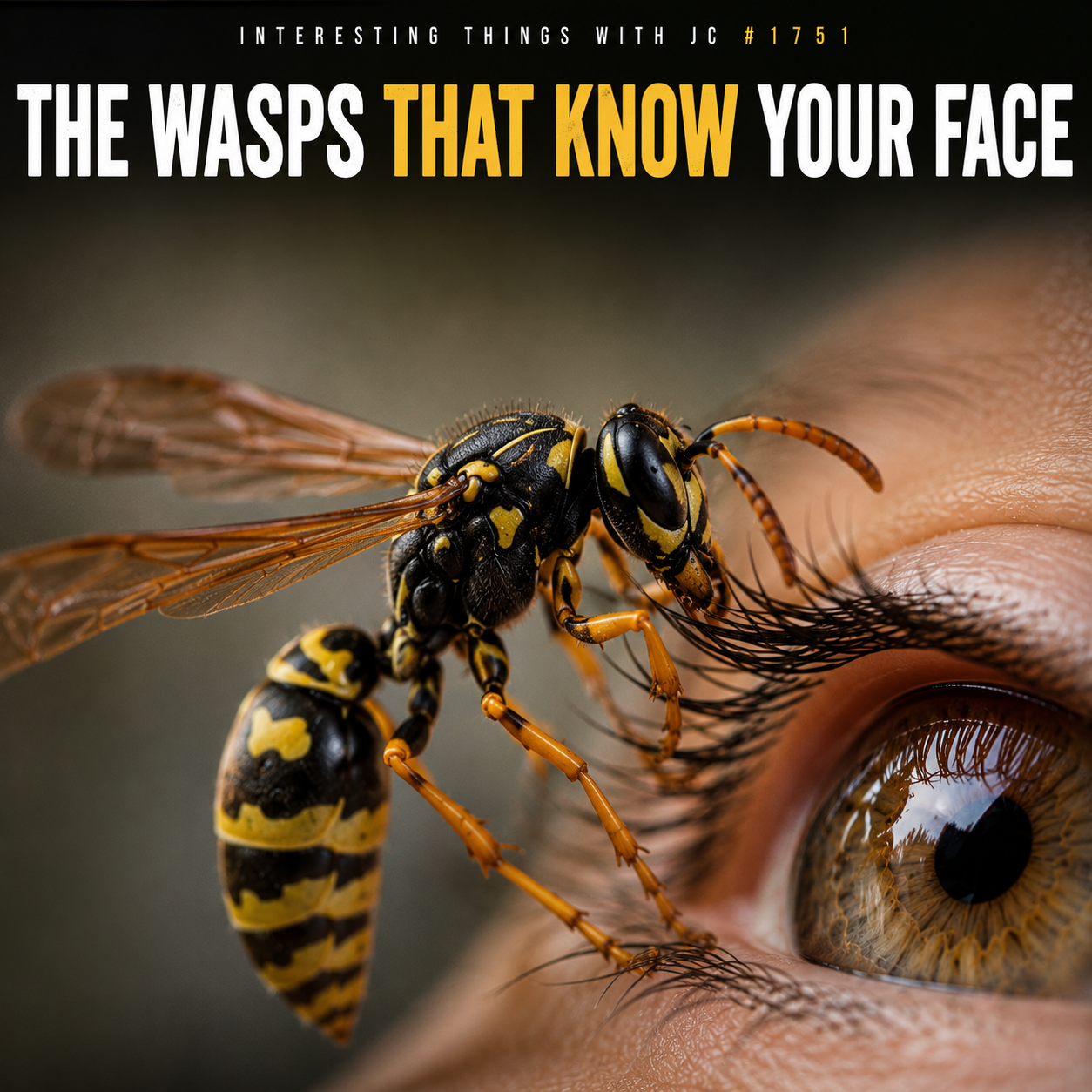
Close-up promotional image for Interesting Things with JC episode 1751, “The Wasps That Know Your Face.” A black-and-yellow wasp is shown beside a human eye, with its legs near the person’s eyebrow and eyelashes. Large white and yellow text across the top reads, “THE WASPS THAT KNOW YOUR FACE.”
Transcript
Interesting Things with JC #1751:
"The Wasps That Know Your Face"
A northern paper wasp colony can look like a gathering of nearly identical insects, but Polistes fuscatus (puh-LISS-teez fuss-KAY-tus) isn't built that way. Across the face are yellow markings that vary from one individual to another, giving each wasp a pattern its nestmates can distinguish.
In 2002, biologist Elizabeth Tibbetts tested whether those differences were actually being used for recognition. These wasps live in colonies with dominance relationships, where remembering another individual can affect how an encounter goes. Tibbetts altered the facial markings of familiar wasps with paint and returned them to their colonies. Nestmates responded with increased aggression. Control wasps painted without changing their identifying patterns didn't receive the same treatment, and as the colony became familiar with an altered face, the aggression declined. The wasps weren't simply reacting to something strange. They were learning who the new face belonged to.
Then researchers pushed the question further. In 2011, Michael Sheehan and Tibbetts trained wasps to discriminate between images. Polistes fuscatus learned normal wasp faces more quickly and accurately than other visual patterns or faces whose features had been rearranged. A closely related species, Polistes metricus (puh-LISS-teez MET-rih-kus), which doesn't normally recognize individuals by their faces, showed no comparable advantage.
The wasps weren't just good at recognizing patterns. Their brains were specialized for recognizing faces.
Later experiments found something even more specific. Polistes fuscatus processes familiar wasp faces holistically (ho-LISS-tik-lee), combining the features and their arrangement instead of simply memorizing one yellow patch at a time. That's a strategy also found in human face perception, reached through an entirely separate evolutionary path.
Experience helps build the ability, too. Socially isolated wasps perform worse at learning faces, suggesting that recognition develops partly through encounters with other wasps.
That wasp isn't carrying much of a brain, at least compared with us, but there's enough going on in there to look at another face, learn it, and remember who it belongs to.
These things know exactly who they're looking at.
These are interesting things, with JC.
Student Worksheet
Student Directions: Complete this worksheet after listening to the episode. Use the transcript when you need to verify evidence. For analysis questions, do more than state what happened: explain why the evidence matters. Unless your teacher gives different instructions, answer in complete sentences.
Part A — Comprehension
Output Expectation: Answer each question in 1–2 complete sentences using information from the episode.
What varies across the faces of individual Polistes fuscatus wasps, and why is that variation important?
What did Elizabeth Tibbetts change in the 2002 experiment?
How did nestmates respond when familiar wasps returned with altered identifying facial markings?
What happened to aggression as colony members became familiar with an altered face?
What did Sheehan and Tibbetts discover when P. fuscatus was trained to discriminate among normal wasp faces, other visual patterns, and rearranged faces?
How did Polistes metricus perform differently from Polistes fuscatus?
What does it mean when the episode says P. fuscatus processes familiar faces holistically?
What effect did social isolation have on face learning?
Part B — Evidence Analysis
Output Expectation: Answer each question in 3–5 complete sentences. Identify the relevant evidence and explain what conclusion that evidence supports.
Experimental Controls: Tibbetts painted both experimental and control wasps, but only the experimental wasps had their identifying facial patterns changed. Why was this control important? What simpler explanation did it help researchers address?
Learning: Aggression toward a wasp with an altered face declined as the colony became familiar with that face. Why is this result important to the interpretation that the wasps were learning identity?
Species Comparison: Why was Polistes metricus useful as a comparison species in the 2011 research? Explain how its performance strengthens the argument that P. fuscatus has a specialized face-learning ability.
Pattern Recognition vs. Face Recognition: What evidence suggests that P. fuscatus was not simply demonstrating superior ability at learning any visual pattern?
Holistic Processing: Explain the difference between recognizing a face holistically and memorizing one isolated yellow marking. Why does this distinction matter?
Part C — Build the Evidence Chain
Output Expectation: For each study or observation, identify Evidence → Conclusion → Limitation. Keep each response to 2–3 sentences.
2002 facial-marking experiment: What evidence was observed? What conclusion does it support? What does it not establish by itself?
2011 visual-discrimination experiment: What additional evidence was obtained? What explanation did this experiment help test?
Comparison with P. metricus: What does the difference between the two species add to the argument?
Social-isolation experiments: What does poorer face learning after isolation suggest about the role of experience?
Part D — Reflection
Output Expectation: Write one evidence-based response of 150–250 words.
The episode concludes that a wasp with a relatively small brain can learn a face and remember who it belongs to. What does the research presented in the episode suggest about the relationship among brain size, social behavior, experience, and specialized cognition? Use at least two specific pieces of evidence from the episode and explain how each supports your reasoning.
Difficulty Scaling: Complete the level assigned by your teacher.
Level 1 — Core Understanding: Complete Part A and identify one piece of evidence supporting individual recognition.
Level 2 — Evidence Analysis: Complete Parts A and B and explain how controls or comparisons strengthen a scientific conclusion.
Level 3 — Advanced Reasoning: Complete Parts A–D and distinguish what the experiments directly demonstrate from conclusions that require additional inference.
Academic Integrity Guidance: Base your responses on the episode and transcript. When explaining the science, separate what researchers observed from what you conclude from those observations. Do not invent experimental details that are not provided in the source material.
Teacher Guide
Quick Start: Begin with the podcast before providing explanation or background. Students should first encounter the evidence in narrative form, then use the transcript and worksheet to analyze how the researchers reached their conclusions. The instructional sequence is listen → identify evidence → analyze experiments → discuss conclusions → assess understanding.
Pacing Guide — Audio First
Bell Ringer | 3–5 minutes: Students respond independently to the opening question before receiving information about the experiments.
Podcast Listening | 5–7 minutes: Play the complete episode without interruption. Students listen for what researchers changed, what the wasps did, and what conclusions followed.
Immediate Recall | 3 minutes: Students record the experiment or result they found most important.
Vocabulary Check | 5 minutes: Clarify individual recognition, discrimination, cognitive specialization, and holistic processing.
Worksheet | 15–20 minutes: Students complete assigned comprehension and evidence-analysis questions.
Evidence Discussion | 10–15 minutes: Use the discussion prompts to examine controls, comparisons, and limits of the evidence.
Formative Check / Assessment | 5–10 minutes: Students demonstrate whether they can move from experimental observation to a supported conclusion.
Exit Ticket | 3 minutes: Students identify one experiment and explain why its design matters.
Bell Ringer: Before listening, respond in 2–3 sentences: What evidence would convince you that an animal recognizes another member of its species as a specific individual rather than simply noticing that it looks different?
Audio Guidance: Do not require extensive note-taking during the first listen. Ask students to listen for three recurring questions:
What changed? What did the researchers manipulate or compare?
What happened? What behavior or learning result was observed?
What does it mean? What conclusion does the result support?
Audio Fallback: If podcast audio is unavailable, read the full transcript aloud or assign a complete independent reading. Preserve the same instructional sequence: students should encounter the transcript before receiving detailed teacher explanation of the experiments.
Time on Task: Core lesson: approximately 45–55 minutes. Extended lesson with advanced analysis or experimental design: approximately 60–75 minutes.
Materials
Episode audio
Full episode transcript
Student Worksheet
Writing materials or digital response platform
Optional teacher-provided images illustrating variation in paper wasp facial markings
Vocabulary Preparation: Before listening, introduce only the pronunciation of Polistes fuscatus and Polistes metricus if needed. After listening, explicitly review individual recognition, discrimination, cognitive specialization, and holistic processing. Students should connect each term to evidence from the episode rather than memorize definitions in isolation.
Common Misconceptions
Misconception: The wasps responded aggressively simply because they had been painted.
Correction: Control wasps were also painted without changing their identifying patterns and did not receive the same treatment.Misconception: Any ability to distinguish visual patterns proves specialized face recognition.
Correction: The 2011 comparison tested this possibility by comparing learning of normal faces with other visual patterns and rearranged faces.Misconception: All paper wasps should have the same face-learning ability.
Correction: The closely related P. metricus did not show the comparable advantage described for P. fuscatus.Misconception: Holistic processing means memorizing one distinctive facial marking.
Correction: Holistic processing involves combining facial features with their arrangement rather than relying on one isolated feature.Misconception: A small brain automatically prevents sophisticated recognition.
Correction: The experiments described in the episode provide evidence that P. fuscatus can learn and recognize individual faces despite its small nervous system.
Discussion Prompts
Which result from the 2002 experiment provides the strongest evidence that facial markings carry information about individual identity? Explain.
Why is the painted control group necessary before concluding that altered identity patterns caused the increased aggression?
Why does declining aggression toward an altered face matter to the researchers' interpretation?
What alternative explanation was addressed by comparing normal wasp faces with other visual patterns and rearranged faces?
Why does the comparison with P. metricus strengthen the case for cognitive specialization?
What does holistic processing add to the evidence beyond simply showing that a wasp can distinguish two images?
What does the social-isolation result suggest about the relationship between biological specialization and experience?
Formative Checks
After Listening: Ask students to state the central scientific claim in one sentence.
After Vocabulary: Ask students to explain the difference between individual recognition and general visual discrimination.
During Worksheet: Check whether students identify both the experimental result and why that result matters.
During Discussion: Ask students to label statements as observation, interpretation, or inference.
Before Assessment: Students should be able to explain why at least one control or comparison makes the evidence stronger.
Differentiation
Additional Support: Allow transcript annotation and provide the structure Researchers changed ___ → Wasps did ___ → This supports ___.
Developing Learners: Assign the comprehension section before moving to evidence analysis and permit paired discussion before written responses.
On-Level Learners: Require complete evidence-and-reasoning responses using specific experimental details.
Advanced Learners: Require students to identify what each experiment establishes, what it does not establish, and what additional experiment could test a remaining question.
Assessment Differentiation: Maintain the same evidence expectations while allowing students to demonstrate understanding through a written response, structured oral explanation, or teacher-approved evidence map. Regardless of format, students must identify a claim, provide relevant evidence, and explain their reasoning.
Time Flexibility: For a shortened lesson, use the podcast, Bell Ringer, Student Worksheet Part A, one Part B analysis question, and the Exit Ticket. For an extended block, complete the full worksheet and add the experimental-design extension.
Substitute Readiness: No specialized biology background is required to facilitate the core lesson. Play or read the episode first, direct students to complete the assigned worksheet sections, use the provided discussion prompts in order, and finish with the Exit Ticket. Do not provide the Answer Key until student work is complete.
Engagement Strategy: Before discussing the results, ask students to predict two outcomes: what should happen if wasps recognize individual identity, and what should happen if they merely react to something visually unusual. Revisit those predictions after examining the controls.
Extensions
Design a follow-up experiment testing whether wasps recognize a familiar face when viewing conditions change.
Identify the experimental variable, control condition, measurable behavior, and predicted result.
Compare what evidence would support specialized face processing with evidence that would support general visual learning.
Develop a new question about how social experience might affect recognition and describe how it could be tested.
Cross-Curricular Connections
Biology: Evolution, animal behavior, social organization, and adaptation.
Psychology: Learning, memory, perception, and recognition.
Neuroscience: Specialized information processing and nervous-system function.
Statistics: Comparing experimental conditions and interpreting behavioral outcomes.
English Language Arts: Evidence-based explanation, source analysis, and scientific argumentation.
SEL Connection: Use the lesson to develop careful perspective-taking and disciplined interpretation rather than anthropomorphism. Students practice recognizing that behavior can carry information while avoiding assumptions about internal experiences that the experiments did not directly test.
Skill Value Emphasis: The central transferable skill is evidence-based judgment. Students practice separating observation from interpretation, identifying controls, comparing explanations, communicating conclusions, and recognizing the limits of available evidence.
Answer Key — Student Worksheet Part A
Polistes fuscatus has yellow facial markings that vary among individuals. The variation matters because nestmates can use those patterns to distinguish individuals.
Tibbetts altered the facial markings of familiar wasps with paint before returning them to their colonies.
Nestmates responded to wasps with altered identifying facial markings with increased aggression.
Aggression declined as colony members became familiar with the altered face.
P. fuscatus learned normal wasp faces more quickly and accurately than other visual patterns or faces whose features had been rearranged.
P. metricus did not demonstrate the comparable advantage for learning normal wasp faces.
Holistic processing means combining facial features and their arrangement rather than simply memorizing one isolated yellow marking.
Socially isolated wasps performed worse at learning faces, suggesting that social experience contributes to development of the ability.
Answer Key — Student Worksheet Part B
Experimental Controls: Because control wasps were also painted, researchers could compare the effect of painting with the effect of changing identifying facial information. The different responses helped address the possibility that nestmates were reacting simply to paint or experimental handling.
Learning: If aggression were only an immediate response to something strange, continued exposure would not by itself demonstrate identification. The decline in aggression as nestmates became familiar with the altered face supports the interpretation that they learned the individual's changed appearance.
Species Comparison: P. metricus is closely related to P. fuscatus but does not normally recognize individuals by their faces. Its lack of a comparable face-learning advantage strengthens the interpretation that the performance of P. fuscatus reflects specialization associated with its social recognition system rather than a general feature shared by closely related paper wasps.
Pattern Recognition vs. Face Recognition: P. fuscatus learned normal wasp faces more quickly and accurately than other visual patterns and rearranged faces. This relative advantage supports specialization for biologically relevant faces rather than superior learning of every visual pattern.
Holistic Processing: Memorizing one yellow patch would rely on an isolated feature. Holistic processing combines features with their spatial arrangement, indicating that the configuration of the face contributes to recognition.
Answer Key — Student Worksheet Part C
2002 Facial-Marking Experiment: Altering identifying facial patterns increased aggression from familiar nestmates, while controls painted without changing those patterns did not receive the same response. This supports the use of facial information in individual recognition, but the experiment alone does not establish every mechanism involved in visual face processing.
2011 Visual-Discrimination Experiment: P. fuscatus learned normal faces more quickly and accurately than comparison stimuli. This helped test whether its performance reflected specialized face learning rather than simply strong general visual-pattern learning.
Comparison with P. metricus: The related species did not show the same advantage. The comparison strengthens the association between specialized face learning and a species that normally uses faces for individual recognition.
Social-Isolation Experiments: Socially isolated wasps performed worse at learning faces. The result suggests that normal social experience contributes to development of effective face-recognition ability.
Answer Key — Student Worksheet Part D: Strong responses should connect at least two findings from the episode to a broader conclusion about cognition. Students may use the facial-alteration experiment, specialized learning of normal faces, the P. metricus comparison, holistic processing, or poorer performance following social isolation. Full-credit reasoning should distinguish evidence directly reported in the episode from broader inference about brain size, evolution, or cognition.
Quiz
Student Directions: Complete all five questions after listening to the episode and completing the worksheet. Select the one best answer for each question. Use the evidence presented in the episode rather than outside information. Answers are intentionally not shown in this section.
Multiple-Choice Questions
What characteristic of Polistes fuscatus provides visual information that nestmates can use to distinguish individuals?
A. Differences in wing length
B. Variable yellow facial markings
C. Differences in nest-building behavior
D. Variable antenna movement
In Tibbetts's 2002 experiment, why were control wasps painted without changing their identifying facial patterns?
A. To determine whether painting or handling alone could explain the nestmates' response
B. To teach the colony to recognize completely unfamiliar wasps
C. To determine whether facial markings affected the wasps' ability to fly
D. To compare facial recognition with nest-building ability
Which finding from the 2011 research provides the strongest evidence that P. fuscatus was not simply better at learning every type of visual pattern?
A. The wasps lived in colonies with dominance relationships
B. The wasps had yellow markings across their faces
C. The wasps learned normal wasp faces more quickly and accurately than other visual patterns or rearranged faces
D. The wasps became less aggressive toward altered individuals over time
Why was Polistes metricus important to the researchers' investigation?
A. It demonstrated that all paper wasps recognize individuals in the same way
B. It provided a closely related comparison species that did not show the same advantage for learning faces
C. It showed that facial markings are unrelated to social behavior
D. It demonstrated that social isolation improves visual learning
Which statement best describes holistic face processing as presented in the episode?
A. Recognizing an individual from a single yellow marking while ignoring the rest of the face
B. Responding to any unfamiliar visual pattern as though it represents a new individual
C. Combining facial features and their arrangement when processing a familiar wasp face
D. Learning facial patterns without previous social experience
Assessment
Student Directions: Use specific evidence from the episode in your responses. A strong answer should make a clear claim, identify relevant evidence, and explain how the evidence supports the claim. Do not simply summarize the episode.
Open-Ended Questions
Evaluating the Evidence: Researchers used several different experiments to investigate face recognition in Polistes fuscatus. Choose two findings from the episode and explain how they work together to support the conclusion that these wasps have a specialized ability for recognizing faces.
Output Expectation: Write 150–200 words. Include two specific pieces of experimental evidence and explain the importance of each.Experience and Cognition: Socially isolated P. fuscatus performed worse at learning faces. What does this result suggest about the relationship between social experience and face recognition? Explain what the evidence supports and identify one conclusion that would go beyond what this result alone establishes.
Output Expectation: Write 100–150 words using evidence-based reasoning.
3–2–1 Rubric
3 — Proficient: Makes an accurate claim; uses specific, relevant evidence; clearly explains how the evidence supports the conclusion; distinguishes experimental findings from inference; and communicates reasoning accurately.
2 — Developing: Makes a generally accurate claim and provides relevant evidence, but the connection between evidence and conclusion is incomplete, unclear, or contains a minor misconception.
1 — Beginning: Provides an unsupported or substantially inaccurate claim, uses little relevant evidence, or summarizes information without explaining how the evidence supports a conclusion.
Exit Ticket: Before leaving, answer in 2–3 complete sentences: Which experiment or comparison from the episode provides the strongest evidence that P. fuscatus recognizes faces in a specialized way? Identify the evidence and explain why you selected it.
Standards Alignment
Alignment Guidance: This lesson is designed for Grades 9–12 and introductory college learners. Standards are included only where a specific lesson task produces measurable evidence of the skill. The strongest alignment is to scientific inquiry, evidence evaluation, disciplinary literacy, communication, and information literacy.
NGSS — Science & Engineering Practices
SEP 4 — Analyzing and Interpreting Data
Lesson Connection: Students analyze the reported behavioral outcomes of the facial-marking, visual-discrimination, species-comparison, and social-isolation experiments.
Measurable Student Skill: Distinguish an experimental observation from the interpretation researchers draw from it.
Evidence of Learning: Student Worksheet Parts B and C; Assessment Question 1.
Alignment Justification: Students use reported experimental results to determine which conclusions about individual recognition and specialized face learning are supported.SEP 6 — Constructing Explanations
Lesson Connection: Students construct an explanation for why the evidence supports specialized face learning in Polistes fuscatus.
Measurable Student Skill: Connect multiple experimental findings through explicit scientific reasoning.
Evidence of Learning: Student Worksheet Part D; Assessment Questions 1–2.
Alignment Justification: Students must move beyond recalling results and explain how those results support a scientific conclusion.SEP 7 — Engaging in Argument from Evidence
Lesson Connection: Students evaluate competing explanations, including general visual-pattern learning versus specialized face learning.
Measurable Student Skill: Defend a conclusion using appropriate and sufficient evidence while identifying limitations.
Evidence of Learning: Teacher Guide discussion prompts; Student Worksheet Part B; Assessment Question 1.
Alignment Justification: Grades 9–12 NGSS practice emphasizes using evidence and scientific reasoning to evaluate and defend explanations. (National Academies)SEP 8 — Obtaining, Evaluating, and Communicating Information
Lesson Connection: Students obtain scientific information from the audio and transcript, evaluate the strength of reported evidence, and communicate conclusions.
Measurable Student Skill: Accurately summarize evidence and explain its significance without overstating what an experiment demonstrates.
Evidence of Learning: Student Worksheet Parts B–D; discussion; Exit Ticket.
Alignment Justification: The lesson directly requires evaluation of scientific claims, methods, and evidence, consistent with the high-school progression of this practice. (Next Generation Science Standards)
CCSS — Reading in Science & Technical Subjects
CCSS.ELA-LITERACY.RST.11-12.1 — Cite specific textual evidence to support analysis of science and technical texts.
Lesson Connection: Students return to the transcript after listening and identify evidence supporting claims about wasp recognition.
Measurable Student Skill: Select relevant textual evidence and explain its relationship to a scientific conclusion.
Evidence of Learning: Student Worksheet Parts B–D; Assessment Question 1.
Alignment Justification: Students must support analysis with specific evidence while recognizing distinctions and limits within the account. (Common Core State Standards Initiative)CCSS.ELA-LITERACY.RST.11-12.2 — Determine central ideas or conclusions and accurately summarize complex scientific information.
Lesson Connection: Students identify the central scientific claim and explain the progression from facial alteration to specialized and holistic face processing.
Measurable Student Skill: Summarize the research sequence accurately without changing the meaning of the evidence.
Evidence of Learning: Formative Check after listening; Student Worksheet Part C.
Alignment Justification: The lesson requires students to reduce several experiments to their central findings and relationships while preserving scientific accuracy. (Common Core State Standards Initiative)
CCSS — Writing
CCSS.ELA-LITERACY.WHST.11-12.1 — Write arguments focused on discipline-specific content.
Lesson Connection: Students construct an evidence-based argument about specialized face recognition.
Measurable Student Skill: State a defensible claim, select relevant evidence, and explain the reasoning connecting evidence to the claim.
Evidence of Learning: Student Worksheet Part D; Assessment Question 1.
Alignment Justification: The assessment directly requires scientific argumentation using relevant evidence and attention to the limits of claims. (Common Core State Standards Initiative)CCSS.ELA-LITERACY.WHST.11-12.2 — Write informative/explanatory texts about scientific procedures, experiments, or technical processes.
Lesson Connection: Students explain how experimental controls and species comparisons contribute to scientific conclusions.
Measurable Student Skill: Present an experimental relationship clearly and accurately in writing.
Evidence of Learning: Student Worksheet Parts B and C; Assessment Question 2.
Alignment Justification: Students explain experimental procedures and their significance rather than merely listing results. (Common Core State Standards Initiative)
CCSS — Speaking & Listening
CCSS.ELA-LITERACY.SL.11-12.1 — Initiate and participate effectively in collaborative discussions.
Lesson Connection: Students discuss alternative explanations, experimental controls, comparative evidence, and limitations.
Measurable Student Skill: Refer to evidence, respond to questions about reasoning, and refine a conclusion during discussion.
Evidence of Learning: Teacher Guide Discussion Prompts 1–7.
Alignment Justification: The discussion requires students to build on ideas, question reasoning, and use evidence to support conclusions. (Common Core State Standards Initiative)CCSS.ELA-LITERACY.SL.11-12.2 — Integrate information presented in diverse formats and media.
Lesson Connection: Students first encounter the scientific account through audio and then use the written transcript for close analysis.
Measurable Student Skill: Integrate information obtained through listening and reading into an evidence-based explanation.
Evidence of Learning: Audio-first listening task; worksheet; discussion.
Alignment Justification: The lesson intentionally combines oral and written presentation of the same scientific information and requires students to use both effectively. (Common Core State Standards Initiative)
C3 Framework — Inquiry
C3 Inquiry Arc — Evaluating Sources and Using Evidence
Lesson Connection: Students repeatedly distinguish evidence, interpretation, and inference while examining scientific claims.
Measurable Student Skill: Determine whether available evidence adequately supports a stated conclusion.
Evidence of Learning: Student Worksheet Parts B and C; Teacher Guide formative checks; Assessment Question 2.
Alignment Justification: Although the lesson is primarily scientific rather than civic, its evidence-evaluation tasks directly reinforce disciplined inquiry: claims must be supported, alternative explanations considered, and conclusions limited to what the evidence warrants.
ISTE Standards for Students
ISTE 1.3.b — Knowledge Constructor: Evaluate Information
Lesson Connection: When digital research is used for the extension, students evaluate the accuracy, validity, origin, and relevance of information about animal cognition.
Measurable Student Skill: Determine whether a digital source provides credible evidence relevant to a research question.
Evidence of Learning: Teacher Guide extension or instructor-assigned research follow-up.
Alignment Justification: The standard specifically addresses evaluation of digital information, making it appropriate when the optional digital research component is used. (ISTE)
Career Readiness Competencies
Analytical Thinking
Lesson Connection: Students separate experimental manipulation, observation, interpretation, and conclusion.
Measurable Student Skill: Analyze an experiment and identify what its evidence does and does not establish.
Evidence of Learning: Student Worksheet Parts B and C.
Alignment Justification: This develops the disciplined analysis required when professional decisions depend on incomplete or competing evidence.Communication
Lesson Connection: Students explain scientific findings through writing and structured discussion.
Measurable Student Skill: Communicate a claim clearly and support it with relevant evidence and reasoning.
Evidence of Learning: Student Worksheet Part D; classroom discussion; Assessment.
Alignment Justification: Effective professional communication requires converting complex evidence into an accurate, understandable explanation.Problem Solving
Lesson Connection: Students determine how experimental controls and comparison conditions address alternative explanations.
Measurable Student Skill: Propose a testable follow-up investigation containing an appropriate variable, comparison, and measurable outcome.
Evidence of Learning: Teacher Guide Extensions.
Alignment Justification: Students practice defining what additional evidence would be needed to resolve an unanswered question.Adaptability
Lesson Connection: Students encounter a sequence in which later experiments add evidence and refine earlier conclusions.
Measurable Student Skill: Revise or strengthen an explanation when additional evidence becomes available.
Evidence of Learning: Student Worksheet Part C and evidence discussion.
Alignment Justification: Students learn that sound conclusions should respond to new evidence rather than remain fixed.Professional Judgment
Lesson Connection: Students distinguish direct experimental findings from broader interpretations about cognition.
Measurable Student Skill: State a conclusion without claiming more than the available evidence demonstrates.
Evidence of Learning: Assessment Question 2; Exit Ticket.
Alignment Justification: Responsible judgment requires recognizing evidentiary limits as well as evidentiary strengths.
Homeschool / Lifelong Learning Alignment
Independent Learning
Lesson Connection: Audio, transcript, vocabulary, worksheet directions, and output expectations provide a complete self-directed learning sequence.
Measurable Student Skill: Independently move from source material to comprehension, analysis, and evidence-based conclusion.
Evidence of Learning: Completed Student Worksheet and Assessment.
Alignment Justification: The lesson can be completed without dependence on specialized classroom equipment or continuous instructor guidance.Information Literacy
Lesson Connection: Learners distinguish observations, claims, evidence, and inference.
Measurable Student Skill: Evaluate whether a conclusion is adequately supported by the information provided.
Evidence of Learning: Student Worksheet Parts B and C.
Alignment Justification: The skill transfers directly to evaluating scientific, professional, and everyday information.Real-World Application
Lesson Connection: Experimental controls demonstrate how stronger comparisons improve confidence in conclusions.
Measurable Student Skill: Explain why a comparison or control is necessary before accepting a causal explanation.
Evidence of Learning: Student Worksheet Part B, Question 1.
Alignment Justification: Evaluating competing explanations is useful far beyond formal scientific research.Self-Directed Inquiry
Lesson Connection: Learners identify an unanswered question and develop a possible follow-up investigation.
Measurable Student Skill: Formulate a testable question and identify evidence that could answer it.
Evidence of Learning: Teacher Guide Extensions.
Alignment Justification: The activity moves learners from consuming information to independently generating productive questions.Transferable Life Skills
Lesson Connection: The lesson repeatedly requires critical thinking, evidence evaluation, communication, reasoning, and decision making.
Measurable Student Skill: Separate what is observed from what is assumed before reaching a conclusion.
Evidence of Learning: Discussion, worksheet, assessment, and Exit Ticket.
Alignment Justification: Disciplined evidence-based judgment is transferable across education, employment, and everyday decision making.
Show Notes
Summary: Northern paper wasps may look nearly identical at first glance, but Polistes fuscatus can use distinctive facial markings to recognize individual wasps. This episode follows the experimental evidence from altered facial markings and colony responses to specialized face learning, comparison with Polistes metricus, holistic processing, and the influence of social experience. In the classroom, the story provides a compact case study in how scientists move from observation to controlled experimentation and increasingly specific conclusions. Students examine not only what researchers discovered, but how controls, comparisons, and follow-up experiments strengthen scientific reasoning. The lesson challenges assumptions about the relationship between brain size and cognitive ability while developing transferable skills in evidence evaluation, critical thinking, inquiry, and responsible interpretation.
References
Tibbetts, E. A. (2002). Visual signals of individual identity in the wasp Polistes fuscatus. Proceedings of the Royal Society B: Biological Sciences, 269(1499), 1423–1428. https://doi.org/10.1098/rspb.2002.2031
Sheehan, M. J., & Tibbetts, E. A. (2011). Specialized face learning is associated with individual recognition in paper wasps. Science, 334(6060), 1272–1275. https://doi.org/10.1126/science.1211334
Sheehan, M. J., & Tibbetts, E. A. (2010). Selection for individual recognition and the evolution of polymorphic identity signals in Polistes paper wasps. Journal of Evolutionary Biology, 23(3), 570–577. https://doi.org/10.1111/j.1420-9101.2009.01923.x