1750: "Trebizond"
Interesting Things with JC #1750: "Trebizond"
Ships carry coffee, copper, cloth, salt, and other goods through Trebizond while steep roads climb from the Black Sea harbor into the Pontic Mountains. The empire that once ruled from the city is already gone, but Greek Orthodox communities remain for centuries—until violence, displacement, and a compulsory population exchange remove most of them from the coast.
Curriculum - Episode Anchor
Episode Title: Trebizond
Episode Number: 1750
Host: JC
Audience: Grades 9–12, introductory college, homeschool, lifelong learners
Subject Area: World History, Ottoman History, Black Sea History, Historical Geography
Instructional Focus: Historical continuity and change, trade networks, multicultural urban life, migration, displacement, and evidence-based historical reasoning
Lesson Overview
Lesson Focus: Students examine Trebizond as a Black Sea port whose geography, trade networks, communities, and historical identity continued to matter long after the Empire of Trebizond ended in 1461.
Learning Objectives: Students will:
Explain how Trebizond's location between the Black Sea and Pontic Mountains influenced transportation, commerce, and regional connections.
Distinguish between political change and social or cultural continuity by comparing the end of the Empire of Trebizond with the continued presence of communities and trade networks.
Analyze how court records, customs records, and international agreements can provide different kinds of historical evidence.
Construct an evidence-based explanation of how geography, commerce, political change, and forced migration shaped Trebizond across several centuries.
Essential Question: How can a city preserve elements of its historical identity even after the political state that once governed it disappears?
Success Criteria: Students can:Identify at least three historically significant periods or developments connected to Trebizond.
Explain the relationship between the city's geography and its economic importance.
Use specific evidence from the episode to distinguish political change from cultural or social continuity.
Explain what different types of historical records can reveal—and what they cannot establish by themselves.
Student Relevance Statement: Cities continually change governments, economies, populations, transportation systems, and cultural identities. Studying Trebizond helps students investigate how places can retain historical connections even through major political and demographic change.
Real-World Connection: The lesson develops the ability to interpret geographic constraints, trade networks, historical records, treaties, and demographic change, skills applicable to history, economics, logistics, public policy, archival research, and international studies.
Workforce Reality: Historical research requires disciplined source evaluation rather than accepting a narrative simply because it sounds convincing. Researchers, analysts, journalists, educators, planners, and other professionals must separate documented evidence from interpretation and communicate uncertainty responsibly.
Key Vocabulary
Trebizond(TREB-ih-zond) — Historical English name for the Black Sea city now called Trabzon in Türkiye.
Trapezous(TRAP-eh-zoos) — Ancient Greek name associated with the city later known as Trebizond.
Pontus(PON-tus) — Historical geographic region along the southern Black Sea coast of northeastern Anatolia.
Pontic Mountains(PON-tik MOUN-tinz) — Mountain system running near the southern Black Sea coast and forming a major geographic barrier behind Trabzon.
Grand Komnenoi(grand kom-NEE-noy) — Ruling dynasty associated with the Empire of Trebizond.
Customs point(KUS-tumz point) — Location where authorities monitored goods moving through trade and collected applicable duties or taxes.
Court register(kort REJ-ih-ster) — Official record preserving legal and administrative transactions such as marriages, property matters, debts, and inheritances.
Pontic Greeks(PON-tik Greeks) — Greek communities historically associated with the Pontus region and its distinctive linguistic and cultural traditions.
Population exchange(pop-yuh-LAY-shun eks-CHAYNJ) — Organized transfer of populations between states; in this lesson, the compulsory 1923 exchange involving Greek Orthodox people in Turkey and Muslims in Greece, subject to specified exceptions.
Displacement(dis-PLAYS-ment) — Forced or involuntary movement of people away from their homes or established communities.
Narrative Core
Open:
Trebizond in 1750 occupied a striking geographic position: the Black Sea lay before it while steep mountain country rose behind it. The physical landscape helped define how the city connected with the wider region.
Info:
Greeks had known the city as Trapezous since antiquity.
Trebizond served for more than two and a half centuries as the capital of the Empire of Trebizond.
Mehmed II conquered the city in 1461, ending the empire as a political state.
The city, its port, its communities, and its regional connections continued after the conquest.
Details:
Geography and Transportation
The harbor connected Trebizond to Constantinople and other Black Sea ports.
Land routes crossed difficult mountain terrain toward Erzurum and regions farther east.
The contrast between maritime and overland transportation helps explain the strategic value of the port.
Commerce
Eighteenth-century trade included commodities such as coffee, rice, metals, hazelnuts, woolen cloth, salt, and other goods.
Customs activity demonstrates Trebizond's role within eastern Black Sea commercial networks.
Geography made water transportation particularly important for bulky cargo.
Community Life
Greek Orthodox communities had deep roots in Pontus.
Armenians formed another historic component of Trebizond's population.
Muslims constituted an important and growing part of the Ottoman-era population.
Court registers preserve evidence of everyday activities involving property, marriage, debt, inheritance, and neighborhood life.
Displacement and Historical Change
The final Ottoman period and Greco-Turkish War brought severe violence, deportation, death, and displacement.
The 1923 population exchange made population transfer compulsory for categories defined by the agreement, with specified exemptions.
For many Pontic Greeks who departed, the Black Sea region remained connected to family and ancestral memory.
Reflection:
Trebizond demonstrates that political history and human history do not move at identical speeds. A state can disappear while trade routes, communities, language, family histories, religious traditions, and memories of place continue across generations.
Closing:
These are interesting things, with JC.
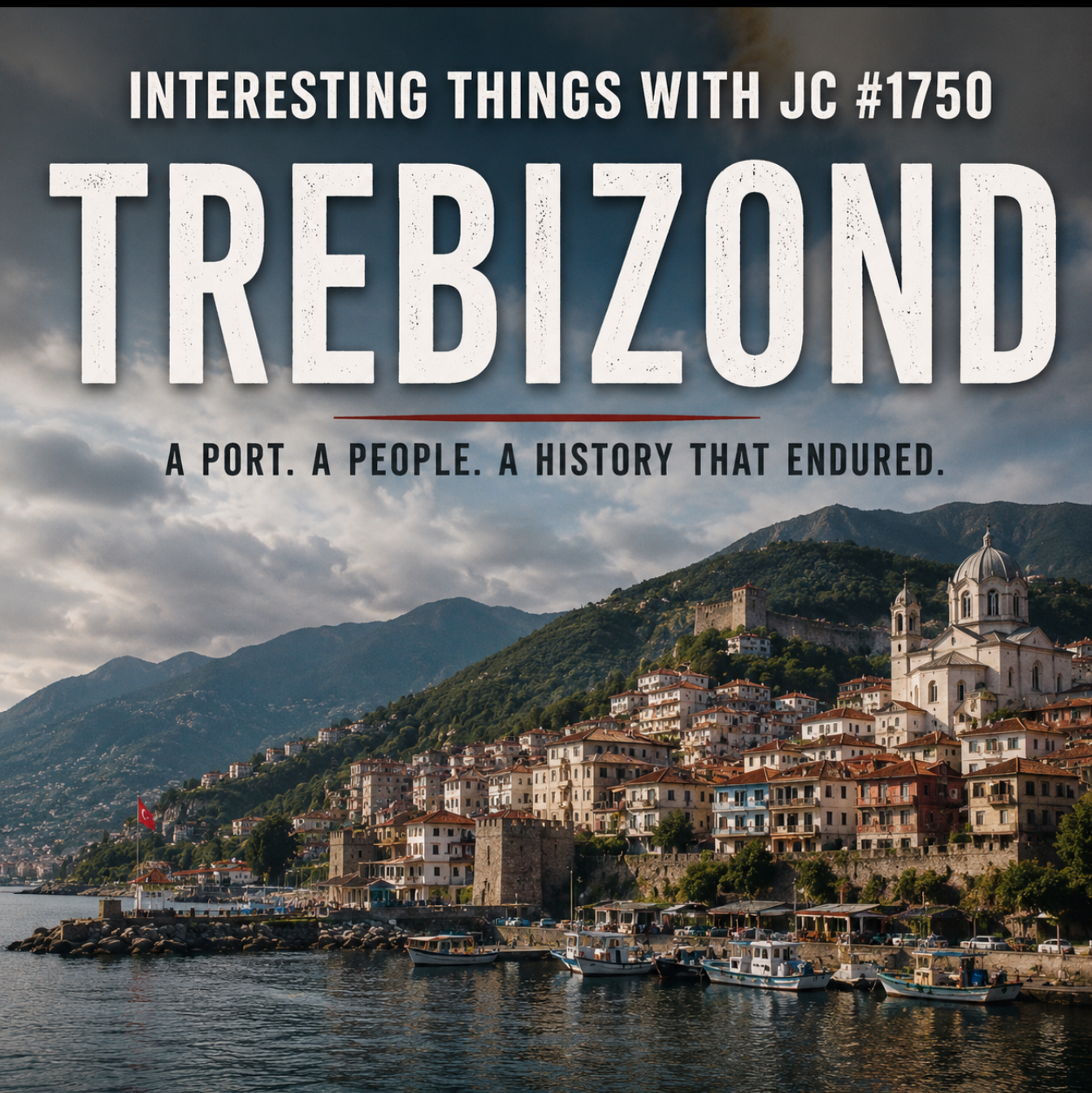
Promotional artwork for “Interesting Things with JC #1750: Trebizond.” Large white text reading “TREBIZOND” appears over a dramatic coastal scene with dark blue water, a hillside city, red-roofed buildings, mountains, boats in the harbor, and a prominent domed church. Smaller text reads, “A Port. A People. A History That Endured.”
Transcript
Interesting Things with JC
#1750: "Trebizond"
In 1750, Trebizond sat where the Black Sea met the Pontic Mountains, with a harbor opening onto the water and steep country rising almost immediately behind it. Greeks had known the city as Trapezous (truh-PEE-zee-uhs) since antiquity, and for more than two and a half centuries it had been the capital of the Greek-speaking Empire of Trebizond, ruled by the Grand Komnenoim (Kom-Nee-Noy). When Mehmed II conquered the city in 1461, that empire ended. The port and its people remained.
The harbor connected Trebizond with Constantinople and other Black Sea ports, while difficult roads crossed the mountains toward Erzurum (ER-zoo-room) and farther east. Eighteenth-century Ottoman records show coffee, rice, tin, copper, hazelnuts, iron, woolen cloth, salt, and other goods moving through the eastern Black Sea trading system, with Trabzon serving as its busiest customs point along this stretch of coast. For bulky cargo, water offered an easier route than the mountain roads behind the city.
Greek Orthodox communities had been rooted throughout Pontus long before the Ottoman conquest and remained there for centuries afterward, alongside Armenians and a growing Muslim population. Court registers from the eighteenth century preserve some of those lives: Muslims and non-Muslims buying and selling property, arranging marriages, settling debts, recording inheritances, and moving through the neighborhoods of the city.
Pontic Greeks carried their own Greek language and traditions shaped by the mountains and the Black Sea, while Armenians formed another historic part of Trebizond's population. During the violence and upheaval of the final Ottoman years and the Greco-Turkish War, many people were killed, deported, or displaced. Then came the compulsory population exchange of 1923, which forced most remaining Orthodox Christians from Turkey while Muslims covered by the agreement were forced from Greece.
For Pontic Greeks forced to leave for Greece, their ancestral home remained here, along the Black Sea, where generations had lived, worked, married, worshipped, and been buried.
The Empire of Trebizond was gone, but the people of this coast had carried its history forward for centuries.
These are interesting things, with JC.
Student Worksheet
Student Output Expectations: Complete Questions 1–8 using the episode as your primary instructional text. Questions 1–4 require concise evidence-based responses; Questions 5–7 require developed analysis; Question 8 requires a structured reflection.
Comprehension — Level 1: Establish the Historical Record
What major political change occurred in Trebizond in 1461?
Identify three goods described as moving through the eastern Black Sea trading system.
What two geographic features made Trebizond's location important?
Identify three population groups discussed in the episode and describe one form of evidence used to investigate everyday life in Ottoman Trebizond.
Analysis — Level 2: Interpret Evidence
Explain the relationship between Trebizond's geography and its importance as a trading center.
Required Output: 4–6 sentences.
Include one geographic feature.
Include one transportation consequence.
Include one piece of commercial evidence.
The episode states, "When Mehmed II conquered the city in 1461, that empire ended. The port and its people remained." Explain the historical distinction being made.
Required Output: One developed paragraph.
Identify what changed politically.
Identify at least two things that demonstrated continuity.
Support the explanation with episode evidence.
Compare the historical value of customs records and court registers.
Required Output: 5–7 sentences.
Explain what customs records can reveal.
Explain what court registers can reveal.
Identify one limitation of relying on a single type of record.
Reflection — Level 3: Synthesize
What does Trebizond suggest about the relationship between political borders, communities, and historical memory?
Required Output: 150–200 words.
State a clear claim.
Use at least two specific details from the episode.
Distinguish historical evidence from your interpretation.
End by explaining why the distinction between a state and its people matters.
Difficulty Scaling:
Foundational: Complete Questions 1–6 using vocabulary definitions and teacher-provided sentence starters.
Standard: Complete Questions 1–8 independently with direct evidence from the episode.
Advanced/College Bridge: Complete Questions 1–8 and add a 200-word source evaluation comparing the evidentiary value of a legal record, commercial record, and international agreement.
Academic Integrity Guidance: Use the episode and assigned sources to construct your own responses. Paraphrase accurately, identify direct quotations when used, and do not present unsupported assumptions or generated material as historical evidence.
Teacher Guide
Quick Start:
Begin with the podcast before providing extended historical explanation.
Ask students to listen for three recurring ideas:
geography
continuity and change
evidence about ordinary life
After listening, have students write one sentence completing: "Trebizond remained important after 1461 because..."
Pacing Guide — Audio First:
0–5 minutes | Bell Ringer: Activate geographic reasoning before introducing historical details.
5–10 minutes | First Audio Listen: Students listen without completing the worksheet.
10–15 minutes | Immediate Recall: Students independently record three facts and one question.
15–25 minutes | Second Listen/Transcript Review: Students annotate references to geography, trade, communities, and political change.
25–40 minutes | Worksheet: Students complete comprehension and analysis tasks.
40–50 minutes | Evidence Discussion: Class compares customs records, court registers, and treaty evidence.
50–60 minutes | Assessment/Exit Ticket: Students complete an open-ended response or exit ticket.
Bell Ringer: Display or describe a coastal city separated from its interior by steep mountains. Ask: "If moving goods by land is difficult but a usable harbor is available, how might geography influence trade, transportation, and the city's importance?" Require a two-sentence prediction.
Audio Guidance:
First Listen: Focus on the overall historical story rather than dates and individual facts.
Second Listen: Track evidence under four categories:
Geography
Commerce
Communities
Political/Demographic Change
Ask students to mark the moment when the narrative moves from the eighteenth century to the twentieth century.
Audio Fallback: If audio is unavailable, the teacher reads the transcript aloud before students receive independent reading time. Preserve the audio-first sequence by treating the initial read-aloud as the first uninterrupted encounter with the episode.
Time on Task: Approximately 55–60 minutes for a standard lesson; 75–90 minutes if the advanced source-analysis extension is included.
Materials:
Episode audio
Transcript
Student Worksheet
Writing materials or digital response platform
Optional physical or digital map of the Black Sea, Anatolia, Constantinople/Istanbul, Trabzon, and Erzurum
Vocabulary Strategy:
Preteach only Trebizond, Pontus, Grand Komnenoi, and population exchange before listening.
Allow students to infer the remaining terms from context.
Revisit court register, customs point, and displacement during evidence analysis.
Common Misconceptions:Misconception: The fall of the Empire of Trebizond meant the city or its population disappeared in 1461.
Correction: Political sovereignty changed, while the city and communities continued under Ottoman rule.
Misconception: A port's importance depends only on its harbor.
Correction: Trebizond's importance also depended on connections between maritime routes and inland routes across difficult terrain.
Misconception: A court register provides a complete picture of society.
Correction: It records matters that entered a particular legal or administrative process; historians must interpret its scope and limitations.
Misconception: The 1923 exchange simply involved voluntary migration.
Correction: The agreement explicitly established a compulsory exchange for populations falling within its provisions, while also specifying exemptions.
Misconception: Cultural identity necessarily disappears when political rule changes.
Correction: Political institutions, communities, languages, traditions, and historical memory can change at different rates.
Discussion Prompts:
Why might mountains make a harbor more economically valuable rather than less valuable?
What can lists of traded goods reveal about connections between regions?
Why are records about marriages, property, debts, and inheritance useful to historians?
What is the difference between the history of a government and the history of a population?
How should historians discuss displacement while remaining precise about what their sources establish?
Formative Checkpoints:
Checkpoint 1: Students correctly identify Black Sea access and mountainous terrain.
Checkpoint 2: Students connect difficult land transportation with the usefulness of maritime transportation.
Checkpoint 3: Students distinguish commercial evidence from evidence of social or family life.
Checkpoint 4: Students explain at least one continuity across the 1461 political transition.
Checkpoint 5: Students distinguish documented facts from interpretive conclusions.
Differentiation:
Developing Readers: Provide a four-column organizer labeled Geography, Trade, Communities, Change.
English Learners: Pair vocabulary with geographic or contextual examples and allow oral rehearsal before written responses.
Advanced Students: Require corroboration across different source types and discussion of evidentiary limitations.
College Bridge: Require students to distinguish primary evidence, secondary scholarship, and narrative synthesis.
Assessment Differentiation:
Students needing support may provide a structured paragraph using claim-evidence-reasoning.
Standard students complete the full open-ended response.
Advanced students must incorporate source-type evaluation and acknowledge a limitation or uncertainty.
Time Flexibility:30-Minute Version: Audio, Questions 1–6, one discussion prompt, exit ticket.
60-Minute Version: Complete core lesson.
90-Minute Version: Add source comparison and extended discussion.
Substitute Readiness: Play or read the episode first, assign Questions 1–8, then have students complete the exit ticket. No additional lecture is required for basic lesson completion.
Engagement Strategy: Use the city's geography as a recurring problem: "You need to move people and cargo between the Black Sea and the interior. What choices does this landscape give you?" Students revisit their initial answer after learning about Trebizond's trade network.
Extensions:
Map a hypothetical cargo route from the Black Sea coast toward Erzurum.
Categorize episode evidence as political, economic, geographic, social, or demographic.
Investigate how historians reconstruct ordinary lives from legal records.
Compare Trebizond before and after 1461 using a continuity-and-change chart.
Cross-Curricular Connections:
Geography: Physical terrain, ports, transportation corridors, and regional connectivity.
Economics: Movement of commodities, transportation costs, customs, and trade networks.
Language Arts: Evidence-based explanatory writing and source interpretation.
Civics: Treaties, state authority, migration policy, and legal documentation.
Information Literacy: Evaluating different categories of historical sources.
SEL Connection: Historical displacement can involve family, identity, community, and loss. Students should discuss affected populations with precision and respect without being required to disclose personal or family experiences.
Skill Value Emphasis:
Evidence evaluation
Historical reasoning
Geographic reasoning
Cause-and-effect analysis
Communication
Source comparison
Professional judgment
Answer Key:
Worksheet 1: Mehmed II conquered Trebizond in 1461, ending the Empire of Trebizond.
Worksheet 2: Any three listed goods, including coffee, rice, tin, copper, hazelnuts, iron, woolen cloth, or salt.
Worksheet 3: The Black Sea/harbor and the Pontic Mountains/steep inland terrain.
Worksheet 4: Greek Orthodox communities/Pontic Greeks, Armenians, and Muslims; court registers are one cited source for everyday social and legal activity.
Worksheet 5: Strong responses connect mountainous terrain and difficult roads with the relative usefulness of maritime transport and then connect the harbor to regional commerce.
Worksheet 6: Political sovereignty changed in 1461, but the city, port, inhabitants, commerce, and long-established communities continued. Students should clearly distinguish institutional change from social or economic continuity.
Worksheet 7: Customs records illuminate goods and commercial movement; court registers illuminate legal, property, marital, debt, and inheritance activity. Strong responses recognize that neither source type alone represents every dimension of society.
Worksheet 8: Answers vary. Full-credit responses establish a defensible claim, use two or more episode details, distinguish evidence from interpretation, and explain continuity or historical memory.
Quiz 1: B
Quiz 2: C
Quiz 3: B
Quiz 4: D
Quiz 5: C
Assessment 1: Full-credit responses explain that the 1461 conquest ended the political empire without ending the city, port, population, or regional functions.
Assessment 2: Full-credit responses connect physical geography to transportation and commerce while using at least two specific episode details.
Quiz
What happened to Trebizond in 1461?
A. It became independent from the Ottoman Empire.
B. Mehmed II conquered it, ending the Empire of Trebizond.
C. Its harbor was permanently abandoned.
D. Its population relocated to Constantinople.
Which geographic combination most directly shaped Trebizond's transportation role?
A. Desert and river delta
B. Open plains and navigable river
C. Black Sea harbor and steep mountain interior
D. Island location and coral reef
Why are eighteenth-century court registers valuable to historians studying Trebizond?
A. They provide complete biographies of every resident.
B. They preserve evidence concerning activities such as marriage, property, debts, and inheritance.
C. They record only military campaigns.
D. They provide maps of every Black Sea trade route.
Which statement best represents continuity after the conquest of 1461?
A. Trebizond immediately regained political independence.
B. Ottoman government disappeared from the region.
C. The Empire of Trebizond continued under a different name.
D. The city, port, and communities continued despite the end of the empire.
What feature of the 1923 population exchange is most important for understanding the episode's discussion of displacement?
A. Participation was entirely voluntary.
B. It applied exclusively to merchants.
C. It established compulsory exchange for populations covered by the agreement, subject to specified exceptions.
D. It restored the Empire of Trebizond.
Assessment
Open-Ended Questions:
Continuity and Change: Explain why 1461 represents both an ending and a continuation in the history of Trebizond.
Required Output: 200–250 words.
Establish a clear historical claim.
Use at least three specific details.
Address political change.
Address at least two forms of continuity.
Geography and Human Activity: Analyze how Trebizond's physical geography influenced its economic and regional importance.
Required Output: 200–250 words.
Identify the relevant geographic features.
Explain their effect on transportation.
Connect transportation to commerce.
Use evidence from the episode.
3–2–1 Rubric:
3 — Proficient/Advanced
Accurate central claim.
Multiple specific pieces of relevant evidence.
Clear reasoning connecting evidence to the claim.
Correct use of historical vocabulary.
Distinguishes documented evidence from interpretation.
2 — Developing
Generally accurate claim.
Some relevant evidence.
Reasoning is present but incomplete or uneven.
Minor factual or vocabulary problems do not undermine the response.
1 — Beginning
Claim is unclear, inaccurate, or missing.
Evidence is minimal or unrelated.
Connections between evidence and conclusion are largely unexplained.
Major misconceptions require correction.
Exit Ticket:
Identify one thing that changed in Trebizond's history.
Identify one thing that continued despite political change.
Name one type of historical source discussed in the lesson and explain what it can reveal.
Expected Output: Three concise responses totaling approximately 75–100 words.
Standards Alignment
NGSS — Science & Engineering Practices
NGSS SEP 8 — Obtaining, Evaluating, and Communicating Information
Connection: Students extract information from the episode, distinguish among historical source types, and communicate an evidence-based explanation.
Measurable Skill: Students accurately select and communicate evidence supporting a historical claim.
Alignment Justification: Although this is a history lesson rather than a science performance-expectation lesson, the information-evaluation practice directly supports the worksheet's source-analysis task and written assessment.
CCSS Reading
CCSS.ELA-LITERACY.RH.11-12.1 — Cite specific textual evidence to support analysis of primary and secondary sources
Connection: Worksheet Questions 5–8 require students to support historical interpretations with specific evidence.
Measurable Skill: Students identify at least two relevant pieces of evidence and connect them to a defensible conclusion.
Alignment Justification: The central instructional task requires evidence-based historical analysis rather than unsupported recall.
CCSS.ELA-LITERACY.RH.11-12.2 — Determine central ideas or information of a primary or secondary source
Connection: Students identify the episode's central relationship among geography, political change, commerce, communities, and continuity.
Measurable Skill: Students produce an accurate summary that connects major details to the episode's central idea.
Alignment Justification: The comprehension and continuity-and-change tasks require students to move from individual details to a coherent historical interpretation.
CCSS Writing
CCSS.ELA-LITERACY.WHST.11-12.2 — Write informative/explanatory texts
Connection: Both open-ended assessment questions require organized historical explanation.
Measurable Skill: Students produce a 200–250-word explanation using relevant facts, domain vocabulary, and logical organization.
Alignment Justification: The assessment explicitly measures the student's ability to explain complex historical relationships in writing.
CCSS.ELA-LITERACY.WHST.11-12.9 — Draw evidence from informational texts to support analysis, reflection, and research
Connection: Worksheet Question 8 and both assessment prompts require students to derive conclusions from assigned historical information.
Measurable Skill: Students incorporate episode evidence into analytical or reflective writing without substituting unsupported claims.
Alignment Justification: Evidence use is explicitly included in the lesson's success criteria and assessment rubric.
CCSS Speaking & Listening
CCSS.ELA-LITERACY.SL.11-12.1 — Initiate and participate effectively in collaborative discussions
Connection: Teacher Guide discussion prompts require students to compare interpretations of geography, evidence, continuity, and displacement.
Measurable Skill: Students contribute an evidence-supported observation and respond substantively to at least one peer's reasoning.
Alignment Justification: Discussion converts individual listening and reading into collaborative historical reasoning.
C3 Framework
C3 D2.His.14.9-12 — Analyze multiple and complex causes and effects of events in the past
Connection: Students examine how geography, transportation, commerce, conquest, war, and international agreements contributed to different historical developments.
Measurable Skill: Students construct a causal explanation containing at least two connected factors rather than attributing change to a single cause.
Alignment Justification: Assessment Question 2 and multiple discussion prompts explicitly require causal historical reasoning.
C3 D2.His.16.9-12 — Integrate evidence from multiple relevant historical sources and interpretations
Connection: Students distinguish among customs records, court registers, narrative synthesis, and treaty evidence.
Measurable Skill: Students explain how two or more source categories contribute different evidence to a historical reconstruction.
Alignment Justification: Worksheet Question 7 directly assesses source integration and evidentiary judgment.
ISTE Standards
ISTE 1.3.b — Knowledge Constructor: Evaluate Information
Connection: Advanced students evaluate the accuracy, relevance, origin, and limitations of historical information and digital sources.
Measurable Skill: Students classify sources by origin and explain why a source is or is not suitable for answering a specific historical question.
Alignment Justification: The advanced source-analysis extension requires deliberate evaluation rather than passive information collection.
Career Readiness Competencies
CR-AT — Analytical Thinking
Connection: Students distinguish political change from economic, cultural, and demographic continuity.
Measurable Skill: Students categorize evidence and construct a logically supported interpretation.
Alignment Justification: The core assessment requires analytical separation of different historical processes.
CR-COM — Communication
Connection: Students explain historical relationships through writing and collaborative discussion.
Measurable Skill: Students communicate a claim, evidence, and reasoning in an organized form appropriate to an academic audience.
Alignment Justification: Written assessments and discussion activities directly evaluate clear communication.
CR-PS/AP/PJ — Problem Solving, Adaptability, and Professional Judgment
Connection: Students work with incomplete categories of historical evidence and determine which sources are appropriate for different questions.
Measurable Skill: Students revise conclusions when evidence is limited, distinguish fact from inference, and select evidence appropriate to the task.
Alignment Justification: These behaviors model responsible analytical decision-making applicable to research, logistics, journalism, education, planning, and other evidence-dependent careers.
Homeschool / Lifelong Learning Alignment
HLL-ILRA — Independent Learning, Information Literacy, Real-World Application, and Self-Directed Inquiry
Connection: Learners can independently listen, annotate, research a question, evaluate sources, and produce an evidence-based explanation.
Measurable Skill: Learners formulate one follow-up question, locate an appropriate source, evaluate its usefulness, and explain how the information changes or strengthens their understanding.
Alignment Justification: The lesson can function without a traditional classroom while preserving structured inquiry and information-literacy expectations.
HLL-TLS — Transferable Life Skills
Connection: Learners practice distinguishing evidence from assertion, evaluating information quality, communicating conclusions, and revising assumptions.
Measurable Skill: Learners apply the claim-evidence-reasoning process to a new historical or real-world information problem.
Alignment Justification: Evidence evaluation, disciplined reasoning, and clear communication transfer beyond the specific study of Trebizond.
Show Notes
Trebizond offers students a compact case study in how geography, commerce, political authority, community life, and historical memory interact across centuries. Beginning with the Black Sea port and Pontic Mountains, the lesson follows the city's transition from the former capital of the Empire of Trebizond into an Ottoman commercial and multicultural urban center before examining the displacement associated with the final Ottoman period and the compulsory population exchange of 1923. Classroom activities emphasize evidence evaluation, continuity and change, geographic reasoning, source limitations, and the responsibility to distinguish documented history from interpretation.
References
Türkiye Diyanet Foundation. (n.d.). Trabzon. TDV İslâm Ansiklopedisi. https://islamansiklopedisi.org.tr/trabzon
Koca, Y. N. (2016). 19. Yüzyılda Trabzon Limanı: Seferler, Tüccarlar, Mallar. Karadeniz Araştırmaları, 13(49). https://dergipark.org.tr/en/pub/karadearas/article/973092
Republic of Türkiye Ministry of Foreign Affairs. (1923). Convention Concerning the Exchange of Greek and Turkish Populations, signed at Lausanne, January 30, 1923. https://www.mfa.gov.tr/lausanne-peace-treaty-vi_-convention-concerning-the-exchange-of-greek-and-turkish-populations-signed-at-lausanne_.en.mfa
Yılmaz, Ö. (2019). Trabzon Şer‘iyye Sicillerindeki Nikah Kayıtları 1750–1755. OTAM Ankara Üniversitesi Osmanlı Tarihi Araştırma ve Uygulama Merkezi Dergisi. https://dergipark.org.tr/en/pub/otam/article/1048996