1749: "Ouzel Lake and the Dangers of Alpine Swimming"
Interesting Things with JC #1749: "Ouzel Lake and the Dangers of Alpine Swimming"
Ouzel Lake can look inviting after a 4.9-mile summer hike, but the mountain water can remain cold enough to trigger an involuntary gasp and rapid breathing almost immediately. Stay in, and cold can begin taking away strength and coordination while you're still nearly five trail miles into Rocky Mountain National Park.
Curriculum - Episode Anchor
Episode Title: Ouzel Lake and the Dangers of Alpine Swimming
Episode Number: 1749
Host: JC
Audience: Grades 9–12, introductory college, homeschool, and lifelong learners
Subject Area: Environmental Science, Human Physiology, Outdoor Safety, Earth Science
Lesson Overview
Learning Objectives: By the end of the lesson, students will be able to:
Describe the geographic and physical characteristics that make Ouzel Lake a remote alpine environment.
Explain the physiological progression from cold shock to physical incapacitation and, with continued exposure, hypothermia.
Distinguish air temperature from water temperature when evaluating cold-water risk.
Apply evidence about environmental conditions and human physiology to make a reasoned outdoor-safety decision.
Essential Question: Why can apparently calm mountain water remain dangerous even when the surrounding air feels warm?
Success Criteria: Students can identify at least three stages or effects of cold-water immersion, explain why each affects self-rescue, and use evidence from the episode to evaluate a realistic scenario.
Student Relevance Statement: Everyday decisions about swimming, hiking, boating, and other outdoor activities require people to recognize hazards that may not be visible.
Real-World Connection: Ouzel Lake provides a case study in risk assessment: a legal and inviting activity can still involve environmental conditions that require preparation and judgment.
Workforce Reality: Park employees, wilderness guides, search-and-rescue personnel, outdoor educators, emergency responders, and recreation professionals routinely evaluate weather, terrain, water conditions, distance, and human limitations before making operational decisions.
Key Vocabulary
Alpine(AL-pine) — Relating to high-elevation mountain environments.
Elevation gain(el-uh-VAY-shun gain) — The total vertical distance climbed along a route.
Cold shock(kohld shahk) — The immediate physiological response to sudden cold-water immersion, which can include involuntary gasping and rapid breathing.
Immersion(ih-MER-zhun) — Partial or complete submersion of the body in water.
Physical incapacitation(FIZ-ih-kul in-kuh-PASS-ih-TAY-shun) — Loss of muscular strength, coordination, or control sufficient to interfere with effective movement or self-rescue.
Hypothermia(hy-poh-THER-mee-uh) — A dangerous reduction in core body temperature; clinically, hypothermia begins below 95°F, or 35°C.
Core body temperature(kor BAH-dee TEM-pruh-chur) — The temperature maintained within the body's internal organs and tissues.
Self-rescue(self RES-kyoo) — Actions a person takes to remove themselves from immediate danger without direct assistance.
Narrative Core
Open:
Ouzel Lake appears to offer an inviting reward after a substantial mountain hike: clear water at an elevation of 10,020 feet.
Info:
Ouzel Lake is in the Wild Basin section of Rocky Mountain National Park.
The episode describes a 4.9-mile approach from the Wild Basin Trailhead with approximately 1,520 feet of elevation gain.
National Park Service information estimates approximately four to five hours of travel.
Swimming or wading is generally allowed in park waters subject to designated closures or restrictions.
Details:
Warm air does not establish that natural water is warm.
Cold-water immersion can immediately produce cold shock, including involuntary gasping and rapid breathing.
Cold water can sharply increase heart rate and blood pressure.
Continued exposure can progressively reduce muscular control in the hands, arms, legs, and feet.
Reduced coordination and strength can compromise swimming and self-rescue before hypothermia becomes the primary problem.
Hypothermia begins as core body temperature falls to approximately 95°F, or 35°C, and can impair physical and cognitive function.
Reflection:
Environmental risk is not determined by appearance alone.
A calm lake on a warm day can contain an invisible temperature hazard, and remoteness adds consequences because leaving the water does not immediately end the wilderness situation.
Closing:
These are interesting things, with JC.
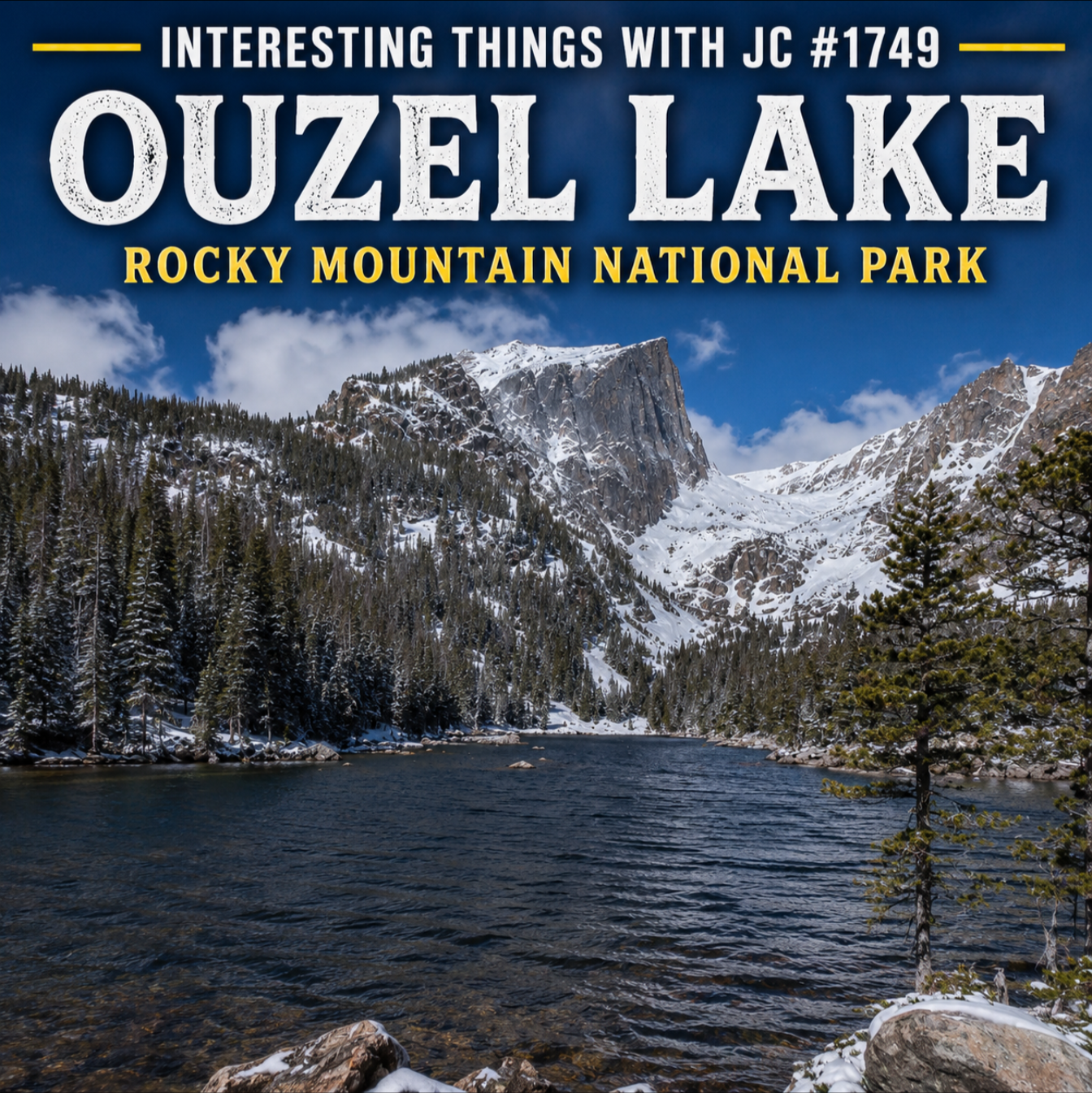
A wide promotional image for Interesting Things with JC #1749: Ouzel Lake. Large white text at the top reads “INTERESTING THINGS WITH JC #1749,” with “OUZEL LAKE” in oversized white lettering below and “ROCKY MOUNTAIN NATIONAL PARK” in yellow. The background shows a dark blue alpine lake surrounded by snow-covered evergreen forest and rugged, snow-dusted mountain peaks under a deep blue sky with scattered clouds. A large pine tree and rocky shoreline frame the right foreground.
Transcript
Interesting Things with JC
#1749: "Ouzel Lake and the Dangers of Alpine Swimming"
Ouzel Lake sits at 10,020 feet, or 3,054 meters, in the Wild Basin section of Rocky Mountain National Park in Colorado. Getting there means hiking 4.9 miles, or 7.9 kilometers, from the Wild Basin Trailhead and gaining about 1,520 feet, or 463 meters, along the way. The National Park Service estimates the hike at four to five hours.
By the time you reach the lake on a warm summer day, getting into that clear mountain water can sound pretty good. Swimming is generally permitted in Rocky Mountain National Park unless a particular body of water is closed, and Ouzel Lake isn't among the swimming closures listed in the park's regulations.
But the temperature of the air doesn't tell you much about the temperature of mountain water. The National Park Service warns that some natural waters remain below 50 degrees Fahrenheit, or 10 Celsius, even in July, and the body's reaction to cold water can begin at temperatures considerably warmer than that.
Sudden immersion can trigger cold shock almost immediately, causing an involuntary gasp followed by rapid breathing that's difficult to control. Heart rate and blood pressure can rise sharply, and the National Weather Service says cold shock in water between 50 and 60 degrees Fahrenheit, or 10 to 15 Celsius, can be just as severe as it is in water near 35 degrees Fahrenheit, or 2 Celsius.
Stay in the water and another problem develops. As the cold interferes with the muscles and nerves controlling your hands, arms and legs, strength and coordination deteriorate. Swimming becomes harder, and in water below 60 degrees Fahrenheit, or about 16 Celsius, physical incapacitation can occur in roughly ten minutes.
Hypothermia develops later, as core body temperature falls toward 95 degrees Fahrenheit, or 35 Celsius, affecting movement, judgment and eventually consciousness. At Ouzel Lake, there's another practical problem once you're out: you're still nearly five trail miles into the Rocky Mountains, where weather and conditions can change quickly.
The lake doesn't need rough water to become dangerous. Cold alone can take away your ability to get yourself out.
These are interesting things, with JC.
Student Worksheet
Purpose: Use evidence from the episode to explain how cold-water exposure can affect the body, evaluate environmental risk, and make a reasoned safety decision.
Part A — Comprehension
Output expectation: Answer each question in 1–2 complete sentences using information from the episode.
Where is Ouzel Lake located, and what is its elevation?
How far is the hike from the Wild Basin Trailhead to Ouzel Lake, and how much elevation does a hiker gain?
Why can warm summer air create a false sense of security around mountain water?
What happens during the body's initial cold-shock response?
How can continued cold-water exposure affect the hands, arms, and legs?
At approximately what core body temperature does hypothermia begin?
Why does Ouzel Lake's remote location increase the consequences of cold-water exposure?
Part B — Sequence the Risk
Output expectation: Complete the sequence below using brief phrases from the episode.
Environmental condition: __________________________________
Immediate body response: __________________________________
Effect on breathing: __________________________________
Effect on strength and coordination: __________________________________
Effect on swimming or self-rescue: __________________________________
Later-stage risk: __________________________________
Additional wilderness challenge: __________________________________
Part C — Evidence Analysis
Output expectation: Answer each question in 3–5 sentences. Use at least two specific facts or numerical details from the episode in each response.
Explain why air temperature alone is not enough information to determine whether entering a mountain lake is safe.
Compare cold shock and physical incapacitation. How are they different, and how can each interfere with self-rescue?
The episode states that cold shock in water between 50°F and 60°F can be severe. Why is that important for someone who assumes only near-freezing water is dangerous?
Explain why distance from the trailhead matters even after a person has successfully exited the water.
How does the episode demonstrate that a hazard does not have to be visible to be serious?
Part D — Claim, Evidence, Reasoning
Scenario: A hiker reaches Ouzel Lake on a warm, sunny afternoon. The surface is calm, swimming is generally permitted, and the hiker feels overheated from the climb. The hiker says, "It looks safe, so I'll swim out a little way."
Output expectation: Complete all three parts.
Claim: State whether the hiker's reasoning is sufficiently informed.
Evidence: Provide three specific facts from the episode that support your claim.
Reasoning: Explain how each fact changes the risk assessment.
Claim:
Evidence 1:
Reasoning:
Evidence 2:
Reasoning:
Evidence 3:
Reasoning:
Part E — Risk-Factor Analysis
Output expectation: For each factor, explain whether it could increase, decrease, or leave the risk unchanged. Support each answer with evidence-based reasoning.
Warm air temperature
Risk effect: ______________________________
Why: ____________________________________
Cold water temperature
Risk effect: ______________________________
Why: ____________________________________
Calm water surface
Risk effect: ______________________________
Why: ____________________________________
Nearly five trail miles from the trailhead
Risk effect: ______________________________
Why: ____________________________________
Declining hand and arm coordination
Risk effect: ______________________________
Why: ____________________________________
Part F — Distinguish the Concepts
Output expectation: Write one accurate sentence for each comparison.
Permitted vs. safe: Explain why an activity being allowed does not mean conditions are automatically safe.
Cold shock vs. hypothermia: Explain the difference in timing and effects.
Hazard vs. appearance: Explain why calm or attractive conditions may not reveal the most important danger.
Exposure vs. consequence: Explain how remaining in cold water can make later consequences more severe.
Part G — Decision-Making Challenge
Output expectation: Write 6–8 sentences.
Imagine you are responsible for advising a group of inexperienced hikers at a remote mountain lake. What information would you want before anyone entered the water? Identify at least four factors and explain why each matters.
Your response must include:
one environmental factor
one physiological factor
one location or access factor
one judgment or decision-making factor
at least three details from the episode
Part H — Reflection
Output expectation: Write one paragraph of 5–7 sentences.
What is the most important lesson from the episode about evaluating risk?
Explain how that lesson could apply to a situation outside mountain swimming.
Difficulty Scaling
Foundation: Complete Parts A, B, and H. Focus on accurate recall and sequencing.
Standard: Complete Parts A–F and H. Use episode evidence in all analytical responses.
Advanced: Complete all parts. In Parts D, E, and G, distinguish between observable conditions, hidden hazards, physiological consequences, and decision-making factors.
Student Output Standards
Use complete sentences unless the prompt requests a short phrase.
Support analytical responses with specific facts from the episode.
Use vocabulary accurately, especially cold shock, physical incapacitation, hypothermia, and self-rescue.
Separate observation from assumption. For example, "the water is calm" is an observation; "the water is safe" is a conclusion that requires additional evidence.
Explain why evidence matters rather than only repeating facts.
Academic Integrity Guidance
Base your answers on the episode and assigned lesson materials.
Write responses in your own words unless specifically asked to quote.
Do not invent temperatures, distances, symptoms, or other details that are not supported by the lesson.
When making a judgment, show the evidence and reasoning that led to your conclusion.
Teacher Guide
Quick Start:
Begin with the podcast audio before introducing technical terminology.
Ask students to record one detail that makes the lake inviting and one that could make it hazardous.
Teach the cold-water progression after the first listen.
Complete the worksheet and evidence-based discussion.
Finish with the exit ticket.
Pacing Guide — Audio First:
0–3 minutes: Bell ringer and prediction.
3–7 minutes: First podcast listen without interruption.
7–12 minutes: Immediate evidence capture and vocabulary clarification.
12–22 minutes: Second listen or transcript review focused on physiological sequence.
22–37 minutes: Student worksheet and evidence analysis.
37–47 minutes: Discussion and scenario application.
47–52 minutes: Formative check, assessment, and exit ticket.
Bell Ringer: "It is 80°F outside, the lake surface is calm, and swimming is permitted. What additional information would you want before entering the water?" Students list three pieces of information and briefly justify each.
Audio Guidance: During the first listen, students should focus on the story rather than taking extensive notes. During a second listen, have students track the sequence: environment → immersion → cold shock → declining muscular control → hypothermia → wilderness consequences.
Audio Fallback: If audio is unavailable, read the supplied transcript aloud before students examine it individually. Preserve the audio-first instructional sequence by treating the initial reading as uninterrupted narration.
Time on Task: Approximately 45–55 minutes for one class period; 70–90 minutes with the advanced investigation or extension.
Materials:
Episode audio
Verbatim transcript
Student worksheet
Writing materials or digital response platform
Optional map of Rocky Mountain National Park for geographic context
Vocabulary Strategy:
Introduce immersion, cold shock, physical incapacitation, and hypothermia as a sequence rather than isolated definitions.
Have students connect each term to a specific effect on breathing, movement, judgment, or self-rescue.
Reinforce the distinction between cold shock and hypothermia.
Misconceptions:
"Warm weather means warm water." Air and water temperatures can differ substantially.
"Hypothermia is the first danger." Cold shock can affect breathing immediately, while loss of muscular control can compromise self-rescue before severe hypothermia develops.
"Strong swimmers are safe." Cold exposure can impair the physiological abilities required for swimming.
"Calm water means safe water." Temperature is a hazard even without waves or obvious currents.
"Permitted means safe." A regulation determines whether an activity is allowed; it does not guarantee safe environmental conditions.
Discussion Prpmpts:
Which fact in the episode most changes how you would evaluate the lake, and why?
Why might people underestimate hazards they cannot see?
How does remoteness change the consequences of an otherwise manageable problem?
What is the difference between recognizing a hazard and evaluating risk?
Formative Checkpoints:
Checkpoint 1: Students correctly distinguish air temperature from water temperature.
Checkpoint 2: Students sequence cold shock before later hypothermia.
Checkpoint 3: Students explain how muscular impairment affects self-rescue.
Checkpoint 4: Students integrate environmental and physiological evidence in their scenario decision.
Differentiation:
Support: Provide a four-stage organizer: conditions → immediate response → continued exposure → consequences.
Developing readers: Pair transcript paragraphs with vocabulary definitions.
Advanced learners: Require students to distinguish hazard, exposure, consequence, and mitigation.
Collaborative learners: Have pairs construct a cause-and-effect chain before independent writing.
Assessment Differentiation: Students may demonstrate understanding through a written response, structured oral explanation, or annotated cause-and-effect model while maintaining the same evidence requirements.
Time Flexibility: For a 30-minute lesson, use one audio listen, comprehension questions 3–5, analysis question 2, and the exit ticket. For an extended block, add the scenario assessment and cross-curricular investigation.
Substitute Readiness: Play or read the episode first. Students then complete the comprehension section independently, compare answers in pairs, complete one analysis question, and submit the exit ticket.
Engagement Strategy: Begin with the apparent contradiction at the center of the episode: warm air, clear water, calm conditions—and a potentially serious cold-water hazard. Ask students to revise their initial risk assessment as evidence is introduced.
Extensions:
Compare cold-water safety recommendations from two authoritative public agencies.
Develop a one-page decision guide for evaluating an unfamiliar natural swimming location.
Investigate how elevation, season, snowmelt, and weather can influence mountain recreation conditions.
Cross-Curricular Connections:
Biology: Thermoregulation, nervous-system function, muscular performance.
Environmental Science: Alpine environments and changing physical conditions.
Physics: Heat transfer between the human body and surrounding water.
Health: Risk recognition and emergency preparedness.
English Language Arts: Evidence-based explanatory and argumentative writing.
SEL: Students practice responsible decision-making by separating impulse ("the water looks inviting") from evidence-based evaluation of consequences.
Skill Emphasis: Analytical thinking, evidence evaluation, communication, situational awareness, problem solving, and professional judgment.
Answer Key:
Comprehension 1: 10,020 feet, or 3,054 meters.
Comprehension 2: 4.9 miles, or 7.9 kilometers, from the Wild Basin Trailhead.
Comprehension 3: Cold shock is the body's immediate response to sudden cold-water immersion; it can cause involuntary gasping and rapid, difficult-to-control breathing.
Comprehension 4: Strength, muscular control, and coordination deteriorate, making effective swimming and self-rescue increasingly difficult.
Comprehension 5: Approximately 95°F, or 35°C.
Analysis 1: Strong answers explain that air and water do not warm identically and cite the episode's warning that natural waters can remain very cold during summer.
Analysis 2: Cold shock primarily creates an immediate breathing and cardiovascular problem; continued cooling can progressively impair muscular control and swimming ability.
Analysis 3: A swimmer who becomes cold or exhausted must still deal with a remote mountain environment and nearly five trail miles of return travel.
Analysis 4: Strong answers connect cold exposure to impaired breathing, muscular control, coordination, judgment, and therefore diminished self-rescue ability.
Reflection: Full-credit responses identify the hiker's assumption as insufficient, use multiple episode facts, and explain how physiological and environmental evidence should affect the decision.
Quiz
Directions: Select the best answer for each question.
What feature of Ouzel Lake is central to the episode's safety lesson?
A. Its water may remain dangerously cold despite warm air
B. Its water is permanently closed to swimming
C. Its shoreline always experiences large waves
D. Its trail can only be reached during winter
Which response can occur almost immediately after sudden cold-water immersion?
A. Gradual acclimatization
B. Involuntary gasping and rapid breathing
C. Increased fine-motor coordination
D. Immediate adaptation to the water temperature
Why can physical incapacitation increase drowning risk?
A. It causes water temperature to decrease
B. It increases the distance to shore
C. It reduces muscular control needed for swimming and self-rescue
D. It eliminates the body's need for oxygen
Hypothermia begins when core body temperature falls to approximately:
A. 98.6°F / 37°C
B. 97°F / 36.1°C
C. 95°F / 35°C
D. 90°F / 32.2°C
Which statement best captures the episode's central reasoning?
A. Only visibly rough water requires preparation
B. Permission to swim establishes that conditions are safe
C. Strong swimmers can disregard water temperature
D. Environmental hazards should be evaluated using conditions and physiological consequences, not appearance alone
Assessment
Open-Ended Questions:
Explain the progression of cold-water immersion described in the episode. Distinguish cold shock, physical incapacitation, and hypothermia, and explain how each can interfere with survival or self-rescue.
Evaluate the statement: "The lake doesn't need rough water to become dangerous." Use at least three pieces of evidence from the lesson to support your reasoning.
3–2–1 Rubric:
3 — Proficient: Accurately explains the relevant physiological and environmental concepts, integrates three or more specific pieces of evidence, and clearly connects evidence to a reasoned conclusion.
2 — Developing: Demonstrates generally accurate understanding and uses some relevant evidence, but connections or explanations are incomplete.
1 — Beginning: Provides limited or inaccurate explanation, minimal supporting evidence, or a conclusion without sufficient reasoning.
Exit Ticket: In 2–3 sentences, identify one cold-water hazard that may not be visually obvious and explain how knowing about it should change a person's decision-making.
Standards Alignment
NGSS — Science & Engineering Practices
SEP: Analyzing and Interpreting Data — Analyzing and Interpreting Data (Grades 9–12).
Lesson Connection: Students interpret numerical information involving elevation, distance, water temperature, exposure time, and core body temperature.
Measurable Skill: Students use quantitative and qualitative evidence to explain cold-water risk.
Alignment Justification: Worksheet and assessment tasks require students to transform environmental and physiological evidence into a supported explanation.
SEP: Engaging in Argument from Evidence — Engaging in Argument from Evidence (Grades 9–12).
Lesson Connection: Students evaluate whether warm air and calm water provide sufficient evidence of safe swimming conditions.
Measurable Skill: Students construct and defend a conclusion using multiple pieces of relevant evidence.
Alignment Justification: The advanced worksheet and assessment explicitly require evidence-based evaluation rather than unsupported opinion.
CCSS Reading
CCSS.ELA-LITERACY.RST.11-12.1 — Cite specific textual evidence to support analysis of science and technical texts.
Lesson Connection: Students extract evidence concerning cold shock, physical incapacitation, hypothermia, and environmental conditions.
Measurable Skill: Students support an analysis with multiple specific facts from lesson materials.
Alignment Justification: Analysis questions and the assessment require direct use of source-based evidence.
CCSS.ELA-LITERACY.RST.11-12.3 — Follow precisely a complex multistep procedure when carrying out experiments, taking measurements, or performing technical tasks; analyze specific results based on explanations in the text.
Lesson Connection: Students trace the sequential physiological effects described for cold-water exposure.
Measurable Skill: Students accurately organize and explain a multistage cause-and-effect process.
Alignment Justification: The lesson's listening organizer and assessment require sequencing cold shock, declining muscular control, and hypothermia.
CCSS Writing
CCSS.ELA-LITERACY.WHST.11-12.2 — Write informative/explanatory texts, including the narration of historical events, scientific procedures/experiments, or technical processes.
Lesson Connection: Students explain the physiological progression produced by cold-water immersion.
Measurable Skill: Students produce a coherent evidence-based explanation using accurate terminology.
Alignment Justification: Assessment Question 1 directly measures scientific explanatory writing.
CCSS.ELA-LITERACY.WHST.11-12.9 — Draw evidence from informational texts to support analysis, reflection, and research.
Lesson Connection: Students use the episode and supporting instructional material rather than relying solely on personal assumptions.
Measurable Skill: Students select relevant evidence and connect it logically to a conclusion.
Alignment Justification: Worksheet analysis, reflection, and assessment tasks all require evidence-supported reasoning.
CCSS Speaking & Listening
CCSS.ELA-LITERACY.SL.11-12.1 — Initiate and participate effectively in a range of collaborative discussions.
Lesson Connection: Students compare risk assessments and discuss how new evidence changes an initial judgment.
Measurable Skill: Students articulate reasoning, respond to peers, and revise conclusions when warranted.
Alignment Justification: The Teacher Guide's structured discussion directly develops collaborative evidence-based communication.
C3 Framework
D2.Geo.2.9-12 — Use maps, satellite images, photographs, and other representations to explain relationships between the locations of places and regions and their political, cultural, and economic dynamics.
Lesson Connection: Students consider Ouzel Lake's mountain location, elevation, trail distance, and remoteness when evaluating human activity there.
Measurable Skill: Students explain how geographic setting influences practical consequences and decision-making.
Alignment Justification: The lesson explicitly connects location and remoteness to the consequences of cold exposure.
ISTE Standards for Students
ISTE 1.3 — Knowledge Constructor.
Lesson Connection: Extension activities require learners to investigate authoritative information and compare evidence about natural-water safety.
Measurable Skill: Students evaluate source relevance and synthesize information into a practical decision guide.
Alignment Justification: The extension moves students from receiving information to independently constructing evidence-based understanding.
Career Readiness Competencies
Analytical Thinking
Connection: Students separate observable conditions from less-visible physiological hazards.
Outcome: Students identify relevant variables before reaching a conclusion.
Justification: The scenario assessment measures evidence-based analysis under realistic uncertainty.
Communication
Connection: Students explain scientific risk through writing and collaborative discussion.
Outcome: Students communicate a conclusion supported by specific evidence.
Justification: Worksheet, discussion, and assessment products require clear explanatory communication.
Problem Solving
Connection: Students evaluate a recreational scenario involving incomplete initial information.
Outcome: Students identify missing information and determine what evidence should influence a decision.
Justification: The bell ringer and advanced worksheet explicitly exercise problem identification and solution reasoning.
Adaptability
Connection: Students reconsider an initial judgment as environmental and physiological evidence becomes available.
Outcome: Students revise a conclusion when new evidence changes the risk assessment.
Justification: The audio-first lesson intentionally contrasts initial appearance with subsequently introduced evidence.
Professional Judgment
Connection: Students distinguish what is legally permitted from what conditions make prudent.
Outcome: Students justify decisions using evidence, consequences, and situational factors.
Justification: This distinction directly supports responsible decision-making in outdoor and workplace environments.
Homeschool / Lifelong Learning Alignment
Independent Learning
Connection: Learners can complete the audio, transcript, worksheet, and assessment without specialized equipment.
Outcome: Learners independently extract and organize key information.
Justification: The lesson provides a self-contained progression from listening through assessment.
Information Literacy
Connection: Learners distinguish observation, assumption, regulation, and evidence.
Outcome: Learners identify which information is relevant to evaluating a real-world claim.
Justification: The central problem requires evidence evaluation rather than accepting surface appearances.
Real-World Application
Connection: Scientific knowledge is applied to hiking, swimming, and outdoor decision-making.
Outcome: Learners transfer physiological concepts to a realistic scenario.
Justification: Application is explicitly measured by the worksheet reflection and exit ticket.
Self-Directed Inquiry
Connection: Extension work encourages investigation of water conditions, environmental variables, and authoritative safety information.
Outcome: Learners formulate questions and locate evidence needed to answer them.
Justification: The extension provides a pathway from guided instruction to independent inquiry.
Transferable Life Skills
Connection: Learners practice situational awareness, evidence evaluation, communication, and risk assessment.
Outcome: Learners apply a structured reasoning process to unfamiliar situations.
Justification: These competencies extend beyond Ouzel Lake to recreation, travel, work, and everyday decision-making.
Show Notes
Ouzel Lake in Rocky Mountain National Park provides a compelling case study in how environmental conditions and human physiology interact. Beginning with an inviting high-elevation lake reached after a substantial hike, this lesson examines why warm air and calm water can create misleading impressions of safety. Students investigate cold shock, declining muscular control, physical incapacitation, hypothermia, and the additional consequences created by a remote mountain setting. The episode gives learners a practical opportunity to build scientific reasoning, evidence evaluation, situational awareness, and responsible decision-making skills that transfer well beyond outdoor recreation.
References
National Park Service. (2026). Ouzel Lake. Rocky Mountain National Park. https://www.nps.gov/romo/planyourvisit/ouzel-lake.htm
National Park Service. (2026). Superintendent's compendium. Rocky Mountain National Park. https://www.nps.gov/romo/learn/management/rmnp_compendium.htm
National Park Service. (n.d.). Water hazards. Health & Safety. https://www.nps.gov/subjects/healthandsafety/water-hazards.htm
National Weather Service. (n.d.). Cold water hazards and safety. https://www.weather.gov/safety/coldwater