1748: "Follow the Leader"
Interesting Things with JC #1748:
"Follow the Leader"
August 18th, 1998 a legendary album dropped. Korn’s original Follow the Leader CD starts with twelve five-second tracks containing no music. A full minute passes before the album finally begins on track thirteen, turning the physical CD’s track sequence into part of the album itself.
Curriculum - Episode Anchor
Episode Title: Follow the Leader
Episode Number: 1748
Host: JC
Audience: Grades 9–12, introductory college, homeschool, lifelong learners
Subject Area: Music History, Media Studies, Popular Culture, Digital Media, Cultural History
Instructional Focus: Media innovation, genre convergence, physical-media design, audience experience, evidence evaluation
Recommended Lesson Length: 55–70 minutes
Lesson Overview
Learning Objectives: By the end of the lesson, students will be able to:
Identify at least four features that distinguished Follow the Leader as a 1998 album and media experience.
Analyze how Korn combined musical collaboration, physical CD design, music video, touring, and early internet broadcasting to reach audiences.
Distinguish documented facts from interpretations or explanations that require qualification.
Construct an evidence-based explanation of how technology and media format can influence the way audiences experience music.
Essential Question: How did Follow the Leader demonstrate that an album could function as more than a collection of songs?
Success Criteria: Students can cite at least three specific details from the episode, explain how each affected the audience experience, and distinguish a documented feature from an interpretation or disputed explanation.
Student Relevance Statement: Students encounter music through streaming, video platforms, social media, live performances, and digital communities. Studying a 1998 album allows them to compare today's integrated media environment with an earlier period when physical media and the emerging internet operated simultaneously.
Real-World Connection: The lesson examines skills still used in music, entertainment, marketing, journalism, media production, and digital communication: audience engagement, collaboration, visual identity, emerging-technology adoption, and evidence verification.
Workforce Reality: Creative industries depend on more than artistic ability. Professionals must communicate, meet production requirements, evaluate technology, collaborate across specialties, understand audiences, and make responsible decisions about how creative work is presented.
Key Vocabulary
Nu metal(NOO MET-uhl): A late-1990s/early-2000s form of heavy music commonly associated with combinations of metal, hip-hop, alternative rock, rhythmic experimentation, and other influences.
Low-tuned(LOH TOOND): Describing an instrument tuned to lower pitches than a conventional tuning, affecting its range and sonic character.
Seven-string guitar(SEV-uhn string guh-TAR): A guitar with an additional string beyond the conventional six, often extending the instrument's lower range.
Genre convergence(ZHAHN-ruh kuhn-VUR-juhns): The blending or interaction of musical styles that are commonly categorized separately.
RealMedia(REEL MEE-dee-uh): Streaming-media technology used during the early development of internet audio and video.
Livestream(LYV streem): Media transmitted over a network so an audience can experience it while the event is occurring.
Physical media(FIZ-ih-kuhl MEE-dee-uh): Material formats used to store and distribute content, such as CDs, records, tapes, and DVDs.
Sequencing(SEE-kwen-sing): The deliberate ordering of tracks or other content within a recorded release.
Cross-promotion(KRAWS pruh-MOH-shuhn): Coordinated exposure in which artists, media, events, or products help introduce audiences to one another.
Primary evidence(PRY-mair-ee EV-ih-duhns): Original material from the period being studied, such as a recording, CD, contemporary article, video, advertisement, or broadcast.
Narrative Core
Open: Imagine buying a new album, putting the CD into a player, and getting silence. Five seconds pass. Then another five. The display advances again and again until a full minute has passed. Only at track thirteen does the album actually begin.
Info: Korn released Follow the Leader in August 1998 during a period when physical CDs, MTV, touring, and an emerging internet could all contribute to the identity of a record. The album combined Korn's established heavy sound with explicit hip-hop collaborations and an unusual physical track sequence.
Details: Twelve five-second tracks precede the first musical track on the original CD. Korn also gave audiences access to recording sessions through the After-School Special web broadcasts using RealMedia. Guest performers connected the record directly with hip-hop and other contemporary artists, while the artwork and music videos expanded its visual identity. The first Family Values Tour extended that genre-crossing approach into live performance.
Reflection: The album provides a useful case study in media convergence before modern social-media platforms. The CD itself carried meaning through sequencing and artwork while television, internet streaming, guest collaborations, and touring expanded the experience beyond the disc.
Closing: These are interesting things, with JC.
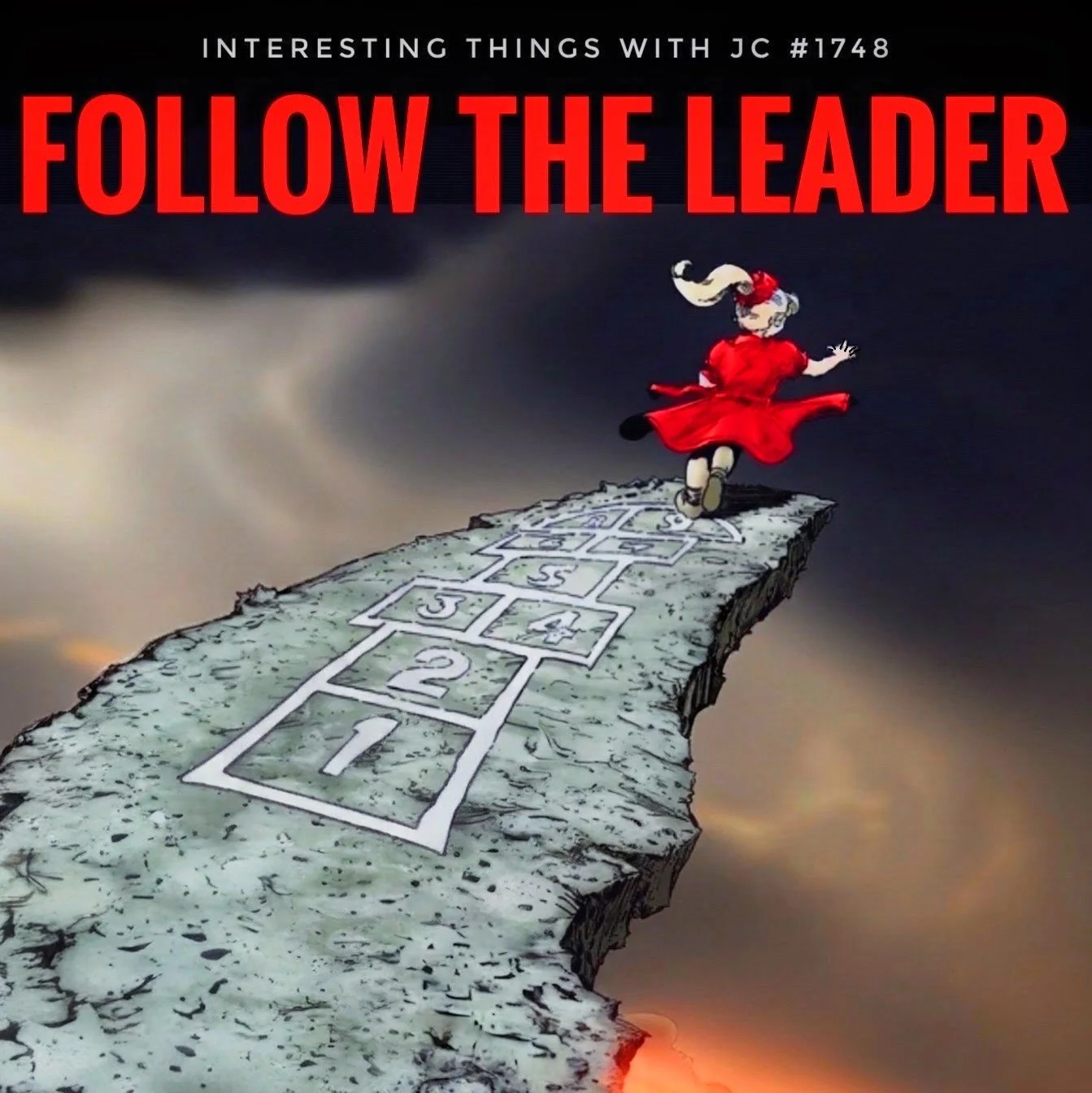
Graphic for Interesting Things with JC #1748: Follow the Leader. Large red text reading “FOLLOW THE LEADER” appears above an illustrated girl in a red dress playing hopscotch toward the edge of a rocky cliff. The numbered hopscotch path stretches from the foreground toward the girl, with a dark, cloudy background surrounding the cliff.
Transcript
Interesting Things with JC #1748:
"Follow the Leader"
When Follow the Leader released August 18, 1998, you could drop the original CD into your player, press play, and hear nothing. Track one lasted five seconds. Track two did the same, then three, four, and every track through twelve. You waited a full minute before the display reached track thirteen and Korn finally started.
By then the band was already unmistakable. Jonathan Davis could move from singing to screaming to sounds that worked more like percussion, while James “Munky” Shaffer and Brian “Head” Welch pushed low-tuned seven-string guitars against Fieldy’s snapping bass and David Silveria’s drums. Metal was there, but so were funk and hip-hop, and on Follow the Leader those connections became explicit. Ice Cube appeared on “Children of the Korn,” Tre Hardson of the Pharcyde joined “Cameltosis,” and Limp Bizkit’s Fred Durst traded lines with Davis on “All in the Family.”
You could even watch some of the album being made. In March 1998, Korn launched a weekly studio stream called After-School Special, or Korn TV, using RealMedia, years before that kind of access became ordinary. Guests dropped in, the band horsed around, and fans got a real-time look at the sessions. The finished record came with artwork from Todd McFarlane’s team: children lined up behind a girl playing hopscotch toward the edge of a cliff. It fit a title that had begun partly as a jab at bands Korn believed were following the sound they had helped create.
Then Follow the Leader debuted at number one on the Billboard 200, selling about 268,000 copies in its first week. “Got the Life” became an MTV fixture, while “Freak on a Leash,” with its animated bullet breaking into a live-action world, became one of the era’s defining videos. A little over a month after the album’s release, on September 22, Korn launched the first Family Values Tour, putting metal, hip-hop, industrial, and the emerging nu-metal scene on the same bill with Limp Bizkit, Ice Cube, Orgy, Incubus, and Rammstein.
The album still began with those twelve empty tracks, and there was a story behind them. A young Korn fan named Justin, who had intestinal cancer, had wished to meet the band. Korn met him. The album includes a song named for him, and the twelve opening tracks have long been associated with Justin because their five seconds each add up to one minute of silence. Another explanation, involving Jonathan Davis’s superstition about ending the album on track thirteen, has also circulated. Whatever led to the final sequencing, the original disc has twelve empty tracks before the music begins.
The CD also shows how differently an album could work in 1998. Korn could broadcast from the studio through the early internet while still using the physical disc itself as part of what you experienced. The track numbers, silence, hidden material, artwork, guest appearances, and music all came together in the same thing you brought home.
Follow the Leader had begun partly as a shot at musicians coming behind Korn, but after August 18, 1998, that line got much longer. The album went to number one, the videos reached mainstream television, and a sound that had been difficult to place only a few years earlier suddenly had millions of people waiting to hear what Korn did next.
These are interesting things, with JC.
Student Worksheet
Student Directions
Step 1: Listen to the complete podcast before closely reading the transcript.
Step 2: Record important details you remember from the audio.
Step 3: Use the transcript to verify details and complete the questions.
Step 4: Support analytical responses with specific evidence from the episode.
Step 5: Clearly distinguish documented facts from interpretations or explanations that remain uncertain.
Student Output Expectations
Comprehension Questions: Answer in 1–2 complete sentences.
Analysis Questions: Answer in 3–5 complete sentences and use specific episode evidence.
Reflection Prompt: Write one developed paragraph of approximately 100–150 words.
Evidence Standard: When a question asks for evidence, identify the specific detail and explain how it supports your answer.
Vocabulary Goal: Correctly use at least three lesson vocabulary terms in your written responses.
Comprehension Questions
The Opening Tracks: What happens during the first twelve tracks of the original Follow the Leader CD?
Your Task: Describe both the length of the tracks and what happens when the listener reaches track thirteen.
Guest Artists: Identify two guest artists mentioned in the episode.
Your Task: Give each artist's name and the song associated with that artist.
Korn TV: What was After-School Special, also called Korn TV?
Your Task: Explain what audiences could experience and identify the streaming technology mentioned in the episode.
Commercial Performance: What happened when Follow the Leader entered the Billboard 200?
Your Task: Identify its chart position and approximate first-week sales.
Family Values Tour: What major tour did Korn launch on September 22, 1998?
Your Task: Name the tour and identify at least two other artists or bands mentioned as part of the lineup.
Analysis Questions
6. Physical Media and Sequencing: How did the twelve opening tracks make the physical CD itself part of the audience experience?
Evidence Requirement: Use at least two details from the episode.
Analysis Requirement: Explain how the sequencing affected what a listener had to experience before hearing the music.
Skill Focus: Cause and effect, media literacy, evidence use.
1998 vs. Today: Compare Korn TV with one way musicians communicate directly with audiences today.
Required Comparison: Identify at least one similarity and one difference.
Analysis Requirement: Consider technology, accessibility, immediacy, interaction, or audience reach.
Skill Focus: Comparison, technological change, adaptability.
Genre Convergence: How do the guest appearances and Family Values Tour support the idea that musical genres were interacting with one another?
Evidence Requirement: Use at least two specific artists, songs, or tour examples.
Analysis Requirement: Explain what the examples demonstrate rather than simply listing them.
Skill Focus: Synthesis, cultural analysis, evidence-based reasoning.
Evidence vs. Interpretation: The episode presents more than one explanation concerning the twelve silent tracks. Why is this important when evaluating historical evidence?
Evidence Requirement: Identify what the original CD itself establishes.
Analysis Requirement: Explain the difference between what can be directly documented and an explanation about why something happened.
Skill Focus: Information literacy, historical reasoning, professional judgment.
Audience Reach: Which element had the strongest potential to expand Korn's audience—the album itself, music videos, web broadcasts, guest collaborations, or touring?
Claim Requirement: Select one.
Evidence Requirement: Support your choice with at least two accurate episode details.
Reasoning Requirement: Explain why your evidence makes your choice stronger than at least one alternative.
Skill Focus: Decision making, argumentation, evidence evaluation.
Reflection Prompt
Question: How does the format through which you experience media affect what that media means to you?
Historical Example: Use at least one feature of the 1998 Follow the Leader experience.
Modern Comparison: Compare that feature with one contemporary digital-media experience.
Required Analysis: Explain how the difference affects access, expectations, behavior, participation, or meaning.
Expected Output: One developed paragraph of approximately 100–150 words.
Skill Focus: Reflection, transfer of learning, communication, media literacy.
Evidence Check
Before Submitting: Review your analytical responses and confirm:
You used specific evidence rather than vague references to the episode.
You explained why the evidence matters.
You separated documented information from interpretation.
You did not present an uncertain explanation as established fact.
You answered every part of each question.
Difficulty Scaling
Foundation
Complete Questions 1–8 and the Reflection Prompt.
Use the transcript while answering.
Use the structure Claim → Evidence → Explanation for analysis.
Sentence starter: “The episode states ___.”
Sentence starter: “This matters because ___.”
Sentence starter: “The evidence supports the idea that ___.”
Core
Complete Questions 1–10 and the Reflection Prompt.
Support Questions 6–10 with specific episode evidence.
Explain connections rather than simply identifying facts.
Distinguish evidence from interpretation in Question 9.
Advanced / Introductory College
Complete all Core requirements.
For Question 9, identify a limitation in the available evidence.
Explain what additional source or evidence could help resolve the uncertainty.
For Question 10, address one reasonable counterargument before defending your conclusion.
Use relevant vocabulary accurately throughout the responses.
Academic Integrity Guidance
Use the Source: Base your responses on information provided in the podcast and transcript unless your teacher specifically assigns outside research.
Use Your Own Reasoning: Evidence may come from the episode, but your explanations should demonstrate your own analysis.
Do Not Guess: If the available evidence does not establish something with certainty, acknowledge that limitation.
Distinguish Evidence: Separate what the episode documents from explanations or interpretations associated with those facts.
Outside Sources: If additional research is assigned, identify where outside information came from rather than presenting it as information contained in the episode.
Student Success Check
I can identify important facts about Follow the Leader and its 1998 media environment.
I can explain how physical media, internet technology, music video, collaboration, and touring affected audience experience.
I can support a claim with specific evidence.
I can distinguish documented evidence from interpretation.
I can compare a historical media experience with contemporary digital media.
I can communicate a conclusion clearly and responsibly.
Teacher Guide
Quick Start
Lesson Goal: Students examine Follow the Leader as a case study in music, physical media, emerging internet technology, visual culture, and audience engagement.
Instructional Priority: Begin with the podcast. Students should hear the complete narrative before closely reading or annotating the transcript.
Listening Lens: Ask students to listen for three categories:
Music: sound, genre, collaborations, performers.
Technology & Media: CD sequencing, RealMedia, Korn TV, music video.
Audience Experience: how listeners encountered, understood, and participated in the album.
Evidence Goal: By the end of the lesson, students should be able to explain a claim using specific episode evidence while distinguishing documented facts from interpretations.
Pacing Guide — Audio First
0–5 Minutes | Bell Ringer
Display the opening question before students receive the transcript.
Students respond independently.
5–12 Minutes | Podcast
Play the complete episode.
Students listen without attempting to transcribe the narration.
Ask students to record only key words or striking details.
12–17 Minutes | Immediate Recall
Students record three details remembered from the episode.
Require one detail about music, one about technology/media, and one about audience experience.
17–27 Minutes | Transcript Verification
Distribute or display the transcript.
Students locate and verify the three details recorded during listening.
Students identify one additional detail they missed during the audio.
27–42 Minutes | Student Worksheet
Complete comprehension questions first.
Move into evidence-based analysis questions.
Teacher circulates and checks evidence selection.
42–55 Minutes | Discussion
Use selected discussion prompts.
Require students to support contributions with episode evidence.
55–65 Minutes | Assessment
Students complete one or both open-ended assessment questions, depending on available time.
Final 3–5 Minutes | Exit Ticket
Students independently demonstrate the central learning outcome.
Bell Ringer
Prompt: Can the format of an album, book, film, game, or other piece of media become part of its meaning? Give one example and explain.
Student Output: 2–3 sentences.
Purpose: Activates prior knowledge before students encounter the unusual structure of the original Follow the Leader CD.
Transition: After several responses, introduce the listening task without explaining the twelve silent tracks in advance.
Audio Guidance
Before Listening: Tell students that complete notes are not necessary. Their task is to determine what makes this album historically interesting beyond its individual songs.
During Listening: Students may record short words or phrases but should prioritize listening.
After Listening: Give students 2–3 minutes of silent recall before providing the transcript.
Teacher Focus: Preserve the narrative reveal of the twelve opening tracks and the connection between physical media and early internet technology.
Audio Fallback
If Podcast Audio Is Unavailable: Read the transcript aloud or assign alternating paragraph readers.
Instructional Requirement: Students should hear the narrative once before beginning close textual analysis.
Alternative: Teacher reads while students initially keep copies face down or screens closed, then provides access for verification.
Goal: Maintain the lesson's audio-first structure even when playback technology fails.
Time on Task
Standard Lesson: 55–60 minutes.
Extended Lesson: 65–70 minutes with full discussion and assessment.
Block Period: Add source evaluation, extension research, or media comparison.
Shortened Period: Prioritize podcast, transcript verification, core worksheet questions, and exit ticket.
Materials
Podcast episode audio
Full episode transcript
Student Worksheet
Assessment
Quiz
Writing materials or LMS response space
Teacher display or board
Optional legal access to period album artwork or other relevant media examples
Vocabulary Strategy
Preteach: physical media, sequencing, genre convergence, livestream, and primary evidence.
Contextualize: Ask students to identify examples of each term while listening or reading.
Reinforce: Require students to correctly use at least three vocabulary terms during discussion or written analysis.
Check: Ask students to explain why sequencing and physical media are particularly important to understanding this episode.
Misconceptions
Silent Tracks: The first twelve tracks are not conventional songs. Each lasts five seconds and contains no music.
Track 13: Track thirteen is the first musical track in the original sequencing; it should not be described simply as the album's thirteenth conventional song.
Early Streaming: Korn did not invent internet streaming. The episode describes the band's use of RealMedia to provide fans with access to studio sessions.
Genre Convergence: Musical collaboration does not mean that metal, funk, hip-hop, industrial, and nu metal became the same genre.
Justin Explanation: Students should distinguish the existence of the twelve five-second tracks from explanations that have circulated concerning why they were included.
Historical Certainty: A frequently repeated explanation should not automatically be treated as proven simply because multiple secondary sources repeat it.
Family Values Tour: Students should understand the tour as evidence of cross-genre programming without assuming that every performer occupied the same musical category.
Discussion Prompts
Physical Media: Why might silence become meaningful when it is deliberately programmed into a CD?
Technology: What did Korn potentially gain by allowing audiences to watch portions of the recording process through the internet?
Genre: What do the album's guest appearances suggest about musical boundaries in the late 1990s?
Audience: How did music videos, touring, physical media, and internet broadcasting create different ways for audiences to encounter the same album?
Historical Evidence: What does the original CD itself prove, and what questions about its sequencing require additional evidence?
Modern Comparison: Is today's music experience more interactive than the experience described in the episode, or interactive in different ways? Defend your answer.
Formative Checkpoints
Checkpoint 1 — Listening Recall: Student identifies one accurate detail from each listening category.
Checkpoint 2 — Verification: Student confirms remembered details using the transcript.
Checkpoint 3 — Evidence vs. Interpretation: Student identifies one directly supported fact and one claim requiring qualification or additional evidence.
Checkpoint 4 — Analysis: Student constructs a claim supported by at least two episode details.
Checkpoint 5 — Discussion: Student verbally explains how one piece of evidence supports a conclusion.
Checkpoint 6 — Exit Ticket: Student transfers the lesson's central idea to the relationship between technology and cultural experience.
Differentiation
Foundation Support
Provide a three-column organizer: Feature → Evidence → Effect on Audience.
Allow students to highlight evidence before composing responses.
Provide sentence starters such as: “The episode states ___, which suggests ___ because ___.”
English Language Learners
Preteach essential vocabulary.
Allow paired verbal rehearsal before written responses.
Permit brief vocabulary definitions during worksheet completion.
Advanced Learners
Ask students to rank different forms of historical evidence by usefulness for answering specific questions.
Require students to explain why one source might establish the existence of the silent tracks while another is needed to establish their intended meaning.
Introductory College
Require explicit differentiation among evidence, inference, interpretation, and corroboration.
Add a short source-evaluation paragraph to the assessment.
Assessment Differentiation
Written Option: Complete the assigned open-ended response using required evidence.
Oral Option: Deliver a structured evidence-based explanation demonstrating the same analytical requirements.
Evidence Map Option: Construct a teacher-approved visual evidence map connecting claims, evidence, and conclusions.
Non-Negotiable Standard: Regardless of format, students must demonstrate accurate evidence use, reasoning, and the ability to distinguish fact from interpretation.
Time Flexibility
40-Minute Version
Bell ringer
Podcast
Brief transcript verification
Core comprehension and analysis questions
Exit ticket
55–60-Minute Version
Complete the standard pacing sequence.
70–90-Minute Version
Add extended discussion, assessment writing, source comparison, or an extension activity.
Two-Day Option
Day 1: Audio, transcript, worksheet, discussion.
Day 2: Evidence evaluation, extension, assessment, and reflection.
Substitute Readiness
Step 1: Present the bell ringer.
Step 2: Play the podcast or read the transcript aloud.
Step 3: Give students time for immediate recall.
Step 4: Distribute the transcript for verification.
Step 5: Assign the Student Worksheet.
Step 6: Use Discussion Prompts 1 and 5 if time permits.
Step 7: Complete the Exit Ticket before dismissal.
Teacher Note: The lesson can be completed without specialized music knowledge. Emphasize evidence, media, technology, and historical reasoning rather than musical preference.
Engagement Strategy
Central Mystery: Use the twelve-track opening as the lesson's hook.
Teacher Move: Before revealing the explanation, ask students what they would think if they purchased a new CD, pressed play, and repeatedly encountered five-second tracks containing no music.
Follow-Up: Ask how that experience differs from selecting the first available song on a modern streaming service.
Purpose: Turn an unusual physical-media feature into an entry point for examining technology, design, audience expectations, and historical context.
Extensions
Physical vs. Streaming: Compare the original CD sequencing with the album's presentation on a contemporary streaming platform.
Early Internet Research: Investigate another documented example of a musician using early internet technology to communicate with audiences.
Visual Analysis: Examine how the album artwork contributes to interpretations of the title Follow the Leader.
Media Map: Create a diagram connecting the album, Korn TV, music videos, guest artists, artwork, touring, and audiences.
Evidence Investigation: Compare what can be learned from an original CD, a contemporary news report, a retrospective article, and an artist recollection.
Modern Application: Design a hypothetical audience-engagement strategy for a creative project using today's technology, then explain how it differs from the possibilities available in 1998.
Cross-Curricular Connections
Music: Genre convergence, instrumentation, collaboration, and musical identity.
History: Late-1990s popular culture and technological change.
English Language Arts: Close reading, evidence selection, argument, and interpretation.
Media Studies: Relationships among physical media, television, internet distribution, visual media, and live performance.
Technology: Early streaming and the evolution of digital audience access.
Visual Arts: Album artwork, visual storytelling, and connections between imagery and meaning.
Business: Audience development, cross-promotion, collaboration, and media strategy.
Career Education: Communication, adaptability, professional judgment, evidence evaluation, and collaborative production.
SEL Connection
Perspective Taking: Students recognize that audiences can experience the same media differently depending on technology, age, context, and prior experience.
Respectful Discussion: Musical preferences are treated as personal perspectives rather than measures of cultural or intellectual value.
Collaboration: Students listen to competing interpretations and respond using evidence rather than dismissing opposing viewpoints.
Responsible Judgment: Students practice acknowledging uncertainty instead of overstating what available evidence proves.
Skill Value Emphasis
Critical Thinking: Determine what conclusions the available evidence actually supports.
Analysis: Explain relationships among music, technology, media, and audience behavior.
Communication: Present clear claims orally and in writing.
Evidence Evaluation: Separate documented facts from interpretation and recollection.
Problem Solving: Determine how to approach conflicting or incomplete historical explanations.
Inquiry: Identify questions requiring additional evidence.
Reasoning: Connect evidence to conclusions rather than simply listing facts.
Decision Making: Select the strongest evidence for a particular claim.
Collaboration: Exchange and evaluate interpretations during discussion.
Career Readiness: Practice adaptability, information literacy, communication, and professional judgment.
Answer Key
Student Worksheet — Question 1
Tracks 1–12 each last five seconds without music.
Together they create approximately one minute before track thirteen begins.
Student Worksheet — Question 2
Accept any two correctly paired examples:
Ice Cube — “Children of the Korn”
Tre Hardson — “Cameltosis”
Fred Durst — “All in the Family”
Student Worksheet — Question 3
After-School Special, also described as Korn TV, was a weekly studio internet stream.
The episode identifies RealMedia as the technology used.
Student Worksheet — Question 4
Follow the Leader debuted at number one on the Billboard 200.
The episode states that it sold about 268,000 copies during its first week.
Student Worksheet — Question 5
The first Family Values Tour.
Student Worksheet — Question 6
Strong responses explain that listeners physically experienced the sequencing because the CD player advanced through twelve five-second tracks before reaching the music.
Students should connect this design choice to anticipation, expectation, sequencing, or the physical experience of the album.
Student Worksheet — Question 7
Answers will vary.
Students should identify a valid similarity, such as direct artist-to-audience access.
They should also identify a meaningful technological difference involving platforms, accessibility, speed, interactivity, or distribution.
Student Worksheet — Question 8
Strong responses connect the album's hip-hop guest performers and the mixed Family Values Tour lineup with interaction among musical genres and audiences.
Students should explain the connection rather than merely list performers.
Student Worksheet — Question 9
The original disc establishes that twelve five-second tracks precede the music.
The episode presents more than one explanation concerning why that sequencing was used.
Students should conclude that historical analysis must distinguish the observable artifact from explanations of intent.
Student Worksheet — Question 10
Answers will vary.
Accept the album, music videos, web broadcasts, collaborations, or touring when supported by at least two accurate details and clear reasoning.
Evaluate the quality of the argument rather than requiring one predetermined choice.
Reflection Prompt
Strong responses compare a 1998 physical-media feature with a contemporary digital experience.
Students should explain how format affects access, expectations, behavior, meaning, or audience participation.
Assessment Question 1
Strong responses use at least three relevant examples and explain how physical and emerging digital media worked together.
Evidence may include CD sequencing, artwork, Korn TV, RealMedia, music videos, collaborations, or touring.
Full-credit responses analyze significance rather than merely cataloging examples.
Assessment Question 2
Strong responses distinguish the documented twelve five-second tracks from explanations concerning their purpose.
Students should explain why evidence strength determines how confidently a historical claim can be made.
Exit Ticket
Accept any accurate 1998 media feature paired with a defensible explanation of how technology shaped cultural experience.
Full-credit responses contain both specific evidence and an analytical conclusion.
Quiz
Directions: Select the best answer for each question.
What distinguishes the opening of the original Follow the Leader CD?
A. Twelve acoustic introductions precede the album
B. Twelve five-second tracks pass before the first musical track
C. The CD begins with a live concert recording
D. Track one contains one minute of recorded dialogue
Which technology was associated with Korn's After-School Special web broadcasts?
A. RealMedia
B. Blu-ray
C. Spotify
D. Satellite radio
Which artist appears on “Children of the Korn”?
A. Rammstein
B. Tre Hardson
C. Ice Cube
D. David Silveria
Which statement best explains why Follow the Leader is useful for studying media convergence?
A. It existed exclusively as a physical CD.
B. Its promotion avoided television and touring.
C. Its audience experience involved physical media, internet streaming, video, collaborations, and live performance.
D. It removed visual artwork so audiences would focus only on sound.
Why does the episode qualify the explanation for the twelve silent tracks?
A. The tracks cannot be verified on surviving CDs.
B. More than one explanation for the sequencing has circulated.
C. The album never contained a song called “Justin.”
D. Korn denied that the album contained thirteen or more tracks.
Assessment
Open-Ended Questions
Media, Technology, and Audience: Explain how Follow the Leader connected physical media with emerging digital media in 1998.
Required Evidence: Use at least three specific details from the episode.
Required Analysis: Explain why each detail mattered to the audience experience rather than simply listing examples.
Possible Evidence: The twelve silent tracks, physical CD sequencing, album artwork, Korn TV/After-School Special, RealMedia streaming, music videos, guest collaborations, or the Family Values Tour.
Expected Output: One well-developed paragraph of approximately 150–200 words.
Skill Focus: Analysis, evidence use, cause and effect, media literacy, communication.
Evidence and Interpretation: Why is it important to distinguish documented evidence from interpretation when studying popular culture?
Required Evidence: Use the twelve silent tracks as the central example and include at least one additional detail from the episode.
Required Analysis: Identify what can be established from the evidence, what remains uncertain, and why the distinction matters.
Possible Direction: Students may discuss the documented twelve five-second tracks alongside the different explanations that have circulated about their purpose.
Expected Output: One well-developed paragraph of approximately 150–200 words.
Skill Focus: Critical thinking, historical reasoning, information literacy, evidence evaluation, professional judgment.
3–2–1 Rubric
3 — Proficient
Claim: Presents a clear, focused response that directly answers the question.
Evidence: Uses three or more accurate and relevant details from the episode when required.
Reasoning: Clearly explains how the evidence supports the conclusion.
Evidence Judgment: Correctly distinguishes documented information from interpretation or uncertain explanation.
Communication: Ideas are organized, specific, and understandable.
2 — Developing
Claim: Presents a reasonable response but may lack precision or development.
Evidence: Uses at least two accurate details but may not fully connect them to the claim.
Reasoning: Shows some analysis, although portions rely on summary.
Evidence Judgment: Recognizes some uncertainty but does not consistently distinguish fact from interpretation.
Communication: Meaning is generally clear but organization or explanation may be incomplete.
1 — Beginning
Claim: Provides an incomplete, unclear, or weakly supported response.
Evidence: Uses little specific evidence or includes significant factual errors.
Reasoning: Primarily summarizes or states an opinion without explaining the evidence.
Evidence Judgment: Treats interpretation as established fact or does not address evidentiary uncertainty.
Communication: Response requires additional development to demonstrate understanding.
Scoring Guidance
Question 1: Evaluate the student's ability to connect specific media features to their effects on audience experience.
Question 2: Evaluate the student's ability to distinguish evidence from interpretation and explain why that distinction matters.
Primary Measure: Reasoning and appropriate evidence use should carry more weight than simple factual recall.
Advanced Performance: Look for synthesis across physical media, digital technology, visual media, collaboration, and live performance rather than isolated examples.
Difficulty Scaling
Foundation: Students may use a Claim → Evidence → Explanation organizer and select evidence directly from the transcript.
Core: Students independently construct both responses using the stated evidence requirements.
Advanced/College: Students must additionally identify a limitation in the available evidence and explain what type of additional source could strengthen the historical conclusion.
Exit Ticket
Prompt: In 2–3 sentences, identify one feature of Follow the Leader that depended on the media environment of 1998 and explain what it demonstrates about the relationship between technology and cultural experience.
Required Output: One specific episode detail plus one analytical conclusion.
Success Check: The response must explain why the chosen feature matters rather than merely identify it.
Skill Check: Evidence selection, synthesis, concise communication, and transfer of learning.
Standards Alignment
NGSS — Science & Engineering Practices
SEP 8 — Obtaining, Evaluating, and Communicating Information
Connection: Students listen to the episode, verify details against the transcript, and distinguish directly supported evidence from interpretation.
Measurable Skill: Students accurately categorize evidence and communicate a conclusion supported by multiple details.
Lesson Application: Student Worksheet questions 6–10, discussion prompts, and Assessment Question 2.
Justification: The lesson requires students to evaluate, interpret, and communicate information rather than rely on factual recall alone.
CCSS Reading
CCSS.ELA-LITERACY.RI.9-10.1 — Cite strong and thorough textual evidence to support analysis of what the text says explicitly as well as inferences drawn from the text
Connection: Students analyze claims about Follow the Leader using specific evidence from the episode and transcript.
Measurable Skill: Students support an analytical claim with at least two relevant details and distinguish explicit information from inference.
Lesson Application: Student Worksheet questions 6, 8, 9, and 10.
Justification: Students must use textual evidence to move from factual information to supported interpretation.
CCSS.ELA-LITERACY.RI.11-12.7 — Integrate and evaluate multiple sources of information presented in different media or formats
Connection: Students encounter the subject through podcast audio and written transcript, with optional analysis of physical and visual media.
Measurable Skill: Students synthesize information from at least two media formats into one supported explanation.
Lesson Application: Audio-first activity, transcript verification, worksheet analysis, and extension activities.
Justification: The lesson directly examines how different forms of media communicate information and shape audience experience.
CCSS Writing
CCSS.ELA-LITERACY.W.9-10.2 — Write informative/explanatory texts to examine and convey complex ideas, concepts, and information clearly and accurately
Connection: Students explain how physical media, emerging digital technology, music video, touring, and collaboration contributed to the album experience.
Measurable Skill: Students produce an organized explanatory response using accurate historical details.
Lesson Application: Reflection Prompt and Assessment Question 1.
Justification: Students must explain relationships among music, technology, media, and audience rather than simply summarize the episode.
CCSS.ELA-LITERACY.W.11-12.9 — Draw evidence from informational texts to support analysis, reflection, and research
Connection: Students ground written interpretations in evidence from the episode and transcript.
Measurable Skill: Students select and incorporate relevant evidence to support an analytical conclusion.
Lesson Application: Student Worksheet questions 6–10 and both open-ended assessment questions.
Justification: Evidence use is required throughout the lesson's analytical and assessment tasks.
CCSS Speaking & Listening
CCSS.ELA-LITERACY.SL.9-10.1 — Initiate and participate effectively in a range of collaborative discussions
Connection: Students discuss interpretations of the album's sequencing, technology, genre connections, and audience experience.
Measurable Skill: Students contribute at least one evidence-supported idea and respond constructively to another interpretation.
Lesson Application: Teacher Guide discussion prompts and formative checkpoints.
Justification: Collaborative discussion develops evidence-based communication, listening, and reasoning.
C3 Framework
D2.His.10.9-12 — Detect possible limitations in various kinds of historical evidence and differing secondary interpretations
Connection: Students separate the documented existence of the twelve silent tracks from different explanations associated with why they were included.
Measurable Skill: Students identify at least one evidentiary limitation and explain how it affects the certainty of a historical conclusion.
Lesson Application: Student Worksheet Question 9 and Assessment Question 2.
Justification: The lesson explicitly requires students to distinguish verifiable evidence from interpretations and circulating explanations.
D2.His.14.9-12 — Analyze multiple and complex causes and effects of events in the past
Connection: Students examine how music, television, internet access, collaborations, touring, physical-media design, and commercial success interacted.
Measurable Skill: Students explain at least three contributing factors and the relationships among them.
Lesson Application: Student Worksheet questions 8 and 10 and Assessment Question 1.
Justification: Students practice multicausal historical reasoning instead of attributing cultural impact to a single factor.
ISTE Standards
ISTE 1.3 — Knowledge Constructor
Connection: Students organize information from different media, evaluate evidence, and construct an interpretation of a historical media artifact.
Measurable Skill: Students distinguish supported facts from uncertain claims and synthesize relevant evidence into a defensible conclusion.
Lesson Application: Transcript verification, Student Worksheet Question 9, and Assessment Question 2.
Justification: The lesson develops information literacy by requiring students to evaluate the reliability and meaning of evidence.
Career Readiness Competencies
Analytical Thinking
Connection: Students determine how multiple media and promotional strategies interacted around Follow the Leader.
Measurable Skill: Students identify relationships among at least three factors and explain their significance.
Lesson Application: Student Worksheet Question 10 and Assessment Question 1.
Justification: Analytical thinking requires students to move beyond observation toward evidence-supported conclusions.
Communication
Connection: Students communicate interpretations through writing and collaborative discussion.
Measurable Skill: Students present a clear claim supported by relevant evidence.
Lesson Application: Discussion prompts, worksheet responses, and assessment.
Justification: Clear evidence-based communication is transferable across academic and professional settings.
Problem Solving
Connection: Students address competing or incomplete explanations rather than automatically accepting one account.
Measurable Skill: Students identify what evidence establishes, what remains uncertain, and what additional information would strengthen a conclusion.
Lesson Application: Student Worksheet Question 9 and Assessment Question 2.
Justification: Effective problem solving requires recognizing uncertainty and evaluating available information before reaching conclusions.
Adaptability
Connection: Students compare emerging internet technology in 1998 with contemporary digital media practices.
Measurable Skill: Students explain how technological change requires creators and audiences to adapt their practices.
Lesson Application: Student Worksheet Question 7 and extension activities.
Justification: Understanding technological change develops awareness of the adaptability required in evolving workplaces.
Professional Judgment
Connection: Students practice qualifying historical claims when available evidence does not establish a single explanation.
Measurable Skill: Students use language that accurately reflects the strength and limitations of available evidence.
Lesson Application: Student Worksheet Question 9, discussion prompts, and Assessment Question 2.
Justification: Responsible professional judgment requires distinguishing evidence, interpretation, and uncertainty.
Homeschool / Lifelong Learning Alignment
Independent Learning
Connection: Learners can independently complete the podcast listening, transcript analysis, worksheet, and assessment.
Measurable Skill: Learners identify a question, locate relevant episode evidence, and construct a supported response.
Lesson Application: Full Student Worksheet and Assessment.
Justification: The lesson provides a complete structure for self-managed learning and reflection.
Information Literacy
Connection: Learners distinguish documented evidence, secondary reporting, interpretation, and recollection.
Measurable Skill: Learners explain why different types of evidence can support different levels of certainty.
Lesson Application: Student Worksheet Question 9 and Assessment Question 2.
Justification: Evaluating information quality is essential for responsible independent learning and decision making.
Real-World Application
Connection: Learners compare historical media strategies with contemporary streaming and audience engagement.
Measurable Skill: Learners produce at least one accurate comparison between a 1998 media practice and a contemporary equivalent.
Lesson Application: Student Worksheet Question 7 and Reflection Prompt.
Justification: Applying historical understanding to contemporary experience demonstrates meaningful knowledge transfer.
Self-Directed Inquiry
Connection: Learners can investigate another example of early digital communication by musicians.
Measurable Skill: Learners formulate a focused research question and identify evidence capable of answering it.
Lesson Application: Teacher Guide extension activities.
Justification: Independent inquiry extends the episode from a completed lesson into a starting point for further investigation.
Transferable Life Skills
Connection: Students practice evidence evaluation, critical thinking, communication, comparison, and responsible judgment.
Measurable Skill: Learners apply the distinction between evidence and interpretation to a new historical or contemporary media claim.
Lesson Application: Reflection Prompt, Assessment Question 2, and Exit Ticket.
Justification: These reasoning skills transfer beyond music history to education, employment, media consumption, and everyday decision making.
Show Notes
Follow the Leader provides a compact case study in music, technology, media, and audience culture at the end of the 1990s. Students examine Korn's unusual CD sequencing, genre-crossing collaborations, early web broadcasts, music videos, visual presentation, commercial success, and Family Values Tour while learning to distinguish documented evidence from interpretations surrounding historical artifacts. The lesson matters because it connects an apparently simple album release to larger questions about how technology changes creative communication, how audiences experience media, and how responsible researchers determine what the available evidence actually supports.
References
AllMusic. (n.d.). Follow the Leader — Korn. https://www.allmusic.com/album/follow-the-leader-mw0000596961
AllMusic. (n.d.). Follow the Leader — Korn: Release information. https://www.allmusic.com/album/release/follow-the-leader-mr0001753181
Apple Music. (n.d.). Follow The Leader — Korn. https://music.apple.com/us/album/follow-the-leader/1165630592
Hochman, S. (1998, August 16). It may be Korn's season. Los Angeles Times. https://www.latimes.com/archives/la-xpm-1998-aug-16-ca-13555-story.html
Korn. (2023, August 13). Our KoRn TV After School Special live streamed on the internet every Thursday back in 1998 [Post]. X. https://x.com/Korn/status/1690834000389210112
Los Angeles Times. (1998, August 28). Stacking up sales. https://www.latimes.com/archives/la-xpm-1998-aug-28-fi-17284-story.html
Loudwire. (2020, August 18). Korn’s ‘Follow the Leader’: 8 facts only superfans would know. https://loudwire.com/korn-follow-leader-album-facts/
Loudwire. (2023, August 18). 26 years ago: Korn release ‘Follow the Leader’. https://loudwire.com/korn-follow-the-leader-album-anniversary/
MTV News. (1998, August 26). Korn tops album heap in chart debut. https://web.archive.org/web/20071218060321/http://www.mtv.com/news/articles/1430996/19980826/korn.jhtml
Rammstein on Tour. (n.d.). 22.09.1998 – Blue Cross Arena, Rochester, NY, United States. https://www.rammsteinontour.com/concert/199831/
Revolver. (2018, August 17). Korn’s ‘Follow the Leader’: 10 things you didn’t know about nu-metal’s first smash. https://www.revolvermag.com/music/korns-follow-leader-10-things-you-didnt-know-about-nu-metals-first-smash/
Riffology. (2024, September 6). The making of Follow the Leader by Korn. https://riffology.co/posts/the-making-of-follow-the-leader-by-korn/
Rolling Stone. (1998, August 26). Follow the Leader: Korn on top. https://www.rollingstone.com/music/music-news/follow-the-leader-korn-on-top-110430/
Songfacts. (n.d.). Justin by Korn. https://www.songfacts.com/facts/korn/justin