1747: "Davy Crockett Before the Legend"
Interesting Things with JC #1747: "Davy Crockett Before the Legend"
Davy Crockett was becoming a legend while he was still alive. He claimed 105 bears in less than a year, fought Andrew Jackson’s Indian Removal Act, and watched stories turn him into a frontier character before the Alamo made that character permanent.
Curriculum - Episode Anchor
Episode Title: Davy Crockett Before the Legend
Episode Number: 1747
Host: JC
Audience: Grades 9–12, introductory college, homeschool, and lifelong learners
Subject Area: U.S. History, American Studies, Civics, Media Literacy
Lesson Overview
Learning Objectives: By the end of the lesson, students will be able to:
Distinguish between documented events in David Crockett’s life and the popular legend that developed around “Davy Crockett.”
Analyze how autobiography, political culture, popular entertainment, and later media contributed to Crockett’s public image.
Evaluate conflicting historical accounts and explain why uncertainty is an important part of responsible historical inquiry.
Use evidence from the episode to construct a supported interpretation of Crockett’s historical significance.
Essential Question: How does a historical person become a legend, and what happens when the legend becomes more recognizable than the documented person?
Success Criteria: Students can identify at least three documented events from Crockett’s life, explain at least two ways his public image was constructed, distinguish evidence from uncertain claims, and support an interpretation with specific evidence from the episode.
Student Relevance Statement: Students encounter public figures through stories, social media, entertainment, biographies, and other forms of representation. Crockett’s story provides a historical case study in how a recognizable public identity can be created, repeated, challenged, and transformed.
Real-World Connection: The lesson develops information literacy by asking students to separate evidence, self-presentation, popular storytelling, and later interpretation—skills useful when evaluating modern media, biographies, documentaries, public claims, and online information.
Workforce Reality: Historians, journalists, researchers, educators, attorneys, analysts, and communications professionals regularly work with incomplete or conflicting evidence. Responsible work requires distinguishing what a source establishes from what remains uncertain.
Key Vocabulary
Frontier(frun-TEER) — A shifting geographic and cultural boundary associated with settlement and expansion; in Crockett’s story, the term also became part of his public identity.
Militia(muh-LISH-uh) — A military force composed primarily of citizens rather than full-time professional soldiers.
Autobiography(aw-toh-bye-OG-ruh-fee) — An account of a person’s life presented as written by that person.
Public image(PUB-lik IM-ij) — The identity or reputation associated with a person in the public imagination.
Legend(LEJ-und) — A story or reputation that develops around a person or event and may combine historical information with exaggeration or later storytelling.
Primary source(PRY-mair-ee SORS) — Evidence originating from the period or person being studied, such as an autobiography, letter, speech, or contemporary account.
Corroboration(kuh-rob-uh-RAY-shun) — Comparing evidence from multiple sources to determine where accounts support, complicate, or contradict one another.
Indian Removal Act(IN-dee-un ree-MOO-vuhl AKT) — The 1830 federal law authorizing the president to pursue the removal of Native nations from lands east of the Mississippi through negotiated exchanges and relocation.
Historical uncertainty(his-TOR-i-kuhl un-SUR-tuhn-tee) — A condition in which surviving evidence does not allow historians to determine an event or interpretation with confidence.
Narrative Core
Open: Before television, the coonskin cap, and “King of the Wild Frontier,” David Crockett experienced a difficult childhood marked by work, movement, limited schooling, and extended time away from his family.
Info: Crockett’s experiences eventually carried him into military service, the Tennessee legislature, and the U.S. House of Representatives. At the same time, his reputation as a hunter and frontiersman became increasingly important to his public identity.
Details: Crockett participated in shaping that identity through his 1834 autobiography while stories and theatrical portrayals were already transforming the historical David Crockett into the popular “Davy Crockett.” His political career included opposition to the Indian Removal Act and electoral victories and defeats before his departure for Texas.
Reflection: Crockett’s death at the Alamo illustrates another challenge of historical study. Sources agree that he died following the Mexican assault on March 6, 1836, but surviving accounts disagree about his precise final moments. Responsible historical reasoning recognizes that some questions remain unsettled when the available evidence cannot establish a definitive answer.
Closing: These are interesting things, with JC.
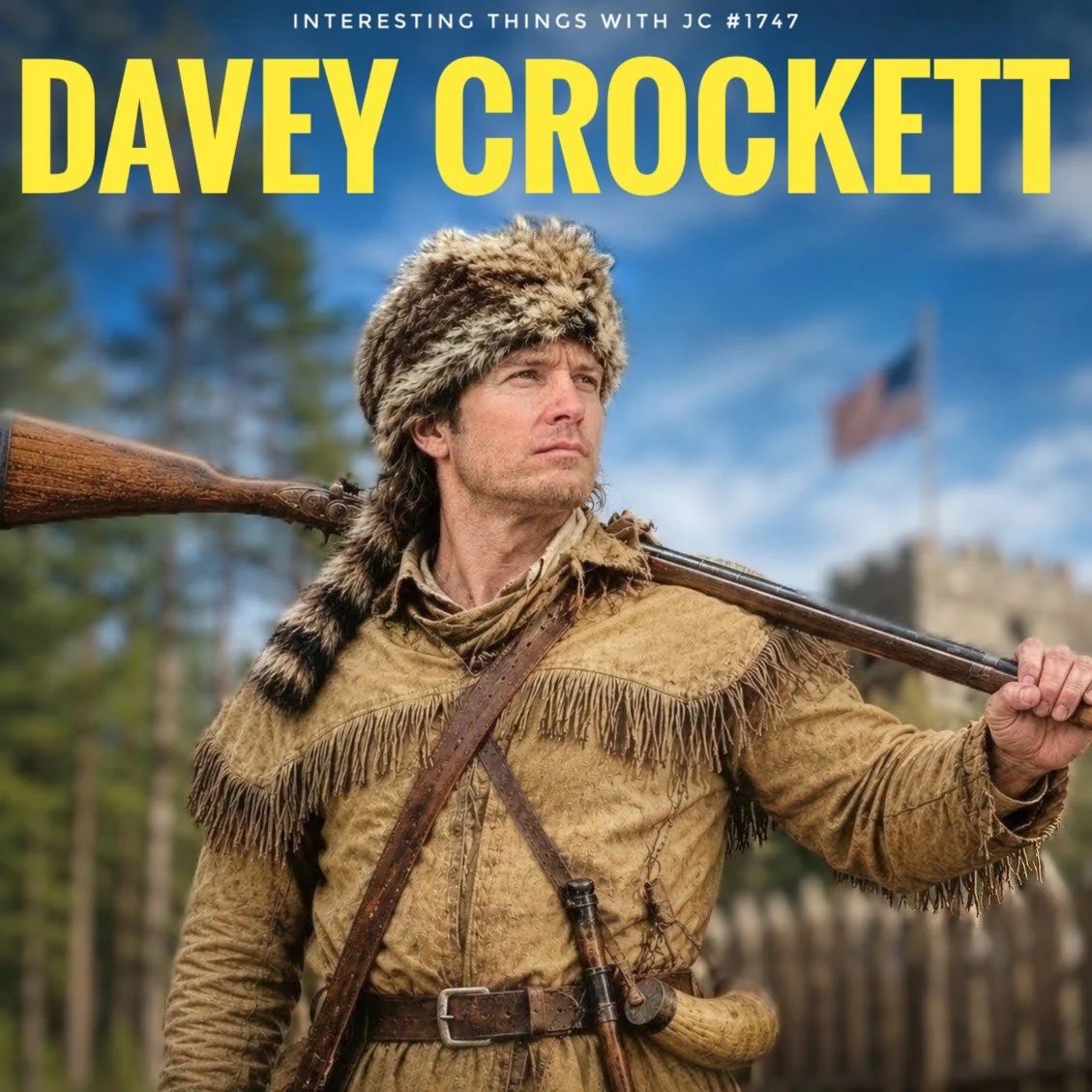
A square promotional image for Interesting Things with JC #1747 featuring a frontiersman in a fur cap and fringed buckskin clothing carrying a long rifle across his shoulders. He stands outdoors with trees, a wooden fort, and an American flag blurred in the background. Large yellow text across the top reads “DAVEY CROCKETT,” with smaller white text above reading “INTERESTING THINGS WITH JC #1747.”
Transcript
Interesting Things with JC #1747:
"Davy Crockett Before the Legend"
Before the coonskin cap, before the television reruns, before anyone called him “King of the Wild Frontier,” David Crockett was a boy born August 17, 1786, in the mountains of what is now eastern Tennessee. His family moved often, money was scarce, and while he was still a child, his father hired him out to drive cattle hundreds of miles into Virginia.
Crockett later wrote that he spent only a few days in school before trouble with another boy, and fear of his father’s punishment, sent him away from home. He stayed gone roughly two and a half years, working as a wagoner and laborer, and when he returned in 1802, he had grown so much that his own family reportedly did not recognize him.
That restless life carried him into the Tennessee militia as a scout during the Creek War, into the state legislature in 1821, and eventually into Congress, but the frontier identity followed him into politics. His reputation as a hunter became part of his public image. In his 1834 autobiography, Crockett claimed that in less than a year he killed 105 bears, describing hunts through freezing weather, dense cane, and rough country where following his dogs could leave him alone overnight in the woods.
By then, stories, stage plays, and political writing were already turning David Crockett into Davy Crockett while he was still alive. Crockett understood the value of that image and helped shape it himself. Even the title of his autobiography, A Narrative of the Life of David Crockett, of the State of Tennessee, Written by Himself, put his own voice against versions of Crockett already circulating in print. The historical man and the character built around him were beginning to overlap more than a century before television made the coonskin cap famous.
The real Crockett was harder to fit inside the character. He served three terms in the House and broke politically with fellow Tennessean Andrew Jackson, including open opposition to the Indian Removal Act of 1830. That put Crockett against Jackson on one of the defining issues of his presidency, while Crockett's political fortunes at home remained unsettled. He lost his congressional seat in 1831, won it back in 1833, and lost again in 1835. After that final defeat, he left Tennessee and headed west.
By February 1836, he had reached San Antonio de Béxar and joined the defenders inside the Alamo as Mexican forces under Antonio López de Santa Anna closed around the mission. On March 6, the Mexican army overwhelmed it, and Crockett died there at forty-nine. Accounts disagree about his final moments. Some place him among those killed during the fighting, while other testimony says he survived the assault and was executed afterward. The surviving evidence does not settle which account is correct.
His death did not settle the question of who Davy Crockett was, either. Books, plays, and retellings continued reshaping him until television introduced yet another version in the 1950s, complete with the coonskin cap and “The Ballad of Davy Crockett.” By then, Americans had inherited a character assembled from the historical man, exaggerations published during his lifetime, Crockett’s own storytelling, and more than a century of people adding something to the story.
He did not simply become a legend after he died. He lived long enough to see it happening, took part in shaping it, and then disappeared inside a Davy Crockett who continued changing long after David Crockett was gone.
The boy who once returned home so changed that his own family reportedly did not recognize him became a man almost everyone recognized, though not always as the man he actually was.
These are interesting things, with JC.
Student Worksheet
Comprehension: Answer each question in 1–2 complete sentences.
What circumstances shaped Crockett’s childhood and early working life?
What positions or forms of public service did Crockett hold before leaving Tennessee?
What hunting claim from Crockett’s autobiography illustrates the frontier identity associated with him?
How did Crockett participate in shaping his own public image?
What does the episode identify as uncertain about Crockett’s death?
Analysis: Answer each question using specific evidence from the episode.
Identify two examples showing a difference between David Crockett the historical person and “Davy Crockett” the public character. Explain why the distinction matters.
Why should Crockett’s autobiography be treated as valuable historical evidence while also being analyzed critically?
How does the disagreement about Crockett’s final moments demonstrate the challenges historians face when reconstructing past events?
Create a three-part evidence chart labeled Documented/Supported, Claimed or Self-Reported, and Uncertain/Disputed. Place at least two episode details in each appropriate category where possible and explain your classification.
Reflection Prompt: In 5–7 sentences, explain whether a legend can help people remember history while simultaneously making the history harder to understand. Use Crockett as your example.
Difficulty Scaling:
Foundation: Identify evidence directly stated in the episode and explain it in your own words.
Core: Compare multiple details and explain how they contribute to Crockett’s historical reputation.
Advanced: Evaluate how autobiography, contemporary popular culture, political identity, and later entertainment complicate attempts to reconstruct the historical Crockett.
Student Output: Submit responses to all comprehension questions, at least two analysis questions, the evidence chart, and the reflection paragraph. Advanced learners should complete all four analysis questions.
Academic Integrity Guidance: Use the episode and assigned classroom sources as evidence. Clearly distinguish Crockett’s own claims from independently supported information and from disputed evidence. Do not present uncertainty as established fact.
Teacher Guide
Quick Start: Begin with the podcast before providing background information. Ask students to listen for two versions of the same person: David Crockett, the historical figure, and Davy Crockett, the developing legend.
Pacing Guide (Audio-First):
0–5 minutes: Bell ringer and prediction.
5–12 minutes: Play the complete podcast episode without interruption.
12–18 minutes: Students record three historical facts, two examples of image-making, and one unresolved question.
18–30 minutes: Vocabulary review and evidence classification.
30–42 minutes: Worksheet analysis and partner discussion.
42–52 minutes: Whole-class discussion of evidence, legend, and historical uncertainty.
52–60 minutes: Assessment or exit ticket.
Bell Ringer: Write three words or images you associate with “Davy Crockett.” Beside each one, indicate where you think that association came from. Students revisit their responses after listening.
Audio Guidance: Before playback, tell students not to attempt full transcription. Listen for transitions among childhood, hunting, politics, the Alamo, and later legend. During a second listening, students may collect evidence for the three categories: supported, self-reported, and disputed.
Audio Fallback: If audio is unavailable, read the supplied transcript aloud or assign alternating paragraphs to readers. Preserve the audio-first sequence by having students hear the narrative before beginning detailed textual analysis.
Time on Task: Standard lesson: approximately 55–60 minutes. Extended evidence analysis: 75–90 minutes.
Materials:
Episode audio
Full transcript
Student Worksheet
Paper or digital evidence chart
Writing materials
Optional teacher-selected primary or secondary sources for extension
Vocabulary Prep: Preteach autobiography, public image, primary source, corroboration, and historical uncertainty. Ask students to apply the terms during discussion rather than memorizing definitions in isolation.
Misconceptions:
Crockett’s famous popular image should not automatically be treated as a literal historical description.
An autobiography is a primary source, but primary does not mean automatically objective or independently verified.
Historical disagreement does not mean that every possible account is equally well supported.
Saying that Crockett’s exact final moments are uncertain is different from saying nothing about his death is known.
Crockett’s opposition to the Indian Removal Act should be studied within the evidence of his political record rather than used to make unsupported assumptions about every aspect of his views.
Discussion Prompts:
Why might a politician benefit from a memorable frontier identity?
What makes Crockett’s autobiography useful to historians?
What limitations should researchers consider when someone describes his own achievements?
At what point can repeated storytelling begin to replace historical memory?
Why is acknowledging uncertainty sometimes more accurate than choosing the most dramatic version of an event?
Formative Checkpoints:
After listening, students identify one fact, one self-reported claim, and one disputed point.
During worksheet work, check whether students cite episode evidence rather than general impressions.
Before assessment, ask students to define corroboration and give an example of why Crockett’s story requires it.
Differentiation:
Provide sentence starters such as “The episode supports ___ by stating ___.”
Allow students to annotate a printed transcript during a second listening.
Pair students for evidence classification before requiring independent writing.
Challenge advanced students to evaluate how a person can function simultaneously as a historical actor and a constructed cultural symbol.
Assessment Differentiation: Students needing support may answer with a claim plus two pieces of evidence. Advanced students should incorporate source limitations, competing interpretations, and a counterargument.
Time Flexibility: For a 40-minute class, complete the podcast, evidence chart, selected discussion questions, and exit ticket. For a block period, add primary-source comparison and the full assessment.
Substitute Readiness: The lesson can be completed from the transcript and worksheet without specialized historical knowledge. The substitute should preserve the sequence: listen/read first, classify evidence second, discuss third, assess last.
Engagement Strategy: Use the contrast between the recognizable “Davy Crockett” image and the historical evidence as an investigative problem. Students become evidence reviewers rather than passive recipients of a biography.
Extensions: Students may compare a passage from Crockett’s 1834 autobiography with a later portrayal and identify what was preserved, exaggerated, omitted, or transformed.
Cross-Curricular Connections: U.S. History connects Crockett to nineteenth-century politics and territorial conflict. English Language Arts examines autobiography, characterization, and narrative construction. Media literacy examines how repeated representations shape public memory.
SEL: Students practice intellectual humility by recognizing when evidence does not justify certainty and respectful discussion when interpretations differ.
Skill Emphasis: Evidence evaluation, analytical thinking, communication, corroboration, source criticism, reasoned judgment, and responsible decision-making.
Answer Key:
Comprehension 1: His early life included frequent family moves, limited money, cattle-driving work, little schooling, running away, and employment as a wagoner and laborer.
Comprehension 2: He served in the Tennessee militia, Tennessee legislature, and U.S. House of Representatives.
Comprehension 3: Crockett claimed that he killed 105 bears in less than a year.
Comprehension 4: His autobiography presented his own version of his life while stories and performances were already creating a public Crockett character.
Comprehension 5: The episode states that accounts disagree over whether Crockett died during the fighting or survived the assault and was subsequently executed.
Analysis 1: Answers should distinguish documented biography from constructed cultural identity and cite at least two examples.
Analysis 2: Students should recognize autobiography as direct evidence of Crockett’s self-presentation while noting that self-reported stories and achievements require critical evaluation and corroboration.
Analysis 3: Strong answers explain that conflicting testimony can prevent historians from reaching certainty and that conclusions should reflect the strength and limitations of surviving evidence.
Analysis 4: Accept classifications supported by the transcript when students clearly explain their reasoning.
Reflection: Responses should present a defensible position and use Crockett-specific evidence rather than unsupported generalization.
Quiz
Which experience was part of Crockett’s early life?
A. Formal military academy training
B. Driving cattle into Virginia
C. Studying law in Washington
D. Working as a newspaper editor
According to his autobiography, what achievement contributed to Crockett’s reputation as a hunter?
A. Crossing the continent alone
B. Killing 105 bears in less than a year
C. Establishing a hunting school
D. Mapping the entire Tennessee frontier
Why is Crockett’s 1834 autobiography especially relevant to the episode’s central idea?
A. It shows Crockett participating in the construction of his own public image.
B. It proves every later Crockett legend was historically accurate.
C. It was written after the television series became popular.
D. It contains the only surviving information about his life.
Which political issue placed Crockett in opposition to Andrew Jackson?
A. The Louisiana Purchase
B. The Indian Removal Act
C. The Missouri Compromise
D. The Monroe Doctrine
What is the most responsible conclusion about Crockett’s final moments at the Alamo based on the episode?
A. Every account describes exactly the same sequence.
B. His death at the Alamo is fictional.
C. Surviving evidence leaves the precise circumstances disputed.
D. Television provides the definitive historical account.
Assessment
Open-Ended Questions:
Explain how David Crockett participated in creating the public identity that later became the legend of “Davy Crockett.” Use at least three specific details from the episode.
Historians sometimes have to write conclusions without resolving every question. Using the accounts of Crockett’s death, explain how a responsible historian should communicate conflicting evidence.
3–2–1 Rubric:
3 — Proficient: Makes a clear claim, uses accurate and specific evidence, distinguishes documented information from claims or uncertainty, and explains the reasoning connecting evidence to the conclusion.
2 — Developing: Makes a relevant claim and includes some accurate evidence, but explanation, source evaluation, or treatment of uncertainty is incomplete.
1 — Beginning: Provides a limited or unsupported claim, uses little specific evidence, or treats disputed information as established fact.
Exit Ticket: In 2–3 sentences, identify one detail about Crockett that became part of his legend and one question that requires careful historical evidence rather than popular memory.
Standards Alignment
NGSS — Science & Engineering Practices
SEP 7: Engaging in Argument from Evidence.
Connection: Students classify claims and evaluate competing accounts of Crockett’s life and death.
Measurable Skill: Construct an interpretation supported by relevant evidence while identifying limitations.
Justification: The lesson uses evidence-based argumentation across historical rather than scientific source material, reinforcing the transferable practice of defending claims with evidence.
CCSS Reading
CCSS.ELA-LITERACY.RH.11-12.1 — Cite specific textual evidence to support analysis of primary and secondary sources.
Connection: Students use transcript evidence and may compare Crockett’s autobiography with secondary historical accounts.
Measurable Skill: Cite specific evidence supporting an interpretation.
Justification: Worksheet and assessment responses require evidence rather than unsupported impressions.
CCSS.ELA-LITERACY.RH.11-12.6 — Evaluate authors’ differing points of view on the same historical event or issue.
Connection: Students examine conflicting accounts surrounding Crockett’s death and differences between self-presentation and later representation.
Measurable Skill: Identify and evaluate differences among historical perspectives.
Justification: Historical uncertainty is a central analytical problem in the lesson.
CCSS.ELA-LITERACY.RH.11-12.9 — Integrate information from diverse sources into a coherent understanding of an idea or event, noting discrepancies among sources.
Connection: Students distinguish autobiography, historical evidence, popular storytelling, and disputed testimony.
Measurable Skill: Synthesize evidence while identifying discrepancies.
Justification: The evidence-classification activity directly requires this reasoning.
CCSS Writing
CCSS.ELA-LITERACY.WHST.11-12.1 — Write arguments focused on discipline-specific content.
Connection: Students construct evidence-supported interpretations of Crockett’s historical reputation.
Measurable Skill: Produce a defensible claim supported by relevant evidence and reasoning.
Justification: Both open-ended assessment questions require historical argumentation.
CCSS.ELA-LITERACY.WHST.11-12.9 — Draw evidence from informational texts to support analysis, reflection, and research.
Connection: Students use episode information to answer analytical and reflective questions.
Measurable Skill: Select and apply relevant textual evidence.
Justification: Evidence use is explicitly required in the worksheet and assessment.
CCSS Speaking & Listening
CCSS.ELA-LITERACY.SL.11-12.1 — Initiate and participate effectively in collaborative discussions.
Connection: Students discuss source reliability, public image, and historical uncertainty after listening.
Measurable Skill: Present evidence, respond to competing interpretations, and refine conclusions through discussion.
Justification: The Teacher Guide includes structured evidence-based discussion prompts.
C3 Framework
D2.His.10.9-12 — Detect possible limitations in various kinds of historical evidence and differing secondary interpretations.
Connection: Students examine the limits of autobiography and conflicting evidence concerning Crockett’s death.
Measurable Skill: Identify at least one limitation affecting a historical conclusion.
Justification: Source limitations are explicitly assessed in the worksheet and teacher checkpoints.
D2.His.14.9-12 — Analyze multiple and complex causes and effects of events in the past.
Connection: Students examine how Crockett’s actions, political identity, autobiography, contemporary storytelling, and later entertainment contributed to his legend.
Measurable Skill: Explain multiple factors contributing to the construction of a historical reputation.
Justification: This directly supports the lesson’s essential question.
ISTE Standards
ISTE Student 1.3 — Knowledge Constructor.
Connection: Students evaluate information, distinguish types of evidence, and organize findings into supported conclusions.
Measurable Skill: Assess source relevance and credibility when constructing historical knowledge.
Justification: The evidence chart and assessment require information evaluation rather than simple recall.
Career Readiness Competencies
Analytical Thinking:
Connection: Students separate documented information, self-reported claims, and disputed evidence.
Measurable Outcome: Correctly classify evidence and justify classifications.
Justification: Professional analysis requires distinguishing confidence levels within available information.
Communication:
Connection: Students explain historical conclusions orally and in writing.
Measurable Outcome: Present a clear claim supported by specific evidence.
Justification: Effective professional communication depends on concise, evidence-supported reasoning.
Problem Solving:
Connection: Students address a historical problem for which the evidence does not produce complete certainty.
Measurable Outcome: Develop the strongest defensible conclusion without overstating the evidence.
Justification: Real-world problem solving frequently occurs with incomplete information.
Adaptability:
Connection: Students revise initial impressions of Crockett after encountering more complicated historical evidence.
Measurable Outcome: Modify an interpretation when new evidence challenges an assumption.
Justification: Adaptability requires responding constructively to better information.
Professional Judgment:
Connection: Students determine what can responsibly be claimed from incomplete or conflicting sources.
Measurable Outcome: Explicitly distinguish established information from uncertainty.
Justification: Responsible professional decisions require appropriate confidence in evidence.
Homeschool / Lifelong Learning Alignment
Independent Learning: Students can complete the listening, transcript analysis, worksheet, and reflection independently.
Outcome: Organize and evaluate historical information without continuous instructor direction.
Justification: The lesson provides a complete pathway for self-directed study.
Information Literacy: Students distinguish source types, claims, corroboration, and uncertainty.
Outcome: Evaluate information before accepting or repeating it.
Justification: These skills transfer directly to everyday media and research.
Real-World Application: Students connect historical reputation-building with modern public communication.
Outcome: Identify how representation can influence understanding of a real person.
Justification: The historical case provides a practical model for evaluating contemporary information.
Self-Directed Inquiry: Students can extend the lesson by comparing Crockett’s autobiography with later portrayals.
Outcome: Develop and investigate an evidence-based research question.
Justification: The extension moves learners from guided analysis to independent inquiry.
Transferable Life Skills: Students practice reasoning, communication, intellectual humility, and evidence evaluation.
Outcome: Make better-supported judgments when information is incomplete or disputed.
Justification: These competencies apply beyond history classrooms to education, work, media consumption, and civic life.
Show Notes
David Crockett’s life offers students an unusually clear opportunity to examine the distance between a historical person and a cultural legend. Beginning with his difficult childhood and following his path through military service, hunting, politics, self-authored storytelling, and the Alamo, this lesson asks students to investigate how “Davy Crockett” developed while David Crockett was still alive. The episode is especially useful for teaching source evaluation because Crockett participated in constructing his own image and because evidence about his final moments remains disputed. Students leave the lesson with a stronger understanding of historical uncertainty, media literacy, corroboration, and the responsibility to distinguish a compelling story from what available evidence can actually establish.
References
Crockett, D. (1834). A narrative of the life of David Crockett, of the state of Tennessee. E. L. Carey and A. Hart. https://www.loc.gov/item/07020555/
Gilder Lehrman Institute of American History. (n.d.). Davy Crockett on the removal of the Cherokees, 1834. https://www.gilderlehrman.org/history-resources/spotlight-primary-source/davy-crockett-removal-cherokees-1834
Kilgore, D. (1978). How did Davy die? Texas A&M University Press. https://archive.org/details/howdiddavydie0000kilg
Lofaro, M. A. (Ed.). (1985). Davy Crockett: The man, the legend, the legacy, 1786–1986. University of Tennessee Press. https://utpress.org/9780870495076/davy-crockett/
Lofaro, M. A. (1976; updated 2023). Crockett, David. In Handbook of Texas Online. Texas State Historical Association. https://tshaonline.org/handbook/entries/crockett-david
Shackford, J. A. (1956). David Crockett: The man and the legend (J. B. Shackford, Ed.). University of North Carolina Press. (Bison Books reprint, 1994). https://www.nebraskapress.unl.edu/bison-books/9780803292307/david-crockett/
Tennessee Historical Society. (n.d.). Crockett, David “Davy.” Tennessee Encyclopedia of History and Culture. https://tennesseeencyclopedia.net/entries/davy-crockett/
Texas State Historical Association. (n.d.). Alamo, Battle of the. In Handbook of Texas Online. https://www.tshaonline.org/handbook/entries/alamo-battle-of-the
Texas State Historical Association. (n.d.). Peña, José Enrique de la. In Handbook of Texas Online. https://www.tshaonline.org/handbook/entries/pena-jose-enrique-de-la