1746: "Julie Newmar"
Interesting Things with JC #1746: "Julie Newmar"
Julie had already won a Tony and trained for years in ballet before playing Catwoman, then used that same attention to movement and body shape to redesign women’s undergarments. In the 1970s, the actress who adjusted Catwoman’s costume for a more feline line secured U.S. patents for pantyhose and brassiere designs under her own name
Curriculum - Episode Anchor
Episode Title: Julie Newmar
Episode Number: 1746
Host: JC
Audience: Grades 9–12, introductory college, homeschool, lifelong learners
Subject Area: Performing Arts, American Popular Culture, Design, Innovation, Career Readiness
Lesson Overview
Learning Objectives:
Trace Julie Newmar’s progression from dance and Broadway to television and invention.
Analyze how training in movement and stagecraft influenced Newmar’s portrayal of Catwoman.
Explain how observation of the human body and clothing informed Newmar’s patented garment designs.
Evaluate evidence showing how skills developed in one field can transfer to another.
Essential Question: How can skills developed in one discipline become tools for innovation in another?
Success Criteria: Students can identify at least three stages of Newmar’s career, cite evidence connecting her performance background to her design work, distinguish documented facts from interpretation, and explain one example of transferable skill.
Student Relevance Statement: Students frequently develop abilities without knowing where those abilities may eventually be useful. Newmar’s career provides a case study in recognizing how observation, discipline, movement, creativity, and problem solving can transfer between fields.
Real-World Connection: Performing, costume design, product design, engineering, entrepreneurship, and many other professions require people to observe problems, apply existing knowledge, test improvements, and communicate solutions.
Workforce Reality: Careers rarely follow a perfectly straight path. Training can create transferable skills, but success in a new field also requires learning, persistence, evidence-based decisions, and professional judgment.
Key Vocabulary
Ballerina(bal-uh-REE-nuh) — A female ballet dancer, particularly one trained in classical ballet.
Stagecraft(STAYJ-kraft) — The practical techniques used to create and perform theatrical productions.
Silhouette(sil-oo-ET) — The visible outline or overall shape of a person or object.
Contour(KON-toor) — The outline or shape of a form.
Patent(PAT-nt) — A legal right granted for an invention that meets applicable requirements.
Inventor(in-VEN-ter) — A person who creates or develops a new device, process, or improvement.
Transferable skill(trans-FER-uh-buhl skil) — An ability developed in one setting that can be applied effectively in another.
Stage movement(STAYJ MOOV-muhnt) — Purposeful physical movement used by a performer to communicate character, emotion, or action.
Narrative Core
Open: Before Julie Newmar became closely associated with Catwoman, she had already developed substantial experience as a dancer and stage performer and had won a Tony Award. Her later television role therefore drew on skills developed long before she entered the Batman series.
Info: Born Julia Chalene Newmeyer in Los Angeles on August 16, 1933, Newmar studied piano and ballet and worked professionally in dance. Her film work included The Band Wagon and Seven Brides for Seven Brothers. Her Broadway career brought major recognition when she won the 1959 Tony Award for Featured Actress in a Play for The Marriage-Go-Round.
Details: Newmar brought her understanding of movement and visual form to Catwoman in Batman. She altered aspects of the costume, including positioning the belt at her hips rather than her waist. She appeared as Catwoman in 13 episodes in 1966–1967. In the 1970s, she applied design thinking to clothing more directly, receiving U.S. patents for a pantyhose design incorporating an elastic shaping band and for brassiere designs. Patent records identify Julie Newmar as the inventor.
Reflection: Her career demonstrates a useful principle: expertise does not always remain inside the field where it was first developed. Knowledge of movement, form, performance, clothing, and the body can become the foundation for solving different kinds of problems.
Closing: These are interesting things, with JC.
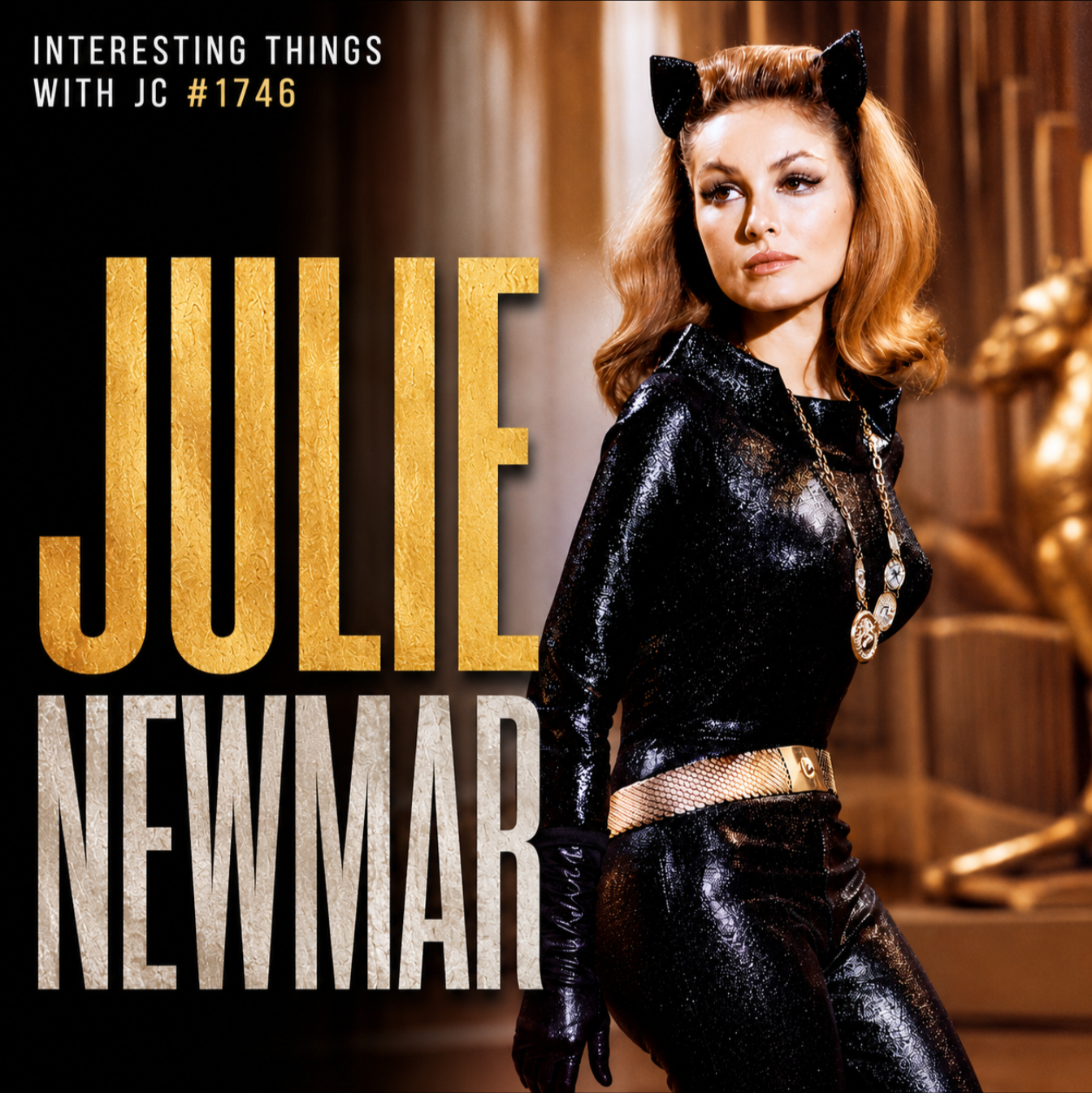
Promotional graphic for Interesting Things with JC #1746 featuring a woman portraying a Catwoman-inspired figure in a glossy black catsuit, long gloves, cat-ear headpiece, and gold belt, posed against a warm brown and gold interior background. Large gold and white text on the left reads “JULIE NEWMAR,” with “INTERESTING THINGS WITH JC #1746” in smaller text at the upper left.
Transcript
Interesting Things with JC #1746:
"Julie Newmar"
Julie Newmar had been a ballerina, a Broadway performer, and a Tony Award winner before anyone asked her to put on a black catsuit. When the offer came to play Catwoman on Batman, Newmar later recalled that she barely knew the show. Her younger brother did, and he told her to take the job.
Born Julia Chalene Newmeyer in Los Angeles on August 16, 1933, Newmar grew up around performance. Her mother had danced in the Ziegfeld Follies, and Julie studied piano and ballet before dancing professionally herself. Film roles followed, including The Band Wagon and Seven Brides for Seven Brothers, but Broadway showed what she could do beyond dance. In 1959, she won a Tony Award for her performance in The Marriage-Go-Round.
So when Newmar arrived on Batman in 1966, Catwoman was being built by someone with years of training in movement and stagecraft. She studied how cats moved and even adjusted the costume, lowering its belt from the waist to the hips to create a more feline line. She appeared as Catwoman in only 13 episodes during the show's first two seasons, but her performance became one of the enduring images of the series.
Then Newmar took that same attention to form and movement somewhere unexpected. In the 1970s, she became an inventor, securing U.S. patents for improvements to women's undergarments. One pantyhose design used an elastic shaping band intended to improve contour and fit. She also patented brassiere designs. These weren't products carrying a celebrity endorsement. The patents named Julie Newmar as the inventor.
There's a connection running through that work without needing much explanation. The dancer understood movement. The actress understood what clothing could do to a silhouette. And the inventor understood that a garment could be redesigned when it didn't move with the body the way she thought it should.
Catwoman may be the image people remember first, but it was only one expression of what Julie Newmar had been doing all along: studying form, movement, and how the two work together.
These are interesting things, with JC.
Student Worksheet
Comprehension Questions:
What forms of artistic training did Newmar receive before becoming widely known as Catwoman?
What major theatrical award did she receive, and for which production?
What costume adjustment does the episode attribute to Newmar?
How many episodes of Batman featured Newmar as Catwoman?
What type of garment improvement was described in Newmar’s pantyhose patent?
Analysis Questions:
Identify two details supporting the claim that Newmar’s portrayal of Catwoman drew on earlier professional skills.
Compare Newmar’s work as a dancer with her work as an inventor. What skill or way of thinking connects the two?
The episode says that Newmar understood “what clothing could do to a silhouette.” Explain how the costume and patent examples support this interpretation.
Separate the episode’s evidence from its interpretation. Identify one documented fact and one conclusion the narrative draws from that fact.
Reflection Prompt: Identify a skill you currently possess that could transfer to a career, project, or responsibility that initially seems unrelated. Explain the connection in 100–150 words.
Difficulty Scaling: Developing learners may complete Questions 1–3 and identify one transferable skill. Grade-level learners complete all questions using specific transcript evidence. Advanced/college learners should additionally evaluate whether the evidence is sufficient to support the narrative’s central connection between performance and invention.
Student Output: Submit complete-sentence responses to all assigned questions plus the 100–150-word reflection. Analytical responses should reference specific evidence from the episode.
Academic Integrity Guidance: Distinguish between what the transcript states, what an outside source documents, and what you infer. When research is assigned, record the source of factual information rather than presenting outside information as your own discovery.
Teacher Guide
Quick Start
Begin with the podcast before providing background information.
Ask students to listen for examples of how one skill can transfer into a different field.
After listening, have students identify the major stages of Julie Newmar’s career before moving into analysis.
Pacing Guide — Audio First
0–3 minutes: Bell ringer
3–8 minutes: Podcast listening
8–13 minutes: Immediate recall and vocabulary check
13–25 minutes: Student Worksheet comprehension and analysis
25–38 minutes: Evidence-based discussion
38–48 minutes: Reflection or open-ended assessment
48–50 minutes: Exit Ticket
Bell Ringer
Prompt: “Name one skill that could be useful in two very different careers. Explain why.”
Students should respond in 2–3 complete sentences.
Use responses to introduce the idea of transferable skills.
Audio Guidance
During the first listen, students should record three words or phrases connected to movement, design, or problem solving.
Ask students to pay attention to the sequence of Newmar’s career: dancer, performer, Catwoman, inventor.
During an optional second listen, students should identify specific evidence showing how skills appear to transfer between those stages.
Audio Fallback
If the podcast cannot be played, read the transcript aloud before students read it independently.
Preserve the audio-first sequence by having students listen before examining the written text.
After the reading, continue with the same worksheet, discussion, and assessment activities.
Time on Task
Standard Lesson: Approximately 50 minutes
Condensed Lesson: Approximately 30 minutes
Extended Lesson: 75–90 minutes with patent or source analysis
Materials
Episode audio
Full transcript
Student Worksheet
Quiz
Assessment
Paper or digital response tool
Optional patent or biographical source excerpts for extension work
Vocabulary Preparation
Preteach: stagecraft, silhouette, contour, patent, transferable skill
Ask students to predict how all five terms might relate to the same person.
Reinforce vocabulary during discussion by requiring students to use at least two terms accurately.
Common Misconceptions
Misconception: Catwoman was Julie Newmar’s first major professional achievement.
Correction: She had substantial dance, film, and Broadway experience before appearing on Batman.
Misconception: Her patents were simply celebrity endorsements.
Correction: Patent records named Julie Newmar as the inventor.
Misconception: Artistic ability and technical problem solving are unrelated.
Correction: The lesson examines how observation, movement, form, and design thinking can operate across different fields.
Misconception: The episode proves that Newmar’s acting career directly caused her inventions.
Correction: The episode presents a supported connection, but students should distinguish documented evidence from interpretation.
Discussion Prompts
Which detail from the episode best demonstrates transferable skill?
How might dance training influence the way someone thinks about costume movement and fit?
What separates noticing a practical problem from developing an invention?
Why is it important to distinguish a documented fact from a biographical interpretation?
Which part of Newmar’s career best demonstrates adaptability? Explain with evidence.
Formative Checkpoints
After Listening: Students identify three stages of Newmar’s career in correct sequence.
During Vocabulary Review: Students explain one vocabulary term using the episode as context.
During Worksheet Analysis: Require at least one specific piece of transcript evidence for each analytical claim.
Before Assessment: Ask students to define transferable skill without repeating the provided definition.
Before Exit Ticket: Students orally state one example of evidence and one interpretation from the lesson.
Differentiation
Developing Learners
Provide a career timeline with key stages already labeled.
Offer sentence starters for evidence-based responses.
Allow replay of the audio or paired evidence collection.
Grade-Level Learners
Complete the full worksheet and discussion tasks.
Require specific transcript evidence in analytical responses.
Advanced / Introductory College Learners
Compare the transcript with patent or biographical records.
Evaluate how strongly outside evidence supports the episode’s interpretation.
Distinguish correlation, influence, and causation.
Assessment Differentiation
Developing: Allow an oral response to one open-ended question using at least two accurate pieces of evidence.
Grade-Level: Require written responses to both assessment questions using specific evidence.
Advanced: Require students to address evidentiary limits and explain where the narrative moves from fact to interpretation.
Time Flexibility
30-Minute Version: Podcast, comprehension Questions 1–3, one analysis question, and Exit Ticket.
50-Minute Version: Complete the full lesson sequence.
75–90-Minute Version: Add primary-source patent examination, source comparison, and extended discussion.
Substitute Readiness
Play or read the episode first.
Distribute the worksheet.
Have students complete the comprehension and analysis questions.
Administer the quiz.
Use the answer key below for review.
No specialized background in theatre, engineering, or patent law is required.
Engagement Strategy
Use a Skill-Transfer Chain:
Dancer
Broadway performer
Catwoman
Inventor
Have students attach one skill, decision, or form of expertise to each stage.
Students must explain how that skill could transfer to the next stage.
Extensions
Examine one of Newmar’s patent records and identify:
The problem being addressed
The proposed design solution
The intended function
Evidence of design thinking
Research another person who transferred skills between significantly different fields.
Create a short comparison explaining similarities and differences in how transferable skills were used.
Cross-Curricular Connections
Theatre: Stage movement, physical characterization, costume choices
Engineering / Design: Problem identification, function, design improvement
History: 1960s television and American popular culture
English Language Arts: Evidence, inference, central idea, argument
Career Education: Adaptability, transferable skills, professional judgment
SEL Connection
Students reflect on adaptability and the value of developing skills that may have uses beyond their original purpose.
Emphasize persistence, observation, discipline, and willingness to apply existing abilities in unfamiliar situations.
Connect the lesson to responsible decision making about education, work, and personal development.
Skill Value Emphasis
Critical thinking
Evidence evaluation
Communication
Observation
Problem solving
Inquiry
Adaptability
Reasoning
Professional judgment
Transfer of knowledge across disciplines
Answer Key
Student Worksheet — Comprehension
Newmar studied piano and ballet and worked in dance, film, and Broadway performance.
She won a Tony Award for her performance in The Marriage-Go-Round.
She lowered the Catwoman costume belt from the waist to the hips.
She appeared as Catwoman in 13 episodes.
The pantyhose design used an elastic shaping band intended to improve contour and fit.
Student Worksheet — Analysis
Responses will vary.
Strong answers should cite specific transcript evidence.
Acceptable connections include movement training, awareness of silhouette, costume modification, garment fit, and later invention.
Students should distinguish documented facts from the narrator’s interpretation of how those facts connect.
Quiz Answer Key
A
B
C
C
C
Assessment Guidance
Full-credit responses should make a clear claim, use accurate evidence, explain how the evidence supports the claim, and distinguish fact from inference where appropriate.
Quiz
Which achievement occurred before Newmar played Catwoman?
A. She received a Tony Award
B. She patented a television camera
C. She directed Batman
D. She became a comic-book illustratorWhy is Newmar’s dance background important to the episode’s central argument?
A. It explains why she stopped acting
B. It demonstrates earlier experience with movement and physical form
C. It proves she designed every Batman costume
D. It shows that ballet and invention require identical trainingWhat change did Newmar make to the Catwoman costume according to the episode?
A. She replaced the mask
B. She eliminated the belt
C. She positioned the belt lower on the hips
D. She changed the costume to whiteWhich evidence most directly establishes Newmar as an inventor?
A. She appeared on Broadway
B. She wore a modified costume
C. U.S. patent records name her as inventor
D. She studied balletWhich statement best expresses the episode’s central idea?
A. Professional careers must remain within one discipline
B. Television acting requires formal engineering training
C. Skills involving observation, movement, and form can transfer across different kinds of work
D. Newmar became successful primarily because of Catwoman
Assessment
Open-Ended Questions:
Using at least three pieces of evidence, explain how the episode connects Newmar’s experience in dance and performance with her later work in garment design and invention.
Evaluate the statement: “Catwoman was only one expression of what Julie Newmar had been doing all along.” Explain what the statement means and assess how strongly the evidence supports it.
3–2–1 Rubric:
3 — Proficient: Makes a clear claim, uses at least three accurate pieces of evidence, explains the connection between evidence and conclusion, and distinguishes fact from inference.
2 — Developing: Makes a reasonable claim and provides some accurate evidence, but explanation, precision, or evidence-to-claim reasoning is incomplete.
1 — Beginning: Provides a limited or unsupported claim, uses little accurate evidence, or does not explain how the evidence supports the conclusion.
Exit Ticket: In 2–3 sentences, name one transferable skill demonstrated by Julie Newmar and identify two different settings in which she applied it.
Standards Alignment
The lesson aligns with Grades 9–12 and introductory college expectations by emphasizing evidence evaluation, critical thinking, communication, inquiry, problem solving, adaptability, and the transfer of skills across disciplines.
NGSS — Science & Engineering Practices
Constructing Explanations and Designing Solutions (Grades 9–12)
Connection: Students examine Julie Newmar’s patented garment designs as examples of identifying a functional concern and developing a design response.
Measurable Skill: Students identify the design problem, proposed solution, and intended function represented by an invention.
Lesson Alignment: Connects directly to the patent-analysis extension and the lesson’s emphasis on problem solving and design thinking.
Obtaining, Evaluating, and Communicating Information (Grades 9–12)
Connection: Students compare statements in the episode with biographical and patent evidence.
Measurable Skill: Students distinguish documented facts from interpretation and communicate an evidence-supported conclusion.
Lesson Alignment: Directly supports Student Worksheet Analysis Question 4 and Assessment Question 2.
CCSS — Reading
CCSS.ELA-LITERACY.RI.11-12.1 — Cite Strong and Thorough Textual Evidence
Connection: Students use specific details from the transcript to analyze Newmar’s career and transferable skills.
Measurable Skill: Students support an interpretation with multiple accurate pieces of textual evidence.
Lesson Alignment: Directly supports the worksheet analysis questions and both open-ended assessment questions.
CCSS.ELA-LITERACY.RI.11-12.2 — Determine Central Ideas
Connection: Students determine how the episode develops its central idea about movement, form, innovation, and transferable expertise.
Measurable Skill: Students identify the central idea and explain how specific details develop it.
Lesson Alignment: Directly supports Quiz Question 5 and Assessment Question 2.
CCSS — Writing
CCSS.ELA-LITERACY.W.11-12.9 — Draw Evidence from Informational Texts
Connection: Students use transcript evidence to support analysis, reflection, and research.
Measurable Skill: Students select and integrate relevant evidence into a coherent written response.
Lesson Alignment: Both open-ended assessment questions require students to support conclusions with lesson evidence.
CCSS.ELA-LITERACY.W.11-12.1 — Write Arguments Supported by Valid Reasoning and Relevant Evidence
Connection: Students evaluate whether the evidence supports the episode’s interpretation of Newmar’s career.
Measurable Skill: Students construct a defensible claim supported by relevant evidence and reasoning.
Lesson Alignment: Directly supports Assessment Question 2 and the advanced differentiation activity.
CCSS — Speaking & Listening
CCSS.ELA-LITERACY.SL.11-12.1 — Participate Effectively in Collaborative Discussions
Connection: Students discuss interpretations of Newmar’s career while referring to evidence from the episode.
Measurable Skill: Students contribute an evidence-supported observation and respond meaningfully to another viewpoint.
Lesson Alignment: Directly supports the Teacher Guide discussion prompts and evidence-based classroom discussion.
CCSS.ELA-LITERACY.SL.11-12.2 — Integrate Multiple Sources Presented in Diverse Media and Formats
Connection: Students combine information presented through podcast audio, written transcript, and optional patent records.
Measurable Skill: Students synthesize information from audio and written sources into a supported conclusion.
Lesson Alignment: Reinforces the lesson’s audio-first structure and optional primary-source patent analysis.
C3 Framework — Inquiry and Evidence
D3.1.9-12 — Gather and Evaluate Sources
Connection: Students examine narrative, biographical, and patent evidence related to Newmar’s career.
Measurable Skill: Students evaluate a source for relevance and determine whether it supports a specific claim.
Lesson Alignment: Directly supports source verification, advanced worksheet activities, and the patent extension.
D4.1.9-12 — Construct and Communicate Conclusions
Connection: Students develop evidence-based conclusions about the relationship between Newmar’s performing and inventive work.
Measurable Skill: Students defend a conclusion using relevant evidence while recognizing limitations in that evidence.
Lesson Alignment: Directly supports Assessment Question 2 and classroom discussion.
ISTE Standards — Digital Research and Communication
ISTE 1.3.b — Knowledge Constructor: Evaluate Information
Connection: Students evaluate digital biographical and patent records when investigating factual claims.
Measurable Skill: Students determine whether a digital source provides reliable evidence for a specific claim.
Lesson Alignment: Supports the lesson’s source-verification and information-literacy activities.
ISTE 1.6.c — Creative Communicator: Communicate Complex Ideas
Connection: Students synthesize Newmar’s multidisciplinary career into an explanation of transferable skills.
Measurable Skill: Students clearly communicate connections among performance, movement, design, and invention.
Lesson Alignment: Supports the assessment, discussion, reflection, and extension products.
Career Readiness Competencies
Analytical Thinking
Connection: Students distinguish documented evidence from inference and narrative interpretation.
Measurable Skill: Students correctly classify evidence and interpretation within the episode.
Lesson Alignment: Directly supports Student Worksheet Analysis Question 4 and Assessment Question 2.
Communication
Connection: Students explain and defend conclusions through written responses and classroom discussion.
Measurable Skill: Students communicate a clear claim supported by relevant evidence.
Lesson Alignment: Reinforced through discussion prompts, worksheet responses, and assessment tasks.
Problem Solving
Connection: Students investigate how observation of garment function can lead to a design improvement.
Measurable Skill: Students identify a practical problem and explain how a proposed design addresses it.
Lesson Alignment: Directly supports the patent-analysis extension.
Adaptability
Connection: Students examine how Newmar applied abilities developed in one professional setting to different forms of work.
Measurable Skill: Students explain how one skill can function effectively in at least two different contexts.
Lesson Alignment: Directly addresses the Essential Question, reflection prompt, and Exit Ticket.
Professional Judgment
Connection: Students evaluate whether available evidence is sufficient to support a conclusion.
Measurable Skill: Students qualify a claim when evidence supports an interpretation but does not establish causation.
Lesson Alignment: Directly supports the advanced analysis and Assessment Question 2.
Homeschool / Lifelong Learning Alignment
Independent Learning
Connection: Learners can independently complete the audio, transcript, worksheet, and evidence-analysis sequence.
Measurable Skill: Learners produce an evidence-supported response with limited instructor assistance.
Lesson Alignment: Supports independent and flexible implementation across homeschool and lifelong-learning environments.
Information Literacy
Connection: Learners distinguish narrative statements from information documented by authoritative sources.
Measurable Skill: Learners corroborate factual claims using appropriate evidence.
Lesson Alignment: Directly supports the lesson’s source-verification activities.
Real-World Application
Connection: Learners connect artistic observation and knowledge of movement with practical product design.
Measurable Skill: Learners explain a real-world problem-and-solution relationship.
Lesson Alignment: Newmar’s garment inventions provide the lesson’s primary applied example.
Self-Directed Inquiry
Connection: Learners develop follow-up questions about Newmar’s career, performance methods, or inventions.
Measurable Skill: Learners formulate a researchable question and identify an appropriate source for investigation.
Lesson Alignment: Directly supports the lesson extension and independent research option.
Transferable Life Skills
Connection: Learners consider how existing abilities can be adapted to unfamiliar responsibilities and opportunities.
Measurable Skill: Learners identify one personal skill and explain its realistic application in another setting.
Lesson Alignment: Directly supports the reflection prompt, Essential Question, and Exit Ticket.
Show Notes
Julie Newmar’s career offers students an unusual study in transferable expertise, moving from ballet and Broadway to one of television’s most recognizable performances and then to patented garment designs. The episode invites learners to look beyond celebrity and examine discipline, observation, movement, design thinking, evidence, and adaptability. In the classroom, Newmar’s story provides a practical way to explore how specialized skills can cross professional boundaries and how documented evidence can be separated from a compelling biographical interpretation.
References
American Theatre Wing. (1959). 1959 Tony Award winners: Julie Newmar, The Marriage-Go-Round. https://www.tonyawards.com/winners/year/1959/category/any/show/any/
Newmar, J. (n.d.). Biography. Julie Newmar Official Website. https://julienewmar.com/biography/
National Museum of American History. (n.d.). Catwoman Costume Belt worn by Julie Newmar on Batman. Smithsonian Institution. https://americanhistory.si.edu/collections/object/nmah_1985683
Google Patents. (1975). US3914799A: Pantyhose with shaping band for cheeky derriere relief. https://patents.google.com/patent/US3914799A/en
Google Patents. (1976). US3935865A: Brassiere. https://patents.google.com/patent/US3935865A/en
Google Patents. (1975). USD235389S: Brassiere. https://patents.google.com/patent/USD235389S/en
Masterworks Broadway. (n.d.). Julie Newmar. https://masterworksbroadway.com/artist/julie-newmar/