1745: "The Wow! Signal"
Interesting Things with JC #1745: "The Wow! Signal"
A radio telescope in Ohio detected a powerful narrowband signal from the direction of Sagittarius for 72 seconds, matching the rise and fall expected from a fixed source in the sky. The signal vanished before the telescope’s second beam crossed the same region, and nearly fifty years of searches have never detected it again.
Curriculum - Episode Anchor
Episode Title: The Wow! Signal
Episode Number: 1745
Host: JC
Audience: Grades 9–12, introductory college, homeschool, lifelong learners
Subject Area: Astronomy, radio astronomy, SETI, scientific inquiry, evidence evaluation
Lesson Overview
Learning Objectives
Explain the Detection: Describe how the Big Ear radio telescope detected the Wow! Signal and explain why its approximately 72-second rise-and-fall pattern was consistent with a fixed celestial source passing through the telescope’s observing beam.
Interpret the Evidence: Explain what the sequence 6EQUJ5 represented and distinguish measured signal intensity from the mistaken idea that the characters formed an encoded message.
Analyze Scientific Significance: Explain why the signal’s narrow frequency range, location near 1420 MHz, and relationship to neutral hydrogen made the observation scientifically noteworthy.
Evaluate Competing Explanations: Compare terrestrial interference, an extraterrestrial transmission, and proposed natural astrophysical explanations using evidence from the episode.
Apply Scientific Reasoning: Explain why the absence of a confirmed repeat detection limits what scientists can conclude and how reproducibility, uncertainty, and new evidence influence scientific judgment.
Key Vocabulary
Big Ear Radio Telescope (BIG EER RAY-dee-oh TEL-uh-skohp) — The Ohio State University radio telescope that detected the Wow! Signal in 1977 while conducting observations associated with the search for extraterrestrial intelligence.
SETI (SET-ee) — Search for Extraterrestrial Intelligence; the scientific search for detectable evidence of technology produced by intelligent life beyond Earth.
Narrowband Signal (NAIR-oh-band SIG-nuhl) — A radio signal concentrated within a very small range of frequencies. The Wow! Signal's narrow frequency range was one reason it attracted scientific attention.
Frequency (FREE-kwen-see) — The number of wave cycles occurring each second, measured in hertz. The Wow! Signal was detected close to 1420 megahertz.
Neutral Hydrogen (NOO-truhl HY-droh-jen) — Hydrogen consisting of one proton and one electron. Neutral hydrogen produces a characteristic radio emission near 1420 MHz, a scientifically important region of the radio spectrum.
Signal Intensity (SIG-nuhl in-TEN-suh-tee) — A measure of the strength of a detected signal. The characters in 6EQUJ5 represented changing intensity levels as the Wow! Signal rose, peaked, and faded.
Radio Interference (RAY-dee-oh in-ter-FEER-ens) — Radio-frequency energy from terrestrial or human-made sources that can interfere with astronomical observations and potentially resemble a signal from space.
Transient (TRAN-zee-ent) — A phenomenon that appears or changes for a limited period. A transient astrophysical event has been proposed as one possible component of a natural explanation for the Wow! Signal.
Magnetar (MAG-neh-tar) — A highly magnetized neutron star capable of producing powerful bursts of electromagnetic radiation. A magnetar or similar transient source has been proposed as a possible trigger in one recent hypothesis for the signal.
Reproducibility (ree-pruh-doo-suh-BIL-uh-tee) — The ability to obtain consistent results through repeated observations or analyses. The lack of a confirmed repeat detection is a central limitation in determining the origin of the Wow! Signal.
Narrative Core
Open: On August 15, 1977, Ohio State University's Big Ear radio telescope detected an unusually strong radio signal from the direction of Sagittarius. It remained in the telescope's observing beam for approximately 72 seconds and was never confirmed again.
Info: Volunteer astronomer Jerry Ehman later noticed the sequence 6EQUJ5 on a computer printout. Those characters represented changing signal intensity, not a decoded message. Ehman circled the sequence and wrote “Wow!” beside it.
Details: The signal was narrow in frequency and appeared near the neutral-hydrogen radio line. Its intensity changed in a pattern closely matching what would be expected as a fixed celestial source passed through Big Ear's beam. Yet it did not appear in the second receiving beam, and subsequent observations failed to reproduce the detection.
Reflection: The case demonstrates the difference between observing something unusual and establishing its cause. Terrestrial interference, extraterrestrial technology, and natural astrophysical mechanisms have all been considered. Recent research has added support to a possible astrophysical explanation involving cold neutral hydrogen and a transient source, but the proposed mechanism remains a hypothesis.
Closing: These are interesting things, with JC.
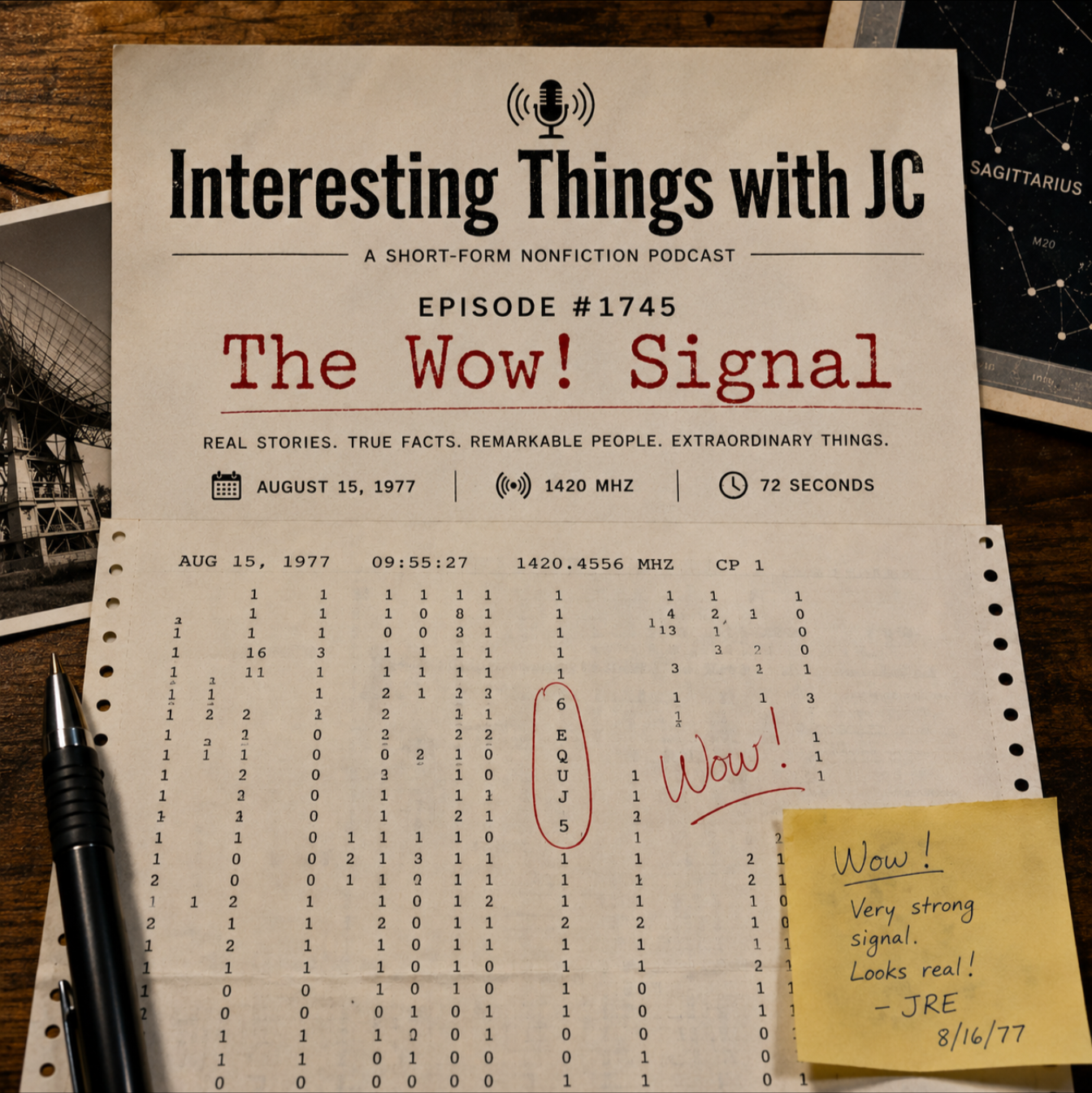
A vintage-style podcast graphic for Interesting Things with JC, Episode #1745, “The Wow! Signal.” A cream-colored episode card rests on a wooden desk alongside photographs of a radio telescope and a Sagittarius star chart. The card highlights August 15, 1977, 1420 MHz, and 72 seconds. Below it is a simulated computer printout with the characters “6EQUJ5” circled in red and “Wow!” handwritten beside them. A pen and yellow handwritten note complete the archival research-desk composition.
Transcript
Interesting Things with JC #1745:
“The Wow! Signal”
On August 15, 1977, the Big Ear radio telescope in Ohio was listening toward Sagittarius when a radio signal crossed one of its beams. It lasted about 72 seconds, rising and falling almost exactly as a fixed point in the sky should as Earth’s rotation carried it through the telescope’s field of view. Then it disappeared.
Big Ear was part of Ohio State University’s search for extraterrestrial intelligence. Unlike a telescope that tracks a target, it stayed fixed while the sky drifted overhead. Its computers recorded the strength of incoming radio energy as characters on continuous paper. A few days later, volunteer astronomer Jerry Ehman sat down with the printout and found the sequence 6EQUJ5. Those six characters were not a message. They recorded the signal’s intensity as it rose, peaked at roughly thirty times the background noise, then faded in a curve that closely matched the telescope’s beam. Ehman circled them in red ink and wrote one word in the margin: “Wow!”
The signal was unusually narrow in frequency and appeared close to 1420 megahertz, near the natural radio emission line of neutral hydrogen. Hydrogen is the most common element in the universe, and that part of the spectrum had long interested SETI researchers because any civilization studying radio astronomy would know it as well. The signal was strong, and its rise and fall fit Big Ear’s observing pattern closely enough to make ordinary nearby interference a poor explanation.
But Big Ear had two receiving beams. A persistent source in the sky should have appeared again when the second beam swept across the same patch of sky a few minutes later. Nothing did. Big Ear returned to the region. Later instruments looked again. The signal was never confirmed a second time.
For decades, proposed explanations ranged from terrestrial interference to comets to an extraterrestrial transmission. None closed the case. More recent work has turned toward a natural origin. Researchers with the Arecibo Wow! project found much weaker narrowband signals near the hydrogen line coming from small clouds of cold neutral hydrogen. They proposed that a rare burst of radiation, perhaps from a magnetar or similar transient source, could briefly stimulate one of those clouds into producing an unusually bright radio emission.
In 2025, the same team reexamined decades of previously unpublished Ohio SETI observations using modern methods, refining the signal’s likely position, frequency, and strength. Their analysis adds support to an astrophysical origin rather than ordinary radio interference, although the exact mechanism remains a hypothesis.
So the original evidence is still almost absurdly small: a few characters on a computer printout, a circle drawn around them, and one word written in the margin.
Jerry Ehman saw a signal that looked enough like a genuine celestial source to deserve attention. One detection could never establish what it was. Nearly fifty years of better instruments and new ideas have narrowed some possibilities without delivering the one thing astronomers needed most in 1977: another signal.
These are interesting things, with JC.
Student Worksheet
Comprehension
The Detection: What instrument detected the Wow! Signal, and when did the detection occur?
Evidence Focus: Identify the telescope and date.
Expected Output: 1 complete sentence.
6EQUJ5: What did the characters 6EQUJ5 represent?
Evidence Focus: Explain what the characters recorded rather than what they might appear to mean.
Expected Output: 1–2 complete sentences.
The 72-Second Pattern: Why was the signal's approximately 72-second rise and fall scientifically significant?
Evidence Focus: Connect the signal pattern to Big Ear's observing beam and Earth's rotation.
Expected Output: 2–3 complete sentences.
1420 MHz: Why was the signal's frequency near 1420 MHz scientifically interesting?
Evidence Focus: Identify the connection to neutral hydrogen.
Expected Output: 2–3 complete sentences.
The Second Beam: What happened when Big Ear's second receiving beam crossed the same region?
Evidence Focus: Identify the missing observation and explain why it mattered.
Expected Output: 2 complete sentences.
Analysis
6. Evidence for a Celestial Source: Identify two observations that support a possible celestial origin and one observation that limits scientists' ability to determine the signal's source.
Required Evidence: Three specific details from the episode.
Required Reasoning: Explain why each detail strengthens or limits the interpretation.
Expected Output: 4–6 complete sentences.
Reproducibility: Why does the failure to detect the signal again matter scientifically?
Required Evidence: Refer to the absence of a confirmed repeat detection.
Required Reasoning: Explain how reproducibility affects confidence in a scientific explanation.
Expected Output: 3–4 complete sentences.
Observation or Hypothesis: Classify each statement as an observation or hypothesis.
The signal was narrowband.
Extraterrestrial technology produced the signal.
The signal appeared near the neutral-hydrogen line.
A transient event stimulated a cloud of neutral hydrogen.
Expected Output: Label all four statements and briefly explain the difference between an observation and a hypothesis.
Competing Explanations: Compare an extraterrestrial-transmission explanation with the proposed natural astrophysical explanation.
Required Evidence: Identify what each explanation proposes.
Required Reasoning: Explain what evidence could strengthen or weaken each explanation.
Expected Output: One evidence-based paragraph of 5–7 sentences.
Reexamining Old Evidence: Why can reanalyzing decades-old scientific observations with modern methods still produce useful information?
Required Evidence: Connect your response to the later reanalysis of Ohio SETI observations.
Required Reasoning: Explain how improved analytical methods can refine earlier measurements or interpretations.
Expected Output: 3–5 complete sentences.
Reflection
Prompt: Should the Wow! Signal be described as evidence of extraterrestrial intelligence, an unexplained astronomical observation, or something else? Defend the description you believe is most scientifically appropriate.
Required Evidence: Use at least two specific details from the episode.
Required Reasoning: Distinguish what scientists observed from what has been proposed to explain it.
Expected Output: One evidence-based paragraph of 4–6 sentences.
Difficulty Scaling
Foundation: Complete Questions 1–7. Use the transcript to locate evidence before writing each response.
Standard: Complete Questions 1–10 and the Reflection. Support analytical responses with specific episode evidence.
Advanced/College: Complete all Standard tasks, then identify the single new observation or measurement that would be most useful for distinguishing between competing explanations.
Advanced/College Output: Add a 4–6 sentence justification explaining why the proposed observation would provide useful evidence.
Student Output Expectations
Comprehension: Answer using complete sentences and accurate episode details.
Analysis: Support conclusions with specific evidence rather than general statements.
Reflection: State a clear position, provide evidence, explain the reasoning, and acknowledge uncertainty where appropriate.
Vocabulary: Accurately use at least three lesson vocabulary terms.
Evidence Standard: Do not treat a possible explanation as an established fact.
Academic Integrity Guidance
Use the Evidence: Base responses on the podcast, transcript, and assigned lesson materials.
Separate Fact from Interpretation: Clearly distinguish direct observations from hypotheses and conclusions.
Acknowledge Uncertainty: If the available evidence does not establish an answer, say so rather than filling the gap with speculation.
Original Reasoning: Explain evidence in your own words and show how you reached your conclusion.
Teacher Guide
Quick Start
Begin with the podcast before providing background information.
Ask students to listen for three categories: what was observed, what was inferred, and what remains unknown.
Move directly from listening into evidence reconstruction and discussion.
Use the worksheet to reinforce the distinction between observation and hypothesis.
Pacing Guide — Audio First
0–5 minutes: Bell ringer and initial prediction.
5–12 minutes: Podcast listening.
12–18 minutes: Reconstruct the key evidence as a class.
18–35 minutes: Student Worksheet.
35–45 minutes: Evidence-based discussion.
45–52 minutes: Assessment and Exit Ticket.
Bell Ringer
Prompt: If a scientific instrument records something extraordinary once but never again, what can scientists responsibly conclude?
Student Output: Write 2–3 complete sentences.
Purpose: Establish the lesson's central tension between an interesting observation and a confirmed explanation.
Audio Guidance
First Listen: Students focus on the overall story rather than attempting to record every detail.
Evidence Focus: Students listen specifically for 72 seconds, 6EQUJ5, 1420 MHz, Big Ear's two receiving beams, and the missing repeat detection.
Listening Goal: Students should be able to identify which details are direct observations and which are interpretations.
Audio Fallback
If Audio Is Unavailable: Read the supplied transcript aloud or have students read it independently.
Maintain the Task: Students still identify observations, interpretations, and unknowns.
Instructional Goal: Preserve the same evidence-analysis sequence even without podcast playback.
Time on Task
Core Lesson: 50–55 minutes.
Condensed Lesson: Approximately 30 minutes.
Extended Lesson: 70–90 minutes with additional analysis or research.
Materials
Episode audio or supplied transcript.
Student Worksheet.
Writing materials or digital document.
Optional three-column evidence organizer.
Optional diagram showing a radio telescope's observing beam.
Vocabulary Preparation
Priority Terms: Radio telescope, narrowband signal, neutral hydrogen, transient, reproducibility.
Before Listening: Briefly introduce terms necessary for understanding the episode.
During Analysis: Require students to use at least three vocabulary terms accurately in written or spoken responses.
Misconceptions
6EQUJ5: It was a representation of measured signal intensity, not a decoded extraterrestrial message.
Unexplained: An unexplained observation is not automatically evidence of extraterrestrial technology.
Natural-Origin Hypothesis: A plausible astrophysical mechanism is not the same as a confirmed explanation.
Single Detection: A one-time observation can have scientific value even when its cause remains unknown.
Repeat Detection: Repetition would strengthen the evidence but should not be described simplistically as automatic “proof.”
Discussion Prompts
Which characteristic of the Wow! Signal provides the strongest reason to consider it scientifically significant?
Which missing piece of evidence creates the greatest uncertainty?
How should scientists communicate a plausible explanation that has not been confirmed?
Can a non-repeating observation still contribute meaningfully to science? Explain.
What new observation would provide the most useful evidence for distinguishing between competing explanations?
Formative Checkpoints
After Listening: Students identify one direct observation and one interpretation.
During Worksheet: Check Question 8 for correct classification of observations and hypotheses.
During Discussion: Listen for students using specific evidence rather than relying on the mystery of the event.
Before Assessment: Ask students to explain why another detection would matter scientifically.
Success Indicator: Students consistently distinguish what was measured from what has been proposed to explain it.
Differentiation
Foundation: Provide a three-column organizer labeled Observation | Interpretation | Unknown.
Standard: Require complete evidence-based responses using specific episode details.
Advanced/College: Require students to determine which follow-up observation would provide the greatest information for distinguishing competing explanations.
Language Support: Allow students to identify evidence in short phrases before converting their ideas into complete analytical sentences.
Assessment Differentiation
Written Option: Complete the standard open-ended assessment.
Structured Option: Use claim-evidence-reasoning prompts to organize responses.
Oral Option: Provide an evidence-based verbal response using the same assessment criteria.
Requirement Across Options: Students must support conclusions with evidence and acknowledge uncertainty.
Time Flexibility
30-Minute Version: Podcast, Worksheet Questions 1–8, one discussion prompt, and Exit Ticket.
50–55-Minute Version: Complete the standard lesson sequence.
70–90-Minute Version: Add source comparison, extended discussion, and a student-designed follow-up observation.
Two-Day Option: Complete podcast and worksheet on Day 1; discussion, extension, and assessment on Day 2.
Substitute Readiness
Step 1: Play the episode or distribute the transcript.
Step 2: Have students complete the listening evidence task.
Step 3: Assign the Student Worksheet.
Step 4: Review responses using the Answer Key.
Step 5: Use one Discussion Prompt for whole-class review.
Step 6: Finish with the Exit Ticket.
Engagement Strategy
Before Listening: Display 6EQUJ5 without explaining what it represents.
Student Prediction: Ask students to record what they think the characters mean.
Reveal: During the episode, students discover that the sequence represents signal intensity rather than a message.
Instructional Purpose: Use the contrast between prediction and evidence to demonstrate why assumptions should be revised when better information becomes available.
Extensions
Observing Strategy: Design a follow-up observation intended to detect a recurrence.
Evidence Test: Identify measurements that could help distinguish natural, terrestrial, and technological explanations.
Archival Analysis: Explain why historical scientific data can become valuable again when analytical methods improve.
Scientific Communication: Write a short public explanation that describes the Wow! Signal accurately without exaggerating what is known.
Cross-Curricular Connections
Physics: Electromagnetic radiation, radio frequencies, signal strength, and hydrogen emission.
Mathematics: Patterns in measured signal intensity and interpretation of quantitative data.
English: Evidence-based argumentation and precise communication of uncertainty.
History of Science: Development of SETI, radio astronomy, and changing observational capabilities.
Technology: Archival data preservation, computational analysis, and improved analytical methods.
SEL
Intellectual Patience: Students practice remaining comfortable with an unresolved question.
Responsible Judgment: Students learn that uncertainty does not require an immediate conclusion.
Adaptability: Students revise interpretations when new evidence changes what can reasonably be claimed.
Respectful Discussion: Students evaluate competing explanations through evidence rather than dismissing opposing interpretations.
Skill Emphasis
Analytical Thinking: Separate observation from interpretation.
Evidence Evaluation: Determine what individual pieces of evidence do and do not establish.
Communication: Explain conclusions accurately and clearly.
Problem Solving: Determine what additional evidence would help resolve uncertainty.
Inquiry: Develop productive follow-up questions.
Reasoning: Connect evidence to conclusions.
Decision Making: Choose conclusions proportional to the available evidence.
Collaboration: Evaluate competing explanations through discussion.
Adaptability: Revise conclusions when new evidence becomes available.
Professional Judgment: Avoid overstating what incomplete evidence establishes.
Answer Key
Question 1: Ohio State University's Big Ear radio telescope detected the signal on August 15, 1977.
Question 2: 6EQUJ5 represented changes in measured radio-signal intensity.
Question 3: The approximately 72-second rise and fall closely matched the expected pattern of a fixed celestial source passing through Big Ear's observing beam.
Question 4: The signal appeared near 1420 MHz, close to the characteristic radio emission frequency of neutral hydrogen.
Question 5: No corresponding signal appeared when the second receiving beam crossed the same region.
Question 6: Supporting evidence can include the beam-shaped intensity pattern and narrow frequency. The lack of recurrence limits identification of the source.
Question 7: A repeat detection could establish recurrence, permit additional measurements, and provide stronger evidence for evaluating possible explanations.
Question 8: Observations: The signal was narrowband; it appeared near the hydrogen line. Hypotheses: Extraterrestrial technology produced it; a transient event stimulated a hydrogen cloud.
Question 9: Strong responses compare what each explanation predicts and identify evidence capable of distinguishing between them.
Question 10: Modern analytical methods can extract improved measurements, patterns, or comparisons from preserved historical observations.
Reflection: Strong responses describe the Wow! Signal as an unexplained observation rather than confirmed extraterrestrial intelligence and support the conclusion with the signal characteristics, single detection, and lack of recurrence.
Quiz
What did the characters 6EQUJ5 represent?
A. Coordinates in Sagittarius
B. Changes in detected signal intensity
C. A decoded extraterrestrial sentence
D. Big Ear's identification numberWhy did the approximately 72-second signal profile attract scientific attention?
A. It matched the expected passage of a fixed source through Big Ear's beam
B. It repeated every 72 seconds
C. It matched a known satellite transmission
D. It contained recognizable mathematical symbolsWhy was the region near 1420 MHz scientifically interesting?
A. It is associated with neutral hydrogen emission
B. It is outside the radio spectrum
C. It can only be produced artificially
D. It cannot travel through interstellar spaceWhat is a major reason the source remains uncertain?
A. The original observation was never recorded
B. Scientists do not know where Big Ear was located
C. The signal has never been confirmed through a repeat detection
D. The signal's intensity was not measuredWhat does the proposed hydrogen-cloud explanation demonstrate about scientific reasoning?
A. New hypotheses can emerge as additional evidence and analytical methods become available
B. The newest hypothesis automatically replaces every previous explanation
C. A plausible mechanism establishes causation
D. Historical observations cannot be scientifically reexamined
Assessment
Open-Ended Questions
Evidence and Uncertainty: Construct an evidence-based explanation of why the Wow! Signal remains scientifically interesting but cannot be confidently identified from the 1977 detection alone.
Required Evidence: Use at least three specific details from the episode.
Required Reasoning: Explain how each detail affects what scientists can reasonably conclude.
Expected Output: One well-developed paragraph of 6–8 sentences.
Evaluating a Hypothesis: Evaluate the proposed natural astrophysical explanation involving neutral hydrogen and a transient source.
Required Evidence: Identify what observations the hypothesis attempts to explain.
Required Reasoning: Explain why the proposed mechanism remains a hypothesis rather than an established conclusion.
Next Step: Identify one additional observation or measurement that could strengthen or weaken the hypothesis.
Expected Output: One well-developed paragraph of 6–8 sentences.
3–2–1 Rubric
3 — Proficient
Presents an accurate and focused claim.
Uses three or more relevant pieces of evidence.
Clearly distinguishes observation, inference, and hypothesis.
Explains how the evidence supports the conclusion.
Acknowledges important limitations or uncertainty.
2 — Developing
Presents a generally accurate claim.
Uses at least two relevant pieces of evidence.
Demonstrates some evidence-based reasoning.
Shows partial understanding of uncertainty or the distinction between observation and hypothesis.
Needs stronger explanation connecting evidence to the conclusion.
1 — Beginning
Presents an unclear, incomplete, or inaccurate claim.
Uses little relevant evidence.
Provides limited reasoning.
Confuses observation with speculation or hypothesis.
Does not adequately address uncertainty.
Exit Ticket
Prompt: Identify the single most important limitation of the Wow! Signal evidence and explain why it matters.
Expected Output: Write 2–3 complete sentences.
Success Check: The response should identify the lack of a confirmed repeat detection and connect that limitation to scientists' inability to confidently determine the signal's source.
Standards Alignment
NGSS — Science & Engineering Practices
SEP 4 — Analyzing and Interpreting Data
Connection: Students analyze the signal’s approximately 72-second intensity pattern, frequency information, and absence of recurrence.
Measurable Student Skill: Distinguish recorded observations from interpretations using at least three accurate examples.
Lesson Evidence: Student Worksheet Questions 6–10.
Justification: Students must analyze observational information before evaluating explanations.
SEP 7 — Engaging in Argument from Evidence
Connection: Students construct and defend a conclusion about what scientists can responsibly infer from the Wow! Signal.
Measurable Student Skill: Produce a conclusion supported by at least three relevant observations while explicitly acknowledging uncertainty.
Lesson Evidence: Reflection Prompt and Assessment Question 1.
Justification: The lesson requires argumentation based on evidence rather than the novelty of a claim.
CCSS Reading
RST.11-12.1 — Cite Specific Textual Evidence to Support Analysis of Science and Technical Texts
Connection: Students identify specific evidence from the transcript when evaluating explanations.
Measurable Student Skill: Support analysis with at least two accurately identified details.
Lesson Evidence: Student Worksheet Questions 6–10 and Assessment Question 1.
Justification: Students must ground conclusions in specific source evidence.
RST.11-12.7 — Integrate and Evaluate Multiple Sources of Information Presented in Diverse Formats and Media
Connection: Students extract information from podcast audio and the accompanying written transcript.
Measurable Student Skill: Synthesize information obtained through listening and reading into a coherent evidence analysis.
Lesson Evidence: Audio-first activity and Student Worksheet.
Justification: The instructional sequence requires students to transfer information between media formats.
CCSS Writing
WHST.11-12.9 — Draw Evidence from Informational Texts to Support Analysis, Reflection, and Research
Connection: Students construct written interpretations grounded in episode evidence.
Measurable Student Skill: Produce an evidence-supported written conclusion that distinguishes fact from hypothesis.
Lesson Evidence: Reflection Prompt and both Assessment questions.
Justification: Written products require evidence rather than unsupported assertion.
CCSS Speaking & Listening
SL.11-12.1 — Initiate and Participate Effectively in Collaborative Discussions
Connection: Students discuss competing interpretations and standards of evidence.
Measurable Student Skill: Present an evidence-supported position and respond constructively to an alternative interpretation.
Lesson Evidence: Teacher Guide Discussion Prompts 1–4.
Justification: Collaborative discussion requires students to articulate and evaluate reasoning.
C3 Framework
D1.5.9-12 — Determine the Kinds of Sources That Will Be Helpful in Answering Compelling and Supporting Questions
Connection: Students determine what additional observations would help resolve uncertainty about the signal.
Measurable Student Skill: Identify a useful follow-up source or measurement and explain its evidentiary value.
Lesson Evidence: Advanced Difficulty Scaling and Assessment Question 2.
Justification: Students determine what evidence is required before a stronger conclusion can be reached.
D3.1.9-12 — Gather Relevant Information from Multiple Sources While Evaluating Origin, Authority, Context, and Corroborative Value
Connection: Students consider how corroboration affects confidence in competing explanations.
Measurable Student Skill: Explain why an independently repeated observation would carry greater evidentiary weight than an isolated detection.
Lesson Evidence: Student Worksheet Question 7 and Discussion Prompt 2.
Justification: Corroboration is central to evaluating the evidentiary strength of the Wow! Signal.
ISTE Standards
ISTE 1.3.b — Knowledge Constructor: Evaluate the Accuracy, Perspective, Credibility, and Relevance of Information, Media, Data, or Other Resources
Connection: Students distinguish measured information from interpretations and speculative explanations.
Measurable Student Skill: Correctly classify evidence and hypotheses and explain the limitations of each.
Lesson Evidence: Student Worksheet Question 8.
Justification: The task directly measures disciplined evaluation of information and claims.
Career Readiness Competencies
Analytical Thinking
Connection: Students organize incomplete evidence and compare competing explanations.
Measurable Student Skill: Identify relevant evidence and determine which conclusions it supports.
Lesson Evidence: Student Worksheet Questions 6–10.
Justification: Analytical judgment with incomplete information is transferable to scientific and professional settings.
Communication
Connection: Students explain conclusions clearly during discussion and written assessment.
Measurable Student Skill: Present a defensible claim supported by specific evidence.
Lesson Evidence: Discussion Prompts, Reflection Prompt, and Assessment.
Justification: Effective professional communication requires explaining both conclusions and the evidence supporting them.
Problem Solving
Connection: Students determine what new evidence would help distinguish between competing explanations.
Measurable Student Skill: Propose a productive next investigative step and explain why it would be useful.
Lesson Evidence: Advanced Difficulty Scaling and Assessment Question 2.
Justification: Students move beyond identifying a problem to proposing an evidence-based method for investigating it.
Adaptability
Connection: Students examine how interpretations can change when archival information is reanalyzed using improved methods.
Measurable Student Skill: Explain when and why a conclusion should be revised in response to additional evidence.
Lesson Evidence: Student Worksheet Question 10.
Justification: Scientific and professional reasoning requires adapting conclusions when better information becomes available.
Professional Judgment
Connection: Students practice withholding certainty when available evidence does not justify a definitive conclusion.
Measurable Student Skill: State a conclusion that accurately reflects both the strength and limitations of the evidence.
Lesson Evidence: Reflection Prompt, Assessment Question 1, and Exit Ticket.
Justification: Responsible judgment requires distinguishing plausible explanations from established findings.
Homeschool / Lifelong Learning Alignment
Independent Learning
Connection: Learners independently identify what is known, unknown, and worth investigating next.
Measurable Student Skill: Formulate one evidence-based follow-up question.
Lesson Evidence: Advanced Difficulty Scaling and Extension activity.
Justification: The lesson supports independent inquiry without requiring continuous instructor direction.
Information Literacy
Connection: Learners distinguish observations, interpretations, hypotheses, and unsupported claims.
Measurable Student Skill: Correctly categorize information by evidentiary status.
Lesson Evidence: Student Worksheet Question 8.
Justification: Evaluating the quality and meaning of information is central to responsible independent learning.
Real-World Application
Connection: Learners apply evidence-evaluation methods to situations involving incomplete information.
Measurable Student Skill: Explain how the same reasoning process could be used outside astronomy.
Lesson Evidence: Reflection Prompt and class discussion.
Justification: The lesson connects scientific reasoning to everyday and professional decision making.
Self-Directed Inquiry
Connection: Learners determine what evidence would be needed to answer an unresolved question more confidently.
Measurable Student Skill: Identify one additional source, observation, or measurement and justify its value.
Lesson Evidence: Assessment Question 2 and Extension activity.
Justification: The activity develops the ability to independently plan the next step in an investigation.
Transferable Life Skills
Connection: Learners practice separating evidence from assumption and communicating uncertainty responsibly.
Measurable Student Skill: Apply the same evidence-analysis process to an unfamiliar claim.
Lesson Evidence: Reflection Prompt and Exit Ticket.
Justification: Critical thinking, judgment, and evidence evaluation transfer across education, work, media, and everyday decisions.
Show Notes
The Wow! Signal gives students a compact case study in how science handles extraordinary but incomplete evidence. Through a mysterious 1977 radio observation, students examine radio astronomy, SETI, neutral hydrogen, signal analysis, reproducibility, competing hypotheses, and the importance of separating observation from interpretation. The lesson matters because the same reasoning applies whenever students encounter an exciting claim supported by limited information: examine the evidence, consider alternatives, communicate uncertainty, and determine what additional evidence would actually help answer the question.
References
Cocconi, G., & Morrison, P. (1959). Searching for interstellar communications. Nature, 184(4690), 844–846. https://doi.org/10.1038/184844a0
Ehman, J. R. (1997). The Big Ear Wow! signal: What we know and don’t know about it after 20 years. Big Ear Radio Observatory / North American AstroPhysical Observatory. https://www.bigear.org/wow20th.htm
Gray, R. H., & Ellingsen, S. (2002). A search for periodic emissions at the Wow locale. The Astrophysical Journal, 578(2), 967–971. https://doi.org/10.1086/342646
Kraus, J. D. (1979). We wait and wonder. Cosmic Search, 1(3). https://www.bigear.org/CSMO/HTML/CS03/cs03p31.htm
Méndez, A., Ortiz Ceballos, K., & Zuluaga, J. I. (2024). Arecibo Wow! I: An astrophysical explanation for the Wow! signal. arXiv. https://arxiv.org/abs/2408.08513
Méndez, A., Ortiz Ceballos, K. N., Zuluaga, J. I., Palencia-Torres, K. D., Smith, A. J., Cardona Rodríguez, A., Socas-Navarro, H., Kipping, D., Hubbard-James, H.-S., Le, M., & Rincón-Torres, A. (2025). Arecibo Wow! II: Revised properties of the Wow! signal from archival Ohio SETI data. arXiv. https://arxiv.org/abs/2508.10657
SETI Institute. (n.d.). The Wow! signal. https://www.seti.org/research/seti-101/the-wow-signal