1744: "The Lemon Juice Heist"
Interesting Things with JC #1744: "The Lemon Juice Heist"
McArthur Wheeler robs Pittsburgh banks with lemon juice on his face because he believes security cameras cannot see him. The cameras see him clearly.
Curriculum - Episode Anchor
Episode Title: The Lemon Juice Heist
Episode Number: 1744
Host: JC
Audience: Grades 9–12, introductory college, homeschool, lifelong learners
Subject Area: Psychology, metacognition, critical thinking, evidence evaluation, scientific reasoning
Lesson Overview
Learning Objectives: By the end of the lesson, students will be able to:
Explain how McArthur Wheeler's mistaken interpretation of evidence contributed to his actions.
Define metacognition and accurately describe the central finding of Kruger and Dunning's 1999 research.
Distinguish between performing a test and designing a test capable of evaluating a claim.
Apply evidence-evaluation strategies to academic, workplace, and everyday decisions.
Essential Question: How can we determine whether evidence actually supports what we believe it supports?
Success Criteria: Students can identify a flawed inference, explain why Wheeler's Polaroid did not establish his claim, accurately interpret the Dunning-Kruger research, and propose a stronger method for testing a claim.
Student Relevance Statement: Students constantly evaluate their own understanding—from deciding whether they are prepared for an exam to judging whether information encountered online is reliable. Knowing how to question one's own conclusions is a practical learning skill.
Real-World Connection: Effective decisions require more than confidence. Science, skilled trades, medicine, technology, business, and everyday problem solving depend on checking assumptions against reliable evidence.
Workforce Reality: Competent professionals seek feedback, verify results, follow established procedures, recognize limits in their knowledge, and revise conclusions when evidence contradicts them.
Key Vocabulary
Metacognition(met-uh-kog-NISH-un) — awareness and evaluation of one's own thinking, knowledge, and performance.
Dunning-Kruger effect(DUN-ing KROO-ger ih-FEKT) — a pattern associated with research showing that poor performers in a domain may substantially overestimate their performance, partly because skills needed to perform well can also be needed to evaluate performance accurately.
Hypothesis(hy-POTH-uh-sis) — a proposed explanation or prediction that can be tested against evidence.
Evidence(EV-ih-dens) — information used to evaluate whether a claim or conclusion is supported.
Inference(IN-fer-ens) — a conclusion reached by reasoning from observations or evidence.
Confirmation bias(kon-fur-MAY-shun BY-us) — a tendency to favor information that appears to support an existing belief while giving insufficient weight to contradictory evidence.
Logical reasoning(LOJ-ih-kul REE-zuh-ning) — using structured relationships between claims and evidence to reach conclusions.
Self-assessment(self uh-SESS-ment) — evaluation of one's own knowledge, skill, or performance.
Calibration(kal-uh-BRAY-shun) — the degree to which confidence or self-assessment corresponds with actual performance.
Narrative Core
Open: On January 6, 1995, McArthur Wheeler and Clifton Earl Johnson robbed two Pittsburgh-area banks without concealing their faces. Wheeler believed lemon juice on his face would prevent security cameras from recording his image.
Info: Lemon juice can function as a form of invisible ink on paper, but Wheeler extended that fact into an unsupported claim about photography. He believed a Polaroid experiment had confirmed his idea.
Details: Surveillance cameras clearly recorded Wheeler. Johnson was arrested on January 12. After Wheeler's surveillance photograph appeared on Pittsburgh Crime Stoppers on April 19, tips led police to arrest Wheeler shortly after midnight on April 20. The case later attracted psychologist David Dunning's attention.
Reflection: Wheeler's failure was not simply that his hypothesis was wrong. He believed he had evidence supporting it and failed to recognize that his test could have produced a misleading result. Kruger and Dunning's later research examined the broader relationship between competence and the ability to assess one's own competence.
Closing: These are interesting things, with JC.
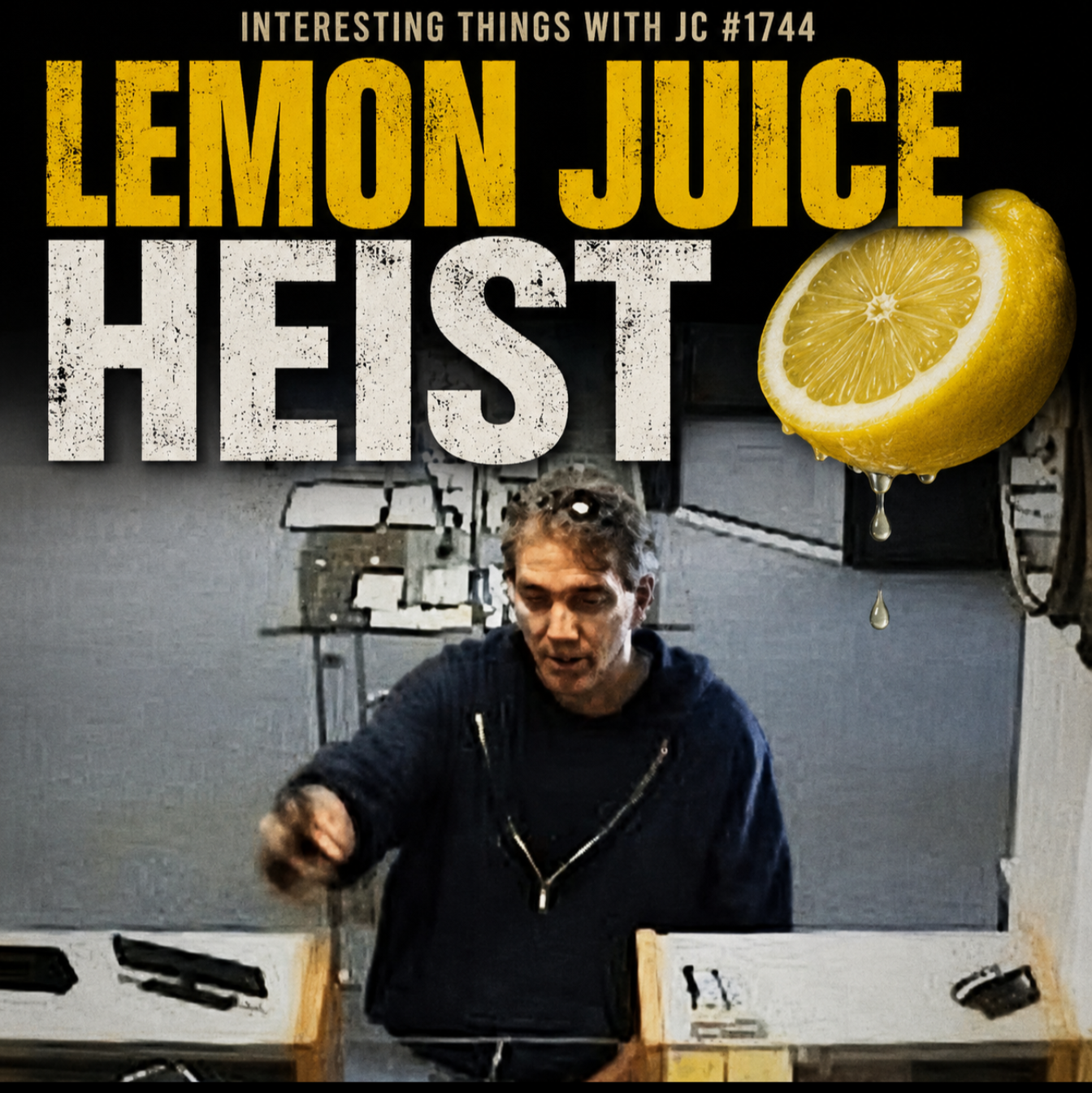
Promotional graphic for Interesting Things with JC #1744: Lemon Juice Heist. Large distressed yellow and white text reading “LEMON JUICE HEIST” appears over a black-and-white bank surveillance image showing a man standing at a teller counter. A large cut lemon with drops of juice appears in the upper-right corner.
Transcript
Interesting Things with JC #1744:
"The Lemon Juice Heist"
On January 6, 1995, two men walked into Pittsburgh-area banks in broad daylight, pointed a semi-automatic handgun, and walked out with cash. They wore no masks. McArthur Wheeler had rubbed lemon juice on his face.
Wheeler and Clifton Earl Johnson believed the juice would make them invisible to security cameras. Lemon juice can be used as invisible ink because it dries clear on paper and reappears when heated, and Wheeler carried that idea one step further. Before the robberies, he covered his face with lemon juice and took a Polaroid of himself. When the photograph developed without a clear image of his face, he accepted it as proof. Detectives later suggested bad film, a camera problem, or Wheeler simply pointing it away from his face.
That afternoon they robbed the Swissvale branch of Mellon Bank of about $5,200 and also hit Fidelity Savings Bank in Brighton Heights. The lemon juice burned Wheeler’s face and eyes, but he still walked into the banks uncovered because he believed the cameras couldn’t see him.
The cameras saw him clearly.
Johnson was arrested within days. Wheeler remained free until April 19, when Pittsburgh Crime Stoppers aired his surveillance photograph on the 11 o’clock news. Tips came in almost immediately, and police arrested him shortly after midnight on April 20.
When detectives showed Wheeler the surveillance photographs, his response was, “But I wore the lemon juice. I wore the lemon juice.”
The story later caught the attention of Cornell psychologist David Dunning. Wheeler had formed a theory, tested it, misread the result, and remained confident enough to act on it. Dunning began wondering whether poor ability could sometimes interfere with a person’s ability to recognize that poor ability in the first place.
With graduate student Justin Kruger, he tested that question. Their 1999 research found that people who performed poorly in areas including humor, grammar, and logical reasoning also tended to substantially overestimate their performance. The pattern became known as the Dunning-Kruger effect.
Squeezing lemons all over your face is not a good idea…it’s pretty dumb.
These are interesting things, with JC.
Student Worksheet
Comprehension Questions:
What did Wheeler believe lemon juice would do when applied to his face?
What experiment did Wheeler perform before the robberies?
What alternative explanations did detectives suggest for the Polaroid result?
What evidence ultimately demonstrated that Wheeler's belief was incorrect?
What did Kruger and Dunning report about low performers in their 1999 research?
Analysis Questions:
Wheeler conducted a test. Explain why conducting a test is not automatically the same as obtaining reliable evidence.
Identify the observation Wheeler treated as confirmation. What additional variables should he have investigated?
Design a safer hypothetical experiment for evaluating a claim about whether a material prevents a camera from recording an ordinary object. Identify the independent variable, comparison condition, expected result, and method for repeating the test.
Explain the difference between confidence in an answer and evidence that the answer is correct.
Why is the ability to evaluate your own knowledge important when learning a new skill?
Reflection Prompt: Describe a non-sensitive situation in which checking your work, seeking feedback, or repeating a test could improve a decision. Explain what evidence would cause you to revise your original conclusion.
Difficulty Scaling:
Foundation: Answer Questions 1–5 using complete sentences.
Standard: Complete Questions 1–10 and the reflection.
Advanced/College: Complete all tasks and evaluate whether the Wheeler story alone constitutes evidence for the Dunning-Kruger effect. Distinguish anecdotal evidence from systematic research.
Student Output: Standard-level students should produce five factual responses, five evidence-based analytical responses, and one 100–150-word reflection.
Academic Integrity Guidance: Use the episode and assigned sources to develop your own reasoning. Clearly distinguish information from the episode from your own inference. Do not present unsupported claims as established findings.
Teacher Guide
Quick Start: Begin with the podcast audio before explaining the psychological concept. Ask students to listen specifically for the difference between what Wheeler believed, what he observed, and what the evidence ultimately demonstrated.
Pacing Guide: 50–60 minutes total.
Podcast/audio and active listening — 5 minutes.
Bell ringer and initial response — 5 minutes.
Vocabulary and concept clarification — 8 minutes.
Worksheet comprehension and analysis — 15 minutes.
Discussion and evidence evaluation — 10 minutes.
Assessment/exit ticket — 7–12 minutes.
Bell Ringer: "Does testing an idea once prove that it is correct? Explain why or why not in two sentences."
Audio Guidance: Do not introduce the Dunning-Kruger effect before playback. Have students record one belief, one test, and one piece of contradictory evidence while listening.
Audio Fallback: If audio is unavailable, read the supplied transcript aloud or have students alternate reading paragraphs. Preserve the audio-first sequence by completing the transcript before direct instruction.
Time on Task: Core lesson requires approximately 50 minutes; advanced analysis can extend the lesson to 70–90 minutes.
Materials:
Episode audio
Transcript
Student worksheet
Writing materials or digital document
Optional board/projector for evidence mapping
Vocabulary Strategy: Introduce hypothesis, evidence, and inference first. Introduce metacognition and the Dunning-Kruger effect after students have analyzed Wheeler's reasoning.
Misconceptions:
The Dunning-Kruger effect does not mean that every inexperienced person believes they are an expert.
Confidence by itself does not establish competence or incompetence.
One unusual criminal case does not scientifically establish a psychological effect.
A test can produce misleading evidence if its design, execution, or interpretation is flawed.
The lesson examines reasoning and evidence; it does not treat Wheeler's behavior as representative of people generally.
Discussion Prompts:
Which failed first in Wheeler's reasoning: his hypothesis, experimental design, interpretation, or verification?
What should a person do when evidence strongly conflicts with an existing belief?
Why might expertise improve someone's ability to recognize errors?
How can feedback improve professional judgment?
Formative Checkpoints:
After audio: Students identify Wheeler's claim and supporting observation.
After vocabulary: Students explain metacognition without using the definition verbatim.
During analysis: Students identify at least two alternative explanations for the Polaroid result.
Before assessment: Students distinguish anecdote from systematic evidence.
Differentiation: Provide a claim-evidence-reasoning organizer for students needing structure. Advanced learners should analyze experimental controls, replication, alternative explanations, and limits on generalization.
Assessment Differentiation: Permit oral responses, structured outlines, or extended written responses when appropriate while maintaining the same evidence and reasoning criteria.
Time Flexibility: For a 30-minute lesson, use audio, Questions 1–7, one discussion prompt, and the exit ticket. For a block period, add the experimental-design task and original-study analysis.
Substitute Readiness: Play/read the episode, assign Questions 1–10, conduct Discussion Prompt 2, administer the quiz, and finish with the exit ticket. No specialized content knowledge is required beyond this guide.
Engagement Strategy: Create three columns labeled Claim, Evidence, and Alternative Explanation. Students classify episode details and defend where each belongs.
Extensions:
Compare self-assessment with actual performance on a low-stakes classroom task.
Develop a checklist for testing claims before acting on them.
Read the abstract of Kruger and Dunning's original study and identify its research question, tasks, and conclusions.
Cross-Curricular Connections: Psychology connects through metacognition; science through experimental design; English through evidence-based argument; mathematics through performance estimates and calibration; career education through verification and professional judgment.
SEL Connection: Emphasize intellectual humility, constructive response to feedback, and the ability to revise an opinion without treating revision as personal failure.
Skill Value Emphasis: Critical thinking, evidence evaluation, communication, problem solving, inquiry, self-monitoring, decision making, and professional responsibility.
Answer Key:
Wheeler believed lemon juice would make his face invisible to security cameras.
He applied lemon juice to his face and took a Polaroid photograph.
Suggested explanations included bad film, a camera problem, or pointing the camera away from his face.
Bank surveillance cameras recorded his face clearly.
Low-performing participants in humor, grammar, and logical-reasoning tasks tended to substantially overestimate their performance.
A test must control relevant variables, produce interpretable evidence, and permit alternative explanations to be evaluated.
Wheeler treated his missing/unclear image as confirmation; students may identify camera aim, film, camera operation, lighting, replication, or comparison images as relevant variables.
Strong responses use an ordinary object rather than a person, compare treated and untreated conditions under identical camera settings, repeat trials, and define in advance what outcome would support or reject the claim.
Confidence is a subjective judgment; correctness depends on performance or evidence.
Accurate self-evaluation helps learners identify gaps, seek appropriate feedback, correct errors, and determine when additional training is necessary.
Quiz
Why did Wheeler apply lemon juice to his face?
A. To alter the lighting around him
B. To make himself invisible to security cameras
C. To remove fingerprints
D. To change his appearance permanentlyWhy did Wheeler believe his Polaroid supported his hypothesis?
A. Police verified the photograph
B. The camera manufacturer confirmed his idea
C. His face did not appear clearly in the resulting photograph
D. He repeated the experiment under controlled conditionsWhich concept most directly describes evaluating one's own thinking or performance?
A. Metacognition
B. Combustion
C. Surveillance
D. PhotochemistryWhat did Kruger and Dunning report in their 1999 research?
A. Everyone consistently underestimated performance
B. Confidence perfectly predicted performance
C. Poor performers tended to substantially overestimate their performance
D. Expertise prevented all errorsWhich response best demonstrates strong evidence evaluation?
A. Accepting the first result that supports a belief
B. Trusting confidence instead of measurement
C. Ignoring contradictory observations
D. Testing alternative explanations and repeating observations
Assessment
Open-Ended Questions:
Explain how Wheeler's Polaroid test illustrates the difference between collecting evidence and interpreting evidence correctly. Use at least three details from the episode.
Explain how metacognition can improve learning or professional decision making. Connect your explanation to the episode and the Kruger-Dunning research.
3–2–1 Rubric:
3 — Proficient: Accurate explanation, specific evidence, clear reasoning, correct use of vocabulary, and a logical connection between evidence and conclusion.
2 — Developing: Generally accurate explanation with some supporting evidence, but reasoning or terminology needs clarification.
1 — Beginning: Limited evidence, significant conceptual misunderstanding, or an unsupported conclusion.
Exit Ticket: In 2–3 sentences, complete: "A good test of an idea must do more than produce the result I expect because…" Include one method for checking whether your interpretation is reliable.
Standards Alignment
NGSS — Science & Engineering Practices
SEP 3 — Planning and Carrying Out Investigations
Connection: Students examine why Wheeler’s Polaroid experiment did not adequately test his claim and redesign it using controls, comparison conditions, and repeated trials.
Measurable Skill: Identify at least three features needed to make an investigation more reliable.
Lesson Evidence: Student Worksheet, Question 8.
Why It Aligns: Students move beyond identifying a faulty conclusion and demonstrate how stronger experimental design can produce more reliable evidence.
SEP 4 — Analyzing and Interpreting Data
Connection: Students distinguish Wheeler’s observation—an unclear Polaroid—from his interpretation that lemon juice caused the result.
Measurable Skill: Generate at least two plausible alternative explanations for the photograph.
Lesson Evidence: Student Worksheet, Questions 6–7; formative checkpoint.
Why It Aligns: Students practice separating what was observed from what can reasonably be concluded from the observation.
SEP 7 — Engaging in Argument from Evidence
Connection: Students evaluate whether the available evidence supports Wheeler’s conclusion.
Measurable Skill: Defend a conclusion with episode evidence while addressing at least one alternative explanation.
Lesson Evidence: Assessment Question 1; classroom discussion.
Why It Aligns: Students construct and defend conclusions based on evidence rather than confidence or assumption.
CCSS — Reading
CCSS.ELA-LITERACY.RI.9-10.1 — Cite Strong and Thorough Textual Evidence
Connection: Students use specific details from the episode transcript to analyze Wheeler’s reasoning.
Measurable Skill: Cite at least three relevant details when constructing an evidence-based explanation.
Lesson Evidence: Assessment Question 1.
Why It Aligns: Students must support analysis with information drawn directly from the source material.
CCSS.ELA-LITERACY.RI.11-12.8 — Delineate and Evaluate Reasoning and Evidence
Connection: Students identify Wheeler’s claim, the evidence he believed supported it, and alternative explanations he failed to consider.
Measurable Skill: Determine whether presented evidence logically supports a stated conclusion.
Lesson Evidence: Student Worksheet, Questions 6–9.
Why It Aligns: Students evaluate the strength and limitations of reasoning rather than merely recalling information.
CCSS — Writing
CCSS.ELA-LITERACY.W.9-10.1 — Write Arguments Supported by Valid Reasoning and Relevant Evidence
Connection: Students construct written explanations evaluating Wheeler’s reasoning and evidence.
Measurable Skill: State a defensible claim and support it with relevant evidence and logical reasoning.
Lesson Evidence: Student Worksheet analysis questions; Assessment Question 1.
Why It Aligns: Students develop evidence-based arguments instead of unsupported opinions.
CCSS.ELA-LITERACY.W.11-12.9 — Draw Evidence from Informational Texts
Connection: Students use transcript information and research context to support analysis and reflection.
Measurable Skill: Distinguish source evidence from personal inference and use both appropriately.
Lesson Evidence: Student Worksheet; open-ended assessment.
Why It Aligns: Students integrate information from instructional material into their own analytical writing.
CCSS — Speaking & Listening
CCSS.ELA-LITERACY.SL.9-10.1 — Initiate and Participate Effectively in Collaborative Discussions
Connection: Students discuss competing explanations for Wheeler’s Polaroid result and evaluate one another’s reasoning.
Measurable Skill: Contribute one evidence-supported interpretation and respond constructively to another interpretation.
Lesson Evidence: Teacher Guide discussion prompts and formative checks.
Why It Aligns: Students practice collaborative reasoning, listening, evidence use, and clear communication.
C3 Framework — Inquiry & Evidence
D2.His.10.9-12 — Detect Possible Limitations in Various Kinds of Historical Evidence
Connection: Students distinguish the Wheeler incident as an individual historical case from the systematic research later conducted by Kruger and Dunning.
Measurable Skill: Explain why a single anecdote cannot independently establish a general psychological effect.
Lesson Evidence: Advanced Student Worksheet task.
Why It Aligns: Students evaluate the limitations of individual accounts and recognize the need for broader evidence before generalizing.
ISTE Standards
ISTE 1.3 — Knowledge Constructor
Connection: Students critically evaluate information and distinguish claims, observations, evidence, inference, and alternative explanations.
Measurable Skill: Correctly classify information according to its role in evaluating a claim.
Lesson Evidence: Claim–Evidence–Alternative Explanation activity.
Why It Aligns: Students develop information-literacy habits needed to construct knowledge from evidence rather than assumption.
Career Readiness Competencies
Analytical Thinking
Connection: Examine whether observations actually justify conclusions.
Measurable Skill: Identify unsupported assumptions or weaknesses within a chain of reasoning.
Lesson Evidence: Student Worksheet, Questions 6–9.
Why It Aligns: Professional decisions frequently require separating evidence from interpretation.
Communication
Connection: Explain conclusions and defend them with specific evidence.
Measurable Skill: Present a clear evidence-supported explanation orally or in writing.
Lesson Evidence: Discussion and open-ended assessment.
Why It Aligns: Effective workplace communication requires explaining both conclusions and the evidence supporting them.
Problem Solving
Connection: Students improve a flawed testing procedure rather than simply identifying its weaknesses.
Measurable Skill: Design a test containing a comparison condition, controlled variables, defined outcome, and replication.
Lesson Evidence: Student Worksheet, Question 8.
Why It Aligns: Students convert analysis into a practical solution.
Adaptability
Connection: Students consider how conclusions should change when new evidence contradicts expectations.
Measurable Skill: Identify evidence that would justify revising an initial conclusion.
Lesson Evidence: Reflection prompt and classroom discussion.
Why It Aligns: Adaptability requires responding constructively when evidence shows that an existing approach is incorrect.
Professional Judgment
Connection: Students examine when verification, feedback, or additional expertise is necessary.
Measurable Skill: Propose at least one verification step before acting on uncertain information.
Lesson Evidence: Reflection activity and exit ticket.
Why It Aligns: Responsible professional judgment includes recognizing uncertainty and verifying important conclusions.
Homeschool / Lifelong Learning Alignment
Independent Learning
Connection: Learners monitor their understanding and identify gaps in their own knowledge.
Measurable Skill: Describe at least one strategy for checking personal understanding or performance.
Lesson Evidence: Metacognition objective; Assessment Question 2.
Why It Aligns: Effective independent learners must recognize when additional learning or feedback is needed.
Information Literacy
Connection: Learners distinguish claims, observations, interpretations, and reliable evidence.
Measurable Skill: Correctly classify information according to its function in an argument or investigation.
Lesson Evidence: Student Worksheet and evidence-classification activity.
Why It Aligns: Information literacy requires evaluating how evidence supports—or fails to support—a claim.
Real-World Application
Connection: Learners transfer evidence-checking principles to school, work, consumer decisions, and everyday problem solving.
Measurable Skill: Identify a realistic situation in which verification could improve a decision.
Lesson Evidence: Student Worksheet reflection.
Why It Aligns: Students apply classroom reasoning skills to decisions beyond the lesson.
Self-Directed Inquiry
Connection: Learners develop questions and tests capable of challenging their initial assumptions.
Measurable Skill: Propose additional evidence capable of confirming, rejecting, or modifying an initial conclusion.
Lesson Evidence: Student Worksheet, Questions 7–8.
Why It Aligns: Independent inquiry requires actively seeking information that can challenge as well as support an existing belief.
Transferable Life Skills
Connection: Learners practice verification, intellectual humility, feedback use, reasoning, and responsible decision making.
Measurable Skill: Develop a repeatable strategy for checking a conclusion before acting on it.
Lesson Evidence: Reflection and exit ticket.
Why It Aligns: The reasoning process can transfer directly to academic, workplace, financial, technical, and everyday decisions.
Show Notes
The Lemon Juice Heist uses an unusual 1995 bank-robbery case to introduce metacognition, evidence evaluation, experimental design, and the research associated with the Dunning-Kruger effect. For students, the lasting lesson is not simply that Wheeler's belief was wrong; it is that conducting a test does not guarantee that a result has been interpreted correctly. The episode provides a memorable starting point for examining intellectual humility, verification, feedback, scientific reasoning, and responsible decision making in school, work, and everyday life.
References
Fuoco, M. A. (1995, April 21). Arrest in bank robbery: Suspect’s TV picture spurs tips. Pittsburgh Post-Gazette. https://www.newspapers.com/article/pittsburgh-post-gazette-pittsburgh-post/184702587/
Fuoco, M. A. (1996, March 21). Trial and error: They had larceny in their hearts, but little in their heads. Pittsburgh Post-Gazette. https://skeptics.stackexchange.com/questions/35801/did-a-thief-think-he-could-conceal-his-identity-from-security-cameras-by-putting
Kruger, J., & Dunning, D. (1999). Unskilled and unaware of it: How difficulties in recognizing one's own incompetence lead to inflated self-assessments. Journal of Personality and Social Psychology, 77(6), 1121–1134. https://doi.org/10.1037/0022-3514.77.6.1121
National Library of Medicine. (1999). Unskilled and unaware of it: How difficulties in recognizing one's own incompetence lead to inflated self-assessments. PubMed. https://pubmed.ncbi.nlm.nih.gov/10626367/
American Chemical Society. (2022). ChemMatters teacher's guide: The chemistry of deception.https://www.acs.org/content/dam/acsorg/education/resources/highschool/chemmatters/documents/2022-dec-tg.pdf
Dunning, D. (2014). We are all confident idiots. Pacific Standard. https://psmag.com/social-justice/confident-idiots-92793/
Martin, A. (2025). Man caught robbing banks because he mistakenly believed lemon juice made him invisible on camera. Medium. https://historianandrew.medium.com/man-caught-robbing-banks-because-he-mistakenly-believed-lemon-juice-made-him-invisible-on-camera-3fc02c75356c