Interesting Things with JC #1833: "COINTELPRO"
In 1971, eight citizens burglarized an FBI office in Pennsylvania and exposed secret surveillance and political interference. The stolen files helped uncover COINTELPRO, a federal program that used infiltration, forged letters, and disinformation against American political organizations.
Curriculum - Episode Anchor
Series: Interesting Things with JC
Episode Number: 1833
Episode Title: COINTELPRO
Host: JC
Subject Area: United States History, Civics, Government, Constitutional Law, Media Literacy
Audience: Grades 9–12, introductory college, homeschool, lifelong learners
Episode Duration: Approximately 4 minutes, 33 seconds at 107 words per minute
Historical Period: 1956–1976, with subsequent institutional reforms
Central Question: How did the FBI use covert operations against domestic political organizations, and what did subsequent investigations reveal about constitutional protections and government accountability?
Instructional Position: This lesson examines documented government activities, their stated purposes, their consequences, and the legal principles involved. Students should distinguish lawful intelligence investigations from unconstitutional interference and distinguish established evidence from disputed interpretations.
Lesson Overview
Essential Understanding
COINTELPRO, an abbreviation for Counterintelligence Program, began under FBI Director J. Edgar Hoover in 1956. Its operations eventually targeted organizations across the political spectrum. Federal agents used surveillance, infiltration, forged correspondence, disinformation, and deliberate interference in organizational affairs.
Documents stolen from an FBI office in Media, Pennsylvania, in March 1971 helped expose federal surveillance practices. Subsequent reporting, investigations, and congressional hearings revealed a broader history of domestic intelligence abuses.
Learning Objectives
Students will be able to:
Identify COINTELPRO's origins, objectives, principal targets, and investigative methods.
Explain the significance of the March 8, 1971, FBI office burglary.
Analyze the differences between collecting intelligence, investigating criminal activity, and disrupting lawful political expression.
Examine documented cases involving Martin Luther King Jr., Jean Seberg, and Fred Hampton.
Explain the Church Committee's findings and their relationship to constitutional protections.
Evaluate historical claims using primary documents, congressional reports, and secondary scholarship.
Construct an evidence-based argument about oversight of federal investigative agencies.
Instructional Duration: One 55–65-minute lesson, or two 45-minute lessons with an extended document-analysis activity.
Prerequisite Knowledge: Basic familiarity with the First Amendment, Fourth Amendment, Cold War, civil rights movement, and Vietnam War.
Guiding Questions
What distinguishes lawful surveillance from political interference?
How can government documents establish intent without proving every intended consequence?
Why is independent oversight important when government activities are classified?
What can journalists, courts, and Congress contribute to public accountability?
Key Vocabulary
COINTELPRO: A series of FBI counterintelligence programs beginning in 1956 that included covert efforts to monitor, discredit, and disrupt designated domestic organizations and individuals.
Counterintelligence: Activities intended to identify, prevent, or counter espionage and other intelligence threats. COINTELPRO also included activities directed at domestic political organizations.
Surveillance: Monitoring people, communications, or activities to gather information.
Infiltration: Placing an agent or informant inside an organization to obtain information or influence activities.
Informant: A person who provides information to investigators, sometimes confidentially.
Disinformation: False or misleading information deliberately circulated to deceive or manipulate.
Covert Operation: An activity conducted in a manner intended to conceal the identity or role of those directing it.
First Amendment: The constitutional amendment protecting religion, speech, the press, peaceful assembly, and petitioning the government.
Fourth Amendment: The constitutional amendment protecting against unreasonable searches and seizures.
Primary Source: Evidence originating from the period or participants being studied, including memoranda, letters, photographs, testimony, and official records.
Church Committee: The United States Senate committee established in 1975 to investigate intelligence activities and abuses.
Congressional Oversight: Legislative examination of executive agencies, their conduct, and their compliance with law.
Declassification: The authorized removal of national-security classification from government information.
Constitutional Rights: Legal protections established by the United States Constitution and interpreted through judicial decisions.
Narrative Core
Opening: A Burglary During a Championship Fight
On March 8, 1971, Muhammad Ali and Joe Frazier fought at Madison Square Garden. That same night, members of the Citizens' Commission to Investigate the FBI burglarized an FBI office in Media, Pennsylvania.
The group had eight members. Their objective was to obtain evidence about federal surveillance practices and release it publicly. The stolen documents were subsequently mailed to journalists, including Betty Medsger of The Washington Post.
Historical Context: The Cold War and Domestic Intelligence
The FBI established COINTELPRO in 1956 against the Communist Party USA. Later programs targeted the Socialist Workers Party, Ku Klux Klan, Black nationalist organizations, and New Left organizations.
The government cited national security, political extremism, and the threat of violence as reasons for intelligence activities. However, congressional investigators later documented operations directed at lawful political expression and association.
Methods: From Observation to Interference
COINTELPRO activities included:
Infiltrating organizations through agents and informants.
Forging correspondence attributed to members or rivals.
Spreading false allegations intended to damage reputations.
Encouraging disputes between political organizations.
Attempting to disrupt meetings, leadership, and organizational relationships.
A crucial distinction is that these activities sometimes sought to alter events rather than simply document them.
Documented Cases
Martin Luther King Jr.: The FBI conducted extensive surveillance and intimidation. In 1964, an anonymous letter accompanied by recordings was sent to King. The letter is widely interpreted as an attempt to pressure him toward suicide. The broader FBI campaign against King must not be treated as entirely identical to formally designated COINTELPRO operations.
Jean Seberg: The FBI targeted the actress because of her financial support for the Black Panther Party and arranged for false information concerning her pregnancy to be circulated.
Fred Hampton: FBI informant William O'Neal supplied intelligence about Hampton, including an apartment floor plan. Chicago police killed Hampton and Mark Clark during a December 4, 1969, raid. The FBI's involvement in preparations for that raid became the subject of prolonged litigation.
Government Accountability
Hoover formally discontinued COINTELPRO in April 1971. The Senate's Church Committee, established in 1975, investigated intelligence activities and reported its findings in 1976.
The committee documented surveillance and political interference that infringed constitutional protections. Its investigations helped establish the public record underlying subsequent oversight and investigative reforms.
Historical Significance
The episode demonstrates how contemporaneous government records, journalism, congressional investigations, and later archival research can collectively establish an account of activities originally concealed from the public.
Transcript
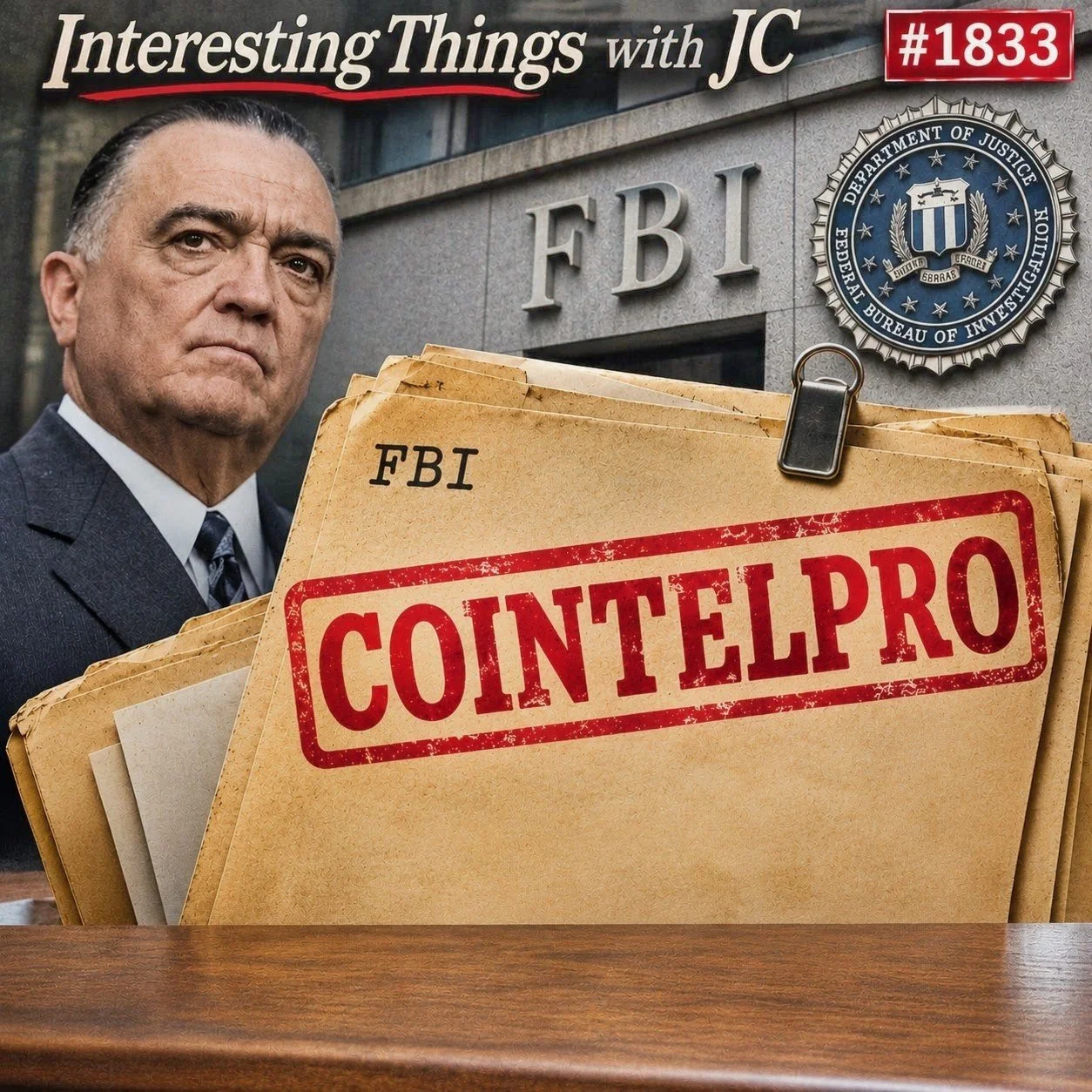
Square podcast cover for Interesting Things with JC, episode #1833, “COINTELPRO.” A portrait representing FBI Director J. Edgar Hoover appears beside an FBI building façade and federal seal. In the foreground, aged manila FBI files display a large red COINTELPRO stamp. The folders rest on a wooden desk, leaving the lower third free of text and visual clutter for captions. Cream lettering identifies the podcast across the top, with the episode number in a red box at upper right.
Interesting Things with JC #1833:
"COINTELPRO"
On March 8, 1971, Muhammad Ali fought Joe Frazier at Madison Square Garden. In Media, Pennsylvania, eight citizens carried out a burglary at a small FBI office, choosing a night when the heavyweight fight would occupy much of the country's attention.
Calling themselves the Citizens' Commission to Investigate the FBI, they took hundreds of files and mailed copies to journalists. Washington Post reporter Betty Medsger published the first account. The burglars were never caught by the FBI.
The documents exposed surveillance and harassment of Americans involved in civil rights and antiwar organizing. They also led reporters and investigators toward a larger secret operation: COINTELPRO, the FBI's Counterintelligence Program.
Director J. Edgar Hoover began the program in 1956, initially against the Communist Party. Separate operations later targeted the Socialist Workers Party, the Ku Klux Klan, Black nationalist organizations, and the New Left. The bureau cited national security and the threat of violence. Yet agents also targeted people engaged in lawful political activity.
They infiltrated organizations, forged correspondence, spread rumors, and encouraged disputes. A Justice Department review later counted more than 2,000 COINTELPRO operations. Agents were not merely observing conflicts. Sometimes they were creating them.
In Los Angeles, an FBI memorandum proposed sending an anonymous letter to the Black Panther Party, pretending to come from the rival US Organization. It would claim that US members planned to ambush Panther leaders in retaliation for an alleged plot against US founder Ron Karenga. The memo explicitly hoped the letter would provoke a vendetta. The surviving document establishes the proposal, not that the threatened violence followed from it.
The bureau's broader campaign against Martin Luther King Junior included wiretapping and an anonymous 1964 letter accompanied by recordings. The letter appeared intended to drive King toward suicide. Not every action against King was formally part of COINTELPRO, but the intimidation is documented.
Actress Jean Seberg was targeted over her financial support for the Black Panther Party. The FBI arranged to circulate a false allegation about her pregnancy.
In Chicago, FBI informant William O'Neal supplied intelligence about Black Panther leader Fred Hampton, including an apartment floor plan. On December 4, 1969, local police raided the apartment, killing Hampton and fellow Panther Mark Clark. The FBI's involvement in preparations for the raid became the subject of prolonged litigation.
Hoover discontinued COINTELPRO in April 1971. Congressional investigations continued. In 1975, the Senate established a committee chaired by Idaho Senator Frank Church. Its investigators examined covert disruption and domestic surveillance across federal intelligence agencies.
The committee's final report appeared in 1976. It found that Americans had been investigated without suspicion of criminal activity and that intelligence agencies had undermined constitutional rights. New investigative guidelines and congressional oversight followed. The FBI now acknowledges that COINTELPRO infringed First Amendment rights.
The files taken from that Pennsylvania office became part of a much larger public record, one that Americans could examine for themselves.
These are interesting things, with JC.
Student Worksheet
Student Instructions: Listen to the episode, review the assigned primary sources, and answer using specific historical evidence. Distinguish documented actions, stated intentions, and demonstrated outcomes.
Comprehension
In what year did COINTELPRO begin, and which organization was its original target?
Why did the Citizens' Commission choose March 8, 1971, for its burglary?
Identify three techniques the FBI used during COINTELPRO operations.
Name three categories of organizations targeted by the program.
Who was Betty Medsger, and what role did she play in bringing FBI documents to public attention?
What was the purpose of the Church Committee, and when did it publish its findings?
Document Analysis
An FBI memorandum proposes sending a forged letter intended to provoke conflict between two organizations. What does this document establish about the FBI's intentions? What additional evidence would establish whether the letter was sent or influenced subsequent events?
Compare surveillance of Martin Luther King Jr. with the documented disinformation operation against Jean Seberg. How were the methods different?
Why should historians distinguish FBI intelligence supplied before Fred Hampton's killing from the actions of the police officers who conducted the raid?
Identify one statement from the Church Committee's findings that supports a conclusion about constitutional rights.
Constitutional Analysis
Which First Amendment protections could be affected by government interference in lawful political organizations?
How does the Fourth Amendment relate to electronic surveillance and government searches?
Can an intelligence investigation serve a legitimate purpose while employing improper methods? Explain with an example.
What are the strengths and limitations of congressional oversight when investigating classified activities?
Reflection
15. Explain how the public historical record might have differed if the stolen FBI documents had never reached journalists.
Primary Source Comparison Activity
Students examine two documents:
A COINTELPRO memorandum describing a proposed disruptive action.
A passage from the Church Committee's 1976 findings.
For each source, identify:
Author or institution
Date
Intended audience
Purpose
Evidence presented
Limitations
Conclusions supported
Difficulty Scaling
Level 1 — Foundational: Answer questions 1–6 and identify two constitutional protections.
Level 2 — Intermediate: Complete questions 1–14 and the document comparison.
Level 3 — Advanced: Complete all questions and evaluate how the Church Committee's findings changed public understanding of domestic intelligence.
Student Output: Written responses, a completed source comparison, and a 150–250-word evidence-based reflection.
Academic Integrity Guidance: Students must distinguish quotations from paraphrases, identify sources, and avoid claiming that a proposed operation necessarily achieved its intended outcome.
Teacher Guide
Quick Start: Play the episode once without interruption. Ask students to identify the historical event that made COINTELPRO publicly visible. Replay relevant passages before beginning document analysis.
Pacing Guide — Audio First
0–5 minutes: Introduce the First Amendment and Fourth Amendment.
5–10 minutes: Play the episode and collect initial observations.
10–18 minutes: Establish the historical timeline from 1956 to 1976.
18–30 minutes: Analyze a COINTELPRO memorandum and its intended effects.
30–42 minutes: Compare the memorandum with Church Committee findings.
42–52 minutes: Discuss legitimate investigative purposes, constitutional limits, and oversight.
52–60 minutes: Complete an evidence-based exit response.
Materials
Episode #1833 audio and transcript.
Student worksheet.
First and Fourth Amendment texts.
Selected COINTELPRO primary documents.
Church Committee report excerpts.
Source-analysis worksheet or notebook.
Internet access or printed source packets.
Teaching Notes
Explain that COINTELPRO was not a single undifferentiated investigation. It encompassed distinct programs and targets.
Distinguish national-security justifications from the legality of particular investigative methods.
Do not characterize every FBI investigation of a political organization as unconstitutional.
Explain that evidence of an operation's proposed objective does not automatically establish its implementation or consequences.
Present the Hampton case carefully, distinguishing FBI intelligence activities, the Chicago police raid, and subsequent litigation.
Discuss the Media burglary as a historically consequential event without suggesting that unlawful entry is an acceptable classroom method of obtaining information.
Avoid treating present-day intelligence agencies as identical to their historical predecessors.
Discussion Prompts
Why might an agency believe disrupting an organization is more effective than monitoring it?
What problems arise when investigators attempt to influence political activity?
Why is documentary evidence important when assessing allegations against government institutions?
How can public disclosure and oversight coexist with legitimate national-security secrecy?
Formative Checkpoints
Students accurately place the program's beginning in 1956.
Students distinguish surveillance from covert disruption.
Students identify at least two affected constitutional protections.
Students differentiate a memorandum's stated intent from an independently established result.
Students explain the Church Committee's role without attributing all later reforms exclusively to that investigation.
Differentiation
Additional Support: Supply a timeline, vocabulary definitions, and short source excerpts.
Advanced Learners: Compare executive-branch investigative guidelines before and after the Church Committee.
English Learners: Preteach constitutional vocabulary and provide sentence frames for evidence-based claims.
Auditory Learners: Replay short transcript segments and allow oral responses.
Visual Learners: Use a chronological diagram linking FBI operations, journalism, congressional investigation, and reforms.
Homeschool: Divide the lesson into a listening session and a separate primary-source investigation.
Answer Key
1956; Communist Party USA.
The Ali–Frazier fight was expected to distract public attention.
Examples include infiltration, forged correspondence, rumors, and deliberate organizational interference.
Examples include the Communist Party, Socialist Workers Party, Ku Klux Klan, Black nationalist organizations, and New Left.
A Washington Post journalist who reported on the stolen FBI documents.
To investigate intelligence activities and abuses; major findings appeared in 1976.
The memorandum establishes a proposed strategy and intended effect. Implementation requires additional records or corroborating evidence.
King's case involved surveillance and intimidation; Seberg's included a deliberately false press allegation.
Intelligence gathering, operational planning, and police use of force are distinct actions requiring separate evidence.
Accept supported passages from the Church Committee report concerning surveillance, political interference, or constitutional rights.
Speech, press, peaceful assembly, and association, the last recognized through First Amendment jurisprudence.
It establishes protections against unreasonable searches and seizures; application depends on the investigative technique and relevant law.
Yes. A legitimate investigative objective does not authorize unlawful tactics.
Oversight can uncover misconduct and recommend reforms, but investigators may face secrecy, incomplete records, or limited access.
Answers should recognize the possibility of delayed or reduced public awareness without claiming that no other disclosure could have occurred.
Sensitive Content Guidance: The lesson discusses political harassment, racial conflict, threats of suicide, and fatal police violence. Students need not view graphic materials or read the full threatening letter sent to King.
Quiz
Instructions: Select the best answer unless otherwise indicated.
1. COINTELPRO began in:
A. 1941
B. 1956
C. 1968
D. 1975
2. Which organization was the original COINTELPRO target?
A. Ku Klux Klan
B. Black Panther Party
C. Communist Party USA
D. Students for a Democratic Society
3. The 1971 FBI burglary occurred in:
A. Chicago, Illinois
B. Media, Pennsylvania
C. Washington, D.C.
D. Los Angeles, California
4. Which journalist reported on the stolen documents?
A. Betty Medsger
B. Ida B. Wells
C. Nell Scovell
D. Martha Gellhorn
5. Which activity best illustrates covert disruption?
A. Publishing a court decision
B. Recording a public speech
C. Forging a letter to provoke organizational conflict
D. Issuing a public annual report
6. Which FBI director initiated COINTELPRO?
A. William Webster
B. J. Edgar Hoover
C. Clarence Kelley
D. Louis Freeh
7. Which individual was targeted through a false story about her pregnancy?
A. Rosa Parks
B. Jean Seberg
C. Betty Friedan
D. Coretta Scott King
8. Who chaired the Senate committee investigating intelligence abuses?
A. Frank Church
B. Barry Goldwater
C. Sam Ervin
D. John McClellan
9. Which statement best describes the Church Committee's findings?
A. All domestic intelligence investigations were prohibited.
B. The FBI had never conducted political surveillance.
C. Federal intelligence agencies had engaged in activities that infringed constitutional protections.
D. Congress eliminated the FBI.
10. A memorandum proposing a forged letter establishes:
A. That the letter was certainly delivered
B. That the intended result definitely occurred
C. The agency's documented proposal or intent
D. That every related allegation was proven
Answer Key: 1. B; 2. C; 3. B; 4. A; 5. C; 6. B; 7. B; 8. A; 9. C; 10. C.
Scoring: 10 points total, 1 point per correct response.
Interpretation
9–10: Strong mastery
7–8: Proficient
5–6: Developing
0–4: Review recommended
Assessment
Summative Task: COINTELPRO, Constitutional Rights, and Government Oversight
Assignment: Write a 600–800-word historical analysis responding to the following question:
How did COINTELPRO demonstrate the risks of covert government interference in domestic political activity, and what did the Church Committee reveal about the need for constitutional safeguards?
Required Components
Historical Context: Explain COINTELPRO's 1956 origins and subsequent expansion.
Operational Evidence: Examine at least two documented FBI methods.
Case Study: Analyze one case involving Martin Luther King Jr., Jean Seberg, Fred Hampton, or an FBI operation targeting organizational conflict.
Constitutional Analysis: Identify relevant First Amendment or Fourth Amendment principles.
Institutional Accountability: Explain the role of journalists, congressional investigators, and subsequent reforms.
Source Evaluation: Use at least three credible sources, including two primary sources.
Assessment Rubric — 100 Points
Historical Accuracy — 25 points: Correct chronology, people, organizations, and events.
Evidence and Source Quality — 25 points: Accurate interpretation of documents and appropriate citations.
Constitutional Reasoning — 20 points: Clear explanation of legal principles and government authority.
Analytical Depth — 20 points: Distinguishes intent, action, consequence, and historical interpretation.
Organization and Clarity — 10 points: Coherent argument and precise language.
Performance Levels
90–100: Advanced — Accurate, independently reasoned, well-supported analysis.
80–89: Proficient — Strong understanding with minor evidentiary or analytical gaps.
70–79: Developing — Adequate understanding requiring stronger source interpretation.
Below 70: Additional instruction and revision recommended.
Alternative Assessments
Documentary Timeline: Construct a sourced timeline of 10 significant events between 1956 and 1976, with a 300-word explanation.
Primary Source Portfolio: Annotate three historical documents, identifying authorship, purpose, evidence, and limitations.
Civics Presentation: Deliver a 5-minute presentation comparing investigative authority and constitutional protections.
Homeschool Option: Complete the primary-source portfolio and a 400-word written reflection.
Academic Integrity: Cite all borrowed evidence and quotations. Students may use digital research tools to locate sources but must inspect the cited documents and independently verify factual claims.
Standards Alignment
Alignment Note: The standards below identify relevant competencies and instructional connections. Not every framework supplies a directly applicable COINTELPRO content standard. Where applicable, the lesson aligns through document analysis, evidence evaluation, civic reasoning, and historical argumentation.
NGSS — Science and Engineering Practices
NGSS is not a primary content framework for this history lesson. The following are transferable evidence-analysis practices, not a claim of full NGSS performance-expectation alignment.
SEP 4 — Analyzing and Interpreting Data: Students compare documentary records and distinguish reported observations from inferred outcomes.
SEP 7 — Engaging in Argument from Evidence: Students support historical conclusions with primary-source evidence.
SEP 8 — Obtaining, Evaluating, and Communicating Information: Students assess the reliability and limitations of archival and congressional sources.
CCSS Reading — History/Social Studies, Grades 9–10
CCSS.ELA-LITERACY.RH.9-10.1 — Cite specific textual evidence to support analysis of primary and secondary sources: Students cite FBI memoranda and congressional findings.
CCSS.ELA-LITERACY.RH.9-10.2 — Determine the central ideas or information of a primary or secondary source: Students summarize the purposes and findings of historical documents.
CCSS.ELA-LITERACY.RH.9-10.6 — Compare the point of view of two or more authors for how they treat the same or similar topics: Students compare FBI and congressional perspectives.
CCSS.ELA-LITERACY.RH.9-10.9 — Compare and contrast treatments of the same topic in several primary and secondary sources: Students evaluate how different accounts describe COINTELPRO.
CCSS Reading — History/Social Studies, Grades 11–12
CCSS.ELA-LITERACY.RH.11-12.1 — Cite specific textual evidence to support analysis of primary and secondary sources: Students evaluate evidence and identify uncertainty.
CCSS.ELA-LITERACY.RH.11-12.2 — Determine central ideas or information of a primary or secondary source: Students analyze the Church Committee's conclusions.
CCSS.ELA-LITERACY.RH.11-12.7 — Integrate and evaluate multiple sources of information presented in diverse formats and media: Students combine audio, historical documents, and secondary research.
CCSS.ELA-LITERACY.RH.11-12.9 — Integrate information from diverse sources into a coherent understanding of an idea or event: Students construct an account of COINTELPRO's development and disclosure.
CCSS Writing — History/Social Studies, Science, and Technical Subjects
CCSS.ELA-LITERACY.WHST.9-10.1 — Write arguments focused on discipline-specific content: Students develop a documented argument about oversight and civil liberties.
CCSS.ELA-LITERACY.WHST.9-10.6 — Use technology to produce, publish, and update writing products: Students prepare a properly cited historical analysis.
CCSS.ELA-LITERACY.WHST.11-12.1 — Write arguments focused on discipline-specific content: Students address competing interpretations and evidentiary limitations.
CCSS.ELA-LITERACY.WHST.11-12.7 — Conduct short as well as more sustained research projects: Students investigate selected COINTELPRO operations.
CCSS.ELA-LITERACY.WHST.11-12.9 — Draw evidence from informational texts to support analysis, reflection, and research: Students incorporate archival evidence.
C3 Framework — College, Career, and Civic Life
D1.5.9-12 — Determine the kinds of sources that will be helpful in answering compelling and supporting questions: Students select appropriate archival and congressional sources.
D2.Civ.4.9-12 — Explain how the U.S. Constitution establishes a system of government that has powers, responsibilities, and limits that have changed over time and that are still contested: Students examine investigative authority and constitutional limitations.
D2.Civ.10.9-12 — Analyze the impact and the appropriate roles of personal interests and perspectives on the application of civic virtues, democratic principles, constitutional rights, and human rights: Students evaluate tensions between security claims and political freedoms.
D2.His.4.9-12 — Analyze complex and interacting factors that influenced the perspectives of people during different historical eras: Students examine Cold War and civil rights contexts.
D2.His.9.9-12 — Analyze the relationship between historical sources and the secondary interpretations made from them: Students compare memoranda, reporting, and historical scholarship.
D3.1.9-12 — Gather relevant information from multiple sources representing a wide range of views while using the origin, authority, structure, context, and corroborative value of the sources to guide the selection: Students evaluate evidence from different institutions.
D4.1.9-12 — Construct arguments using precise and knowledgeable claims, with evidence from multiple sources: Students complete the summative assessment.
ISTE Standards for Students
1.3 Knowledge Constructor: Students curate credible historical sources and assess their reliability.
1.4 Innovative Designer: Students may design a documentary timeline or source-analysis portfolio.
1.6 Creative Communicator: Students communicate findings through structured written or multimedia work.
1.7 Global Collaborator: Students may collaboratively evaluate evidence and compare interpretations.
Career and Technical Education — Career Readiness Competencies
Research and Information Management: Locate, organize, and verify records.
Critical Thinking: Separate claims, evidence, assumptions, and conclusions.
Ethical Reasoning: Evaluate responsibilities associated with government authority.
Professional Communication: Prepare a clear, documented analytical report.
Legal and Public Administration Awareness: Examine the relationship between investigative practice, oversight, and law.
ACRL Framework for Information Literacy
Authority Is Constructed and Contextual: Students distinguish institutional authority from the accuracy of individual claims.
Information Creation as a Process: Students trace information from FBI documents to journalism and congressional reports.
Information Has Value: Students examine the civic significance of access to historical records.
Research as Inquiry: Students develop questions that require corroboration.
Scholarship as Conversation: Students compare historical interpretations and new archival findings.
Searching as Strategic Exploration: Students locate original documents and assess their provenance.
Bloom's Revised Taxonomy
Remember: Identify major dates, individuals, and institutions.
Understand: Explain the purposes and methods of COINTELPRO.
Apply: Use constitutional principles to evaluate a historical example.
Analyze: Distinguish operational intent from documented consequences.
Evaluate: Judge the strength of historical evidence and oversight mechanisms.
Create: Produce a sourced historical argument or documentary timeline.
Universal Design for Learning — UDL
Multiple Means of Engagement: Offer choice among historical cases and assessment formats.
Multiple Means of Representation: Provide audio, transcript, accessible primary-source excerpts, and chronological aids.
Multiple Means of Action and Expression: Permit written, oral, or multimedia responses aligned to the same evidence standards.
United Kingdom — Key Stage 3
History — Challenges for Britain, Europe and the wider world, 1901 to the present day: Comparative study of twentieth-century state authority, protest, and civil liberties.
Citizenship — Parliamentary democracy and the operation of government: Compare U.S. congressional oversight with British parliamentary accountability.
English — Critical reading and evaluation: Analyze historical documents and contrasting accounts.
United Kingdom — Key Stage 4
GCSE History — Modern world depth studies: Supplemental study of the United States during the Cold War and civil rights era, where relevant to the selected specification.
GCSE Citizenship — Rights and responsibilities: Compare legal safeguards, state powers, and democratic accountability.
GCSE English Language — Critical evaluation of nonfiction: Analyze purpose, audience, and evidence.
United Kingdom — Key Stage 5
A-Level History — Historical interpretations and source analysis: Evaluate contemporary evidence and subsequent historiography.
A-Level Politics — Democracy, rights, and constitutional arrangements: Examine separation of powers, civil liberties, and legislative scrutiny.
A-Level Law — Public law and legal protections: Compare constitutional rights and government accountability mechanisms.
International Baccalaureate
IB Diploma Programme History — History of the Americas: Investigate the civil rights movement, domestic politics, and Cold War America.
IB Diploma Programme Global Politics — Rights and Justice: Examine government power and individual liberties.
IB Theory of Knowledge — History: Evaluate how secrecy, disclosure, and source selection influence historical knowledge.
IB Extended Essay: Support independent research into a specific documented COINTELPRO operation.
Cambridge International
Cambridge IGCSE History — Twentieth-century international and national history: Supplement studies of Cold War politics and civil rights, subject to the chosen syllabus.
Cambridge International AS & A Level History — Source-based analysis: Evaluate provenance, reliability, and competing interpretations.
Cambridge International Global Perspectives — Research, analysis, and evaluation: Investigate the relationship between public information and institutional accountability.
Introductory College
United States History Since 1877: Cold War domestic politics, civil rights, and state authority.
American Government: Federal investigative agencies, constitutional protections, and legislative oversight.
Media Studies: Investigative journalism, documentary evidence, and public disclosure.
Information Literacy: Source authentication, archival research, and evidentiary limitations.
Legal Studies: Civil liberties, government accountability, and constitutional interpretation.
Show Notes
Interesting Things with JC #1833: "COINTELPRO"
Episode Summary: In March 1971, eight citizens burglarized an FBI office in Media, Pennsylvania, and sent stolen documents to journalists. Their disclosures helped expose federal surveillance practices and contributed to the public investigation of COINTELPRO, a program that used infiltration, forged correspondence, and disinformation against domestic political organizations. This episode examines the program's origins, documented operations, consequences, and the Church Committee's findings.
Key Historical Dates
1956: FBI Director J. Edgar Hoover initiates COINTELPRO against the Communist Party.
1964: The FBI sends an anonymous threatening letter and recordings to Martin Luther King Jr.
December 4, 1969: Fred Hampton and Mark Clark are killed during a Chicago police raid.
March 8, 1971: The Citizens' Commission burglarizes the FBI office in Media, Pennsylvania.
April 1971: Hoover formally discontinues COINTELPRO.
1975: The U.S. Senate establishes the Church Committee.
1976: The committee publishes its principal findings on intelligence activities and abuses.
Featured Historical Figures
J. Edgar Hoover: FBI director who initiated COINTELPRO.
Betty Medsger: Journalist who reported on documents obtained in the Media burglary.
Martin Luther King Jr.: Civil rights leader subjected to FBI surveillance and intimidation.
Jean Seberg: Actress targeted by FBI disinformation.
Fred Hampton: Black Panther leader killed in a Chicago police raid.
William O'Neal: FBI informant who supplied intelligence about Hampton.
Frank Church: U.S. senator who chaired the Senate intelligence investigation.
Key Takeaways
COINTELPRO encompassed separate FBI operations targeting multiple political organizations.
Some operations went beyond information gathering to interfere with lawful political activity.
Primary documents are essential for distinguishing what officials intended, authorized, and actually carried out.
Journalistic reporting and congressional investigation helped expose activities that had been concealed from the public.
The historical record illustrates the importance of constitutional limits and institutional oversight.
Content Advisory: Includes historical discussion of government harassment, threats of suicide, political conflict, and fatal police violence. No graphic imagery or operational instructions are required.
Access: RSS | MP3 | Open Curriculum: https://jimconnors.net
Educational Use: Suitable for secondary education, introductory college, homeschool instruction, and independent study. Adapt document selections to student maturity and course requirements.
References
Primary Sources and Government Records
1. Federal Bureau of Investigation — COINTELPRO Vault. Declassified FBI records concerning domestic counterintelligence programs. Primary source collection.
https://vault.fbi.gov/cointel-pro
2. United States Senate — Church Committee Historical Overview. Official history of the Senate Select Committee to Study Governmental Operations with Respect to Intelligence Activities.
https://www.senate.gov/about/powers-procedures/investigations/church-committee.htm
3. United States Senate — Final Report of the Select Committee to Study Governmental Operations with Respect to Intelligence Activities, 1976. Congressional findings on intelligence activities and domestic abuses. Accessible through the U.S. Government Publishing Office.
https://www.govinfo.gov
4. Federal Bureau of Investigation — FBI History. Official institutional history, including discussion of domestic intelligence activities and their consequences.
https://www.fbi.gov/history
5. National Archives and Records Administration — Research Our Records. Federal archival collections and research guidance relevant to twentieth-century government investigations.
https://www.archives.gov/research
Historical Scholarship and Archival Collections
6. Stanford University — Martin Luther King, Jr. Research and Education Institute. Historical research and documentary material concerning King and the FBI.
https://kinginstitute.stanford.edu
7. University of Pennsylvania — Kislak Center for Special Collections, Rare Books and Manuscripts. Archival resources, including collections associated with journalist Betty Medsger.
https://www.library.upenn.edu/kislak
8. Medsger, Betty. The Burglary: The Discovery of J. Edgar Hoover's Secret FBI. Alfred A. Knopf, 2014. Historical investigation of the Media burglary and its consequences.
Publisher: https://www.penguinrandomhouse.com
9. The Washington Post — Historical Reporting Archive. Newspaper reporting and retrospective coverage of the Media burglary and COINTELPRO.
https://www.washingtonpost.com
Constitutional and Educational Resources
10. National Archives — The Bill of Rights. Official presentation of the first ten amendments to the U.S. Constitution.
https://www.archives.gov/founding-docs/bill-of-rights
11. National Constitution Center — Interactive Constitution. Constitutional text and interpretive resources for First Amendment and Fourth Amendment instruction.
https://constitutioncenter.org/the-constitution
12. National Council for the Social Studies — C3 Framework. College, Career, and Civic Life Framework for Social Studies State Standards.
https://www.socialstudies.org/standards/c3
13. Common Core State Standards Initiative — English Language Arts Standards. Reading and writing standards for literacy in history and social studies.
https://www.thecorestandards.org/ELA-Literacy/
14. Next Generation Science Standards. Science and Engineering Practices, referenced here only for transferable evidence-analysis competencies.
https://www.nextgenscience.org
15. ISTE — Standards for Students. Digital research, knowledge construction, and communication competencies.
https://iste.org/standards/students
16. Association of College and Research Libraries — Framework for Information Literacy for Higher Education. Research and source-evaluation principles.
https://www.ala.org/acrl/standards/ilframework
17. CAST — Universal Design for Learning Guidelines. Accessible instructional design principles.
https://udlguidelines.cast.org
18. UK Department for Education — National Curriculum. Official curriculum resources for England.
https://www.gov.uk/national-curriculum
19. International Baccalaureate — Diploma Programme. Programme information for History, Global Politics, and Theory of Knowledge.
https://www.ibo.org/programmes/diploma-programme/
20. Cambridge International Education — Programmes and Qualifications. Syllabus resources for History and Global Perspectives.
https://www.cambridgeinternational.org/programmes-and-qualifications/
Source Evaluation Note: The FBI Vault and Church Committee materials are the preferred starting points for original evidence. General institutional and publisher URLs above are discovery resources, not direct citations to particular documents. Teachers should identify and inspect the exact document or report passage before assigning a claim-specific primary-source analysis.