Interesting Things with JC #1849: "Andy Taylor – Guitarist of Duran Duran"
Before becoming one of the defining guitarists of the MTV generation, Andy Taylor performed in working men's clubs and entertained servicemen in West Germany. From Duran Duran and the Power Station to collaborations with Robert Palmer and Rod Stewart, we remember the accomplished guitarist, songwriter, producer, husband, father, and grandfather whose musical legacy spans more than 4 decades.
Curriculum - Episode Anchor
Series: Interesting Things with JC™
Episode Title: Andy Taylor – Guitarist of Duran Duran
Episode Number: 1849
Host: JC
Episode Focus: The life, musicianship, professional accomplishments, and enduring cultural legacy of Andy Taylor (1961–2026).
Audience: Grades 9–12, introductory college, homeschool, lifelong learners
Subject Areas: Music history, cultural studies, English language arts, media literacy, performing arts, career and technical education
Estimated Audio Runtime: 4 minutes, 52 seconds
Instructional Duration: 45–60 minutes
Extended Instruction: 90–120 minutes
Instructional Format: Audio first, transcript analysis, guided discussion, historical research, and creative application
Essential Question: How can an individual musician influence popular culture through both publicly recognized performances and contributions behind the scenes?
Access: Free, open educational curriculum
Website: https://www.jimconnors.net
Lesson Overview
Students examine the life and professional career of Andy Taylor, an English guitarist, songwriter, and record producer whose work with Duran Duran, the Power Station, and other recording artists helped shape popular music during the 1980s and subsequent decades.
The lesson explores Taylor's development from a young working musician in northeastern England to an internationally recognized recording artist. Students investigate the relationship between musical training, collaboration, technological innovation, artistic identity, commercial success, and cultural legacy.
Particular attention is given to the distinction between performing, songwriting, and producing music, allowing students to recognize creative contributions that may not receive the same public attention as a featured vocalist or band.
Learning Objectives
Upon completion of this lesson, students will be able to:
Identify significant events in Andy Taylor's life and musical career.
Explain how Duran Duran incorporated elements of rock, funk, disco, and electronic music into its recordings.
Distinguish among the professional responsibilities of a guitarist, songwriter, recording artist, and record producer.
Analyze the influence of MTV and music videos on the international distribution of popular music.
Describe how professional collaboration can extend an artist's influence beyond membership in a single band.
Evaluate primary and secondary sources when researching a musician's biography.
Explain how commercial success, artistic influence, and professional recognition represent different measures of achievement.
Construct an evidence based interpretation of an individual's cultural legacy.
Demonstrate respectful language when discussing an individual's illness, passing, and surviving family.
Cross Curricular Connections
Music: Instrumentation, arrangement, rhythm, genre, performance, and production.
History: British and American popular culture during the late 20th century.
Media Studies: Music television, visual branding, and international audiences.
Economics: Recording contracts, royalties, intellectual property, and commercial distribution.
English Language Arts: Biography, narrative structure, quotation analysis, and research writing.
Technology: Electronic synthesizers, recording studios, audio engineering, and broadcast media.
Career Education: Professional development, collaboration, transferable skills, and creative entrepreneurship.
Prior Knowledge: No formal musical training is required. Familiarity with popular music, recorded performances, and television or digital media is helpful.
Key Vocabulary
Guitarist: A musician who plays the guitar, contributing rhythm, melody, harmony, or instrumental solos.
Songwriter: A person who creates or contributes to the lyrics, melody, harmony, or musical structure of a song.
Record Producer: A professional who oversees and shapes the development of a recorded musical performance.
Arrangement: The organization of musical elements, including instrumentation, rhythm, melody, harmony, and structure.
Rhythm Guitar: Guitar playing that supports a composition through chords, rhythmic patterns, and harmonic accompaniment.
Lead Guitar: Guitar playing that emphasizes melodic phrases, solos, and prominent instrumental passages.
Riff: A recognizable recurring musical phrase, often played on guitar or bass.
Funk: A musical genre characterized by rhythmic emphasis, syncopation, and strong interaction between bass, drums, and other instruments.
Disco: A genre of dance music associated with steady rhythmic patterns, orchestration, bass lines, and electronic instrumentation.
New Wave: A broad musical movement emerging in the late 1970s that incorporated elements of punk, pop, rock, and electronic music.
Synthesizer: An electronic musical instrument that generates and modifies sound through analog or digital processes.
Syncopation: Rhythmic emphasis placed on beats or subdivisions that are not ordinarily accented.
Multitrack Recording: A recording technique that captures separate musical performances on individual tracks for later editing and mixing.
Supergroup: A musical group formed by performers already recognized for their work with other artists or bands.
Session Musician: A musician hired to perform on a recording or live production without necessarily becoming a permanent member of the featured act.
Discography: An organized record of an artist's published musical recordings.
Billboard Hot 100: An American music chart that ranks popular songs using commercial and audience consumption data appropriate to its historical period.
Multiplatinum: A recording certification indicating multiple platinum sales or consumption thresholds, as defined by the certifying organization.
Intellectual Property: Legally protected creations, including musical compositions and sound recordings.
Royalties: Payments associated with the authorized use, distribution, performance, or licensing of intellectual property.
Cultural Legacy: The lasting influence of an individual, group, or creative work on society and subsequent generations.
Primary Source: Original evidence created by a participant, witness, or organization directly associated with an event.
Secondary Source: An account that interprets, analyzes, or summarizes information derived from other sources.
Pronunciation Guide
Tynemouth: TIN-muth
Cullercoats: KUL-er-kohts
Ibiza: ee-BEE-thah
Danse Macabre: dahnss muh-KAHB
Simon Le Bon: SY-mun luh-BON
Narrative Core
Historical Context
Andy Taylor was born on February 16, 1961, in Tynemouth, England, and raised in Cullercoats, a coastal community historically associated with fishing.
His early experiences performing professionally exposed him to different musical styles, audiences, and working conditions. These experiences preceded his recruitment into Duran Duran in 1980.
During the early 1980s, popular music underwent significant changes as electronic instruments became increasingly prominent and music television created new opportunities for international exposure.
Duran Duran developed a musical identity that combined electronic instrumentation with conventional rock instruments, funk influenced rhythms, and carefully produced recordings.
Musical Development and Professional Identity
Taylor's guitar playing contributed to the interaction between electronic and acoustic or amplified instruments within Duran Duran.
Rather than treating guitar and synthesizers as competing technologies, the band incorporated both into its arrangements. Guitar could provide rhythmic accents, distorted textures, melodic passages, and instrumental contrast.
Taylor's musical interests also extended into heavier rock. His participation in the Power Station demonstrated his ability to work outside the musical identity associated with Duran Duran.
Career Chronology
1961: Born in Tynemouth, England.
1970s: Develops his guitar skills and begins performing professionally.
1980: Joins Duran Duran after responding to an advertisement in Melody Maker.
1981: Duran Duran releases its self titled debut album.
1982: The band releases Rio, an internationally successful album.
1983: Duran Duran releases Seven and the Ragged Tiger.
1985: The Power Station releases its debut album; Duran Duran records “A View to a Kill” and performs at Live Aid.
1986: Taylor pursues independent recording projects, including “Take It Easy.”
1987: Releases his solo album Thunder.
1988: Contributes songwriting and production to Rod Stewart's Out of Order.
Early 2000s: Reunites with Duran Duran's classic lineup.
2004: Participates in the release of Astronaut.
2006: Departs Duran Duran again.
2022: Inducted into the Rock and Roll Hall of Fame as a member of Duran Duran.
2023: Releases Man's a Wolf to Man and contributes to Duran Duran's Danse Macabre.
The Power Station and Musical Collaboration
The Power Station brought together Andy Taylor, John Taylor, Robert Palmer, and Tony Thompson. Its membership connected musicians associated with new wave, rock, funk, and disco.
The group's recordings provide an opportunity to examine how musicians carry skills and influences between professional projects.
Students should consider how a musician's established public identity may represent only part of that individual's creative abilities.
Technology and Popular Culture
MTV began broadcasting in the United States on August 1, 1981. Its programming helped establish music videos as an important promotional medium.
Duran Duran became closely associated with this development. Its international success reflected an interaction among musical composition, recorded sound, visual presentation, distribution, and audience reception.
Students can compare the role of music television during the 1980s with contemporary streaming platforms, social media, and digital video distribution.
Recognizing Contributions Beyond Performance
Taylor's independent career illustrates several interconnected occupations within the recording industry:
Performing musicians contribute instrumental or vocal performances.
Songwriters develop musical compositions.
Producers guide the artistic and technical development of recordings.
Collaborators contribute specialized skills to projects associated with other artists.
These roles can overlap, and a single individual may perform several responsibilities on the same recording.
Legacy and Historical Interpretation
An artist's influence cannot be measured exclusively through record sales or chart rankings. Professional recognition, technical ability, creative partnerships, influence on subsequent performers, and the continued circulation of recorded work provide additional evidence.
Taylor's career offers students an opportunity to investigate how artistic contributions survive through recordings, documentation, professional relationships, and cultural memory.
Common Misconceptions
Andy, John, and Roger Taylor were not related.
Duran Duran's use of synthesizers did not eliminate the importance of guitar.
A record producer does not necessarily perform every instrument heard on a recording.
A song's featured performer is not necessarily its sole songwriter.
A successful music video does not independently establish the quality or influence of a musical composition.
Leaving a band does not necessarily end professional collaboration with its members.
Commercial popularity and artistic significance are related but distinct concepts.
Transcript
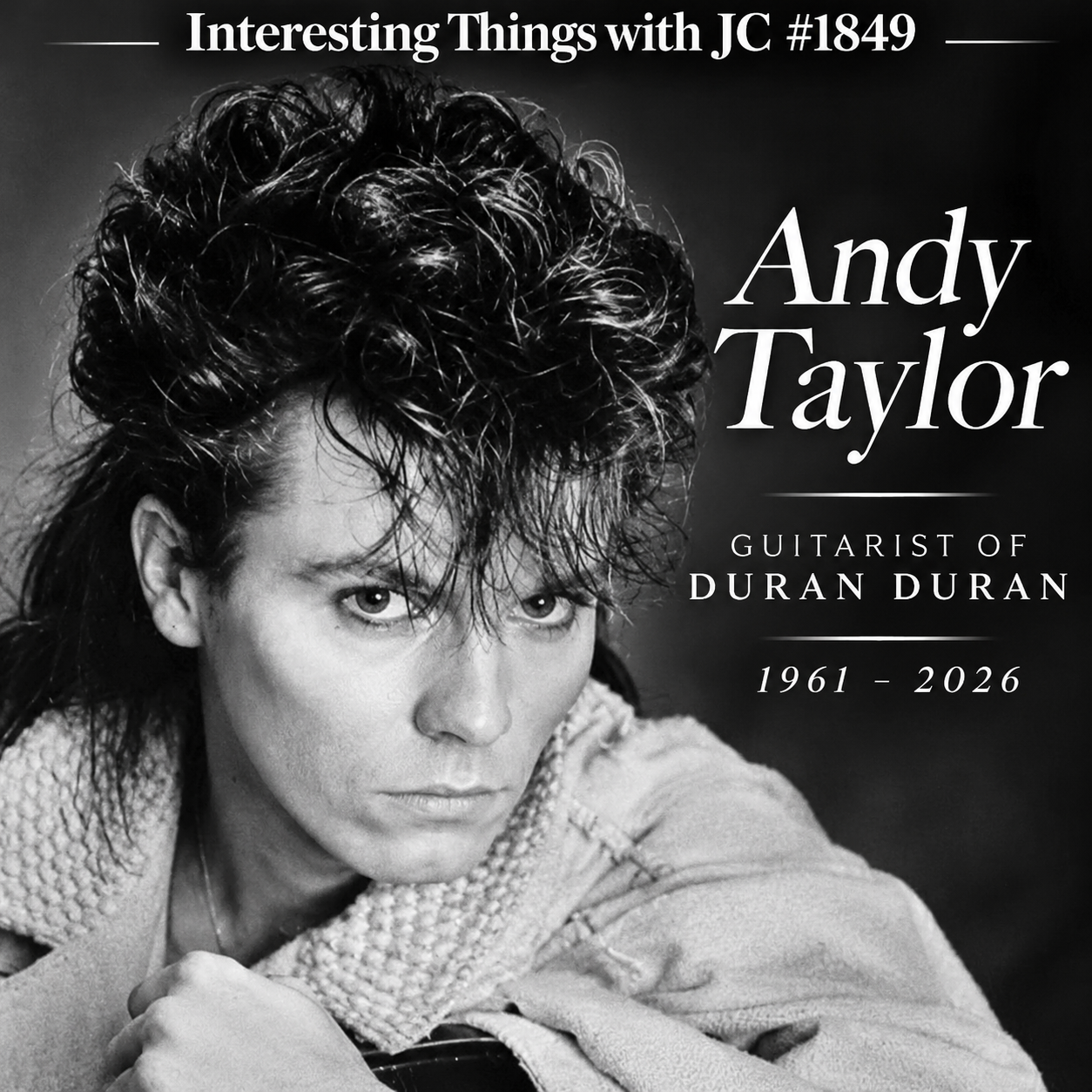
Black and white memorial cover featuring a digitally reconstructed portrait of a young Andy Taylor with dark, tousled hair and a light jacket with a textured collar. White serif lettering against a dark background reads “Interesting Things with JC #1849,” “Andy Taylor,” “Guitarist of Duran Duran,” and “1961–2026.” The composition honors Taylor’s life and musical legacy.
Interesting Things with JC #1849:
"Andy Taylor – Guitarist of Duran Duran"
In 1980, an advertisement appeared in the British music publication Melody Maker. A band in Birmingham was looking for a guitarist. Among the musicians who auditioned was a 19 year old from northeastern England named Andy Taylor. He later joked that of the roughly 40 people who auditioned, he was apparently the only one who knew how to tune his guitar.
Andrew Arthur Taylor was born on February 16, 1961, in Tynemouth (TIN-muth), England. He grew up in Cullercoats (KUL-er-kohts), a coastal village where generations of his family had worked in the fishing industry.
One of his guitar teachers was Dave Black, who played with the Spiders from Mars following their years with David Bowie. Taylor left school early, performing in working men's clubs and eventually entertaining American servicemen stationed in West Germany.
The band that hired him in Birmingham was Duran Duran.
With Simon Le Bon, Nick Rhodes, John Taylor, and Roger Taylor, Andy helped combine the rhythmic qualities of funk and disco with the aggression of rock and the emerging possibilities of electronic synthesizers. Despite sharing a surname, none of the 3 Taylors were related.
He cowrote “Girls on Film,” “Rio,” and “Hungry Like the Wolf.” His guitar work helped define the sound of the MTV generation, although his personal musical tastes leaned toward heavier bands like AC/DC.
In 1985, Andy and John Taylor joined Robert Palmer and Chic drummer Tony Thompson to form the Power Station. Their recordings of “Some Like It Hot” and “Bang a Gong” both reached the American Top 10.
That same year, Duran Duran performed at Live Aid in Philadelphia and became the first artist to take a James Bond theme, “A View to a Kill,” to number 1 on the Billboard Hot 100.
After leaving Duran Duran, Taylor played guitar on Robert Palmer's number 1 hit “Addicted to Love.” His own single, “Take It Easy,” appeared in the 1986 film American Anthem. He collaborated with Sex Pistols guitarist Steve Jones on his solo album Thunder.
He also cowrote and coproduced material for Rod Stewart's multiplatinum album Out of Order, including the hit “Lost in You,” and worked with Belinda Carlisle and Tony Banks of Genesis.
Taylor reunited with Duran Duran in the early 2000s, recording Astronaut in 2004. Even after leaving again in 2006, he continued recording with Simon Le Bon at his home studio in Ibiza (ee-BEE-thah), Spain.
In 2022, prostate cancer prevented him from attending his induction into the Rock and Roll Hall of Fame. He had even purchased a new guitar for the occasion.
He continued recording, contributing to Duran Duran's 2023 album Danse Macabre (dahnss muh-KAHB) and releasing his own album, Man's a Wolf to Man.
Andy Taylor passed away peacefully at home on November 23, 2026, surrounded by his family. He was 65.
His wife, Tracey, remembered a man whose greatest happiness came from being together with their 4 children and grandson.
Reflecting on Andy's guitar playing across Duran Duran's first 3 albums, bassist John Taylor offered perhaps the finest compliment one recording musician could give another:
“Not one bad note.”
For more than 4 decades, Andy Taylor gave millions of people music to remember their own lives by. And through those recordings, generations who never saw him perform will still have the opportunity to hear him play.
These are interesting things, with JC.
Student Worksheet
Student Name: ______________________________
Date: ______________________________
Class: ______________________________
Part A — Listening Comprehension
Listen to the episode and answer the following questions using complete sentences.
Where was Andy Taylor born, and in which coastal community was he raised?
How did Taylor discover the opportunity to audition for Duran Duran?
Identify 2 professional experiences Taylor had before joining Duran Duran.
Name the other 4 members of Duran Duran's classic lineup.
Which musical genres contributed to Duran Duran's distinctive sound?
Who were the 4 members of the Power Station?
What historical achievement did “A View to a Kill” accomplish in 1985?
Identify 2 artists outside Duran Duran with whom Taylor collaborated.
What professional recognition did Taylor receive in 2022?
Identify 2 recording projects Taylor contributed to in 2023.
Part B — Chronological Reasoning
11. Arrange the following events in chronological order:
Release of Astronaut
Formation of the Power Station
Release of Thunder
Andy Taylor joins Duran Duran
Rock and Roll Hall of Fame induction
Release of Rio
Calculate Taylor's age when he joined Duran Duran.
Calculate the approximate number of years between Taylor joining Duran Duran and his Rock and Roll Hall of Fame induction.
Explain how Taylor's professional activities changed between 1980 and 1988.
Part C — Musical Analysis
Listen to teacher selected excerpts from the following recordings using authorized sources:
Duran Duran — “Hungry Like the Wolf” (1982)
The Power Station — “Some Like It Hot” (1985)
Andy Taylor — “Take It Easy” (1986)
Rod Stewart — “Lost in You” (1988)
Describe the guitar sound in 2 of the selected recordings.
Identify differences in the rhythmic character of Duran Duran and the Power Station.
Explain how guitar and electronic instrumentation can coexist within a musical arrangement.
Describe how a musician might adjust their playing when collaborating with artists from different genres.
Explain why listening alone may not establish which musician performed a particular instrumental passage.
Locate an official recording credit and identify the responsibilities assigned to at least 2 contributors.
Part D — Media and Cultural Analysis
Explain how MTV changed the way audiences discovered popular music during the 1980s.
Compare MTV's distribution model with a contemporary music streaming or video platform.
Explain why audiences might recognize a song without knowing the names of its songwriters, producers, or instrumentalists.
Distinguish between commercial success and artistic influence.
Describe one advantage and one limitation of using music charts to evaluate an artist's historical significance.
Part E — Primary Source Investigation
Locate Taylor's 2022 Rock and Roll Hall of Fame letter or an official statement published by Duran Duran.
Identify the author, publication date, intended audience, and publisher.
Explain why the document qualifies as a primary source.
Identify 2 factual details supported by the document.
Explain how the author's personal relationship to the subject might influence the document's tone.
Compare the primary source with an independently published biography or news report. Identify one point of agreement and one difference in emphasis.
Part F — Reflection and Critical Thinking
John Taylor described Andy's playing with the words “Not one bad note.” What does this statement suggest about their professional relationship?
Why might the testimony of a fellow recording musician provide a different perspective from that of a music critic?
How can an artist's work remain culturally relevant after their passing?
What responsibilities should a biographer observe when discussing an individual's illness and family?
Which aspect of Taylor's career best demonstrates the value of professional adaptability? Support your response with 2 examples.
Difficulty Scaling
Level 1 — Foundational: Complete questions 1–14 using the episode and transcript.
Level 2 — Analytical: Complete questions 15–25 using authorized musical recordings and supporting materials.
Level 3 — Advanced: Complete questions 26–35 using independent research and documented evidence.
Student Output: Written responses, a chronological sequence, comparative listening observations, and a short evidence based reflection.
Academic Integrity Guidance: Students must distinguish their own interpretations from documented facts. All quotations, recording credits, and externally researched claims must include attribution. Artificial intelligence generated summaries must not substitute for examination of original sources.
Teacher Guide
Instructional Purpose
This lesson uses the biography of Andy Taylor to introduce students to the collaborative nature of popular music and the relationship between artistic development, technology, commercial distribution, and cultural influence.
Teachers do not need specialized musical training to deliver the lesson. The activities emphasize historical reasoning, attentive listening, source evaluation, and communication.
Quick Start: Play the episode without interruption. Ask students to identify one accomplishment they already recognized and one contribution they had not previously known.
Materials
Episode audio and transcript.
Student worksheet.
Internet access or printed source excerpts.
Authorized recordings or music video excerpts.
Headphones or classroom audio equipment.
Writing materials or digital document software.
Optional musical instruments or digital audio workstation.
Pacing Guide — Audio First
0–5 minutes: Introduce the essential question and activate prior knowledge about popular music.
5–10 minutes: Play the episode.
10–18 minutes: Review vocabulary and complete foundational comprehension questions.
18–28 minutes: Construct a chronological outline of Taylor's career.
28–40 minutes: Conduct comparative listening using selected recordings.
40–50 minutes: Examine primary and secondary sources.
50–60 minutes: Complete a written reflection and formative assessment.
Extended Pacing Guide — 90–120 Minutes
0–15 minutes: Episode listening, vocabulary, and comprehension.
15–35 minutes: Historical research and timeline development.
35–55 minutes: Comparative listening and musical analysis.
55–75 minutes: Investigate recording credits and professional roles.
75–95 minutes: Evaluate primary and secondary sources.
95–120 minutes: Complete and present an evidence based assessment.
Guided Listening Activity
Students compare Duran Duran's “Hungry Like the Wolf” with the Power Station's “Some Like It Hot.”
Ask students to identify differences in instrumentation, rhythm, vocal delivery, guitar prominence, and overall musical texture.
Students without formal music training may describe what they hear using ordinary language. Encourage them to support observations with specific moments in the recordings rather than relying exclusively on subjective preferences.
Suggested Discussion Prompts
How might years of performing for different audiences prepare a musician for international success?
Why might a musician pursue an independent project while already belonging to a successful band?
How did music videos alter the relationship between musicians and audiences?
What happens when electronic and traditional instruments are combined within the same arrangement?
Why are production and songwriting credits important when documenting music history?
How can a respectful biography acknowledge illness without allowing it to overshadow professional accomplishments?
Formative Checkpoints
Students correctly identify the chronological order of major career events.
Students distinguish songwriting from instrumental performance and production.
Students recognize that Duran Duran's 3 members named Taylor were unrelated.
Students identify at least one difference between the musical approaches of Duran Duran and the Power Station.
Students support historical claims with identifiable evidence.
Students demonstrate appropriate distinctions between factual statements and personal interpretations.
Differentiation
Additional Support: Provide a partially completed timeline, vocabulary definitions, and selected transcript excerpts.
Advanced Learners: Assign research into recording personnel, production techniques, copyright ownership, or the historical development of MTV.
English Language Learners: Provide pronunciation guides, visual vocabulary support, and sentence starters.
Students with Hearing Disabilities: Provide transcripts, captioned videos, recording credits, and visual representations of musical structure.
Students with Visual Disabilities: Provide accessible electronic text, descriptive audio materials, and verbal explanations of visual media.
Homeschool Learners: Replace classroom discussion with a guided conversation or independent research journal.
Introductory College Learners: Require comparative source analysis, documented recording credits, and a more substantial historical argument.
Universal Design for Learning
Engagement: Allow students to select a recording, collaborator, or professional role for deeper investigation.
Representation: Present information through audio, text, timelines, musical recordings, and visual materials.
Action and Expression: Permit written essays, recorded presentations, annotated timelines, or accessible multimedia projects.
Social and Emotional Considerations
The episode includes references to prostate cancer, bereavement, and family loss. Teachers should approach these subjects respectfully and avoid requiring students to disclose personal experiences with illness or grief.
Provide alternative reflection questions when appropriate.
Career Exploration
Introduce students to occupations connected with the recording industry:
Performing musician
Songwriter
Record producer
Audio engineer
Music publisher
Recording technician
Artist manager
Music journalist
Broadcast producer
Music archivist
Entertainment attorney
Digital media specialist
Ask students to identify the education, technical abilities, professional experience, and collaborative skills associated with one occupation.
Copyright and Media Use: Use legally authorized recordings and video excerpts. Classroom educational use does not automatically authorize unrestricted copying, redistribution, or public performance.
Quiz
Instructions: Select the best answer for each multiple choice question. Complete the remaining questions using information from the episode.
Part A — Multiple Choice
1. Andy Taylor was born in which country?
A. Scotland
B. England
C. Ireland
D. Wales
2. Taylor discovered Duran Duran's guitarist opening through:
A. A television competition
B. A recording contract
C. An advertisement in Melody Maker
D. A university music program
3. Which combination best describes Duran Duran's musical influences?
A. Classical music and opera exclusively
B. Rock, funk, disco, and electronic music
C. Country and bluegrass exclusively
D. Traditional folk music exclusively
4. Which vocalist participated in the Power Station?
A. David Bowie
B. Rod Stewart
C. Robert Palmer
D. Phil Collins
5. Which drummer was a member of the Power Station?
A. Roger Taylor
B. Tony Thompson
C. Steve Jones
D. Nick Rhodes
6. Which Duran Duran recording became the first James Bond theme to reach number 1 on the Billboard Hot 100?
A. “Rio”
B. “The Reflex”
C. “A View to a Kill”
D. “Girls on Film”
7. Which Rod Stewart album included contributions from Andy Taylor?
A. Out of Order
B. Rio
C. Thunder
D. Astronaut
8. What was the title of Taylor's 1987 solo album?
A. Seven and the Ragged Tiger
B. Thunder
C. Danse Macabre
D. The Power Station
9. Which organization inducted Duran Duran in 2022?
A. British Film Institute
B. Library of Congress
C. Rock and Roll Hall of Fame
D. Recording Industry Association of America
10. Which album did Taylor release in 2023?
A. Man's a Wolf to Man
B. American Anthem
C. Astronaut
D. Out of Order
Part B — True or False
Andy, John, and Roger Taylor were brothers.
MTV contributed to Duran Duran's international exposure.
Andy Taylor worked exclusively as a guitarist throughout his career.
Taylor participated in recording Duran Duran's Astronaut.
A musician's creative influence can extend beyond the recordings released under their own name.
Part C — Short Answer
Explain the difference between a songwriter and a record producer.
Identify one way Taylor demonstrated musical versatility.
Explain why official album credits are valuable historical sources.
Describe one difference between commercial recognition and artistic influence.
Explain how recorded music can preserve an artist's cultural legacy.
Answer Key
Multiple Choice: 1. B; 2. C; 3. B; 4. C; 5. B; 6. C; 7. A; 8. B; 9. C; 10. A.
True or False: 11. False; 12. True; 13. False; 14. True; 15. True.
Short Answer — Suggested Responses
A songwriter creates or contributes to a musical composition. A producer guides the artistic and technical development of its recorded performance.
Taylor performed with Duran Duran, pursued heavier rock through the Power Station, released solo recordings, and collaborated with other artists as a songwriter and producer.
Album credits identify contributors and their professional responsibilities, helping researchers distinguish documented participation from assumptions.
Commercial recognition can be measured through sales, chart positions, or certifications. Artistic influence includes effects on musical styles, techniques, and subsequent performers.
Recordings preserve musical performances and compositions, allowing future audiences to experience and study an artist's work.
Scoring: Questions 1–15 are worth 1 point each. Questions 16–20 are worth 3 points each.
Total Available Points: 30.
Performance Benchmarks
27–30 points: Advanced mastery.
24–26 points: Proficient understanding.
21–23 points: Developing understanding.
18–20 points: Additional reinforcement recommended.
Below 18 points: Guided review recommended.
Assessment
Summative Assessment — The Musician Behind the Music
Students will develop an evidence based biographical analysis examining Andy Taylor's contributions to popular music beyond his membership in Duran Duran.
Central Research Question: How did Andy Taylor's work as a guitarist, songwriter, producer, and collaborator contribute to his lasting cultural influence?
Required Components
A historically accurate introduction.
A chronological account of significant career developments.
Analysis of at least 3 musical recordings or professional projects.
Explanation of Taylor's responsibilities in those projects.
Discussion of the relationship between musical creativity and technological change.
Evaluation of at least one primary source.
A concluding interpretation of Taylor's cultural legacy.
A bibliography containing at least 3 credible sources.
Acceptable Submission Formats
Written research essay of 750–1,000 words.
Recorded documentary or podcast of 5–7 minutes.
Accessible multimedia presentation of 8–12 slides.
Annotated digital exhibition containing at least 6 historical entries.
Assessment Rubric — 100 Points
Historical Accuracy — 25 points: Correct dates, individuals, professional relationships, chronology, and musical credits.
Research and Evidence — 20 points: Credible sources, accurate attribution, and appropriate distinctions between primary and secondary evidence.
Musical and Cultural Analysis — 20 points: Meaningful examination of instrumentation, collaboration, artistic identity, and historical context.
Critical Thinking — 15 points: Well supported interpretations and recognition of different measures of artistic influence.
Organization and Communication — 10 points: Clear structure, effective language, and coherent presentation.
Ethical Representation — 10 points: Respectful treatment of the subject, accurate quotation, responsible discussion of illness, and recognition of creative ownership.
Mastery Levels
90–100: Advanced.
80–89: Proficient.
70–79: Developing.
60–69: Emerging.
Below 60: Additional instruction required.
Performance Based Extension — Recording Credits Investigation
Students select a commercially released recording associated with Andy Taylor and investigate its credited contributors.
Identify the featured recording artist.
Identify the credited songwriter or songwriters.
Identify the producer or producers.
Identify credited instrumentalists when documentation is available.
Explain the differences between composition ownership and sound recording ownership.
Present findings with appropriate source attribution.
Creative Extension — Produce a Musical Arrangement
Using available instruments or digital recording software, students create an original 30–60 second musical passage combining rhythmic accompaniment, a melodic element, and contrasting instrumentation.
Students assign production responsibilities, document creative contributions, and prepare a complete credit list.
No existing copyrighted melody or recording is required.
Advanced Research Extension
Students investigate one of the following topics:
The historical development of MTV and music video distribution.
The influence of funk and disco on British new wave music.
The professional relationship between session musicians and featured artists.
The economics of songwriting royalties and recorded music.
The role of charitable music events such as Live Aid.
The criteria used by institutions to recognize artistic achievement.
The preservation of popular music through archives and recording collections.
Exit Ticket
Identify one Andy Taylor accomplishment you did not know before this lesson.
Explain one difference between a performing musician and a record producer.
Identify one source you would consult to verify a musician's contribution to a recording.
Standards Alignment
The following standards are instructional alignments based on the activities provided. They do not constitute formal endorsement, accreditation, or certification by the issuing organizations.
National Core Arts Standards — Music
MU:Re7.2.H.Ia — Analyze: Students examine how musical elements and context influence responses to music through comparative listening.
MU:Re8.1.H.Ia — Interpret: Students support interpretations of musical works using evidence from recordings and historical context.
MU:Re9.1.H.Ia — Evaluate: Students apply established criteria when evaluating musical performances and artistic contributions.
MU:Cn10.0.H.Ia — Synthesize and Relate: Students connect personal interests, knowledge, and experiences with musical choices and creative development.
MU:Cn11.0.H.Ia — Relate to Context: Students investigate relationships between music, history, technology, culture, and professional collaboration.
Measurable Outcome: Students produce a comparative analysis of at least 2 recordings using specific musical observations and historical evidence.
https://www.nationalartsstandards.org
Common Core State Standards — Reading in History and Social Studies
CCSS.ELA-LITERACY.RH.9-10.1: Cite specific textual evidence to support analysis of primary and secondary sources.
CCSS.ELA-LITERACY.RH.9-10.2: Determine central ideas or information and provide accurate summaries.
CCSS.ELA-LITERACY.RH.9-10.3: Analyze the development of historical events and relationships between events.
CCSS.ELA-LITERACY.RH.9-10.6: Compare authors' perspectives and treatments of historical subjects.
CCSS.ELA-LITERACY.RH.9-10.9: Compare and contrast treatments of the same topic in primary and secondary sources.
CCSS.ELA-LITERACY.RH.11-12.1: Connect specific evidence to an understanding of the source as a whole.
CCSS.ELA-LITERACY.RH.11-12.7: Integrate information from diverse sources and formats.
CCSS.ELA-LITERACY.RH.11-12.9: Integrate information from primary and secondary sources into coherent historical interpretations.
Measurable Outcome: Students compare Taylor's documented career history with an official statement and an independently published secondary source.
https://www.thecorestandards.org/ELA-Literacy/RH/
Common Core State Standards — Writing
CCSS.ELA-LITERACY.WHST.9-10.2: Write informative and explanatory texts using accurate historical information.
CCSS.ELA-LITERACY.WHST.9-10.7: Conduct research projects to answer questions and solve problems.
CCSS.ELA-LITERACY.WHST.9-10.8: Gather relevant information, evaluate source credibility, and avoid plagiarism.
CCSS.ELA-LITERACY.WHST.9-10.9: Draw evidence from informational texts to support analysis and research.
CCSS.ELA-LITERACY.WHST.11-12.1: Develop arguments supported by relevant evidence.
CCSS.ELA-LITERACY.WHST.11-12.8: Evaluate the strengths and limitations of sources while integrating information selectively.
Measurable Outcome: Students complete an organized biographical analysis supported by at least 3 credible sources.
https://www.thecorestandards.org/ELA-Literacy/WHST/
Common Core State Standards — Speaking and Listening
CCSS.ELA-LITERACY.SL.9-10.1: Participate effectively in collaborative discussions.
CCSS.ELA-LITERACY.SL.9-10.2: Integrate information presented through diverse media and formats.
CCSS.ELA-LITERACY.SL.9-10.4: Present information and supporting evidence clearly.
CCSS.ELA-LITERACY.SL.11-12.4: Present findings with a clear perspective, logical organization, and appropriate supporting evidence.
Measurable Outcome: Students communicate findings from their musical and historical investigations through discussion or a structured presentation.
https://www.thecorestandards.org/ELA-Literacy/SL/
C3 Framework — College, Career, and Civic Life
D2.His.1.9-12: Evaluate how historical events and developments were shaped by unique circumstances and broader historical contexts.
D2.His.2.9-12: Analyze change and continuity across historical periods.
D2.His.4.9-12: Analyze complex relationships among historical perspectives.
D2.His.11.9-12: Critique the usefulness of historical sources for particular historical inquiries.
D3.1.9-12: Gather relevant information from multiple sources while considering their origins and credibility.
D4.2.9-12: Construct explanations using sound reasoning, correct sequence, and relevant evidence.
Measurable Outcome: Students connect Taylor's professional development to changes in the recording industry and popular culture between 1980 and 2023.
https://www.socialstudies.org/standards/c3
ISTE Standards for Students
1.2 — Digital Citizen: Students demonstrate responsible use of copyrighted recordings, images, and information.
1.3 — Knowledge Constructor: Students evaluate digital sources and construct evidence based historical interpretations.
1.6 — Creative Communicator: Students communicate findings through appropriate written, audio, or multimedia formats.
1.7 — Global Collaborator: Students investigate international musical collaboration and participate in cooperative learning activities.
Measurable Outcome: Students create a properly attributed digital research product demonstrating responsible media use.
https://iste.org/standards/students
NGSS — Interdisciplinary Science and Engineering Extensions
The episode is primarily a music history and cultural studies lesson. The following NGSS connections apply only when teachers implement the optional sound and recording technology investigation.
HS-PS4-1: Use mathematical representations to support claims regarding relationships among wave speed, frequency, and wavelength.
HS-PS4-2: Evaluate questions about the advantages of digital transmission and storage of information.
Science and Engineering Practice — Analyzing and Interpreting Data: Compare measured sound frequencies and waveforms.
Crosscutting Concept — Structure and Function: Examine how guitar strings, pickups, amplifiers, and synthesizers produce or modify sound.
Measurable Outcome: Students investigate the relationship between musical pitch and frequency, or compare analog and digital methods of recording sound.
https://www.nextgenscience.org
Career and Technical Education — Arts, Audio/Video Technology, and Communications
Identify professional responsibilities within music production and distribution.
Demonstrate appropriate communication and collaboration during creative projects.
Apply ethical practices involving copyright, attribution, and intellectual property.
Investigate career pathways in audio engineering, broadcasting, music publishing, and entertainment production.
Demonstrate technical and creative problem solving through an original recording project.
Measurable Outcome: Students develop a career profile or complete a collaborative recording activity with documented professional responsibilities.
ACRL Framework for Information Literacy for Higher Education
Authority Is Constructed and Contextual: Evaluate the authority of musicians, record labels, journalists, and historical institutions.
Information Creation as a Process: Examine how recordings, biographies, interviews, and official statements are produced.
Information Has Value: Investigate intellectual property, attribution, and ownership.
Research as Inquiry: Develop research questions about musical collaboration and artistic legacy.
Searching as Strategic Exploration: Locate and compare relevant archival materials, recording credits, and institutional sources.
Scholarship as Conversation: Recognize that historical interpretations develop through multiple perspectives and sources.
Measurable Outcome: Students explain why different sources may provide different accounts of the same artist while maintaining distinctions between evidence and interpretation.
https://www.ala.org/acrl/standards/ilframework
England — Key Stage 3 Music
Listen with increasing discrimination to a wide range of musical traditions.
Develop understanding of musical structures, styles, genres, and historical contexts.
Identify relationships among musical elements, instruments, and technologies.
Evaluate the work of musicians and composers.
England — Key Stage 4 and Key Stage 5 Adaptation
Analyze musical characteristics and stylistic conventions.
Investigate the social, cultural, and historical contexts of musical works.
Evaluate musical performance, composition, and production.
Develop independent research and critical listening skills.
Measurable Outcome: Students produce comparative listening notes and a historically contextualized evaluation of Taylor's musical contributions.
https://www.gov.uk/government/publications/national-curriculum-in-england-music-programmes-of-study
International Baccalaureate — Middle Years Programme and Diploma Programme
MYP Arts: Investigate artistic practices, develop creative understanding, and evaluate artistic work.
MYP Individuals and Societies: Examine historical context, cultural relationships, and evidence.
DP Music: Explore music in context and investigate relationships among musical practices, cultures, and creative processes.
Approaches to Learning: Develop research, communication, critical thinking, collaboration, and reflection.
Measurable Outcome: Students connect musical works with cultural and historical contexts through documented investigation and reflective analysis.
Cambridge International — Music
Cambridge IGCSE Music (0410): Develop listening skills and understanding of musical styles, instruments, and historical contexts.
Cambridge International AS & A Level Music (9483): Develop critical listening, contextual understanding, independent investigation, and analytical communication.
Measurable Outcome: Students compare recordings, identify musical characteristics, and support interpretations with contextual research.
https://www.cambridgeinternational.org
Bloom's Revised Taxonomy
Remember: Recall musicians, recordings, dates, and significant career events.
Understand: Explain the relationship between musical genres and professional responsibilities.
Apply: Use vocabulary to describe selected recordings.
Analyze: Compare instrumentation, production approaches, and historical sources.
Evaluate: Assess evidence concerning artistic influence and professional legacy.
Create: Produce an original arrangement, documentary, research essay, or digital exhibition.
CAST Universal Design for Learning Guidelines 3.0
Design multiple means of engagement through student choice and culturally relevant musical examples.
Design multiple means of representation through audio, text, accessible media, and historical documentation.
Design multiple means of action and expression through flexible assessment formats.
Measurable Outcome: Students demonstrate equivalent learning objectives through accessible instructional and assessment pathways.
https://udlguidelines.cast.org
Show Notes
Episode: Interesting Things with JC #1849: "Andy Taylor – Guitarist of Duran Duran"
Before becoming one of the defining guitarists of the MTV generation, Andy Taylor performed in working men's clubs and entertained servicemen in West Germany. From Duran Duran and the Power Station to collaborations with Robert Palmer and Rod Stewart, we remember the accomplished guitarist, songwriter, producer, husband, father, and grandfather whose musical legacy spans more than 4 decades.
Featured Individuals
Andy Taylor
Simon Le Bon
John Taylor
Roger Taylor
Nick Rhodes
Dave Black
Robert Palmer
Tony Thompson
Rod Stewart
Steve Jones
Belinda Carlisle
Tony Banks
Selected Discography and Listening Resources
Duran Duran — Duran Duran, 1981.
Rio — Duran Duran, 1982.
Seven and the Ragged Tiger — Duran Duran, 1983.
The Power Station — The Power Station, 1985.
“A View to a Kill” — Duran Duran, 1985.
“Take It Easy” — Andy Taylor, 1986.
Thunder — Andy Taylor, 1987.
Out of Order — Rod Stewart, 1988.
Astronaut — Duran Duran, 2004.
Man's a Wolf to Man — Andy Taylor, 2023.
Danse Macabre — Duran Duran, 2023.
Additional Reading
Wild Boy: My Life in Duran Duran — Andy Taylor, 2008. Taylor's autobiography provides a firsthand account of his early life, musical development, professional relationships, and experiences within the recording industry. Students should recognize the distinction between autobiographical recollection and independently corroborated historical evidence.
Accessible Cover Art Description
Square black and white memorial cover featuring an AI reconstructed portrait of Andy Taylor inspired by a vintage photograph. He has dark, voluminous hair and wears a light colored jacket with a textured collar. White lettering across the top reads “Interesting Things with JC #1849.” Text on the right reads “Andy Taylor,” “Guitarist of Duran Duran,” and “1961–2026.” The monochrome composition and restrained typography establish a respectful commemorative tone.
Content Advisory: References to cancer, passing, and bereavement.
Educational Keywords: Andy Taylor biography, Duran Duran history, 1980s popular music, British new wave, rock guitar, funk music, MTV history, music production, songwriting, recording credits, artistic collaboration, cultural legacy, media literacy, music education, creative careers.
Hashtags: #AndyTaylor #DuranDuran #MusicHistory #MusicEducation #RockAndRoll #MediaLiteracy #OpenCurriculum #InterestingThingsWithJC
Episode Access
RSS | MP3 | Open Curriculum: https://www.jimconnors.net
YouTube: https://www.youtube.com/@interestingthingswithjc
References
Primary Sources and Official Institutional Resources
Duran Duran — Official Website
Official band history, discography, announcements, member statements, and archival materials. Students should consult the band's official publications when researching Taylor's membership, collaborations, and professional accomplishments.
Rock and Roll Hall of Fame — Duran Duran
Institutional documentation of Duran Duran's 2022 induction, providing historical context and professional recognition.
Live Aid — Official Resources
Historical information concerning the 1985 charitable music event and its cultural significance.
Billboard
Historical chart information for Duran Duran, the Power Station, Robert Palmer, and Rod Stewart. Students should consult individual chart records when establishing peak positions.
Recording Industry Association of America — Gold & Platinum Database
Official American recording certification database. Students can investigate certification levels for selected albums and distinguish certifications from chart positions.
ASCAP — American Society of Composers, Authors and Publishers
Resources concerning musical composition credits, copyright, performance rights, and songwriting royalties.
BMI — Broadcast Music, Inc.
Resources concerning music licensing, songwriting, performance rights, and registered musical compositions.
United States Copyright Office
Authoritative information concerning copyright protection, musical compositions, sound recordings, and intellectual property.
Library of Congress — National Recording Preservation Board
Educational and historical resources concerning the preservation of recorded sound and its cultural significance.
https://www.loc.gov/programs/national-recording-preservation-board/
Secondary Sources and Research Resources
AllMusic
Discographies, artist biographies, album information, and recording personnel credits. Individual credits should be compared with original album documentation where available.
Discogs
A community maintained database of commercially released recordings, physical editions, liner notes, and personnel credits. Useful for identifying recording documentation, but entries should be independently corroborated.
Encyclopaedia Britannica
Background information concerning popular music history, rock, disco, electronic music, and cultural developments.
BBC
British cultural history, music journalism, interviews, and biographical reporting.
Associated Press
Independent reporting and biographical coverage of musicians, cultural events, and entertainment history.
Reuters
Independent international reporting and historical context concerning entertainment and cultural developments.
Source Evaluation Guidance
Students should prioritize original album liner notes, official recording credits, firsthand interviews, autobiographical materials, and institutional records when establishing specific musical contributions.
Chart rankings, certification thresholds, publication dates, and recording personnel should be verified individually rather than inferred from an artist's general association with a project.
Editorial Verification Note: This curriculum preserves the supplied episode transcript. The reference links identify relevant research institutions and resources, but individual obituary statements, quotations, recording credits, and standards codes have not been independently reopened and verified during this curriculum preparation. Those details should receive final verification before formal educational publication. The cover artwork is an AI reconstruction rather than an unaltered archival photograph.
Educational Access: This curriculum is provided for educational use without a subscription or paywall. Third party recordings, photographs, and publications remain subject to their respective copyright and licensing requirements.
Interesting Things with JC™
Independent educational storytelling and open curriculum.
© 2026 Jim Connors LLC. All Rights Reserved.