1573: "Levi Strauss"
Interesting Things with JC #1573: "Levi Strauss" – He never chased gold, he sold survival. A broken seam, a copper rivet, and one brutal workday at a time, Levi got richer than the miners. The real strike wasn’t in the ground.
Curriculum - Episode Anchor
Episode Title: Levi Strauss
Episode Number: 1573
Host: JC
Audience: Grades 9–12, college intro, homeschool, lifelong learners
Subject Area: U.S. History, Economic History, Entrepreneurship, Material Science (textiles), Intellectual Property
Lesson Overview
Learning Objectives
Define how supply businesses profited during the California Gold Rush without mining gold directly.
Explain how rivets and twill weaving improved the durability of work clothing.
Analyze why patents and partnerships (Davis + Strauss) mattered for scaling an invention into a mass-market product.
Compare “resource rush” wealth (mining) versus “infrastructure/supply” wealth (tools, clothing, logistics).
Key Vocabulary
Dry goods (dry goodz) — Retail/wholesale items like fabric, clothing, and notions (not food). Example: Levi entered the dry goods trade in New York before moving west.
Wholesale (hohl-sayl) — Selling goods in large quantities to other businesses. Example: Strauss opened a wholesale supply business serving miners and workers.
Hydraulic mining (hy-draw-lik MY-ning) — Mining method using high-pressure water to wash away hillsides and expose gold-bearing material. Example: The episode describes intense work conditions that damaged clothing.
Rivet (RIV-it) — A metal fastener that strengthens a weak point in material. Example: Jacob Davis used copper rivets to reinforce stress points on work pants.
Patent (PAT-ent) — A legal protection for an invention for a limited time. Example: U.S. Patent No. 139,121 protected the riveted pocket-opening improvement.
Twill (twil) — A fabric weave with diagonal ribs that can increase strength and drape. Example: Denim is a cotton twill associated with durable workwear.
Indigo dye (IN-di-goh dye) — A dye commonly used for blue denim; it tends to color outer fibers more than the core, creating fading patterns. Example: Denim fades with wear as indigo rubs off over time.
Narrative Core
Open – How the story hooks the listener.
He never panned for gold, yet he became wealthier than most who did.
Info – Background or supporting context.
Löb (Loeb) Strauss was born in Bavaria in 1829, immigrated as a young man, and entered the dry goods trade in New York before heading to San Francisco.
The Gold Rush rapidly transformed San Francisco into a booming hub where supply and logistics could be as profitable as mining.
Details – The twist, turning point, or key facts.
Strauss built wealth by supplying miners and laborers, not by mining.
Jacob Davis reinforced pants with copper rivets, then partnered with Strauss to patent the idea in 1873 (Patent No. 139,121).
The Two Horse patch (introduced in 1886) visually promised durability.
Reflection – Broader meaning or emotional resonance.
Big “rush” moments create opportunity for the people who solve practical problems: clothing that lasts, supplies that arrive, systems that scale.
Closing – Always close with: "These are interesting things, with JC."
These are interesting things, with JC.
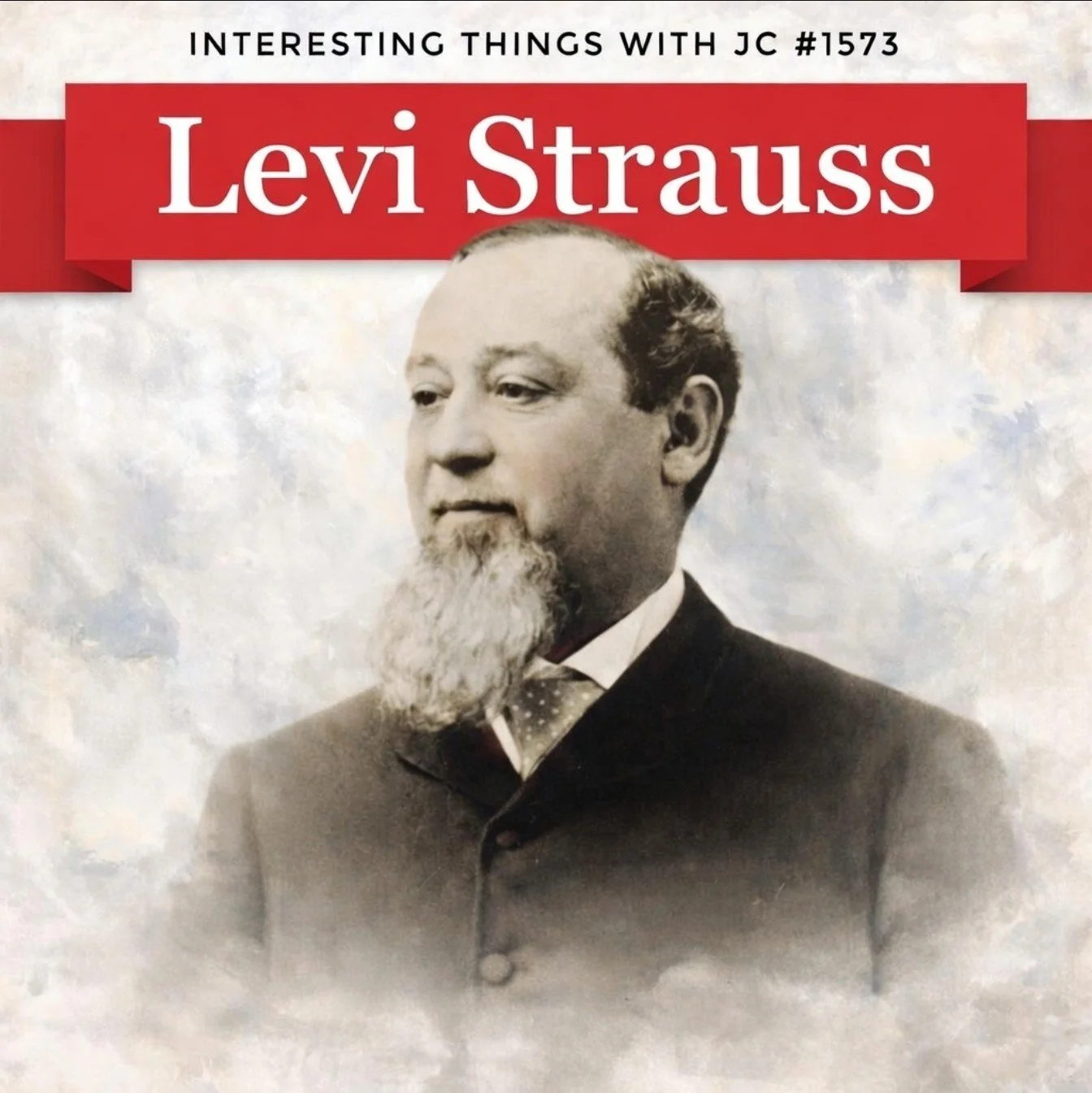
A square episode cover image reads “INTERESTING THINGS WITH JC #1573” above a large red banner titled “Levi Strauss.” Below the banner is a sepia-toned portrait of Levi Strauss wearing a dark suit and tie against a light, cloudy background.
Transcript
Interesting Things with JC #1573: "Levi Strauss"
He never panned for gold.
Yet he became wealthier than most who did.
Loeb Strauss (Loh-eb) was born on February 26, 1829, in Buttenheim (Boot-en-hime), Bavaria (Buh-vair-ee-uh). His family was Jewish. His father, a peddler, died of tuberculosis in 1846. The following year, at age 18, Levi immigrated to the United States with his mother and sisters, joining relatives in New York and entering the dry goods trade.
In 1848, gold was discovered in California. By 1850, San Francisco had grown from roughly 1,000 residents to about 25,000. Large clipper ships more than 100 feet long (30.5 meters) were abandoned in the harbor as crews rushed inland.
In 1853, at 24 years old, Levi Strauss moved to San Francisco and opened a wholesale supply business.
He did not mine for gold. He supplied the miners.
They worked 10 to 12 hours a day. Hydraulic mining blasted hillsides with water pressures exceeding 100 pounds per square inch (690 kilopascals). Clothing failed constantly at stress points.
In 1872, a Latvian-born tailor in Reno named Jacob Davis began reinforcing work pants with copper rivets about half an inch wide (1.27 centimeters). He could not afford the $68 patent filing fee, roughly $1,600 today. He wrote to his fabric supplier, Levi Strauss.
On May 20, 1873, U.S. Patent No. 139,121 was granted for riveted waist overalls made from a tough cotton twill called serge de Nîmes (sairzh duh Neem). The diagonal weave added strength. Indigo dye bonded only to the surface of the cotton fibers, which is why denim fades with wear instead of wearing through.
Those riveted waist overalls evolved into the iconic Levi’s 501® jeans. In 1886, the company introduced the Two Horse leather patch, showing two horses trying to pull a pair of jeans apart, a visual promise of durability.
By the late 19th century, Levi Strauss & Co. was supplying miners, railroad crews, and laborers across the American West.
Levi Strauss died on September 26, 1902, in San Francisco at age 73. His estate was worth nearly $6 million, about $175 million in today’s dollars.
He never mined for gold.
These are interesting things with JC.
Student Worksheet
Short-Answer / Creative Prompts
Describe two ways Levi Strauss made money during the Gold Rush without mining.
Explain why work pants might fail at “stress points.” Name at least two stress points on pants.
In your own words, what problem did Jacob Davis solve with copper rivets?
Why might a patent be important when turning an idea into a product sold across a region?
Create a 6–8 sentence “mini-story” about a modern-day equivalent of Levi Strauss (someone who profits by supplying a boom).
Teacher Guide
Estimated Time
45–60 minutes (single class) or two 45-minute sessions (with extension activities).
Pre-Teaching Vocabulary Strategy
“Concept sort” on the board: Business, Mining, Clothing/Textiles, Law/Patents.
Students place vocabulary terms into categories, then justify one placement aloud.
Anticipated Misconceptions
“Everyone got rich by mining.”
Clarify: Many people profited by providing goods, transportation, food, clothing, banking, and services in boomtown economies.
“Hydraulic mining used small water pressure.”
Clarify: Historical accounts describe very high pressures—often hundreds of psi in some systems—used to move massive amounts of earth, which helps explain intense wear on gear and clothing.
“Denim and ‘serge de Nîmes’ origins are perfectly settled.”
Clarify: Many sources connect “denim” to “de Nîmes,” but textile history can include multiple overlapping threads (France, Italy, India) depending on the scholar/source.
Discussion Prompts
What kinds of people become essential during a “rush” (gold, oil, tech, housing booms)?
Is it more reliable to profit from a boom by selling tools or by chasing the main prize? Why?
How do branding and symbols (like the Two Horse patch) create trust?
Differentiation Strategies: ESL, IEP, gifted
ESL
Provide a bilingual glossary template (word, simple definition, sketch, example sentence).
Sentence frames: “Levi Strauss became successful because ____.”
IEP
Chunk the transcript into 3 sections; after each, students answer one guided question.
Provide a labeled diagram of pants with “stress points” (pockets, seams, crotch seam).
Gifted
Compare patents: Have students read a brief excerpt/diagram from the patent page and explain what is being protected.
Debate: “Branding is as important as engineering.” Use evidence from the Two Horse patch and rivets.
Extension Activities
Primary/Secondary Source Check: Students locate one company history source and one museum/academic source and compare what each emphasizes.
Math Connection: Convert 100 psi to kPa; then discuss why a unit conversion matters in technical reading.
Product Design Challenge: Design a modern “durability test” for workwear and propose where reinforcements should go.
Cross-Curricular Connections
Economics: Supply-and-demand during boom economies; opportunity cost and risk.
Engineering/Materials: Weaves, fasteners, stress points, and wear patterns.
Civics/Law: Why patents exist and what they protect.
Media Literacy: How brand storytelling shapes what people remember about history.
Quiz
Q1. What was Levi Strauss’s main strategy during the Gold Rush era?
A. He mined gold in the Sierra Nevada
B. He supplied miners and workers through a wholesale business
C. He ran the largest shipyard in San Francisco
D. He invented hydraulic mining
Answer: B
Q2. Who first used copper rivets to reinforce work pants in the episode?
A. JC
B. Hirsch Strauss
C. Jacob Davis
D. James W. Marshall
Answer: C
Q3. What did U.S. Patent No. 139,121 relate to?
A. A steam engine for mining
B. A method for fastening pocket openings with rivets
C. A new gold panning technique
D. A railroad brake system
Answer: B
Q4. Why does denim commonly fade with wear (as described in the episode)?
A. Indigo dye penetrates deeply and then evaporates
B. Indigo primarily colors outer fibers, rubbing off over time
C. Denim is painted blue, so the paint cracks
D. Denim contains gold dust that oxidizes
Answer: B
Q5. What was the Two Horse patch meant to communicate?
A. That the pants were made for horseback riding only
B. A promise of strength and durability
C. That the pants were made in France
D. That the pants were waterproof
Answer: B
Assessment
Open-Ended Questions
Explain how Levi Strauss’s business model shows a different path to wealth than gold mining. Use at least three facts from the episode.
Describe how an invention (rivets on work pants) became a widely recognized product. Include the role of partnership, patenting, and branding.
3–2–1 Rubric (apply to each question)
3 = Accurate, complete, thoughtful (uses multiple correct episode facts; explains cause/effect clearly; strong organization)
2 = Partial or missing detail (some correct facts but limited explanation; missing one key element like patent/branding/market need)
1 = Inaccurate or vague (few facts, major errors, or unclear reasoning)
Standards Alignment
Common Core ELA (Grades 11–12)
CCSS.ELA-LITERACY.RH.11-12.2 — Determine central ideas of a historical text; students trace the episode’s main claim about “supplying vs. mining.”
CCSS.ELA-LITERACY.RH.11-12.3 — Evaluate explanations for events; students connect Gold Rush conditions to clothing failure and design changes.
CCSS.ELA-LITERACY.WHST.11-12.1 — Write arguments using evidence; students argue whether suppliers had an advantage over prospectors.
CCSS.ELA-LITERACY.SL.11-12.1 — Collaborative discussions; students debate the value of patents/branding in innovation.
C3 Framework (Social Studies)
D2.His.1.9-12 — Evaluate how historical events shape outcomes; the Gold Rush reshaping San Francisco and western labor markets.
D2.Eco.1.9-12 — Analyze incentives; why selling supplies could be less risky than mining.
D2.Eco.2.9-12 — Use economic reasoning; scarcity, demand spikes, and prices in boomtowns.
NGSS (High School Engineering Design)
HS-ETS1-1 — Define criteria/constraints; students define durability constraints for workwear under harsh labor conditions.
HS-ETS1-3 — Evaluate solutions; compare stitched seams vs. riveted reinforcements for stress points.
ISTE Standards (Students)
ISTE 3 Knowledge Constructor — Students gather and evaluate sources about the patent and Gold Rush-era San Francisco.
ISTE 6 Creative Communicator — Students create a short explanation (poster/podcast mini-segment) linking material science + history.
International Equivalents (content-based, non-ideological)
UK National Curriculum (History, KS4 skill continuity) — Use evidence to understand how a major event (Gold Rush) shaped society and economy; evaluate interpretations (supplier vs. miner narratives).
Cambridge IGCSE History (0470 skills alignment) — Source evaluation and causation/consequence: how conditions drove innovation in workwear and business practice.
IB DP Individuals and Societies (History/Economics skill alignment) — Analyze economic decision-making in historical contexts; evaluate how technology and institutions (patents) affect markets.
Show Notes
Levi Strauss built extraordinary wealth during the California Gold Rush era without mining a single ounce of gold, by supplying the people who did. The episode follows Strauss from his Bavarian birth and immigration to the U.S. into the dry goods trade, then to San Francisco, where the city’s explosive growth created nonstop demand for durable clothing and supplies. A key turning point arrives when tailor Jacob Davis reinforces work pants with copper rivets and partners with Strauss to secure a U.S. patent in 1873, helping transform practical workwear into an iconic product line. In class, this story works as a sharp case study in economic incentives (selling tools vs. chasing the prize), engineering design (stress points, fasteners, and fabric weave), and how patents and branding, like Levi’s Two Horse patch introduced in 1886, can scale an invention into a lasting business legacy.
References
Downey, L. (2014). Levi Strauss: A biography (PDF). Levi Strauss & Co. https://www.levistrauss.com/wp-content/uploads/2014/01/Levi-Strauss-Full-Biography.pdf
Levi Strauss & Co. (n.d.). A riveting story. Levi Strauss & Co. https://www.levi.com/US/en_US/blog/article/lvc-a-riveting-story
Levi Strauss & Co. (2011, July 1). Two horses. One message. Levi Strauss & Co. https://www.levistrauss.com/2011/07/01/two-horses-many-versions-one-message/
History.com Editors. (2025, May 27). Levi Strauss and Jacob Davis receive patent for blue jeans. HISTORY. https://www.history.com/this-day-in-history/may-20/levi-strauss-and-jacob-davis-receive-patent-for-blue-jeans
U.S. National Park Service. (2025, July 12). Buried ships of San Francisco. https://www.nps.gov/safr/learn/historyculture/buried-ships-of-san-francisco.htm
Google Patents. (1873). US139121A: Improvement in fastening pocket-openings. https://patents.google.com/patent/US139121A/en
U.S. Geological Survey. (n.d.). Hydraulic mining techniques, California, 1870s. https://www.usgs.gov/media/images/hydraulic-mining-techniques-california-1870s
Hunerlach, M. P., Rytuba, J. J., & Alpers, C. N. (2004). Mercury contamination from hydraulic placer-gold mining in the Sierra Nevada, California. https://files01.core.ac.uk/download/pdf/17244674.pdf