Interesting Things with JC #1550: “Hákarl” - This food smells like poison because it used to be. Hákarl is fermented Greenland shark, made edible through chemistry, time, and desperation. This episode explains how Icelanders turned something toxic into survival.
Curriculum - Episode Anchor
Survival knowledge preserved through food science, cultural tradition, and environmental adaptation in Icelandic history.
Episode Title: Hákarl
Episode Number: 1550
Host: JC
Audience: Grades 9–12, college intro, homeschool, lifelong learners
Subject Area: History, Biology, Anthropology, Food Science
Lesson Overview
This lesson explores how environmental pressures shaped food preservation techniques in medieval Iceland, using Hákarl as a case study. Students examine biological toxicity, chemical processes of fermentation, and cultural continuity, connecting survival science with historical context.
3–4 measurable learning objectives using action verbs:
Define the biological traits of the Greenland shark that make its flesh toxic when fresh.
Explain the chemical processes that occur during fermentation and drying of Hákarl.
Analyze how environmental constraints influenced Icelandic food traditions.
Compare survival-based food practices with modern cultural preservation.
Key Vocabulary
Hákarl (HOW-kartl) — Fermented Greenland shark meat preserved through burial and air-drying.
Greenland shark (GREEN-lend shark) — A long-living Arctic shark species with toxic flesh when fresh.
Urea (yur-EE-uh) — A nitrogen-based waste compound found in high concentrations in shark tissue.
Trimethylamine oxide (try-METH-uh-leen uh-MINE ox-side) — A chemical that stabilizes shark cells in cold water.
Fermentation (fur-men-TAY-shun) — A biochemical process where microorganisms break down compounds over time.
Narrative Core
Open – A food so pungent it smells like poison, yet once meant survival.
Info – Iceland’s harsh environment and limited resources after settlement.
Details – The toxic chemistry of shark meat and the multi-stage preservation process.
Reflection – Human ingenuity under necessity and cultural memory preserved in food.
Closing – These are interesting things, with JC.
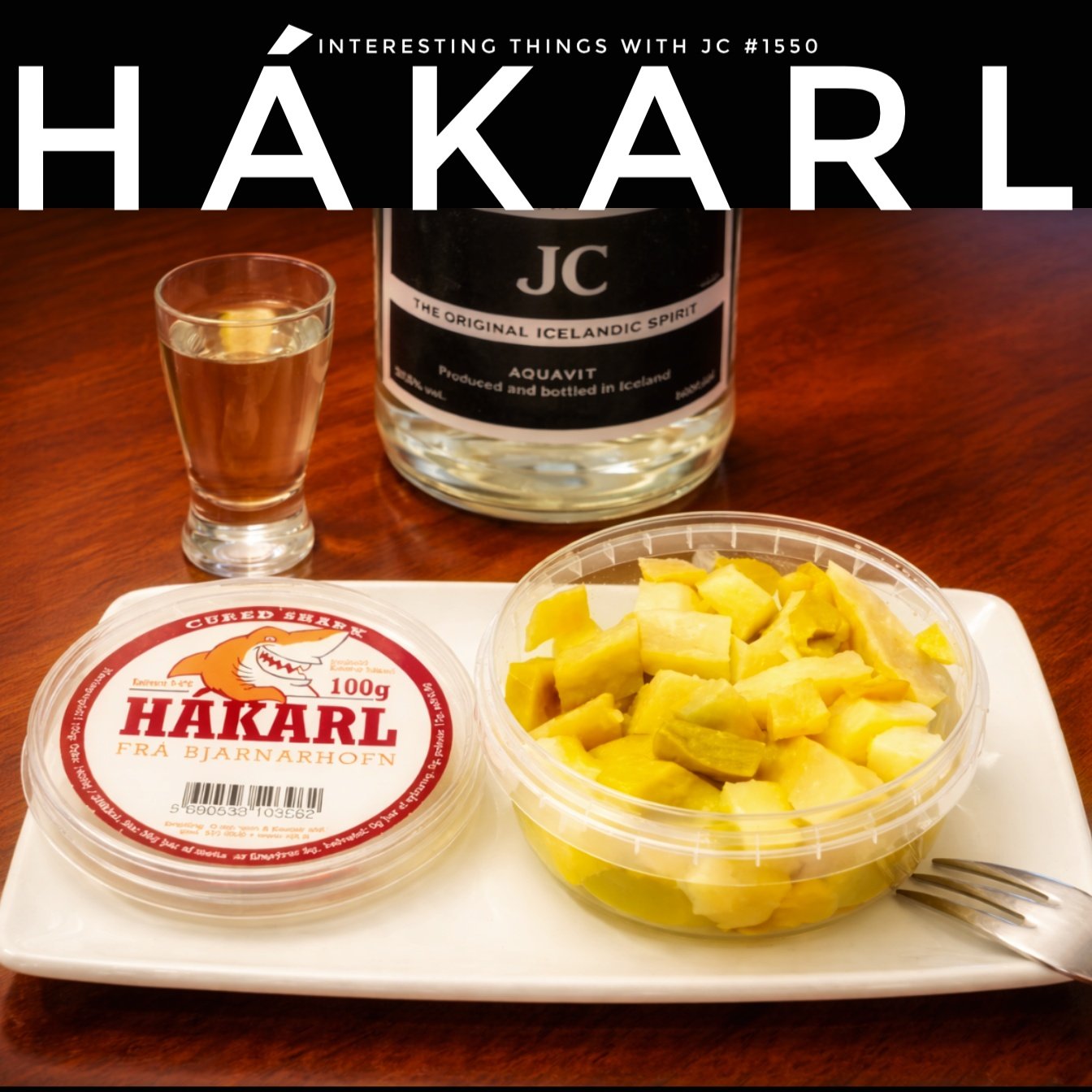
Plate of Icelandic Hákarl with cubed fermented shark, a fork, and a shot of clear liquor beside an aquavit bottle on a wooden table.
Transcript
Interesting Things with JC #1550: “Hákarl”
In Iceland, there’s a food that smells like poison. That’s not exaggeration. For centuries, that smell meant you survived the winter—or you didn’t.
The food is Hákarl (HOW-kartl). It’s made from the Greenland shark, a massive animal that can grow to about 21 feet long (6.4 meters) and weigh more than 2,200 pounds (1,000 kilograms). These sharks live in Arctic waters and can survive for an estimated 250 to over 400 years, longer than any other known vertebrates.
Fresh, the meat is dangerous.
Greenland shark flesh is loaded with urea and trimethylamine oxide (try-METH-uh-leen uh-MINE ox-side). Those chemicals act like antifreeze, keeping the shark alive in near-freezing water. In the human body, they convert into ammonia. Eat the meat fresh and you risk severe illness, confusion, and neurological symptoms.
Early Icelanders didn’t have the option to walk away.
After settlement began around 874 AD, Iceland offered little margin for waste. Farming was limited. Winters were long. Fishing was risky. When a shark was caught or washed ashore, it represented months of food—if it could be made safe.
So they engineered a solution.
The shark was beheaded, gutted, and cut into heavy slabs, often weighing around 100 pounds (45 kilograms) each. Those pieces were buried in gravel or placed in weighted containers for six to twelve weeks. During that time, toxic fluids drained out, and fermentation broke down the dangerous compounds.
Then came the waiting.
The meat was hung in open sheds for four to six months, exposed to cold air and wind. A hard brown crust formed on the outside and was cut away, leaving firm, pale flesh inside.
That’s Hákarl (HOW-kartl).
It’s served in small cubes, usually during Þorrablót (THOR-rah-bloht), a midwinter festival honoring traditional foods. The smell is sharp and ammonia-heavy. The taste is less extreme but lingers. Many people chase it with Brennivín (BREN-neh-veet-n), a strong local schnapps.
Today, no one needs Hákarl (HOW-kartl) to survive. But it remains.
Not as a prank. Not as a dare. As proof of what people will figure out when failure isn’t an option.
That smell isn’t there for shock. It’s there because history demanded it.
These are interesting things, with JC.
Student Worksheet
Explain why fresh Greenland shark meat is toxic to humans.
Describe the two main stages of making Hákarl.
Why was wasting food not an option for early Icelanders?
How does Hákarl function as a cultural artifact today?
Teacher Guide
Estimated Time
45–60 minutes
Pre-Teaching Vocabulary Strategy
Introduce key chemical terms using simple diagrams and analogies.
Anticipated Misconceptions
Fermentation is spoilage rather than controlled preservation.
All traditional foods are consumed for novelty rather than necessity.
Discussion Prompts
How does environment shape culture?
Can survival-based traditions remain relevant today?
Differentiation Strategies: ESL, IEP, gifted
Provide visual timelines for ESL learners.
Chunk reading sections for IEP accommodations.
Encourage gifted students to research other fermented foods globally.
Extension Activities
Compare Hákarl to other preserved foods like kimchi or lutefisk.
Investigate modern food safety regulations versus historical practices.
Cross-Curricular Connections
Biology: Chemical adaptation in organisms
Chemistry: Breakdown of nitrogen compounds
History: Viking-era survival strategies
Anthropology: Food as cultural identity
Quiz
Q1. Why is fresh Greenland shark meat dangerous?
A. High fat content
B. Presence of ammonia-producing compounds
C. Bacterial infection
D. Freezing temperature
Answer: B
Q2. What process makes Hákarl safe to eat?
A. Cooking
B. Smoking
C. Fermentation and drying
D. Freezing
Answer: C
Q3. Why did early Icelanders preserve shark meat?
A. Taste preference
B. Trade value
C. Lack of other food sources
D. Religious reasons
Answer: C
Q4. How long is Hákarl typically hung to dry?
A. One week
B. One month
C. Four to six months
D. One year
Answer: C
Q5. When is Hákarl traditionally eaten today?
A. Summer solstice
B. Þorrablót festival
C. National Day
D. Harvest season
Answer: B
Assessment
Explain how Hákarl demonstrates human adaptation to extreme environments.
Analyze the role of fermentation in making toxic foods edible.
3–2–1 Rubric
3 = Accurate, complete, thoughtful
2 = Partial or missing detail
1 = Inaccurate or vague
Standards Alignment
NGSS HS-LS2-6
Evaluate how changes in environmental conditions affect ecosystem stability and species survival.
Connection: Students examine how Arctic marine ecosystems shaped the Greenland shark’s biology and how Icelandic human populations adapted survival strategies in response to environmental constraints.
UK National Curriculum – Biology (Key Stage 4)
Topic: Ecology and adaptations.
Connection: Students study how organisms are adapted to extreme environments and how humans respond biologically and culturally to environmental pressures.
NGSS HS-PS1-2
Construct and revise explanations for chemical reactions based on conservation of matter.
Connection: The fermentation and drying of Hákarl are analyzed as chemical processes that reduce toxic compounds (urea and trimethylamine oxide), transforming unsafe meat into an edible food source.
UK GCSE Chemistry (AQA / OCR / Edexcel)
Topic: Chemical changes and reactions.
Connection: Fermentation is explored as a real-world chemical transformation involving compound breakdown and gas release, reinforcing applied chemistry concepts.
CCSS.ELA-LITERACY.RH.9-10.2
Determine the central ideas of a primary or secondary historical source and provide an accurate summary.
Connection: Students identify the central historical challenge of food scarcity in medieval Iceland and summarize how Hákarl emerged as a survival-based food practice.
UK National Curriculum – History (Key Stage 3)
Skill Focus: Historical interpretation and explanation.
Connection: Learners explain how historical context and environmental conditions influenced daily life and survival decisions in past societies.
C3 D2.Geo.5.9-12
Analyze the relationship between human populations and the environment.
Connection: The episode illustrates how Iceland’s geography, climate, and isolation shaped food systems and cultural traditions.
UK National Curriculum – Geography (Key Stage 3)
Topic: Human–physical geography interactions.
Connection: Students evaluate how physical environments influence human settlement, resource use, and cultural practices.
IB Diploma Programme Biology
Topic: Adaptation and human interaction with biological systems.
Connection: Students explore physiological adaptations of the Greenland shark and examine how humans applied biological knowledge to mitigate toxicity through preservation techniques.
Cambridge IGCSE Biology
Topic: Adaptation and survival in organisms.
Connection: The Greenland shark serves as a case study in biochemical adaptation, while Hákarl demonstrates applied human problem-solving in extreme environmental conditions.
Show Notes
This episode examines Hákarl, a traditional Icelandic fermented shark dish, as a lens into survival, chemistry, and cultural continuity. Students learn how biological toxins, environmental hardship, and human innovation intersect. The topic highlights resilience, problem-solving, and the preservation of historical knowledge through food traditions, making it relevant for discussions in science and social studies classrooms today.
References
Nielsen, J., Hedeholm, R. B., Heinemeier, J., Treble, P., Juul, S., Steingrímsson, S. Á., ... & Olsen, J. (2016). Eye lens radiocarbon reveals centuries of longevity in the Greenland shark (Somniosus microcephalus). Science, 353(6300), 702–704. https://www.science.org/doi/10.1126/science.aaf1703
U.S. National Oceanic and Atmospheric Administration. (2024). How long do Greenland sharks live? NOAA National Ocean Service. https://oceanservice.noaa.gov/facts/greenland-shark.html
Shark Trust. (2020). Creature feature: Greenland shark. https://www.sharktrust.org/blog/creature-feature-greenland-shark
Florida Museum of Natural History. (2025). Greenland shark – Discover fishes. University of Florida. https://www.floridamuseum.ufl.edu/discover-fish/species-profiles/greenland-shark
Ólafsdóttir, G., Guðjónsdóttir, M., Sveinsdóttir, K., & Sveinsdóttir, H. (2023). Unlocking the microbial diversity and the chemical changes throughout the fermentation process of “hákarl”, Greenland shark. Heliyon, 9(12), Article e3350. https://pmc.ncbi.nlm.nih.gov/articles/PMC10700383
Food Insider. (n.d.). How Icelandic fermented shark is made [Video]. YouTube. https://www.youtube.com/watch?v=QnjtnzyTNoQ
Guide to Iceland. (2025). Þorrablót: Celebrating Iceland's midwinter feast. https://guidetoiceland.is/connect-with-locals/sigrunthormar/orrablot