1588: "Sarah Brown"
Interesting Things with JC #1588: "Sarah Brown" - In a Broadway world built on wagers and floating crap games one woman refuses to play. Sarah Brown runs a Salvation Army mission surrounded by gamblers and drifters. Then the most confident gambler in the city walks through her door and everything changes.
Curriculum - Episode Anchor
Episode Title: Sarah Brown
Episode Number: 1588
Host: JC
Audience: Grades 9–12, introductory college, homeschool, lifelong learners
Subject Areas: Literature, Theatre History, Character Study, Adaptation, Cultural History
Lesson Overview
This episode centers on Sarah Brown, the Salvation Army missionary from Damon Runyon’s 1933 short story “The Idyll of Miss Sarah Brown,” later adapted into the Broadway musical Guys and Dolls. In both versions, Sarah Brown stands in sharp contrast to the gambling culture around her, and that contrast drives the story’s moral and emotional tension. Runyon’s story established both Sarah Brown and Sky Masterson, while the 1950 Broadway musical expanded their relationship into one of the best-known plots in American musical theatre.
Students can use this episode to analyze character contrast, motivation, persuasion, adaptation, and theme. Sarah Brown is especially useful for classroom study because she is not defined by spectacle or gambling skill; instead, she functions as a moral counterweight whose presence changes the story’s central gambler. In the musical synopsis, Nathan Detroit’s thousand-dollar bet with Sky Masterson specifically turns on whether Sky can persuade Sarah Brown to go with him to Havana.
Learning Objectives
Students will:
Identify Sarah Brown as a fictional character first appearing in Damon Runyon’s “The Idyll of Miss Sarah Brown.”
Explain Sarah Brown’s role in Guys and Dolls as a missionary whose values conflict with the gamblers around her.
Analyze how the episode presents Sarah Brown as the reason Sky Masterson changes.
Compare literary source material with musical adaptation.
Evaluate how contrast between risk and morality shapes plot and theme.
Key Vocabulary
Missionary — A person devoted to religious outreach or service. Sarah Brown is presented as a Salvation Army missionary.
Wager — A bet on an uncertain outcome.
Odds — The chances that something will happen.
Reputation — The opinion others hold about a person’s character or conduct.
Adaptation — A retelling of a work in another form, such as from short story to stage musical.
Contrast — The difference between two characters, settings, or ideas used to build meaning.
Persuasion — The act of trying to convince someone to think or act differently.
Moral center — A character who anchors the ethical direction of a story.
Narrative Core
Open
The episode begins in the gambling world of Guys and Dolls, where dice, wagers, and nerve shape social standing.
Info
Sarah Brown is introduced as the figure who does not live by those rules. She first appeared in Damon Runyon’s 1933 story “The Idyll of Miss Sarah Brown.”
Details
She works as a Salvation Army missionary while gamblers and drifters move through the Broadway setting around her. In the musical adaptation, Nathan Detroit bets Sky Masterson one thousand dollars that Sky cannot persuade Sarah Brown to go to Havana with him.
Reflection
The story’s deeper conflict is not whether Sky can win a bet, but whether sincerity can break through performance, charm, and manipulation.
Closing
These are interesting things, with JC.
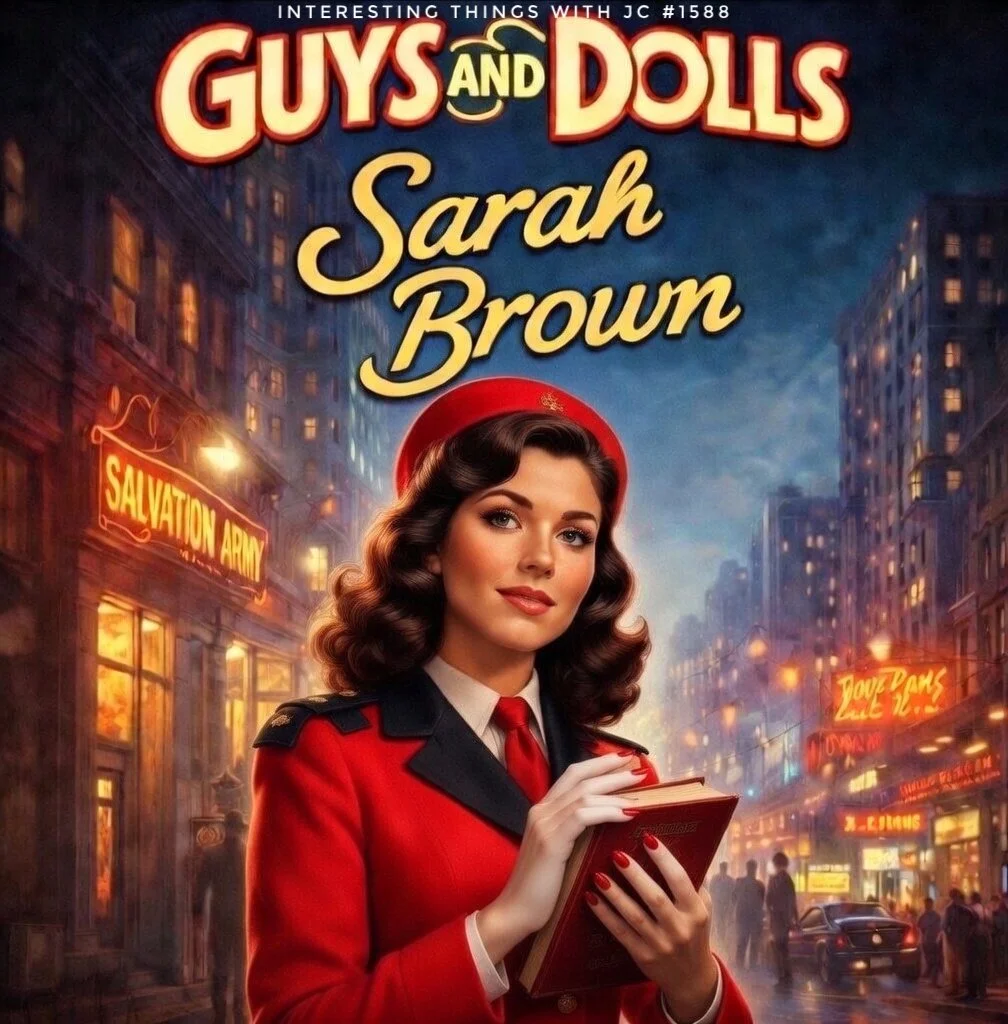
Illustrated poster for “Interesting Things with JC #1588” showing the fictional character Sarah Brown from Guys and Dolls standing on a neon-lit city street at night. She wears a red Salvation Army-style uniform and hat and holds a small book in her hands. Large title text reads “Guys and Dolls Sarah Brown.”
Transcript
Interesting Things with JC #1588: "Sarah Brown"
In the Broadway world of Guys and Dolls, gamblers live by odds. Dice roll in back rooms, wagers move across tables, and reputations are built on nerve.
But every gambling world eventually meets someone who refuses to play the game.
Her name is Sarah Brown.
Sarah Brown first appeared in Damon Runyon’s 1933 short story “The Idyll of Miss Sarah Brown.” In Runyon’s Broadway world of floating crap games and fast-talking gamblers, she stands apart from almost everyone around her.
She is a missionary with the Salvation Army.
While gamblers chase luck through cards and dice, Sarah Brown runs a small mission in the middle of the Broadway district. That neighborhood covers about one square mile, about 2.6 square kilometers, filled with theaters, nightclubs, and men who spend their nights chasing the next wager.
Sarah Brown is there for a different reason.
She is trying to change them.
Night after night she stands outside the mission inviting gamblers, drinkers, and drifters to step inside and listen. Most walk past. Some laugh. A few stop long enough to hear what she has to say.
Then one evening a gambler walks through the door.
Sky Masterson.
Sky is famous for taking impossible bets. One of those wagers sends him to Sarah Brown’s mission. Another gambler named Nathan Detroit offers one thousand dollars if Sky can persuade the straight-laced missionary to join him for dinner in Havana, Cuba.
At first Sarah refuses. She believes gamblers are dishonest. She believes men like Sky Masterson represent the trouble she is trying to keep out of her mission.
But something unexpected happens.
The gambler who bets on everything meets someone who refuses to play along.
And slowly, the man who trusts probability more than people begins to change.
Sarah Brown is not the gambler in the story.
She is the reason the gambler changes.
These are interesting things, with JC.
Student Worksheet
Who created Sarah Brown, and in what story did she first appear?
How does the episode contrast Sarah Brown with the gamblers around her?
What is Nathan Detroit’s wager involving Sarah Brown?
Why does Sarah Brown initially distrust Sky Masterson?
What does the episode suggest Sarah Brown represents in the story?
Teacher Guide
Estimated Time
One class period, about 35–45 minutes
Before Listening or Reading
Introduce the terms missionary, wager, odds, and adaptation. Ask students to predict what kind of conflict emerges when a character guided by moral conviction enters a world guided by risk and betting.
Anticipated Misconceptions
Students may think Sarah Brown is merely a supporting romantic character; the episode argues that she is structurally central because she changes the trajectory of Sky Masterson’s story.
Students may assume the story is only about gambling, when it is also about persuasion, integrity, and transformation.
Students may not realize Sarah Brown originated in prose fiction before becoming a stage character.
Discussion Prompts
Why does Sarah Brown’s refusal to “play the game” matter so much?
How does the story use contrast between Sarah Brown and Sky Masterson?
Is Sarah Brown powerful because she changes others, or because she refuses to change herself too quickly?
How do adaptation and performance make Sarah Brown more visible in the musical than in a short episode summary?
Differentiation
For ESL learners, provide sentence starters such as “Sarah Brown differs from the gamblers because…”
For students with processing supports, break the transcript into four short sections and discuss one at a time.
For advanced learners, compare Sarah Brown with another morally grounded character from drama or fiction.
Extension Activities
Compare the episode to the original Runyon story summary.
Track how Sarah Brown is described in narrative prose versus musical synopsis.
Write a short reflective paragraph from Sarah Brown’s point of view after meeting Sky Masterson.
Create a character-contrast chart for Sarah Brown and Sky Masterson.
Quiz
Q1. Sarah Brown first appeared in which work?
A. Guys and Dolls
B. The Idyll of Miss Sarah Brown
C. Luck Be a Lady
D. The Hot Box Review
Answer: B
Q2. What is Sarah Brown’s role in the story world?
A. Nightclub singer
B. Gambler
C. Missionary
D. Police officer
Answer: C
Q3. Who makes the thousand-dollar bet involving Sarah Brown?
A. Arvide Abernathy
B. Damon Runyon
C. Nathan Detroit
D. Nicely-Nicely Johnson
Answer: C
Q4. What does Sarah Brown most clearly represent in the episode?
A. Luck
B. Moral conviction
C. Fame
D. Comedy relief
Answer: B
Q5. According to the episode, why is Sarah Brown important?
A. She runs the gambling tables
B. She writes the wager
C. She is the reason the gambler changes
D. She owns the mission building
Answer: C
Assessment
Constructed Response Prompts
Explain how Sarah Brown functions as a contrast to the gambling world around her.
Describe how the episode presents Sarah Brown as central to Sky Masterson’s character development.
3–2–1 Rubric
3 — Accurate, complete, and supported by details from the episode
2 — Generally accurate but lacking detail or explanation
1 — Limited, vague, or inaccurate understanding
Standards Alignment
U.S. Standards
CCSS.ELA-LITERACY.RL.11-12.1
Students cite strong textual evidence to explain Sarah Brown’s role and significance in the episode.
CCSS.ELA-LITERACY.RL.11-12.3
Students analyze how character interaction drives the plot, especially the contrast between Sarah Brown and Sky Masterson.
CCSS.ELA-LITERACY.RL.11-12.6
Students examine how point of view and narrative framing shape audience understanding of Sarah Brown.
C3 D2.His.1.9-12
Students consider how literary and theatrical works reflect time, place, and social setting.
ISTE 1.3.a-b
Students evaluate source credibility when comparing the episode with literary and theatre-history references.
International Equivalents
England National Curriculum, English KS4
Supports close reading, interpretation, and analysis of how writers create character and meaning.
IB Diploma Programme, Language A: Language and Literature
Supports analysis of literary works and the relationship between text, audience, and context.
Cambridge IGCSE Literature in English (0475)
Supports informed literary response, attention to writer’s craft, and interpretation of character and theme.
Show Notes
This episode focuses on Sarah Brown as one of the most important moral and structural characters in Guys and Dolls. Although the musical is widely remembered for its gamblers, songs, and humor, Sarah Brown provides the ethical pressure that gives the story depth. She originated in Damon Runyon’s 1933 short story “The Idyll of Miss Sarah Brown,” and the later Broadway adaptation preserved her central role as the missionary whose presence forces Sky Masterson into genuine self-examination. The original Broadway production of Guys and Dolls opened on November 24, 1950, and the musical’s official synopsis confirms the wager in which Nathan Detroit bets Sky one thousand dollars that he cannot persuade Sarah Brown to go with him. That conflict makes Sarah Brown ideal for classroom study because she represents conviction, resistance to manipulation, and the narrative force of principled character.
A useful teaching angle is that Sarah Brown is not important because she joins the gamblers’ world, but because she interrupts it. In literary terms, she is both a character and a standard against which other characters are measured. In adaptation terms, she shows how Broadway musicals often transform a compact prose premise into fuller emotional drama. In classroom discussion, students can explore how sincerity becomes a force strong enough to challenge charm, probability, and social performance.
References
Damon Runyon. (1933, January 28). The Idyll of Miss Sarah Brown. https://damonrunyon.neocities.org/Broadway_Stories/The_Idyll_of_Miss_Sarah_Brown
Internet Broadway Database. (n.d.). Guys and Dolls (Original Broadway production). https://www.ibdb.com/broadway-production/guys-and-dolls-1892
Music Theatre International. (n.d.). Full synopsis: Guys and Dolls. https://www.mtishows.com/full-synopsis/757
Music Theatre International. (n.d.). Guys and Dolls. https://www.mtishows.com/guys-and-dolls