Interesting Things with JC #1584: "The Hafele–Keating Experiment" – In 1971 four atomic clocks boarded commercial airliners and circled the Earth. When they returned, the clocks no longer matched those on the ground. The difference was measured in billionths of a second and confirmed Einstein’s prediction that motion and gravity change time.
Curriculum - Episode Anchor
Episode Title: The Hafele–Keating Experiment
Episode Number: 1584
Host: JC
Audience: Grades 9–12, college intro, homeschool, lifelong learners
Subject Area: Physics, history of science, measurement science, scientific inquiry
Lesson Overview
Students examine how the 1971 Hafele–Keating experiment used portable cesium atomic clocks on commercial flights to test Einstein’s predictions about motion, gravity, and time. The lesson connects special relativity, general relativity, atomic timekeeping, and modern GPS technology. A modern second is defined from the cesium-133 transition frequency of 9,192,631,770 cycles, and the original 1972 results reported eastbound clocks losing 59 ± 10 nanoseconds and westbound clocks gaining 273 ± 7 nanoseconds relative to U.S. Naval Observatory reference clocks.
Measurable learning objectives:
Define atomic clock, relativity, nanosecond, and reference frame using accurate scientific language.
Compare the effects of motion and gravity on time in eastbound and westbound flights.
Analyze how experimental evidence from the Hafele–Keating flights supported Einstein’s predictions.
Explain why GPS systems require relativistic corrections to remain accurate in daily navigation.
Key Vocabulary
Cesium atomic clock (SEE-zee-um uh-TOM-ik klok) — A clock that keeps time using the highly stable frequency of cesium-133 atoms; the modern second is defined from 9,192,631,770 oscillations of this transition.
Relativity (rel-uh-TIV-uh-tee) — Einstein’s framework describing how time, motion, and gravity relate; in this episode, relativity predicts that clocks can tick at different rates depending on speed and gravitational field.
Special relativity (SPEH-shul rel-uh-TIV-uh-tee) — The part of Einstein’s theory showing that motion affects time, so faster motion makes a clock run slower relative to a comparison frame.
General relativity (JEN-er-uhl rel-uh-TIV-uh-tee) — The part of Einstein’s theory showing that gravity affects time, so clocks farther from Earth’s mass run slightly faster.
Nanosecond (NAN-oh-SEK-und) — One billionth of a second; the Hafele–Keating results were measured at this tiny scale.
Reference clock (REF-er-ens klok) — A clock used as the comparison standard; in this experiment, the flying clocks were compared with clocks at the U.S. Naval Observatory.
GPS (jee-pee-ESS) — The Global Positioning System, which depends on precise satellite timing and relativity corrections; without them, errors would accumulate by about 38 microseconds and roughly 10 kilometers per day.
Narrative Core
Open – Four heavy atomic clocks are carried through airports like luggage, creating immediate curiosity about why ordinary flights might test the nature of time itself.
Info – The episode introduces cesium atomic clocks, the scientific definition of a second, and Einstein’s claims that both motion and gravity affect how fast time passes.
Details – Hafele and Keating synchronize four cesium clocks with U.S. Naval Observatory clocks, fly them east and west around Earth on commercial jets, and compare the results. The measured outcomes align closely with the 1972 published predictions: eastbound clocks lost time and westbound clocks gained time.
Reflection – The story shows that relativity is not just abstract theory. It affects real technologies, especially GPS, whose satellite clocks must be corrected for both motion and gravity to provide accurate positioning.
Closing – These are interesting things, with JC.
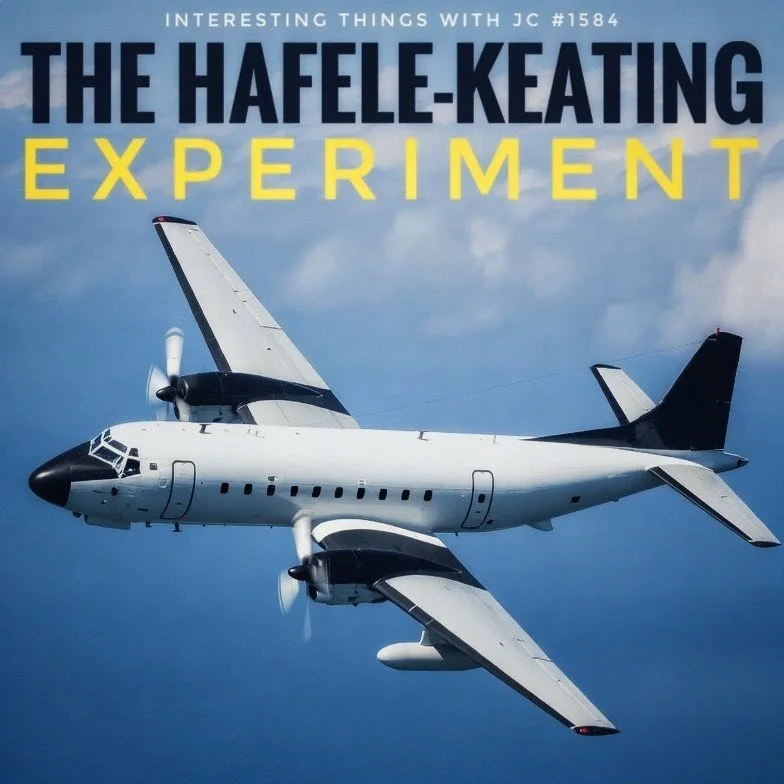
Square cover image for “Interesting Things with JC #1584: The Hafele-Keating Experiment.” A white twin-engine propeller airplane with dark blue tail and nose flies across a bright blue sky with soft clouds. Large title text at the top reads “THE HAFELE-KEATING EXPERIMENT,” with “EXPERIMENT” in yellow.
Transcript
Interesting Things with JC #1584: "The Hafele–Keating Experiment"
In October 1971, four atomic clocks were packed into cases and carried through airport terminals like ordinary luggage. They boarded commercial passenger jets leaving the United States.
The clocks didn’t look impressive. But each one was a cesium atomic clock (SEE-zee-um), built to measure time with extreme precision.
Inside the device, cesium atoms vibrate a little over nine billion times every second (9,192,631,770). That vibration defines the modern length of a second.
Physicists Joseph Hafele (HAY-fel) and Richard Keating (KEE-ting) wanted to test something unusual.
Does time change depending on motion and gravity?
Albert Einstein predicted that it does.
Special relativity says motion slows time. Faster motion means a slower clock.
General relativity says gravity affects time as well. Farther from Earth, time moves slightly faster.
Airplanes experience both.
So Hafele and Keating synchronized four atomic clocks with reference clocks at the United States Naval Observatory in Washington, D.C. Then they placed the clocks on commercial jetliners and flew them around the world.
Two trips went east. Two went west.
Each flight circled about 24,900 miles (40,100 kilometers)—the circumference of the Earth.
The jets cruised near 35,000 feet (10,700 meters) and about 560 miles per hour (900 kilometers per hour).
Earth’s rotation added another factor. At the equator the planet moves east at 1,040 miles per hour (1,670 kilometers per hour).
So eastbound planes moved faster relative to Earth’s center. Westbound flights canceled part of that motion.
Before takeoff, the equations predicted the outcome.
Eastbound clocks would lose time.
Westbound clocks would gain time.
The difference would be measured in billionths of a second.
When the clocks returned and were compared with the Naval Observatory reference clocks, the results matched Einstein’s predictions.
The changes were incredibly small.
But they were measurable.
Eastbound clocks lost 59 nanoseconds.
Westbound clocks gained 273 nanoseconds.
Each cesium clock weighed about 80 pounds (36 kilograms), and Richard Keating personally carried them through airports to avoid shocks that could disturb the timing.
The lesson still matters today.
GPS satellites orbit about 12,550 miles (20,200 kilometers) above Earth. Their clocks run faster than clocks on the ground by about 38 microseconds per day.
Without relativity corrections, GPS positions would drift roughly 6 miles (10 kilometers) every day.
All of it confirmed by four atomic clocks that circled Earth in 1971.
These are interesting things, with JC.
Student Worksheet
What was the main scientific question Hafele and Keating wanted to test?
Why would an eastbound flight and a westbound flight affect clock measurements differently?
What role did the U.S. Naval Observatory clocks play in the experiment?
Why are nanoseconds important in this experiment even though they are extremely small?
Write a short paragraph explaining how the Hafele–Keating experiment connects to the way GPS works today.
Teacher Guide
Estimated Time
One 45–60 minute class period, or two shorter class sessions
Pre-Teaching Vocabulary Strategy
Begin with a quick term sort using the words atomic clock, relativity, gravity, motion, reference frame, and nanosecond. Ask students to predict which terms belong to physics, technology, or measurement science before reading the transcript. After the reading, revisit the sort and revise definitions using evidence from the episode.
Anticipated Misconceptions
Students may think time is always constant and identical everywhere.
Students may assume the changes in the experiment were too small to matter.
Students may confuse special relativity and general relativity as the same effect.
Students may think GPS is purely geometric and does not depend on precise timing.
Students may assume the aircraft alone caused the result, without recognizing Earth’s rotation and altitude as important variables.
Discussion Prompts
How can a theory be considered trustworthy before everyday people can directly observe its effects?
Why is careful measurement central to modern science?
What makes the Hafele–Keating experiment persuasive as evidence?
Why does the same scientific principle matter both in a 1971 airplane experiment and in twenty-first-century navigation?
Differentiation Strategies
ESL: Provide a vocabulary bank with phonetic spellings and sentence frames such as “The eastbound clocks lost time because…”.
IEP: Chunk the transcript into short sections and pair each section with one guiding question.
Gifted: Have students compare the relative contributions of speed and gravity to the final results and research an additional experimental test of relativity.
Extension Activities
Students create a visual timeline of the experiment from clock synchronization to final comparison.
Students calculate how far a timing error would propagate in a navigation system over one day.
Students compare Hafele–Keating with another relativity test, such as muon decay evidence or modern optical clock experiments.
Cross-Curricular Connections
Physics: time dilation, frames of reference, precision measurement
History of science: experimental confirmation of major theories
Mathematics: interpreting very small quantities and comparing measured vs. predicted values
Engineering and technology: satellite navigation and systems accuracy
Literacy: summarizing technical information accurately
Quiz
Q1. What type of clocks were carried on the flights?
A. Quartz wristwatches
B. Cesium atomic clocks
C. Sundials
D. Mechanical marine chronometers
Answer: B
Q2. According to special relativity, what does faster motion do to a clock?
A. It makes the clock run faster
B. It has no effect
C. It makes the clock run slower
D. It resets the clock
Answer: C
Q3. Why did westbound clocks gain time relative to the reference clocks?
A. They were heavier
B. They canceled part of Earth’s rotational motion and also experienced reduced gravity at altitude
C. They were turned off during flight
D. They crossed fewer time zones
Answer: B
Q4. Which institution provided the comparison clocks?
A. NASA
B. CERN
C. United States Naval Observatory
D. Smithsonian Institution
Answer: C
Q5. Why is the Hafele–Keating experiment still important today?
A. It proved airplanes can fly around the world
B. It led directly to the invention of jet engines
C. It showed relativity matters for technologies such as GPS
D. It replaced atomic clocks with digital clocks
Answer: C
Assessment
Open-Ended Question 1
Explain how both motion and gravity influenced the airplane clocks in the Hafele–Keating experiment.
Open-Ended Question 2
Describe why GPS would become inaccurate without relativity corrections, using evidence from the episode.
3–2–1 Rubric
3 = Accurate, complete, thoughtful explanation using correct scientific vocabulary and clear evidence from the episode
2 = Partially accurate response with some correct details but missing explanation or precision
1 = Inaccurate, vague, or unsupported response
Standards Alignment
U.S. Standards
NGSS HS-PS4-1 — Students use mathematical representations to support claims about frequency and wave behavior; this connects to the cesium transition frequency used to define the second.
NGSS HS-PS4-3 — Students evaluate claims, evidence, and reasoning in physics; this fits the episode’s focus on experimental confirmation of a theoretical prediction.
CCSS.ELA-LITERACY.RST.11-12.1 — Students cite specific textual evidence in science texts; they can support claims using details from the transcript and the published results.
CCSS.ELA-LITERACY.RST.11-12.2 — Students determine central ideas and summarize complex scientific processes accurately; this aligns with explaining relativity and atomic clock evidence in simpler but correct language.
C3 D3.3.9-12 — Students identify evidence from multiple sources to detect inconsistencies and strengthen claims; this matches comparing theory, flight data, and observed timing results.
ISTE 1.3.a / 1.3.b — Students plan research strategies and evaluate the accuracy and credibility of information; this fits investigating how experiment, observatory timekeeping, and GPS evidence support the topic.
International Academic Equivalents
AQA A-Level Physics 3.12.3.2–3.12.3.3 — Students study Einstein’s special relativity and time dilation; this aligns directly with the episode’s explanation of moving clocks running differently.
Cambridge International AS & A Level Physics (9702) — The syllabus emphasizes major theoretical concepts and strong practical skills, making this episode suitable for linking theory, measurement, and experimental evidence.
IB Diploma Programme Physics — The course emphasizes nature of science, critical thinking, and experimental work, which aligns with studying how precision measurement tests theory.
Show Notes
This episode explores the 1971 Hafele–Keating experiment, in which four cesium atomic clocks were flown around the world on commercial airliners to test Einstein’s predictions about time dilation. The topic is highly classroom-relevant because it brings together abstract physics, experimental design, and modern technology in a single story. Students can see that special relativity and general relativity are not merely theoretical ideas; they produce measurable effects that were observed in the original experiment and continue to matter in GPS satellite timing today. The episode also reinforces the importance of precision measurement, evidence-based reasoning, and the role of reference standards such as those maintained by the U.S. Naval Observatory and national metrology institutions.
References
Hafele, J. C. (1972). Around-the-world atomic clocks: Predicted relativistic time gains. Science, 177(4044), 166–168. https://www.science.org/doi/10.1126/science.177.4044.166
National Institute of Standards and Technology. (2019, April 9). Second: Introduction. https://www.nist.gov/si-redefinition/second-introduction
National Institute of Standards and Technology. (n.d.). NIST’s cesium fountain atomic clocks. https://www.nist.gov/pml/time-and-frequency-division/time-realization/cesium-fountain-atomic-clocks
U.S. Naval Observatory. (2021, October 15). Hafele-Keating anniversary. https://www.cnmoc.usff.navy.mil/Portals/49/Hafele-Keating%20Anniversary.pdf
Ashby, N. (2003). Relativity in the Global Positioning System. Living Reviews in Relativity / PMC. https://pmc.ncbi.nlm.nih.gov/articles/PMC5253894/
Francis, S., et al. (2003). Timekeeping and time dissemination in a distributed space-based clock ensemble. National Institute of Standards and Technology. https://tf.nist.gov/general/pdf/1869.pdf