Interesting Things with JC #1629: "The Sacking of the Libraries of Alexandria and Cleopatra" – Caesar burns ships in Alexandria’s harbor to block an enemy fleet, but the fire spreads into a city built to collect written knowledge. The damage does not end in one destruction, because war, political change, and attacks on later institutions keep breaking the system that held the libraries together until the record itself survives only in fragments. Thank you to Sofia from Greece for co-writing today's episode!
Curriculum - Episode Anchor
Episode Title: Library of Alexandria and Cleopatra
Episode Number: 1629
Host: JC
Audience: Grades 9–12, Introductory College, Homeschool, Lifelong Learners
Subject Area: World History / History of Knowledge
Lesson Overview
Objectives:
Trace the timeline of key events contributing to the decline of the Library of Alexandria
Analyze how physical, political, and cultural systems impact knowledge preservation
Evaluate the role of Cleopatra VII within a shifting intellectual environment
Apply historical understanding to modern knowledge systems and risks
Essential Question:
How does the stability of a society influence what knowledge survives?
Success Criteria:
Students can construct a cause-and-effect timeline, explain cumulative loss, and connect ancient and modern knowledge systems.
Student Relevance:
Students depend on digital knowledge systems; this lesson shows how fragile information systems can be.
Real-World Connection:
Data storage, cybersecurity, archives, and cloud systems mirror ancient preservation challenges.
Workforce Reality:
Archivists, historians, IT professionals, and data managers must protect and maintain information systems under changing conditions.
Key Vocabulary
Alexandria (ˌal-ig-ˈzan-drē-ə): Major ancient center of learning in Egypt
Ptolemaic (ˌtä-lə-ˈmā-ik): Dynasty that built Alexandria’s knowledge system
Mouseion (myoo-ˈzē-ən): Research institution housing scholars and texts
Scroll (skrōl): Ancient written record on papyrus
Serapeum (ser-ə-ˈpē-əm): Secondary temple-based library collection
Fragmentation (frag-mən-ˈtā-shən): Breakdown into disconnected parts
Commentary (ˈkä-mən-ˌter-ē): Scholarly explanation of texts
Aurelian (ȯ-ˈrē-lē-ən): Roman emperor linked to urban destruction
Hypatia (hī-ˈpā-shē-ə): Philosopher symbolizing intellectual transition
Narrative Core
Open: Fire spreads across Alexandria’s harbor, threatening a system built to collect the knowledge of the known world.
Info: The Library of Alexandria operated within the Mouseion as a living research institution, not just storage, but active scholarship.
Details: Its decline unfolded across centuries—Caesar’s fire, Roman warfare, destruction of the Serapeum, and shifts in intellectual priorities. Cleopatra’s presence marks a transitional moment within this system.
Reflection: Knowledge systems require stability; when disrupted repeatedly, they lose not only content but continuity.
Closing: These are interesting things, with JC.
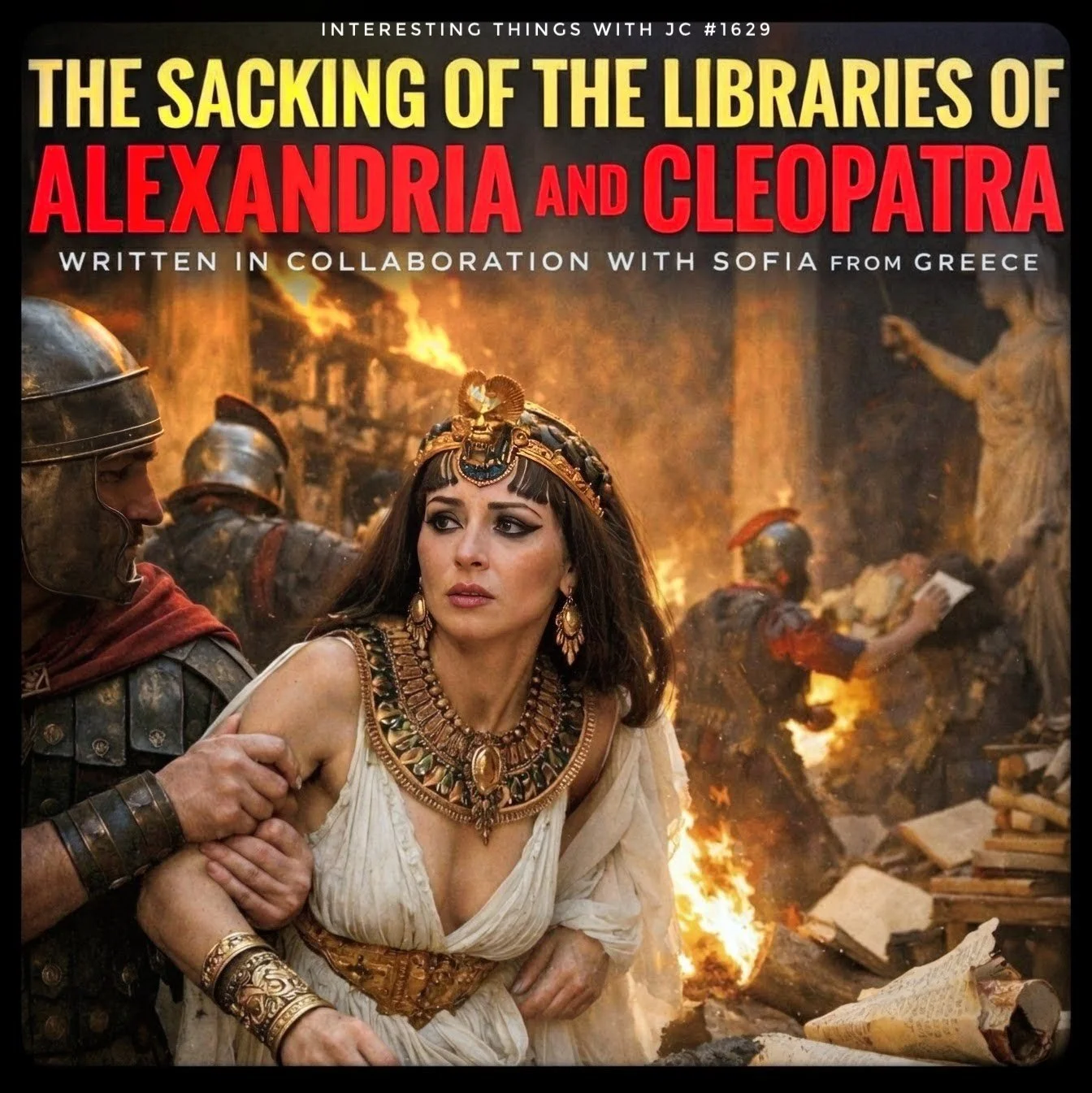
A woman representing Cleopatra in ancient Egyptian attire is pulled by a soldier as a city burns behind her, with flames, scattered scrolls, and soldiers moving through the destruction.
Transcript
Interesting Things with JC #1629:
"The Sacking of the Libraries of Alexandria and Cleopatra"
A fire starts in the harbor at Alexandria, ships burning in tight rows, flames lifting off the water and catching the storage buildings along the edge of the city.
It’s 48 BC, and Julius Caesar is trapped, outnumbered, holding ground in a capital that isn’t his. He orders the ships burned to block the enemy fleet. The move works. The harbor becomes a barrier.
But the fire doesn’t stay contained.
It climbs into the city.
Alexandria had been built for accumulation. Under the Ptolemaic rulers, successors of Alexander the Great, the system was direct. Gather every written work that could be found. Ships entering port were searched. Scrolls were taken, copied, and often the originals were kept. Over time, the city became a collection point for the intellectual record of the Mediterranean world.
The Library of Alexandria grew out of that system. Not a single building, but part of the Mouseion, where scholars lived and worked. The collection likely held hundreds of thousands of scrolls, including works tied to Homer and mathematical foundations associated with Euclid. But just as important were the commentaries, revisions, and comparisons that happened inside the system itself.
So when fire reaches the dockside storage, something unstable is introduced into a system built on physical text. Ancient sources disagree on the scale. Some describe large losses. Others suggest the main collections were spared and only nearby warehouses burned.
Because the fall of Alexandria’s libraries does not happen in one moment.
After Caesar leaves, the city continues under Roman control. The primary collection weakens over time, but other centers remain, including the Serapeum. The system is no longer unified, but it is still functioning.
Then in the 3rd century AD, during internal conflict in the Roman Empire, fighting under Aurelian damages large sections of the city, including areas tied to the earlier scholarly district.
Then in 391 AD, under a Christian Roman government, pagan temple complexes are targeted. The Serapeum is destroyed. By then, whatever survives of the earlier system is already fragmented, but another layer is removed.
Inside this timeline is Cleopatra VII.
She is in Alexandria when Caesar sets the harbor fire. This is her capital, her base of power, and part of the system she inherits. Later accounts suggest she tried to rebuild the collections after the damage. One claim says Mark Antony transferred large numbers of scrolls from Pergamon to Alexandria.
Even at that point, there is recognition that something had been lost that could not be easily replaced.
Because rebuilding a library is not the same as restoring what it held. Copies can be made when originals survive. Entire works disappear when they don’t. And when the commentaries that explain those works vanish at the same time, later generations inherit fragments without the context that once made them usable.
By 30 BC, after Cleopatra’s defeat by Octavian, Egypt becomes part of the Roman system. The long project of centralized knowledge collection continues to weaken under shifting control, changing priorities, and repeated disruption.
There is no single destruction.
There is fire. There is war. There is policy. There is neglect.
Each one takes something.
And over time, what disappears is not just a number of scrolls, but entire lines of thought that no longer have a way forward because the record that carried them is gone.
And at some point, that loss is no longer only written. It becomes human.
The murder of Hypatia in 415 AD is often seen as a symbolic turning point, not the beginning of the decline, but the moment it becomes visible.
Philosophers and scholars increasingly found themselves in a world that was changing around them. Some left Alexandria. Others adapted.
Philosophy began to merge with theology. The focus of inquiry shifted from mathematics and astronomy toward doctrinal concerns.
Scientific exploration narrowed, and those who carried this intellectual tradition were gradually dispersed to places like Athens and later Constantinople, where fragments of that knowledge continued under different conditions.
What was lost in Alexandria was not only knowledge. It was the environment that allowed it to exist.
And in the centuries that followed, what remained did not simply preserve that tradition. It transformed it. Fragments of earlier thought were absorbed into new systems, reinterpreted, and in some cases completely redefined. What had once been part of a living, open intellectual world became something scattered, surviving only in echoes, translations, and indirect references. And so the disappearance of Alexandria was not an ending in a single moment, but a long transformation of how knowledge itself would be carried forward, less as a unified body, and more as pieces reconstructed across time.
Thank you to Sofia from Greece for co-writing today's episode!
These are interesting things, with JC.
Student Worksheet
Comprehension Questions:
What decision did Julius Caesar make in 48 BC, and why?
How did the Ptolemaic system collect and manage knowledge?
What role did the Serapeum play after the main library weakened?
Analysis Questions:
Construct a timeline of at least four events contributing to Alexandria’s decline.
Explain how “fragmentation” affected the usefulness of knowledge over time.
Why is rebuilding knowledge more difficult than preserving it?
Reflection Prompt:
Compare the loss of the Library of Alexandria to a modern scenario (e.g., internet collapse, data breach). What would be lost beyond files?
Difficulty Scaling:
Level 1: Identify key facts
Level 2: Explain relationships between events
Level 3: Evaluate long-term impacts and modern parallels
Student Output:
Timeline (visual or written)
Short analysis (2–3 paragraphs)
Reflection response (1 paragraph)
Academic Integrity Guidance:
Paraphrase ideas from the transcript
Use evidence to support claims
Avoid copying language directly
Teacher Guide
Quick Start: Play audio → students note key events → build timeline → discussion → worksheet
Pacing Guide (Audio-First):
Bell Ringer (5 min)
Audio Listening (10 min)
Timeline Construction (10 min)
Discussion (10 min)
Worksheet (15–20 min)
Bell Ringer: List three systems you rely on daily (internet, school records, etc.). What would happen if they disappeared?
Audio Guidance:
First listen: overall narrative
Second pass (optional): pause at each event for timeline notes
Audio Fallback:
Teacher reads transcript aloud
Students annotate for cause/effect language
Time on Task: 45–55 minutes
Materials: Transcript, paper or digital timeline tools, worksheet
Vocabulary Strategy:
Pre-teach terms using real-world analogies (e.g., “cloud storage” vs scroll archives)
Misconceptions:
One catastrophic event destroyed the library
All knowledge disappeared instantly
Hypatia’s death directly destroyed the library
Discussion Prompts:
What conditions allow knowledge to grow?
What conditions cause knowledge to disappear?
Is digital knowledge safer than physical knowledge?
Formative Checkpoints:
Accurate sequencing of events
Ability to explain cause and effect
Use of vocabulary in context
Differentiation:
Provide timeline template for support
Challenge advanced students to compare with another historical knowledge center
Assessment Differentiation:
Written, oral, or visual timeline options
Time Flexibility:
Extend with research or compress to core timeline activity
Substitute Readiness:
Lesson can run using transcript and worksheet alone
Engagement Strategy:
Frame lesson as “What if everything you know disappeared?”
Extensions:
Compare Alexandria to modern cloud data centers
Research preservation methods (digital backups, archives)
Cross-Curricular Connections:
Technology: data storage systems
Science: information systems stability
SEL Connection:
Understanding shared human responsibility for knowledge
Skill Value Emphasis:
Systems thinking, historical reasoning, evidence-based analysis
Student Worksheet & Discussion Answer Key:
Caesar burned ships to block enemies
Knowledge collected via acquisition and copying system
Serapeum functioned as secondary repository
Decline caused by multiple events over centuries
Fragmentation reduced usability of knowledge
Quiz
Why did Julius Caesar burn ships in Alexandria?
A. Celebration
B. Naval defense strategy
C. Religious ritual
D. Trade disputeThe Mouseion was primarily a:
A. Military base
B. Religious temple
C. Research institution
D. Government officeWhat does fragmentation mean in this context?
A. Growth of knowledge
B. Loss of organization and continuity
C. Increase in scrolls
D. Translation of textsWhich event represents later destruction?
A. Homer’s writings
B. Aurelian’s conflict
C. Euclid’s work
D. Trade expansionWhy is the Library’s loss significant?
A. It ended all writing
B. It removed entire lines of thought
C. It stopped trade
D. It changed geography
Assessment
Open-Ended Questions:
Describe how at least three different factors contributed to the decline of Alexandria’s knowledge system.
Evaluate how the loss of context (commentaries and explanations) affects future understanding of information.
Rubric (3–2–1):
3: Thorough explanation, accurate evidence, clear reasoning
2: Partial explanation, some supporting detail
1: Minimal or unclear response
Exit Ticket:
One sentence: What matters more, preserving information or preserving context? Explain briefly.
Standards Alignment
NGSS HS-ETS1-1: Analyze complex real world systems by identifying relationships, constraints, and points of failure, applied to the rise and decline of Alexandria’s knowledge system
NGSS HS-ETS1-2: Design and evaluate solutions to complex problems, applied through student proposals for modern knowledge preservation systems
CCSS RH.9-10.2: Determine central ideas of a historical text and analyze how they develop over time through events such as Caesar’s fire and later conflicts
CCSS RH.9-10.3: Analyze how individuals and events interact over time, including Cleopatra VII, Roman leadership, and shifting cultural forces
CCSS WHST.9-10.2: Write informative texts explaining historical processes such as fragmentation and knowledge loss
CCSS WHST.9-10.9: Draw evidence from informational texts to support analysis and reflection
C3 D2.His.1.9-12: Evaluate how historical events and developments were shaped by unique circumstances in Alexandria
C3 D2.His.14.9-12: Analyze multiple and complex causes and effects of events in the past, focusing on cumulative decline rather than a single event
C3 D2.His.16.9-12: Integrate evidence from multiple sources to develop claims about historical change and continuity
ISTE 3a: Plan and employ effective research strategies to locate and evaluate information about historical knowledge systems
ISTE 3d: Build knowledge by actively exploring real world issues and analyzing systems such as libraries and data networks
Career Readiness: Apply systems thinking, risk analysis, and information management skills to real world scenarios involving data preservation and loss
Career Readiness: Evaluate the impact of infrastructure failure on knowledge based industries and research fields
Lifelong Learning: Develop independent inquiry skills and the ability to connect historical lessons to modern information challenges
Lifelong Learning: Practice critical evaluation of sources and understand the importance of preserving context alongside information
Show Notes
This lesson explores the gradual decline of the Library of Alexandria, emphasizing how knowledge systems depend on stability, preservation, and context over time. It also highlights a unique collaboration, as Sofia from Greece, a dedicated listener and talented content creator known for her documentary style social media storytelling, co wrote the episode. This marks the first time anyone has co written an episode within the series. The opportunity came together organically, reflecting the shared curiosity behind this topic.
References
Encyclopaedia Britannica. (n.d.). Library of Alexandria. https://www.britannica.com/topic/Library-of-Alexandria
Encyclopaedia Britannica. (n.d.). The fate of the Library of Alexandria. https://www.britannica.com/topic/Library-of-Alexandria/The-fate-of-the-Library-of-Alexandria
History.com Editors. (n.d.). What destroyed the Library of Alexandria? https://www.history.com/articles/library-of-alexandria-destroyed
Ohio State University. (n.d.). The burning of the Library of Alexandria. https://ehistory.osu.edu/articles/burning-library-alexandria
World History Encyclopedia. (n.d.). Library of Pergamon. https://www.worldhistory.org/Library_of_Pergamon/
Serapea Project (CUNY). (n.d.). The Christian destruction of the Roman Serapeum. https://serapeaegypt.commons.gc.cuny.edu/destruction/the-christian-destruction-of-the-roman-serapeum/
First Things. (n.d.). The perniciously persistent myths of Hypatia and the Great Library. https://firstthings.com/the-perniciously-persistent-myths-of-hypatia-and-the-great-library/