Interesting Things with JC #1628: "Shooting Drones with an F-35" – An F-35 pilot slows a supersonic aircraft to match a drone moving slower than highway traffic, because closing too fast erases the shot, and even with fused tracking and clean intercept solutions, the engagement shifts as multiple drones arrive together while the aircraft’s missile count drops.
Curriculum - Episode Anchor
Episode Title: Shooting Drones with an F-35
Episode Number: 1628
Host: JC
Audience: Grades 9–12, introductory college, homeschool, lifelong learners
Subject Area: Aerospace engineering, defense technology, physics of interception
Lesson Overview
Objectives:
Explain how an aircraft uses multiple sensors to build a single target track from limited data.
Describe how speed, closure rate, angle, and timing affect an aerial intercept.
Analyze why a technically successful weapon system can still face limits in a multi-target scenario.
Evaluate how constraints such as ammunition load, time on station, and target prioritization shape real-world decisions.
Essential Question: How can an advanced fighter aircraft intercept a small, slow drone, and why does that problem become harder when many drones arrive together?
Success Criteria:
I can define sensor fusion, closure rate, track, and intercept geometry.
I can explain why “faster” is not always “better” in an intercept.
I can identify at least two operational limits that affect drone defense.
I can support my explanation with evidence from the episode and lesson discussion.
Student Relevance: This lesson shows how engineering systems solve problems under pressure, using information, timing, and limited resources rather than brute force alone.
Real-World Connection: Modern aircraft combine radar, infrared, and electro-optical data into one pilot display, while counter-drone defense increasingly depends on layered decisions because drone threats can appear in groups rather than one at a time.
Workforce Reality: Aerospace crews, pilots, engineers, maintainers, and analysts all work under constraint. High-performance systems still face tradeoffs in cost, time, capacity, and decision quality.
Key Vocabulary
Sensor fusion(SEN-ser FYOO-zhuhn): The combining of data from multiple sensors into one usable picture for the operator.
Closure rate(KLOH-zher rayt): The speed at which one object is getting closer to another.
Intercept geometry(IN-ter-sept jee-OM-uh-tree): The position, angle, and motion relationship needed for one aircraft or weapon to reach a target.
Track(trak): A continuously updated estimate of a target’s location, direction, and motion.
Infrared(in-fruh-RED): Energy associated with heat that some sensors can detect.
Electro-optical(ee-LEK-troh OP-ti-kuhl): Sensor systems that use visible or infrared imagery to detect or identify objects.
Low-observable(loh uhb-ZUR-vuh-buhl): Designed to reduce detectability, often by radar.
Weapons bay(WEP-unz bay): An internal compartment that carries weapons inside the aircraft.
Time on station(tym on STAY-shuhn): How long an aircraft can remain in the fight area before it must leave.
Prioritization(pry-or-uh-tuh-ZAY-shuhn): Deciding which targets or tasks matter most when resources are limited.
Narrative Core
Open: A fighter jet is built for speed, but this episode begins with restraint. The pilot must slow the moment down to make the shot possible.
Info: The lesson centers on how the F-35 uses sensor fusion to create a reliable track from radar, infrared, and optical inputs. That fused picture helps the pilot understand where the drone is, where it is going, and how fast the distance is closing.
Details: The episode explains that the problem is not simply spotting a drone. It is managing approach speed, firing angle, and timing before the fighter overruns the target. It then expands the problem: one drone may be manageable, but many drones can force hard choices because the aircraft carries only a limited internal weapons load and cannot remain on station forever. Lockheed Martin describes the F-35’s internal carriage as limited in low-observable configuration, while official and government sources on drone defense emphasize that grouped drone threats complicate defense and require layered decisions.
Reflection: Students should notice that the episode is really about disciplined decision-making under constraint. The aircraft is advanced, but success still depends on geometry, judgment, and choosing which problem to solve first.
Closing: These are interesting things, with JC.
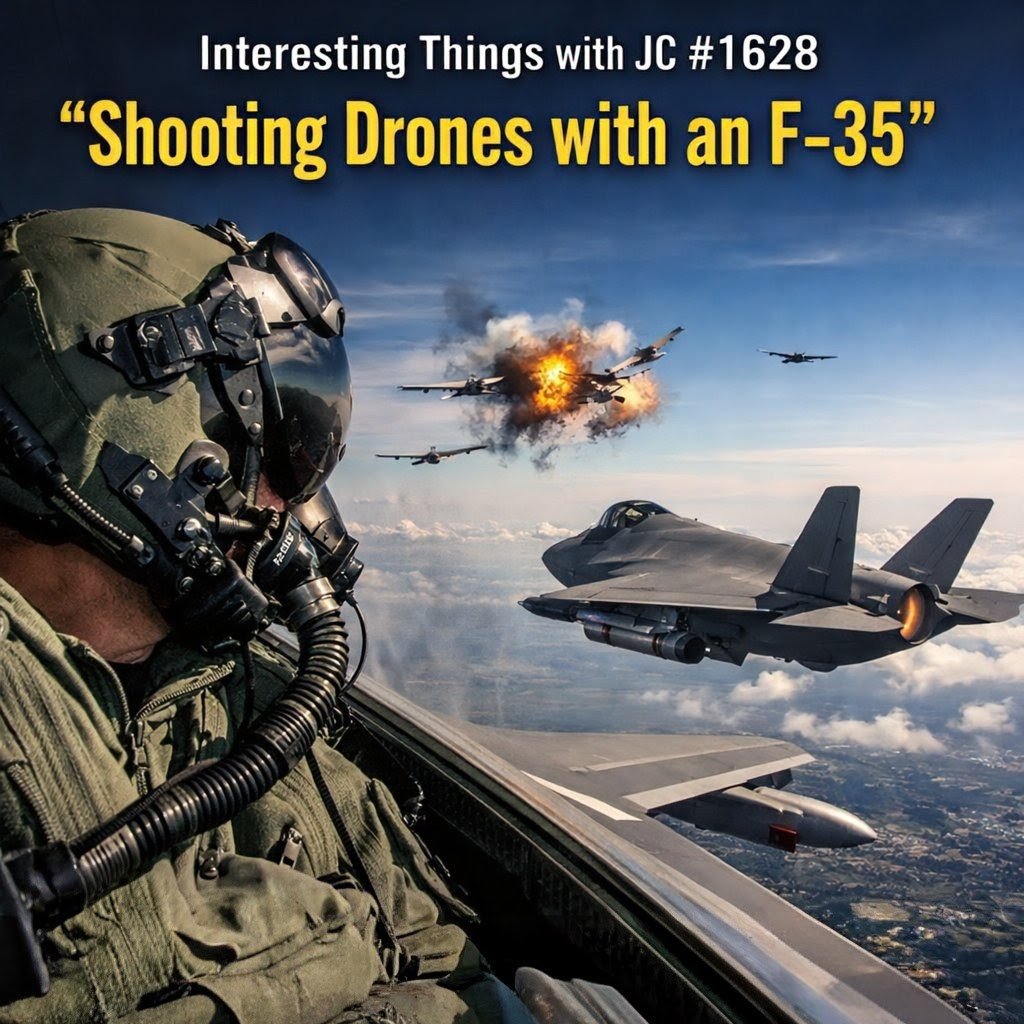
Graphic for Interesting Things with JC episode 1628, titled “Shooting Drones with an F-35.” A pilot wearing a flight helmet is seen inside a cockpit in the foreground, while an F-35 flies near several drones and a midair explosion above clouds.
Transcript
Interesting Things with JC #1628:
"Shooting Drones with an F-35"
At altitude, a pilot eases the throttle back and holds it there, because the target ahead of him is moving slower than a car on the highway, and if he closes too fast, the shot disappears before it ever forms.
The aircraft wants to accelerate. Everything about it is built for that. But in this moment, control means resisting that instinct and matching something that was never meant to be chased by a fighter.
What makes the intercept possible isn’t speed, it’s how the aircraft builds a picture. The F-35 is constantly combining radar returns, infrared signatures, and optical tracking into a single solution. A small drone doesn’t present much on its own, but it still gives off heat, movement, and shape, and from altitude those fragments get fused into a stable track the pilot can trust.
That track carries more than position. It holds direction, closure rate, and a predicted path forward, which lets the pilot solve the intercept before the aircraft ever gets close. The goal is to stay outside the drone’s envelope, hold the geometry, and release a weapon that already has a clean solution the moment it leaves the rail.
That’s where the system hands off to the pilot.
He’s managing closure, angle, and timing together, because the aircraft can overtake the target in seconds if the approach isn’t controlled. Too much speed and the intercept turns into a pass. Too little and the geometry falls apart. The shot only works if all three line up at once, and the decision to fire sits on that alignment.
In small numbers, it stays controlled. One or two drones can be found, tracked, and engaged from advantage, often without the target ever reacting.
But these systems are not used one at a time.
They’re launched in groups, spaced and timed to arrive together, forcing the defender to work multiple tracks at once. The F-35 carries a limited number of missiles when it’s operating in a low-observable configuration, and each engagement removes one from the aircraft.
The drones don’t carry that limit.
So the problem shifts from solving a single intercept to managing a sequence under constraint. The aircraft can still find targets, still build tracks, still produce clean shots, but it cannot stay on station indefinitely and it cannot engage everything it sees.
What remains is timing, selection, and discipline under pressure, because every shot has to count before the aircraft runs out of weapons and has to leave the fight.
These are interesting things, with JC.
Student Worksheet
Comprehension
What problem does the pilot face when chasing a drone that moves much slower than the fighter?
What three kinds of information does the episode say the F-35 combines into one track?
What does the track provide besides position?
Why can too much speed ruin the intercept?
Why does the problem change when drones arrive in groups?
Analysis
Explain why this episode argues that control matters more than raw speed. Use at least two details from the transcript.
Describe how sensor fusion helps a pilot trust a target track even when the drone is small.
Compare the challenge of intercepting one drone with the challenge of defending against a group.
Identify the main constraints in the episode and rank them from most important to least important. Defend your ranking.
Reflection
Where else in life do people need to make careful decisions under resource limits?
What is one example from school, sports, work, or daily life where using all your resources at once would be a bad strategy?
Difficulty Scaling
Core: Answer questions 1–5 in complete sentences.
Standard: Complete all comprehension and analysis questions.
Advanced: Add a short paragraph explaining how engineering design and human judgment work together in this episode.
Student Output Expectations
Use complete sentences.
Support analysis answers with evidence from the transcript.
For advanced responses, write one well-structured paragraph of 6–8 sentences.
Academic Integrity Guidance
Use your own words unless directly quoting the transcript.
If you quote, copy the line exactly and place it in quotation marks.
Do not invent technical claims that were not discussed in class or in the episode.
Teacher Guide
Quick Start: Play the episode once without interruption. On the second pass, pause after each major idea: slow approach, fused tracking, geometry, and multi-drone limits.
Pacing Guide (Audio-First):
Bell ringer and prediction: 5 minutes
First listen: 4–5 minutes
Vocabulary and concept check: 8 minutes
Second listen with pauses: 10 minutes
Worksheet work time: 12–15 minutes
Discussion and formative check: 8–10 minutes
Exit ticket: 3 minutes
Bell Ringer: Write this on the board: “Why might a very fast aircraft struggle to hit a much slower target?” Have students answer before hearing the episode.
Audio Guidance: Tell students to listen for the moment when speed becomes a disadvantage and for each limit placed on the aircraft.
Audio Fallback: If audio is unavailable, read the transcript aloud twice. First for flow, second with pauses for annotation.
Time on Task: 45–55 minutes, adaptable to a shorter 30-minute discussion lesson or a longer 70-minute analysis block.
Materials:
Episode audio or printed transcript
Student worksheet
Board or projector
Highlighters or annotation tools
Vocabulary Prep: Preteach sensor fusion, closure rate, and intercept geometry. Students do not need advanced math, but they should understand relative motion.
Misconceptions:
Faster always means easier.
Detecting a target is the same as being ready to fire.
One advanced aircraft can solve every drone threat by itself.
More technology removes the need for human judgment.
Discussion Prompts:
Why does the pilot have to resist what the aircraft naturally wants to do?
Which matters more in this episode: seeing the target or solving the timing?
Why does a swarm or grouped attack change the defender’s job?
What does the episode suggest about the limits of even top-tier technology?
Formative Checks:
Ask students to define closure rate in their own words.
Have pairs sketch a simple intercept with arrows showing target path and fighter path.
Ask for one sentence explaining why limited missiles matter.
Differentiation:
Provide a vocabulary bank and sentence stems for emerging learners.
Allow verbal answers before written responses.
Invite advanced learners to model the tradeoff between speed and overshoot using diagrams.
Assessment Differentiation:
Core learners may answer one open-ended prompt instead of two.
Advanced learners may compare this episode to missile defense or air traffic control decision-making.
Time Flexibility: The lesson can be split into two days: Day 1 for audio and concepts, Day 2 for analysis and assessment.
Substitute Readiness: The transcript allows full lesson delivery even without prior subject expertise. Focus on relative motion, decision-making, and limited resources.
Engagement Strategy: Use a “faster is not always better” hook. Many students expect speed to solve the problem; the episode overturns that assumption.
Extensions:
Connect to physics by graphing relative speed and closure.
Connect to engineering by mapping how multiple sensors improve reliability.
Connect to ethics and civics by discussing why high-stakes systems require disciplined use.
Cross-Curricular:
Physics: relative motion, vectors, closure
Engineering: systems integration, tradeoffs
Computer science: data fusion and decision support
ELA: evidence-based explanation
SEL: Emphasize calm decision-making, restraint, and disciplined thinking under pressure.
Skill Emphasis: Systems thinking, close listening, evidence-based reasoning, technical vocabulary, and decision analysis.
Answer Key:
Bell Ringer: Because a fast aircraft can close too quickly, overshoot, lose geometry, or turn the shot into a pass.
Comprehension 1: The pilot risks closing too fast and losing the shot before it forms.
Comprehension 2: Radar, infrared, and optical tracking.
Comprehension 3: Direction, closure rate, and predicted path.
Comprehension 4: Excess speed turns the intercept into a pass and breaks timing and angle control.
Comprehension 5: Multiple drones force the defender to manage several tracks while dealing with limited missiles and limited time on station.
Analysis sample points:
Control matters more than speed because the fighter is naturally faster than the target, yet success depends on matching motion and preserving geometry.
Sensor fusion helps by combining weak signals into a more stable and trusted track.
One drone is a single intercept problem; many drones become a resource-management problem.
Strong answers identify weapons count, time on station, and target prioritization as central constraints.
Quiz
Which idea is the main focus of the episode?
A. The F-35 is too slow to catch drones
B. The hardest part is building new drones in flight
C. A successful intercept depends on information, timing, and control
D. Drones cannot be detected by modern aircraftWhat does sensor fusion do in this lesson?
A. It increases the size of the aircraft engine
B. It combines different sensor inputs into one usable picture
C. It removes the need for a pilot
D. It turns a drone into a missileWhy can too much speed be a problem during the intercept?
A. It makes the aircraft invisible
B. It causes the drone to speed up
C. It can turn the intercept into a pass
D. It reduces the aircraft’s altitude immediatelyWhich constraint becomes especially important when drones arrive in groups?
A. Paint color
B. Missile supply
C. Pilot age
D. Runway lengthWhat does the episode suggest about advanced technology?
A. It removes all limitations
B. It guarantees success without judgment
C. It still depends on disciplined human choices
D. It works only against large targets
Assessment
Open-Ended Questions:
Explain how the episode uses the idea of “restraint” to teach something important about technology and skill.
Why does the problem of drone defense change from interception to prioritization when many targets appear at once?
3–2–1 Rubric:
3: Clear, accurate explanation using multiple details from the episode; shows strong understanding of constraints and reasoning.
2: Mostly accurate explanation using at least one supporting detail; shows partial understanding.
1: Limited or unclear explanation; few or no supporting details; misunderstanding of key concepts.
Exit Ticket:
Write one sentence completing this idea: “The episode shows that the most powerful system in the sky can still be limited by __________.”
Standards Alignment
NGSS HS-ETS1-1: Students analyze the drone-intercept problem by identifying criteria and constraints, including closure rate, weapon limits, time on station, and the need to engage multiple targets. This directly matches the standard’s focus on specifying qualitative and quantitative criteria and constraints for solutions.
NGSS HS-ETS1-2: Students break a complex aerospace problem into smaller engineering problems: detection, tracking, intercept geometry, timing, and resource management. This matches the standard’s requirement to design a solution to a complex real-world problem by dividing it into manageable parts.
NGSS HS-ETS1-3: Students evaluate response options and tradeoffs by discussing which targets to prioritize and why limited missiles and limited station time matter. This aligns with evaluating solutions using prioritized criteria and tradeoffs under constraints such as safety and reliability.
NGSS HS-ETS1-4: Extension students can model intercept outcomes with simple simulations or diagrams showing overshoot, timing windows, and changing geometry. This aligns with using simulation to model the impact of proposed solutions in systems with multiple interacting constraints.
CCSS.ELA-LITERACY.RST.9-10.2 / RST.11-12.2: Students determine the central ideas of a technical text and accurately summarize the episode’s explanation of sensor fusion, closure rate, and intercept logic. The Common Core specifically calls for determining central ideas or conclusions and summarizing technical information accurately.
CCSS.ELA-LITERACY.RST.11-12.7: Students integrate information from transcript language, teacher diagrams, and optional charts or simulations to explain how geometry affects an intercept. This matches the standard on integrating and evaluating information in diverse formats and media to solve a problem.
CCSS.ELA-LITERACY.RST.11-12.9: Students synthesize the episode with outside technical sources on F-35 sensor fusion and drone-swarm challenges to build a coherent explanation of the broader defense problem.
CCSS.ELA-LITERACY.WHST.9-10.1 / WHST.11-12.1: Students write evidence-based arguments about why speed alone does not solve the intercept problem and how resource constraints change decision-making. The writing standards call for discipline-specific arguments supported by relevant data and evidence.
CCSS.ELA-LITERACY.WHST.9-10.2 / WHST.11-12.2: Students write informative explanations describing the technical process of detection, track-building, and engagement, using domain-specific vocabulary accurately.
ISTE Student Standard 1.5.a, 1.5.b, 1.5.c: Students define the problem, identify relevant data, and decompose a complex system into component parts such as sensors, tracking, geometry, and weapons management. Those indicators are explicitly named in the ISTE Student Standards for Computational Thinker.
C3 Framework Dimension 1 and Dimension 3: Students develop questions about technical claims, evaluate evidence from transcript and source material, and use that evidence to explain how systems behave under operational limits. The C3 Inquiry Arc emphasizes developing questions, evaluating sources, and using evidence.
Career Readiness: Students practice systems thinking, evidence-based communication, prioritization, and decision-making under constraint. These are directly reinforced by the engineering, literacy, inquiry, and computational-thinking standards above.
Homeschool/Lifelong Learning: The lesson supports independent reading of a technical transcript, vocabulary development, structured questioning, and written explanation without requiring specialized lab equipment. That fits the lesson’s modular, discussion-based design and the cross-disciplinary literacy expectations in science and technical subjects.
Show Notes
This lesson uses a high-interest aviation scenario to teach students that advanced technology does not remove the need for careful judgment. By focusing on sensor fusion, closure rate, and limited resources, the episode turns a dramatic defense topic into a grounded study of systems thinking, physics, and real-world decision-making.
References
Lockheed Martin. (2024, March 14). Outsight In: F-35 sensor fusion in focus. https://www.f35.com/f35/news-and-features/f35-sensor-fusion-in-focus.html
U.S. Air Force Nuclear Weapons Center. (n.d.). F-35A Lightning II. https://www.afnwc.af.mil/About-Us/Fact-Sheets/Article/2074660/f-35a-lightning-ii/
Lockheed Martin. (n.d.). 5th Gen capabilities. https://www.f35.com/f35/about/5th-gen-capabilities.html
U.S. Government Accountability Office. (2023, September 14). Science & tech spotlight: Drone swarm technologies (GAO-23-106930). https://www.gao.gov/assets/gao-23-106930.pdf
U.S. Government Accountability Office. (2023, April 17). Directed energy weapons: DOD should focus on transition challenges to field capabilities for military operations and broader agency missions (GAO-23-105868). https://www.gao.gov/assets/gao-23-105868.pdf