1627: "British Columbia Tree Seed Centre"
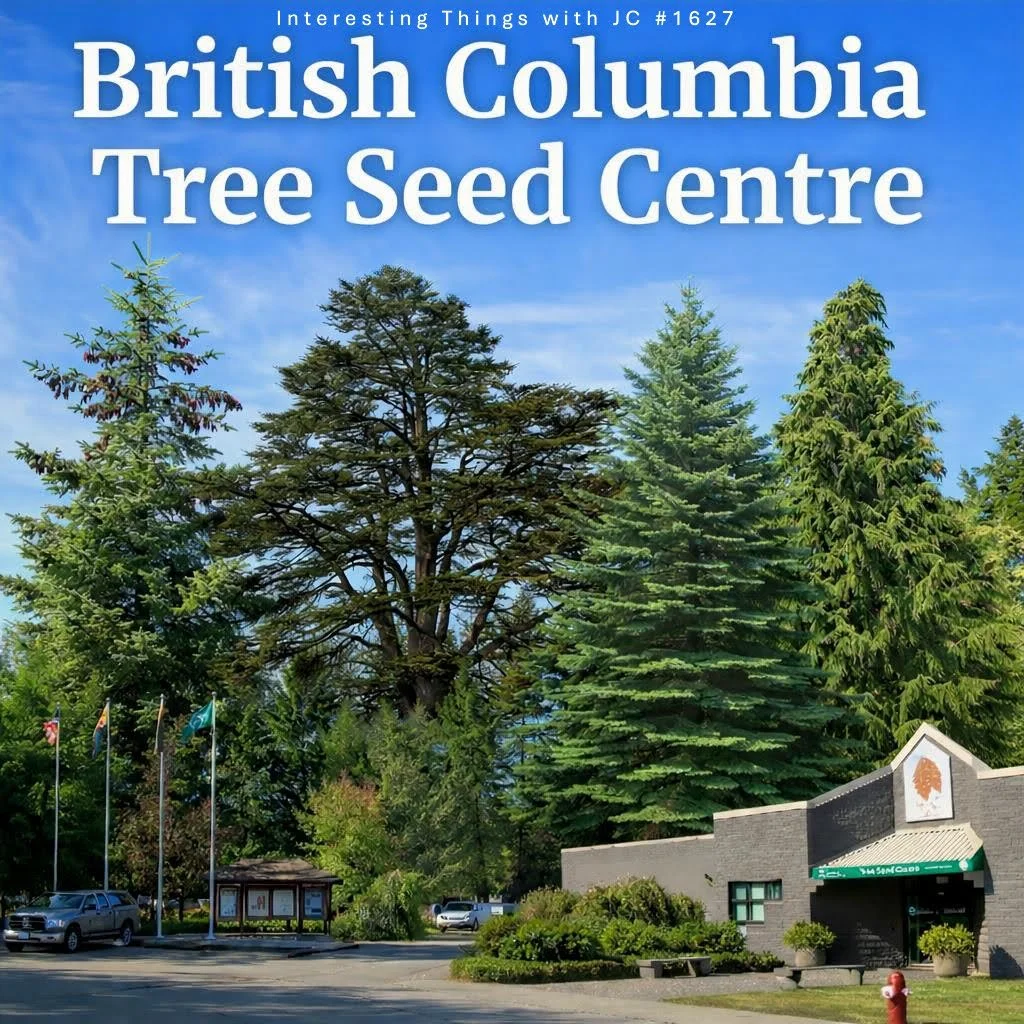
British Columbia Tree Seed Centre
Interesting Things with JC #1627 - A government seed bank stores millions of tree seeds labeled by exact origin while forests are already being cut and replanted, and every new hillside is rebuilt using seeds matched not by species alone but by the specific elevation and climate they came from, repeating this selection every time land is cleared.
Curriculum - Episode Anchor
Episode Title: British Columbia Tree Seed Centre
Episode Number: 1627
Host: JC
Audience: Grades 9–12, Introductory College, Homeschool, Lifelong Learners
Subject Area: Environmental Science / Forestry / Geography
Lesson Overview
Students investigate how scientific systems use geographic and biological data to restore forests with precision.
Objectives:
Explain how seed provenance affects tree survival and ecosystem stability
Describe the full lifecycle of seed collection, processing, storage, and deployment
Analyze how environmental variables influence plant adaptation
Evaluate how government-managed systems support sustainable resource use
Essential Question: Why is matching seed origin to environment essential for long-term forest survival?
Success Criteria: Students can explain provenance-based planting, describe storage processes, and justify outcomes using environmental reasoning
Student Relevance Statement: Students connect ecological science to real-world land use decisions and environmental responsibility
Real-World Connection: Forestry management, conservation science, and climate adaptation rely on data-driven biological systems
Workforce Reality: Careers demand precision, documentation, long-term planning, and environmental accountability under changing conditions
Key Vocabulary
Reforestation (ree-for-uh-STAY-shun): Replanting trees in cleared or damaged areas
Seed Bank (seed bank): Controlled facility storing seeds for future planting
Provenance (PROV-uh-nuhns): The geographic origin of a seed
Viability (vy-uh-BIL-ih-tee): Ability of a seed to germinate and grow
Elevation (el-uh-VAY-shun): Height above sea level influencing climate
Climate Zone (KLY-mit zohn): Region defined by long-term weather patterns
Douglas Fir (DUG-lus fur): A major commercial and ecological tree species
Germination (jer-muh-NAY-shun): The process of a seed beginning to grow
Adaptation (ad-ap-TAY-shun): Traits that improve survival in specific conditions
Narrative Core
Open: A sealed metal door in a forest holds millions of future trees, each waiting for the right place to grow.
Info: The British Columbia Tree Seed Centre exists to ensure forests are rebuilt using seeds matched precisely to their original environments.
Details: Seeds are collected from known locations, labeled by elevation, latitude, and climate, then processed and stored under controlled conditions to preserve viability for decades.
Reflection: Forest recovery is not random—it depends on scientific accuracy, environmental data, and long-term planning.
Closing: These are interesting things, with JC.
Transcript
Interesting Things with JC #1627:
"British Columbia Tree Seed Centre"
A metal door sits in the middle of a forest outside Surrey, British Columbia, and behind it are millions of trees that don’t exist yet.
Inside, the British Columbia Tree Seed Centre is the province’s seed bank for reforestation, built and run by the government of British Columbia to support one job: rebuilding forests inside British Columbia. The seeds here are not collected for global use. They are selected, tracked, and stored to go back into the ground they came from, or somewhere very close to it.
Each seed is part of that system.
Every one is labeled by elevation, latitude, and climate zone, tied to where it came from. Not just species, but origin. A Douglas fir from a coastal valley is not the same as one from a dry interior slope once you see how they grow.
By the early 20th century, logging in British Columbia was moving faster than forests could recover. Fires, clear-cutting, and uneven replanting left areas without the right conditions for regrowth. Trees returned, but not always the right ones, and not always strong enough to last.
So the province built a system around seeds. Cones were collected from known locations. Seeds were extracted, cleaned, tested, and dried to precise levels before being sealed and stored just above freezing, where they can remain viable for decades. Today, the centre holds tens of millions of seeds, each one matched to the type of land it is meant for.
Foresters do not just ask what to plant. They ask where the seed came from and where it is going. A seed from 1,000 meters in a colder climate can fail near sea level. One from a warmer region can grow too fast and become vulnerable to frost. Each seed lot carries a record of the conditions it is built to handle.
When a hillside is cleared, or a stand goes down, the replacement forest does not begin with a guess.
It begins with a labeled seed, pulled from storage, matched to that ground, chosen because it comes from conditions that fit that place.
These are interesting things, with JC.
Student Worksheet
Comprehension Questions:
What is the primary purpose of the Tree Seed Centre?
What specific information is recorded for each seed?
How are seeds preserved for long-term storage?
Analysis Questions:
Explain why two trees of the same species may perform differently in different environments.
How does this system reduce failure in reforestation efforts?
Reflection Prompt:
Why is long-term planning necessary when restoring natural systems?
Difficulty Scaling:
Basic: Define key terms and identify concepts
Intermediate: Explain relationships between environment and growth
Advanced: Evaluate system effectiveness and predict outcomes
Student Output:
Short-answer responses (3–5 sentences each)
One analytical paragraph (5–7 sentences)
Academic Integrity Guidance:
Use original wording
Support answers with evidence from the transcript
Avoid copying full sentences
Teacher Guide
Quick Start: Play the audio and ask students to identify why location matters in biology
Pacing Guide (Audio-First):
Bell Ringer (5 min)
Audio Listening (5 min)
Guided Discussion (10 min)
Worksheet Completion (20 min)
Bell Ringer: What could go wrong if trees are planted without considering environment?
Audio Guidance: Pause after seed labeling section to reinforce provenance
Audio Fallback: Teacher reads transcript aloud with emphasis on key sections
Time on Task: 40 minutes
Materials: Audio or transcript, worksheet, board/notes
Vocabulary Strategy: Pre-teach using real-world examples (local plants)
Misconceptions:
Species alone determines success
All environments support similar growth
Faster growth is always better
Discussion Prompts:
Why track elevation and climate instead of just species?
How does this system reduce waste and failure?
Formative Checkpoints:
Check student explanations during discussion
Review worksheet responses for accuracy
Differentiation:
Provide sentence starters for support
Offer extension research on local ecosystems
Assessment Differentiation:
Allow verbal explanation or visual diagram
Time Flexibility:
Extend discussion or assign worksheet as homework
Substitute Readiness:
Fully scripted with transcript and prompts
Engagement Strategy:
Problem-based scenario: “Restore a damaged forest”
Extensions:
Compare global seed banks vs regional systems
Cross-Curricular Connections:
Biology (adaptation), Geography (climate zones), Environmental science
SEL Connection:
Stewardship and responsibility for shared natural system
Skill Value Emphasis:
Data interpretation, systems thinking, environmental reasoning
Answer Key:
Seeds must match environmental conditions to survive
Storage preserves viability over decades
Incorrect placement leads to weak or failed growth
Quiz
What is the main purpose of the Tree Seed Centre?
A. Export seeds globally
B. Store and match seeds for reforestation
C. Study wildlife
D. Produce lumberWhat determines where a seed should be planted?
A. Color
B. Size
C. Origin conditions
D. AgeWhy are seeds stored just above freezing?
A. To stop all biological processes permanently
B. To preserve viability over time
C. To make them grow faster
D. To change their geneticsWhat is a risk of planting seeds in the wrong location?
A. Faster growth
B. Improved strength
C. Failure or vulnerability
D. Increased biodiversityWhat does “provenance” refer to?
A. Soil quality
B. Seed origin
C. Tree height
D. Climate change
Assessment
Open-Ended Questions:
Describe how environmental factors influence the success of reforestation efforts.
Explain the role of data and record-keeping in managing natural resources effectively.
Rubric (3–2–1):
3: Complete, accurate explanation with clear evidence and reasoning
2: Partial explanation with some correct ideas
1: Minimal or unclear understanding
Exit Ticket:
Identify one environmental factor that affects tree growth and explain its impact.
Standards Alignment
NGSS HS-LS2-7: Design, evaluate, and refine solutions for reducing impacts of human activities on biodiversity; students analyze reforestation systems as a solution
NGSS HS-LS4-4: Construct explanations based on evidence for how natural selection leads to adaptation; students connect seed origin to survival outcomes
NGSS HS-ESS3-3: Create computational or conceptual models to simulate impacts of resource management; students evaluate forestry systems
CCSS RST.9-10.2: Determine central ideas of scientific texts; students extract key concepts from the transcript
CCSS WHST.9-10.2: Write informative texts; students produce structured explanations of ecological systems
CCSS SL.9-10.1: Initiate and participate in collaborative discussions; students engage in guided discussion
ISTE 4 (Innovative Designer): Use data to solve real-world environmental problems; students analyze seed matching systems
ISTE 5 (Computational Thinker): Understand data-driven systems; students interpret environmental variables
C3 D2.Geo.4.9-12: Analyze relationships between environmental characteristics and human activity; students evaluate reforestation decisions
C3 D2.Geo.8.9-12: Evaluate human population and resource use impacts; students connect forestry practices to sustainability
Career Readiness: Apply scientific data and environmental knowledge to resource management scenarios
Homeschool/Lifelong Learning: Build independent understanding of ecological systems and human-environment interaction
Show Notes
This lesson demonstrates how reforestation depends on precision, not guesswork. By examining how seeds are matched to their original environments, students see how science, data, and long-term planning are used to rebuild ecosystems responsibly and effectively.
References
British Columbia Ministry of Forests. (n.d.). Tree Seed Centre. Province of British Columbia. https://www2.gov.bc.ca/gov/content/industry/forestry/managing-our-forest-resources/tree-seed/tree-seed-centre
British Columbia Ministry of Forests. (n.d.). Tree seed. Province of British Columbia. https://www2.gov.bc.ca/gov/content/industry/forestry/managing-our-forest-resources/tree-seed
British Columbia Ministry of Forests. (n.d.). Chief Forester's Standards for Seed Use. Province of British Columbia. https://www2.gov.bc.ca/gov/content/industry/forestry/managing-our-forest-resources/tree-seed/legislation-standards/chief-forester-s-standards-for-seed-use
British Columbia Ministry of Forests. (n.d.). Seed planning zones. Province of British Columbia. https://www2.gov.bc.ca/gov/content/industry/forestry/managing-our-forest-resources/tree-seed/seed-planning-use/seed-planning-chronology/seed-planning-zones
British Columbia Ministry of Forests. (n.d.). Cone and seed processing. Province of British Columbia. https://www2.gov.bc.ca/gov/content/industry/forestry/managing-our-forest-resources/tree-seed/tree-seed-centre/cone-seed-processing
O’Neill, G. (2017). A proposed climate-based seed transfer system for British Columbia (Technical Report 099). British Columbia Ministry of Forests, Lands and Natural Resource Operations. https://www2.gov.bc.ca/assets/gov/farming-natural-resources-and-industry/forestry/tree-seed/climate-based-seed-transfer/tr099.pdf
Ying, C. C., & Yanchuk, A. D. (2006). The development of British Columbia's tree seed transfer guidelines: Purpose, concept, methodology, and implementation. Forest Ecology and Management, 227(1-2), 1-13. https://www.sciencedirect.com/science/article/abs/pii/S0378112706001046
Vancouver Sun. (2018, October 2). B.C.'s tree seed bank plants hundreds of millions each year. https://vancouversun.com/news/local-news/b-c-s-tree-seed-bank-plants-hundreds-of-millions-of-seedlings-each-year
Forest Genetics Council of British Columbia. (2024). Tree Seed Centre update [Presentation]. https://forestgeneticsbc.ca/wp-content/uploads/2024/02/9-Dave-Kolotelo-Tree-Seed-Centre-Update.pdf