Interesting Things with JC #1626: "Can You Hear Electricity?" – A glass globe spins under a hand in a London lab as charge builds and sharp snaps break the air, but the sound isn’t electricity and the same effect continues from lab sparks to lightning strikes to power lines as air keeps expanding under sudden energy.
Curriculum - Episode Anchor
Episode Title: Can You Hear Electricity
Episode Number: 1626
Host: JC
Audience: Grades 9–12, introductory college, homeschool, lifelong learners
Subject Area: Physics / Electricity / Waves / Engineering
Lesson Overview
Objectives:
Explain why electrical events can produce sound without electricity itself being directly audible.
Describe how rapid heating, vibration, and material deformation create clicks, hums, whines, hisses, and thunder.
Compare static discharge, lightning, dimmers, chargers, and transmission lines as examples of the same cause-and-effect chain.
Apply vocabulary about sound waves, electric discharge, alternating current, resonance, and magnetostriction to real systems.
Essential Question: If electricity is silent, why do so many electrical systems make noise?
Success Criteria: Students can trace at least three examples from electric activity to a physical response in matter to a sound heard in air, using accurate scientific vocabulary.
Student Relevance Statement: Students hear chargers, lights, storms, and power lines regularly. This lesson turns familiar sounds into a way of understanding unseen physical processes.
Real-World Connection: Electricians, audio engineers, utility workers, electronics designers, and safety inspectors all need to identify whether a sound signals normal operation, inefficiency, or a hazard.
Workforce Reality: In technical fields, unusual noise is often an early clue. Professionals are expected to connect sound to heat, vibration, field effects, and material behavior without guessing.
Key Vocabulary
Static electricity(STAT-ik ih-lek-TRIS-ih-tee): Electric charge that builds up on a surface rather than flowing continuously through a circuit.
Discharge(dis-CHARJ): A sudden movement of electric charge from one place to another.
Pressure wave(PRESH-er wayv): A traveling disturbance in a medium such as air; sound is a pressure wave.
Ionization(eye-uh-nuh-ZAY-shun): The process of knocking electrons free from atoms or molecules, creating charged particles.
Alternating current (AC)(AWL-ter-nay-ting KUR-ent): Electric current that reverses direction periodically.
Hertz(hurts): A unit of frequency meaning cycles per second.
Resonance(REZ-uh-nuns): Increased vibration that occurs when a system is driven near one of its natural frequencies.
Magnetostriction(mag-NEE-toh-STRIK-shun): A change in the shape or dimensions of magnetic materials when magnetized.
Corona discharge(kuh-ROH-nuh dis-CHARJ): Partial electrical breakdown of air around a high-voltage conductor.
Shockwave(SHOK-wayv): A strong pressure disturbance created when matter expands or compresses extremely rapidly.
Narrative Core
Open: A spark snaps. A dimmer buzzes. A charger whines. Thunder rolls. It can seem like electricity has a sound.
Info: But electricity itself is silent. What we hear is matter reacting. Air heats and expands. Metals and magnetic materials vibrate. Structures resonate. The sound comes from the response, not the charge alone.
Details: In Francis Hauksbee’s early electrostatic experiments, friction built charge on a spinning glass globe and produced visible discharge and sharp snaps. In lightning, the same basic process happens on a much larger scale when air is heated almost instantly and becomes thunder. In homes, dimmers and chargers can create vibrations in bulbs, coils, transformers, or nearby structures. On transmission lines, corona discharge can produce a hiss or crackle as air partially ionizes around conductors.
Reflection: Different sounds can come from very different systems, yet the pattern stays the same: electrical energy changes the behavior of materials, and those material changes create vibrations that travel through air.
Closing: These are interesting things, with JC.
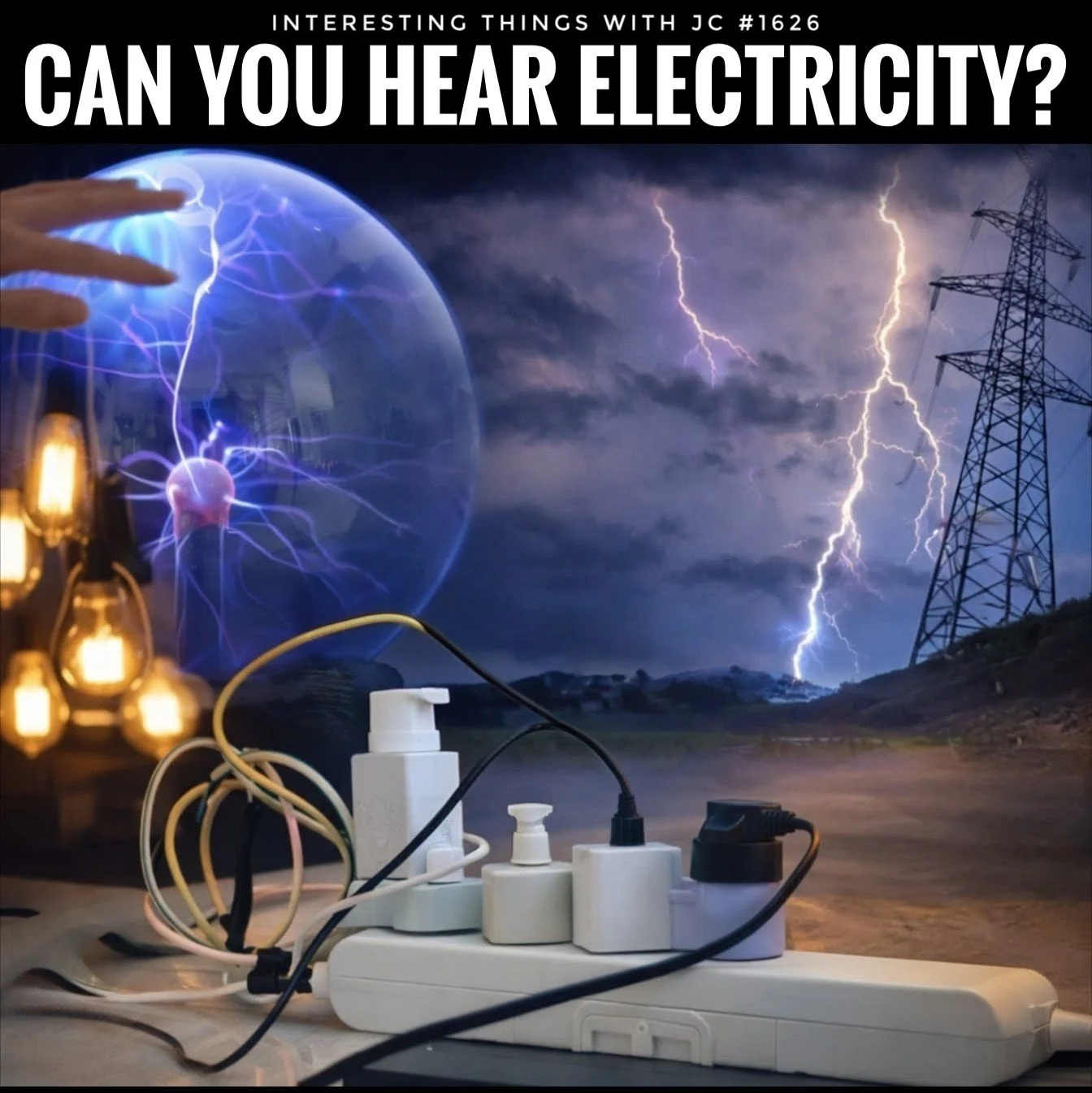
A composite educational image illustrates different ways electricity produces sound. On the left, a glowing plasma globe emits branching purple and blue arcs as a hand reaches toward it. In the foreground, a white power strip holds multiple plugs and phone chargers with tangled cords. To the far left, several warm incandescent light bulbs glow softly. In the background, a dark stormy sky shows bright lightning bolts striking near a tall electrical transmission tower. Across the top, bold text reads: “CAN YOU HEAR ELECTRICITY?”
Transcript
Interesting Things with JC #1626:
"Can You Hear Electricity"
A glass globe spins on a hand crank in London in the early 1700s. As the charge builds, it crackles.
It sounds like electricity.
It isn’t.
In that room, Francis Hauksbee is generating static electricity by friction, rotating a glass sphere while pressing his hand against it. The globe glows from ionized gas inside, and as the charge builds and jumps, it produces sharp snaps.
What you’re hearing is not electricity itself.
When a discharge jumps, it heats the surrounding air almost instantly. The air expands rapidly, creating a pressure wave. That wave is sound. A small discharge makes a faint click. A larger one produces a louder crack.
The sound is the air reacting.
By the mid-1700s, Benjamin Franklin demonstrates that lightning is electrical in nature. A lightning channel heats the air to roughly 30,000 kelvin in microseconds. The air expands violently, creating the shockwave we hear as thunder, the same process, scaled up from a faint snap in a lab to a roar across the sky.
Now bring it into everyday systems.
An incandescent lamp on a dimmer can produce a low buzz. In the U.S., alternating current runs at 60 hertz, with power fluctuating at 120 hertz. The chopped waveform from the dimmer creates magnetic forces and vibrations, sometimes in the filament itself, often in the bulb structure or dimmer components, producing that familiar hum.
A phone charger shifts the frequency.
Modern chargers convert power using high-frequency switching, typically between 20,000 and 100,000 hertz. Inside, inductors and transformers experience rapidly changing magnetic fields. Those fields cause microscopic shape changes in the materials, a phenomenon called magnetostriction. The resulting vibrations, often through resonance or lower-frequency byproducts, produce a faint audible whine.
Lower frequency? You hear a buzz. Higher frequency effects? You hear a whine.
Same chain.
Electric current flows. Materials respond. Air carries the vibration.
Scale it again to transmission lines.
High-voltage lines create electric fields strong enough to ionize the surrounding air, producing corona discharge. Each micro-discharge heats and expands the air locally, creating a continuous hiss or crackle, especially in humid conditions.
Electricity itself is silent.
Every sound in this story is something else giving way under it: air expanding, metal shifting, materials deforming under force and snapping back in fractions of a second.
You don’t hear electricity.
You hear what it does to the world around it.
These are interesting things, with JC.
Student Worksheet
Comprehension Questions:
What is the main claim of the episode about electricity and sound?
What happens to air when an electrical discharge jumps?
Why does lightning produce thunder?
What device in the episode is used as an early example of static electricity?
What is corona discharge?
Analysis Questions:
Compare the sound from a small lab discharge with the sound from lightning. What process is the same, and what changes with scale?
Explain how a dimmer switch can lead to a buzz even though electric current itself is silent.
Describe how magnetostriction helps explain the faint whine from some phone chargers.
The episode says, “Same chain.” Write the chain in your own words using at least three steps.
Reflection Prompt:
Think of one sound from home, school, or outside that may be connected to electricity. What materials might be vibrating, heating, or deforming to create that sound?
Difficulty Scaling:
Support: Complete the sentence frame: “Electricity is silent, but it can cause sound when ______ reacts by ______.”
Core: Write one paragraph explaining one example from the episode.
Challenge: Create a short comparison explaining why buzz, whine, hiss, crackle, and thunder can all come from electrical systems without being “the sound of electricity.”
Student Output: Submit responses in complete sentences. For the challenge option, include at least four vocabulary terms correctly.
Academic Integrity Guidance: Use the episode and class discussion for evidence. Write explanations in your own words. Do not copy transcript lines as your final answer unless directly quoting with quotation marks.
Teacher Guide
Quick Start: Play the episode first. Ask students to listen for every place where sound appears. Then have them identify what is physically vibrating or expanding in each case.
Pacing Guide (audio-first):
Bell ringer and prediction: 5 minutes
First listen to episode: 4–5 minutes
Pair discussion: 5 minutes
Mini-lesson on sound as a pressure wave: 8 minutes
Worksheet work time: 12–18 minutes
Review and exit ticket: 5 minutes
Bell Ringer: Write on the board: “Can you hear electricity?” Students answer yes or no and give one example from daily life.
Audio Guidance: Tell students to listen for five examples: static snap, thunder, dimmer buzz, charger whine, transmission-line hiss.
Audio Fallback: If audio cannot be played, read the transcript aloud once, then have students annotate each sound source and its physical cause.
Time on Task: 40–50 minutes standard; compress to 30 minutes by using only comprehension and one analysis question; extend to 60 minutes by adding a waveform or resonance demo.
Materials:
Episode audio or printed transcript
Student worksheet
Board or projector
Optional speaker, bulb/dimmer image, charger image, or transmission-line image
Vocabulary Prep: Preteach discharge, pressure wave, resonance, alternating current, and magnetostriction. Have students sort terms into “electric process,” “material response,” and “sound result.”
Misconceptions:
Students may think electricity itself has a direct audible sound.
Students may think thunder is the sound of clouds colliding.
Students may assume a noisy charger always means danger.
Students may think every high-pitched sound is caused by the same mechanism.
Discussion Prompts:
Why is “you hear what it does to the world around it” a more accurate scientific statement?
How does scale change the sound from a tiny spark to thunder?
Why might the same electrical system sound different under different conditions?
How can sound help technicians diagnose a system?
Formative Checkpoints:
After listening, students name one sound and one physical cause.
Mid-lesson, students complete the chain: “Current or charge changes matter, matter vibrates or heats air, air carries sound.”
Before exit, students explain one example without using the phrase “because electricity is loud.”
Differentiation:
Provide a cause/effect chart for support learners.
Allow oral responses before written responses.
Challenge advanced students to distinguish direct heating effects from vibration/resonance effects.
Assessment Differentiation:
Support: one open-ended response with sentence frames.
Core: both open-ended responses in paragraph form.
Advanced: add a labeled diagram tracing energy transfer in one example.
Time Flexibility: The lesson works as a single class, advisory enrichment, homeschool mini-unit, or short college bridge activity.
Substitute Readiness: The transcript and worksheet are self-contained. A substitute can run the lesson by reading the transcript, using the bell ringer, and collecting the exit ticket.
Engagement Strategy: Use familiar sounds first. Students are more likely to understand the physics once they connect it to things they have actually heard.
Extensions:
Investigate why transformers often hum at twice line frequency.
Research why wet weather can increase audible noise near high-voltage lines.
Compare audible and non-audible frequencies in power electronics.
Cross-Curricular: Physics connects with engineering design, history of science, technical communication, and career education.
SEL: Students practice revising an intuitive idea when evidence shows a more accurate explanation.
Skill Value Emphasis: Observation, causal reasoning, evidence-based explanation, and technical vocabulary are core skills in science, trades, and engineering.
Answer Key:
Electricity itself is silent; sound comes from air or materials reacting to electrical activity.
The air heats quickly, expands, and creates a pressure wave.
Lightning heats air extremely fast, creating a shockwave heard as thunder.
Francis Hauksbee’s spinning glass globe/electrostatic generator.
Partial electrical breakdown of air around a high-voltage conductor.
Same process: rapid heating/response of matter creates sound; scale changes intensity from click to thunder.
A dimmer changes the waveform and can cause parts of the bulb or dimmer system to vibrate, producing a buzz.
Rapid magnetic changes can slightly deform magnetic materials; those vibrations can become audible as a whine.
Acceptable chain: electric charge/current changes material conditions → air or components heat/vibrate/deform → vibration moves through air as sound.
Reflection answers will vary if they identify a plausible reacting material and explain the sound pathway clearly.
Quiz
Which statement best matches the episode’s main idea?
A. Electricity always produces a natural hum.
B. Electricity is silent, but it can cause materials and air to create sound.
C. Thunder is caused by clouds scraping against each other.
D. Phone chargers create sound because electrons collide with speakers.What directly creates the sound from a small electrical spark?
A. The color of the spark
B. The electric field alone
C. Rapid expansion of heated air
D. Gravity pulling on the chargeIn the episode, magnetostriction is most closely connected to which example?
A. A kite in a storm
B. A phone charger’s faint whine
C. A glass globe glowing in London
D. A student speaking near a power outletWhat is corona discharge?
A. A total loss of power in a circuit
B. The cooling of metal in a transformer
C. Partial ionization of air around a high-voltage conductor
D. A mechanical switch turning off a lampWhy might a dimmer produce a buzz?
A. It adds extra sound waves to the room on purpose
B. It creates vibrations in components or bulb structures
C. It turns direct current into sound current
D. It removes all electrical resistance
Assessment
Open-Ended Questions:
Explain why the episode says, “You don’t hear electricity. You hear what it does to the world around it.” Use two examples from the episode.
Compare one heating-based example and one vibration-based example from the episode. How does each produce sound?
Rubric (3–2–1):
3: Response is accurate, uses evidence from the episode, applies vocabulary correctly, and clearly explains the full cause-and-effect chain.
2: Response is mostly accurate and includes some evidence, but the explanation is partial, simplified, or missing vocabulary precision.
1: Response shows limited understanding, contains major inaccuracies, or does not explain how sound is produced.
Exit Ticket: In one or two sentences, complete this idea: “Electricity is silent, but sound can happen when ______.”
Standards Alignment
NGSS HS-PS4-1: Use mathematical representations or explanations of wave behavior to show that sound is a wave produced by disturbances traveling through a medium; students identify sound as a pressure wave in air.
NGSS HS-PS3-2: Develop and use models to illustrate that energy at one scale can be described in terms of fields, motion, and interactions; students trace electrical energy into heating, vibration, and sound.
CCSS.ELA-LITERACY.RST.11-12.2: Determine the central ideas of a scientific text and summarize complex concepts accurately; students extract and restate the lesson’s main claim and supporting examples.
CCSS.ELA-LITERACY.WHST.9-12.2: Write informative explanations using precise language and domain-specific vocabulary; students explain causal chains from electric process to audible result.
C3 Framework D2.Sci.6.9-12: Use disciplinary reasoning to explain how scientific ideas help interpret phenomena; students use evidence and reasoning to explain snaps, thunder, hums, and whines.
ISTE 1.3 Knowledge Constructor: Students evaluate information from audio and class materials, organize it, and build an evidence-based explanation of a real-world phenomenon.
Career Readiness: Students practice diagnostic reasoning by linking observed sound to physical causes in electrical systems, a measurable skill in technical trades, maintenance, and engineering.
Show Notes
This lesson uses a short podcast episode to help students distinguish between electricity itself and the physical effects electricity causes in air and materials. By connecting static sparks, thunder, dimmers, chargers, and transmission lines, students build a practical understanding of waves, energy transfer, and system behavior. The topic matters because real scientific literacy often begins with reinterpreting common experiences more accurately.
References
Benjamin Franklin. (2026). In Encyclopaedia Britannica. https://www.britannica.com/biography/Benjamin-Franklin/Achievements-and-inventions
Bonneville Power Administration. (2025). South of Tri-Cities Reinforcement Project draft environmental assessment. https://www.bpa.gov/-/media/Aep/efw/nepa/active/south-of-tri-cities/20250501-draftEA-SOTC-web.pdf
Britannica. (2026). Electrostatic generator. https://www.britannica.com/technology/electrostatic-generator
Britannica. (2026). Francis Hauksbee, the Elder. https://www.britannica.com/biography/Francis-Hauksbee-the-Elder
Britannica. (2026). Magnetostriction. https://www.britannica.com/science/magnetostriction
Lutron Electronics. (n.d.). Maestro PRO troubleshooting guide. https://support.lutron.com/us/en/product/maestro/article/troubleshooting/MA-PRO-FAQ-Troubleshooting-Guide
National Oceanic and Atmospheric Administration. (2023, April 5). The sound of thunder. https://www.noaa.gov/jetstream/lightning/sound-of-thunder
Texas Instruments. (2014). UCC28950 / audible noise. https://e2e.ti.com/support/power-management-group/power-management/f/power-management-forum/424023/ucc28950-audible-noise