1625: "Radiation Experiments on Civilians"
Interesting Things with JC #1625: "Radiation Experiments on Civilians" – A man is already on the table when something is injected before his injuries are treated, and nothing appears wrong as his body quietly carries it while measurements continue. Others follow the same pattern without being fully told.
Curriculum - Episode Anchor
Episode Title: Radiation Experiments on Civilians
Episode Number: 1625
Host: JC
Audience: Grades 9–12, Introductory College, Homeschool, Lifelong Learners
Subject Area: Science, Ethics, History
Lesson Overview
Objectives:
Explain how radioactive materials interact with the human body over time
Analyze historical examples of human radiation experiments using evidence
Evaluate the role of informed consent in scientific research
Connect scientific data collection to ethical responsibility and regulation
Essential Question: How should scientific advancement be balanced with human rights and informed consent?
Success Criteria:
Students accurately describe radiation exposure effects (bone, tissue, DNA)
Students identify ethical concerns in historical case studies
Students construct evidence-based explanations of why consent is required
Student Relevance Statement: Medical research affects treatments, safety standards, and technologies students may encounter in healthcare or careers. Understanding past practices builds awareness of rights and protections.
Real-World Connection: Modern radiation safety standards in medicine, nuclear energy, and environmental protection are based on historical data, including early human exposure studies.
Workforce Reality: Careers in medicine, radiology, research, and engineering require strict adherence to ethical standards, documentation, and informed consent protocols.
Key Vocabulary
Radiation (ray-dee-AY-shun): Energy emitted as particles or waves, capable of affecting biological tissue
Plutonium (ploo-TOH-nee-um): A radioactive element used in nuclear reactions and weapons
Isotope (EYE-suh-tohp): Variants of elements with different neutron counts, often radioactive
Exposure (ik-SPOH-zhur): Contact with radiation or harmful substances
Bone Marrow (bohn MAIR-oh): Tissue inside bones that produces blood cells
DNA Damage (dee-en-AY DAM-ij): Harm to genetic material that can affect cell function
Informed Consent (in-FORMD kun-SENT): Permission given with full understanding of risks and purpose
Dosage (DOH-sij): Measured amount of a substance or radiation received
Sievert (SEE-vert): Unit measuring biological effect of radiation
Gray (gray): Unit measuring absorbed radiation dose
Narrative Core
Open: A patient lies on a table. Treatment is expected. But before anything begins, something is added, without explanation.
Info: During the 1940s through the 1970s, researchers sought to understand how radiation behaves inside the human body. Unknown variables required data—real data from living systems.
Details: Patients, children, and soldiers were exposed to radioactive substances or environments. Plutonium injections, iodine studies, and nuclear test observations all generated measurable data—tracking how radiation moved, accumulated, and affected biological systems. In many cases, participants were not fully informed.
Reflection: The data shaped modern radiation science—defining exposure limits, safety standards, and long-term biological effects. But it also raised a critical issue: can knowledge gained without consent be justified by its usefulness?
Closing: These are interesting things, with JC.
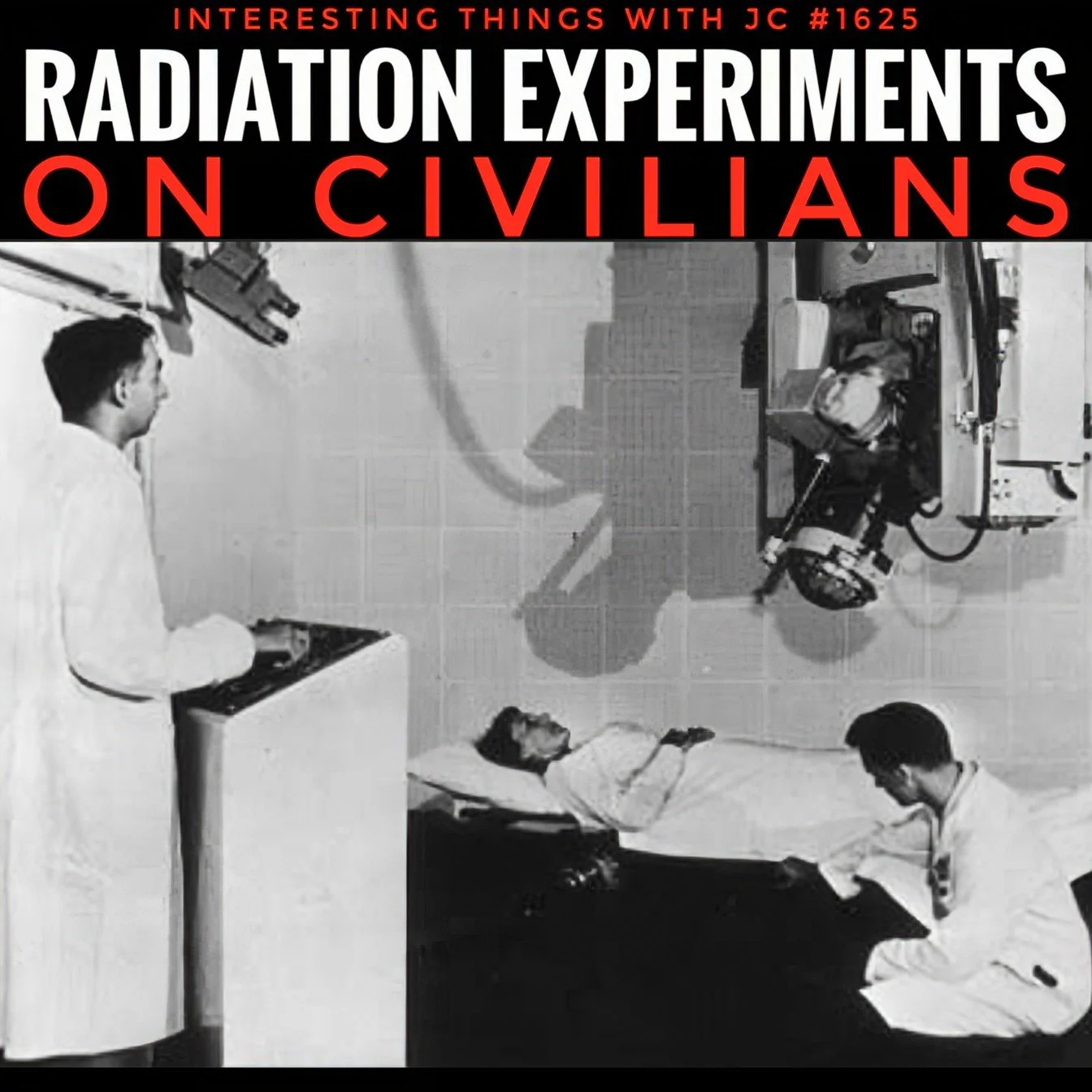
Black-and-white photo of a patient lying on a medical table while two clinicians operate a large radiation machine positioned above the body, with another clinician standing nearby; bold text above reads “Radiation Experiments on Civilians” and “Interesting Things with JC #1625.”
Transcript
Interesting Things with JC #1625:
Radiation Experiments on Civilians
They didn’t all know they were part of an experiment.
A patient goes in for treatment. A child is given a measured dose. A soldier is told to stand in position and watch the horizon. In each case, something else is happening. Data is being collected. Exposure is being measured. And the person at the center of it is not always told why.
In April 1945, at Oak Ridge, Tennessee, a construction worker named Ebb Cade is brought into a hospital with serious injuries. Before those injuries are fully treated, he is injected with plutonium without his knowledge. Doctors track it through his body, collecting blood, urine, bone, and teeth samples to see where it settles and how long it stays.
He is one of 18 patients injected with plutonium between 1945 and 1947.
But that is only one piece of a larger system.
Plutonium was new. No one knew how it behaved inside the human body over time. The questions were direct. How much sticks to bone. How much moves through organs. What stays, and for how long.
Animal studies could not answer it.
So the work moved into hospitals.
In Rochester, a patient named Albert Stevens is injected with plutonium after being misdiagnosed with terminal cancer. He lives more than 20 years, carrying one of the highest recorded levels of plutonium in the human body. Researchers track it the entire time.
Other studies follow the same pattern.
Radioactive iodine is given to children to measure how the thyroid absorbs it. At test sites in Nevada, during exercises like Operation Desert Rock, soldiers are placed near nuclear blasts. Trenches are dug about 6 to 8 feet deep, roughly 2 meters. They turn away, then watch the fireball rise. Some are later sent toward the blast area to simulate combat.
Distance. Exposure. Physical response. All recorded.
In hospitals, patients are exposed to total body radiation in the range of 100 to 300 rads, about 1 to 3 gray. At that level, the body begins to break down. Bone marrow damage. Immune suppression. Cell damage that does not fully repair.
Sometimes it is called treatment. Sometimes it is measurement.
The methods change. The pattern does not.
From the mid 1940s through the 1970s, several thousand radiation experiments involve civilians and service members. Some include consent. Some do not. In many cases, people are not fully told what is being done.
The people chosen are often those with the least ability to refuse. Hospital patients. Institutionalized children. Soldiers under orders.
The data becomes the foundation.
It defines exposure limits. It shapes how radiation is measured, in rem and later sieverts. It explains how radioactive material builds up in bone and damages DNA over time.
For years, much of this stays classified.
In 1994, President Bill Clinton orders a full investigation, creating the Advisory Committee on Human Radiation Experiments.
The findings are clear.
Thousands of people were involved. Some studies caused little harm. Others crossed the line, especially where there was no informed consent.
On October 3, 1995, Clinton issues a public apology, acknowledging that citizens had been used without their knowledge in certain cases. Some families receive compensation.
By then, the standard was already set by the Nuremberg Code, requiring voluntary consent.
But the data was already collected.
It came from blood, bone, and tissue. From isotopes tracked inside the body over years.
Measured. Recorded. Used.
And in many cases, never fully explained to the people involved.
These are interesting things, with JC.
Student Worksheet
Comprehension Questions:
What was the purpose of injecting plutonium into patients?
What types of data were collected from exposed individuals?
What physical effects can occur from high radiation exposure?
Who were commonly selected for these experiments?
Analysis Questions:
Why were animal studies considered insufficient for this research?
How did these experiments contribute to modern radiation safety standards?
What ethical principles were violated in these cases?
Reflection Prompt:
Should scientific knowledge gained without consent be used today? Explain your reasoning with evidence.
Difficulty Scaling:
Level 1: Identify key facts from the transcript
Level 2: Explain cause and effect relationships
Level 3: Evaluate ethical implications and justify a position
Student Output: Written responses (short answer + paragraph) with cited evidence from transcript
Academic Integrity Guidance: Responses must be original, based on provided material, and clearly explained in the student’s own words
Teacher Guide
Quick Start: Play the podcast first; students listen without notes, then replay with guided questions
Pacing Guide (audio-first):
Listen (5 min)
Guided discussion (10 min)
Worksheet completion (20 min)
Reflection and review (10 min)
Bell Ringer: What responsibilities do scientists have when testing new discoveries on humans?
Audio Guidance: Encourage active listening; pause at key sections for clarification
Audio Fallback: Provide printed transcript for silent reading and annotation
Time-on-Task: 45–60 minutes total
Materials: Audio device, transcript, worksheet, writing tools
Vocabulary Prep: Pre-teach “radiation,” “isotope,” and “informed consent” with examples
Misconceptions:
Radiation always causes immediate visible harm
All experiments were medically justified
Discussion Prompts:
Why might individuals not have been informed?
How should risk be communicated in science?
Formative Checkpoints:
Accurate use of vocabulary
Evidence cited in responses
Differentiation:
Provide sentence starters for emerging learners
Extend with research tasks for advanced students
Assessment Differentiation:
Oral responses or visual diagrams as alternatives
Time Flexibility: Can be split into two sessions (science + ethics focus)
Substitute Readiness: Transcript and worksheet allow independent completion
Engagement Strategy: Real-case storytelling to build curiosity and critical thinking
Extensions: Research modern radiation safety laws or medical imaging practices
Cross-Curricular: Science (biology), History (Cold War era), Ethics (philosophy)
SEL: Builds awareness of trust, responsibility, and human dignity
Skill Emphasis: Critical thinking, evidence evaluation, ethical reasoning
Answer Key:
Comprehension:
To study how plutonium moves and remains in the body
Blood, urine, bone, teeth samples
Bone marrow damage, immune suppression, DNA damage
Patients, children, soldiers
Analysis (sample):
Human biological responses differ from animals
Helped define exposure limits and measurement units
Lack of informed consent, exploitation of vulnerable groups
Quiz
What element was injected into patients to study radiation effects?
A. Uranium
B. Plutonium
C. Radon
D. CarbonWhat unit measures biological radiation impact?
A. Watt
B. Volt
C. Sievert
D. NewtonWhat body system is heavily affected by radiation exposure?
A. Digestive
B. Skeletal
C. Immune
D. RespiratoryWhy were soldiers placed near nuclear blasts?
A. Training only
B. Equipment testing
C. Data collection on exposure
D. Evacuation drillsWhat ethical principle was often missing?
A. Efficiency
B. Accuracy
C. Informed consent
D. Documentation
Assessment
Open-Ended Questions:
Explain how radiation exposure affects the human body over time.
Evaluate whether the scientific benefits justified the methods used.
Rubric (3–2–1):
3: Complete, accurate, evidence-based explanation
2: Partial understanding with some supporting detail
1: Minimal or unclear response
Exit Ticket: One sentence: What is one rule that must always be followed in human research?
Standards Alignment
NGSS HS-LS1-1: Explain how systems of specialized cells function in organisms → Students analyze radiation effects on body systems
NGSS HS-ETS1-3: Evaluate solutions based on constraints → Students evaluate ethical constraints in research
CCSS.ELA-LITERACY.RST.11-12.2: Determine central ideas of scientific texts → Students extract key concepts from transcript
CCSS.ELA-LITERACY.WHST.11-12.1: Write arguments with evidence → Students justify ethical positions
C3 D2.His.14.9-12: Analyze multiple perspectives in historical context → Students examine past research practices
ISTE 3: Knowledge Constructor → Students gather and evaluate evidence from informational text
Career Readiness: Apply ethical standards in professional environments → Students connect to medical and scientific careers
Homeschool/Lifelong Learning: Develop independent critical thinking and ethical reasoning skills
Show Notes
This lesson explores the intersection of science and ethics through historical radiation experiments on civilians. Students examine how scientific knowledge was developed and the human cost involved, building critical awareness of informed consent and responsibility in research practices.
References
The U.S. Department of Energy report, Human radiation experiments: The Department of Energy Roadmap to the story and the records (1995). https://inldigitallibrary.inl.gov/PRR/87678.pdf
Advisory Committee on Human Radiation Experiments. (1995). Final report. https://ehss.energy.gov/ohre/roadmap/achre/report.html
Centers for Disease Control and Prevention. Radiation and your health. https://www.cdc.gov/radiation-health/index.html
National Cancer Institute. (2022). Radiation therapy and side effects. https://www.cancer.gov/about-cancer/treatment/types/radiation-therapy