1624: "Cord Meyer"
Interesting Things with JC #1624: "Cord Meyer" – Cord Meyer routes hidden CIA funding into magazines, student groups, and cultural institutions that present themselves as independent. The people involved do not know the source, but the same influence appears across trusted platforms. The system shapes what is published, taught, and accepted as credible without disclosure
Curriculum - Episode Anchor
Episode Title: Cord Meyer
Episode Number: 1624
Host: JC
Audience: Grades 9–12, Introductory College, Homeschool, Lifelong Learners
Subject Area: U.S. History, Cold War Studies, Media Studies, Civics
Lesson Overview
Objectives:
Trace how Cord Meyer’s World War II experience shaped his early commitment to world federalism and later anti-communist intelligence work.
Explain how the CIA’s International Organizations Division used covert funding to support anti-communist cultural, labor, and student networks during the Cold War.
Evaluate the tension between defending democratic institutions and secretly influencing them.
Assess how revelations in 1967 changed public trust in media, civic groups, and intellectual organizations.
Essential Question: How can a person or institution try to defend freedom while also weakening trust in free society?
Success Criteria:
Students can summarize Meyer’s shift from wounded Marine officer to world federalist leader to senior CIA official.
Students can identify at least three types of organizations involved in Cold War cultural influence campaigns.
Students can distinguish between evidence, interpretation, and unresolved speculation in a historical case.
Students can support an argument in writing using details from the transcript and lesson materials.
Student Relevance Statement: This lesson helps students understand why people question media credibility, institutional independence, hidden sponsorship, and government messaging. It connects directly to modern questions about influence, persuasion, transparency, and trust.
Real-World Connection: Governments, nonprofits, media outlets, universities, and advocacy groups all depend on credibility. This lesson shows how funding structures, even when justified as necessary, can alter public perception once exposed.
Workforce Reality: Historians, journalists, analysts, public servants, intelligence professionals, teachers, and nonprofit leaders must evaluate sources carefully, communicate honestly, and understand how hidden incentives affect public confidence.
Key Vocabulary
Supranational(soo-pruh-NASH-uh-nuhl): Existing above the authority of individual nations.
Federalism(FED-er-uh-liz-um): A system in which power is divided among levels of government; in this lesson, it refers to proposals for world government with real legal authority.
Sovereignty(SOV-rin-tee): The authority of a state to govern itself without outside control.
Covert action(KOH-vurt AK-shun): Secret efforts by a government to influence events while concealing its role.
Cutout(KUHT-out): An intermediary used to hide the original source of money, information, or direction.
Deniability(dih-NY-uh-bil-uh-tee): The ability to deny involvement because evidence of direct connection has been obscured.
Congress for Cultural Freedom(KONG-gres for KUL-chur-uhl FREE-dum): A Cold War cultural network later revealed to have received CIA backing. (CIA)
Non-communist left(non-KOM-yuh-nist left): Writers, thinkers, and activists who were politically left-leaning but opposed Soviet communism.
Propaganda(prop-uh-GAN-duh): Information intended to shape attitudes or behavior, often selectively or strategically.
Civil society(SIV-uhl suh-SY-uh-tee): Organizations and associations outside direct government control, such as clubs, unions, student groups, journals, and charities.
Narrative Core
Open: Cord Meyer’s life followed a striking arc. He entered adulthood as a Marine officer in the Pacific, where he was badly wounded on Guam in 1944 and lost an eye. The violence of the war, along with the later death of his twin brother Quentin at Okinawa, deepened his belief that another world war, especially in the atomic age, could destroy civilization.
Info: After the war, Meyer became a leading advocate for world federalism. His book Peace or Anarchy and his work with the United World Federalists argued that peace required authority stronger than voluntary diplomacy alone. Archival records and surviving photographs also place him in the orbit of Albert Einstein and other postwar internationalists who supported stronger global institutions.
Details: The Cold War changed Meyer’s path. In 1951 he joined the CIA, and by the mid-1950s he was leading the International Organizations Division, which covertly supported anti-communist student, labor, and cultural groups abroad. The Congress for Cultural Freedom became one of the best-known examples. It sponsored conferences, journals, and intellectual exchange while masking the source of financial support. Many participants believed they were operating independently, which was exactly what made the model effective.
Reflection: Meyer defended this work as a practical answer to Soviet front organizations and propaganda networks. Yet the later exposure of CIA funding created a lasting problem. Once people learned that supposedly independent voices had hidden state backing, the credibility of those institutions suffered. The lesson is not just about one man. It is about a larger democratic dilemma: secrecy may produce short-term strategic gains, but it can also damage the trust that open societies rely on.
Closing: These are interesting things, with JC.
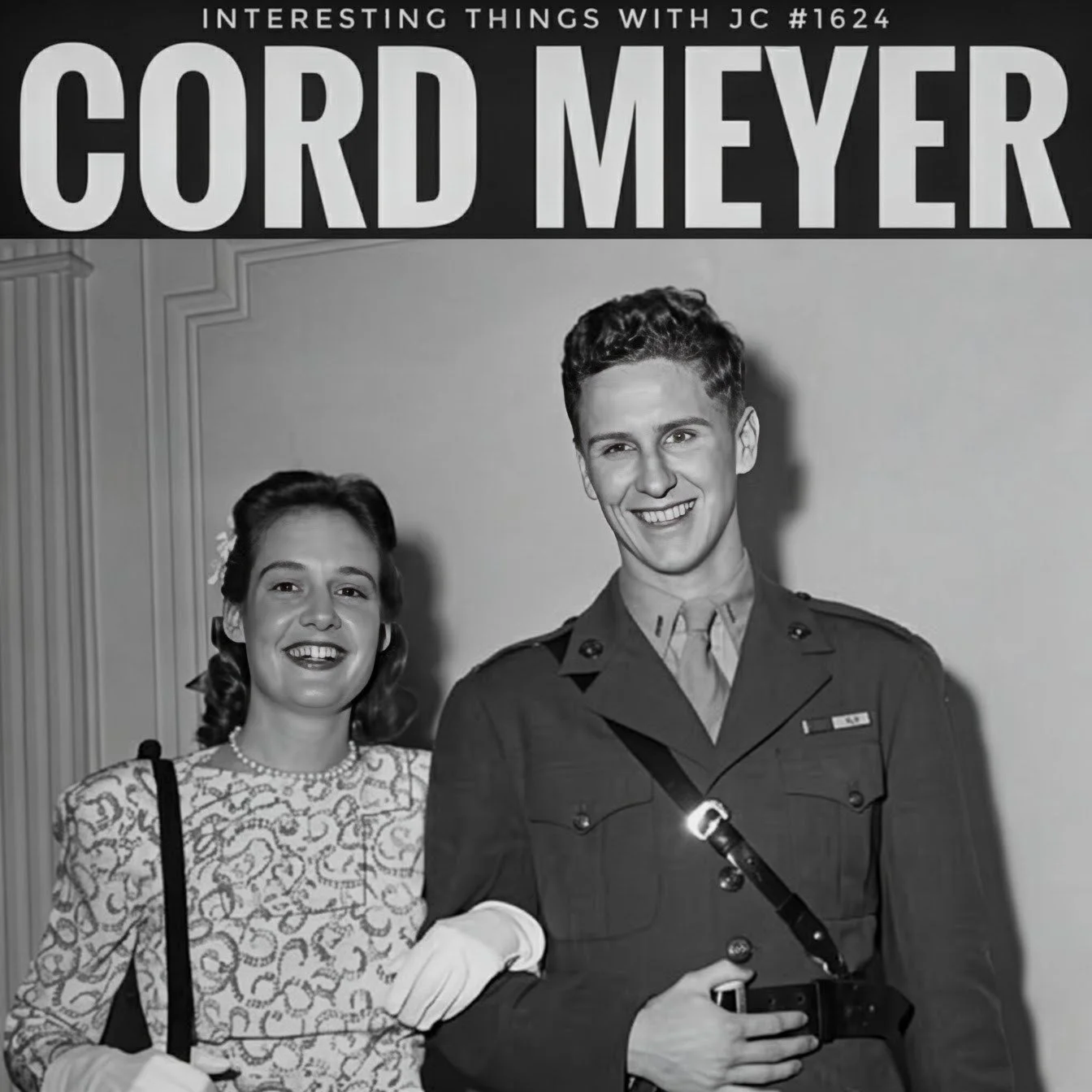
Young Cord Meyer, a U.S. Marine officer during World War II, stands with a companion in a formal portrait, reflecting the period before his transition from wartime service to influential roles in postwar policy and Cold War intelligence.
Transcript
Interesting Things with JC #1624:
"Cord Meyer"
Cord Meyer was 24 years old on Guam in 1944 when shrapnel from a Japanese grenade destroyed his left eye during combat. A Marine first lieutenant leading a machine gun platoon, he was badly wounded and initially feared dead. He survived, though the injury stayed with him for life. His twin brother Quentin would die later at Okinawa. The Pacific war left its mark, but it also sharpened a conviction. Another global conflict, especially in the nuclear age, could end civilization.
Back home, Meyer channeled that into public advocacy. In his 1947 book Peace or Anarchy, he argued that preventing catastrophe required more than alliances or the fledgling United Nations. It demanded real authority above nations. A supranational federal system to control weapons and enforce peace. He became president of the United World Federalists, growing the organization and attracting support from figures like Albert Einstein. For a moment after the war, the idea of moving beyond pure national sovereignty was debated openly in American intellectual life.
The Cold War changed the equation. Soviet expansion, proxy conflicts, and aggressive front organizations made pure idealism vulnerable. The battlefield of ideas, universities, unions, magazines, student groups, mattered as much as any military front. The Soviets invested heavily in shaping that space. The United States responded in kind, but often out of sight.
In 1951, Meyer joined the Central Intelligence Agency at the invitation of Allen Dulles. By 1954, he headed the International Organizations Division. His role involved routing funds, frequently through private foundations and cutouts, into non communist networks abroad. Student associations, labor groups, cultural congresses, and intellectual journals. The mechanism was designed for deniability. Support flowed quietly so the recipients could maintain credibility as independent voices promoting democratic values and countering Soviet influence. Many participants never knew the ultimate source. They believed their work stood on its own merit.
A centerpiece was the Congress for Cultural Freedom. It sponsored high profile conferences, backed journals like Encounter, and wove together writers, artists, and thinkers across Europe and beyond. The operation helped nurture the non communist left and push back against Marxist appeal among intellectuals. Similar relationships extended to groups like the National Student Association. These were sophisticated systems of influence. Not crude propaganda, but positioned ideas, amplified through access, repetition, and the aura of autonomy.
Meyer rose through the ranks, later heading the Covert Action Staff and serving as assistant deputy director of plans. Critics would later associate him with broader efforts sometimes labeled Operation Mockingbird, a term for alleged CIA cultivation of journalistic and media channels to shape narratives. While the precise scope remains debated and no single program bore that name, the underlying architecture of hidden subsidies and relationships was real. It extended the logic of the International Organizations Division. Build reach and legitimacy without fingerprints.
His personal story intersected with Washington power in ways that still raise questions. He and his wife, artist Mary Pinchot Meyer, divorced around 1958 to 1959 after marrying in 1945. In 1958 their son Michael was killed by a car in Washington, D.C. Mary moved in high circles, including connections to President John F. Kennedy. In 1964, she was murdered while walking along the C and O Canal towpath in Washington, D.C. A suspect was acquitted. Lingering uncertainties and theories persist.
By the mid 1960s, the machinery Meyer helped operate began to surface. In 1967, Ramparts magazine and subsequent reporting exposed CIA funding of supposedly independent organizations, from student groups to cultural outlets. The reaction was swift and damaging. Outlets and institutions built on claims of intellectual freedom suddenly appeared compromised. Participants who had acted in good faith felt used. Public trust in media, academia, and civic groups shifted. What had been framed as necessary defense in a total ideological contest now looked, to many, like manipulation from within.
Meyer defended the approach. In his 1980 memoir Facing Reality From World Federalism to the CIA, he described the evolution as a clear eyed response to Soviet tactics. The Cold War demanded contesting the war of ideas, not ceding ground. Leaving cultural and intellectual terrain uncontested would have been as costly as any battlefield defeat. He saw the systems as extensions of conflict. Pragmatic tools in a dangerous world.
Yet the exposure revealed a deeper tension in the design itself. Covert funding created dependencies that, once revealed, tainted the very independence that gave the efforts credibility. Networks meant to strengthen Western voices instead fed a narrative of hidden control. Institutions that once seemed organic now carried the shadow of external direction. The short term gains in countering Soviet fronts came with long term erosion. A harder skepticism toward information sources, a reflex to question motives in journalism and public discourse, and a fraying of the boundary between genuine civil society and state power.
Meyer did not set out to undermine trust. He began as a wounded idealist seeking structures to secure peace, then adapted to build covert ones to defend freedom against a determined adversary. But the systems he helped construct, pipelines of money and influence threaded through foundations, magazines, and organizations, carried consequences that outlasted the immediate battle. Once the veil lifted, the machinery that positioned ideas so effectively also made it easier for suspicion to take root.
Cord Meyer died of lymphoma and other ailments on March 13, 2001, at the age of 80. He had lived long enough to see the Cold War end in the West’s favor and to watch the deeper skepticism he helped make possible settle into the foundations of public life.
There is no sharp break in the story. Just one through line. A man shaped by war, trying to answer how to preserve a free world in an age of total contest, from a grenade scarred foxhole in the Pacific to the subtle architectures of the cultural Cold War.
These are interesting things, with JC.
Student Worksheet
Listening Purpose: As you listen, track how Meyer’s goals changed, what stayed consistent, and where secrecy changed the meaning of his work.
Student Output: Complete all section responses in complete sentences. Use at least three details from the transcript. For the analysis response, cite or paraphrase specific moments from the episode.
Academic Integrity Guidance: Base your answers on the episode and lesson materials. Distinguish clearly between what the transcript states, what the historical record confirms, and what remains debated. Do not present speculation as fact.
Comprehension Questions:
What wartime experiences most shaped Cord Meyer’s early worldview?
What did Meyer argue was necessary to prevent another catastrophic world war?
What was the purpose of the United World Federalists?
What was the CIA’s International Organizations Division designed to do?
Why were student groups, labor organizations, journals, and cultural networks strategically important during the Cold War?
What happened in 1967 that changed how many people viewed these organizations?
Analysis Questions:
How did Meyer’s transition from world federalist to intelligence official reflect the pressures of the early Cold War?
Was covert support for anti-communist organizations fundamentally different from propaganda, or was it a more sophisticated form of it? Explain.
Why did secrecy make the supported groups appear more credible at first?
How did exposure of the funding system damage trust even among people who agreed with the anti-Soviet goal?
What is the difference between defending democratic values and controlling democratic discourse?
The transcript says there is “no sharp break” in Meyer’s story. Do you agree? Why or why not?
Reflection Prompt:
Write a paragraph explaining whether Meyer should be remembered primarily as an idealist, a strategist, or a cautionary figure. Support your answer with evidence from the episode.
Difficulty Scaling:
Support Level: Complete sentence starters for Questions 1–4 and define five vocabulary terms in your own words.
On-Level: Answer all comprehension and analysis questions with evidence from the transcript.
Advanced: In addition to the worksheet, write a short evidence-based response comparing public trust before and after the 1967 revelations.
Output Expectations:
Comprehension: 1–2 sentences each
Analysis: 3–5 sentences each
Reflection: 1 well-developed paragraph
Advanced extension: 2 structured paragraphs with evidence
Teacher Guide
Quick Start:
Open with the bell ringer.
Pre-teach five key terms.
Play the episode once without interruption.
Pause on the second listen for note-taking at major turning points.
Move students into worksheet, discussion, quiz, and exit ticket.
Pacing Guide (Audio-First):
Bell Ringer and vocabulary preview – 8 minutes
First listen – length of episode
Brief debrief – 5 minutes
Second listen with pauses or transcript review – 10 minutes
Worksheet completion – 20 minutes
Whole-class discussion – 10 minutes
Quiz – 8 minutes
Assessment exit ticket – 5 minutes
Bell Ringer:
Ask students: “Is it ever acceptable for a democracy to use secret methods to defend itself?”
Have students write a 3-sentence response before hearing the episode.
Revisit the same question after instruction to measure change in thinking.
Audio Guidance: Tell students to listen for three shifts: Meyer the Marine, Meyer the global reformer, and Meyer the covert operator. Encourage them to mark where motives stay the same even as methods change.
Audio Fallback: If audio is unavailable, use the transcript as a close-reading text. Read the opening and final paragraphs aloud, then assign pairs to annotate the middle sections for organizations, motives, and consequences.
Time on Task: This lesson fits a 55–70 minute class period, a block period with expanded discussion, or an asynchronous homeschool session using the transcript and worksheet.
Materials:
Episode audio or transcript
Student worksheet
Highlighters or annotation tools
Projector or board for vocabulary and timeline notes
Quiz copy
Exit ticket slip or digital form
Vocabulary Strategy:
Preview terms before listening
Ask students to circle where each term appears in context
Have students restate three terms in plain language after the lesson
Common Misconceptions:
Students may assume all anti-communist groups were openly controlled by government agencies; in many cases the issue was concealed funding, not public affiliation.
Students may assume every later rumor about media influence was one unified proven program; the historical record supports covert relationships and subsidies, but not every popular label or claim is equally documented.
Students may assume Meyer began as a lifelong hard-line operative; the record shows a substantial early phase centered on world federalism and postwar peace advocacy.
Students may confuse personal mystery with historical proof in the Mary Pinchot Meyer case; the murder remains unresolved, and teachers should model careful source boundaries.
Discussion Prompts:
Did Meyer’s ideals disappear, or were they redirected?
Can secret support ever strengthen free institutions, or does secrecy always weaken them?
How should historians judge actions taken under intense geopolitical pressure?
What happens to public trust when institutions appear independent but are not fully transparent?
Why are universities, magazines, arts organizations, and student groups important in a “war of ideas”?
Bonus: How did Meyer affect society today?
Formative Checkpoints:
After the first listen, ask students to identify Meyer’s three life phases.
Midway through the worksheet, ask students to explain “deniability” in their own words.
Before the quiz, have students write one sentence defining the central tension of the lesson.
Differentiation:
Provide guided notes with a three-column organizer: Early Beliefs, Cold War Actions, Long-Term Consequences
Allow verbal responses for selected worksheet items
Chunk the transcript into short sections for emerging readers
Pair vocabulary with examples from current media ecosystems without making partisan comparisons
Assessment Differentiation:
Allow audio-recorded responses for open-ended questions
Permit sentence frames for students needing language support
Offer an advanced evidence chart for honors or college-prep learners
Time Flexibility:
Short format: Bell ringer, one listen, core worksheet, exit ticket
Standard format: Full lesson sequence
Extended format: Add document comparison or mini-research on Cold War cultural institutions
Substitute Readiness: This lesson can run with only the transcript, worksheet, and quiz. The substitute should emphasize source-based thinking and avoid extending discussion into unsupported speculation.
Engagement Strategy: Use a visible timeline on the board: Guam 1944 → World Federalism → CIA International Organizations Division → 1967 Exposure → Legacy. Students add one phrase or consequence under each point as the lesson progresses.
Extensions:
Compare Meyer’s story to another Cold War figure who moved from idealism to realpolitik
Research Encounter magazine or the Congress for Cultural Freedom
Write a short editorial defending or criticizing covert cultural influence
Cross-Curricular Connections:
History: Cold War, postwar internationalism, propaganda, civic trust
ELA: Argument writing, close reading, source evaluation
Media Studies: Funding, credibility, hidden influence, narrative framing
Government/Civics: State power, accountability, institutional legitimacy
SEL Connection: Students practice ethical reasoning, perspective-taking, and discomfort tolerance by considering how a person can act from sincere motives while still causing long-term harm.
Skill Emphasis:
Source evaluation
Historical reasoning
Argument from evidence
Distinguishing fact from interpretation
Ethical analysis of institutions
Answer Key:
Comprehension 1: Meyer was badly wounded on Guam, lost an eye, and later learned his twin brother died at Okinawa; these experiences shaped his postwar thinking.
Comprehension 2: He argued that preventing another global catastrophe required supranational authority stronger than loose alliances.
Comprehension 3: The United World Federalists promoted stronger world governance structures to preserve peace.
Comprehension 4: The International Organizations Division covertly funded anti-communist cultural, student, labor, and intellectual organizations.
Comprehension 5: Those institutions shaped opinion, legitimacy, and elite discourse in the Cold War contest.
Comprehension 6: The 1967 revelations exposed CIA funding relationships and damaged trust.
Analysis guidance: Strong answers should explain continuity in motive, change in method, the value of perceived independence, and the credibility costs of secrecy.
Reflection guidance: Accept well-supported answers naming Meyer as idealist, strategist, cautionary figure, or a combination, as long as students use evidence.
Quiz
Which wartime event most directly shaped Cord Meyer’s early postwar worldview?
A. He served at the Nuremberg trials
B. He was wounded on Guam and lost an eye
C. He worked in wartime codebreaking
D. He was captured and held as a prisoner of warWhat was the central argument of Meyer’s postwar advocacy?
A. The United Nations should be abolished immediately
B. Isolationism was the safest path for the United States
C. Peace required stronger authority above nation-states
D. Cultural organizations should remain outside politicsWhat did the CIA’s International Organizations Division primarily do in Meyer’s era?
A. Publicly run embassy press offices
B. Secretly support non-communist organizations and networks
C. Manage battlefield troop deployments
D. Oversee domestic election law enforcementWhy did covertly funded groups often appear especially credible?
A. They openly advertised government sponsorship
B. They refused all outside money
C. They were seen as independent voices
D. They operated only inside the United StatesWhat was one major result of the 1967 exposure of CIA funding?
A. Greater faith in institutional neutrality
B. Stronger public trust in all media outlets
C. Reduced concern about propaganda
D. Increased skepticism toward civic and cultural institutions
Assessment
Open-Ended Questions:
Explain how Cord Meyer’s life illustrates the shift from post-World War II idealism to Cold War strategic competition. Use at least four details from the lesson.
Evaluate this claim: “Hidden support for democratic voices may win a short-term struggle but lose long-term public trust.” Agree or disagree, and defend your position with evidence.
3–2–1 Rubric:
3 – Strong: Response is accurate, uses multiple specific details, explains cause and effect clearly, and distinguishes evidence from speculation.
2 – Developing: Response is mostly accurate, uses some evidence, but explanation or precision is uneven.
1 – Beginning: Response is vague, weakly supported, or confuses key facts, claims, and interpretations.
Exit Ticket:
What is one fact you learned about Cord Meyer?
What is one tension or contradiction in his story?
What is one question this episode leaves you with about trust, secrecy, or public institutions?
Standards Alignment
NGSS Connection (Interdisciplinary Science and Engineering Practices):
Asking Questions and Defining Problems: Students ask how systems built to reduce geopolitical risk can create new civic problems. Measurable skill: students generate historically grounded questions about cause, consequence, and institutional design.
Engaging in Argument from Evidence: Students evaluate whether covert influence strengthened or weakened democracy using episode evidence. Measurable skill: students make a claim and support it with specific historical details.
Obtaining, Evaluating, and Communicating Information: Students extract key information from audio and transcript, assess credibility, and communicate conclusions in writing. Measurable skill: students summarize and evaluate evidence accurately.
CCSS Literacy in History/Social Studies:
CCSS.ELA-LITERACY.RH.11-12.1: Cite specific textual evidence to support analysis of primary and secondary sources. Measurable skill: students reference exact details from transcript and lesson materials.
CCSS.ELA-LITERACY.RH.11-12.6: Evaluate authors’ differing points of view on the same historical event or issue. Measurable skill: students distinguish Meyer’s self-justification from later criticism.
CCSS.ELA-LITERACY.WHST.11-12.1: Write arguments focused on discipline-specific content. Measurable skill: students produce evidence-based written arguments on secrecy and trust.
CCSS.ELA-LITERACY.SL.11-12.1: Initiate and participate effectively in collaborative discussions. Measurable skill: students discuss ethical and historical tensions using evidence.
C3 Framework for Social Studies:
D2.His.1.9-12: Evaluate how historical events and developments were shaped by unique circumstances of time and place as well as broader historical contexts. Measurable skill: students place Meyer within WWII and Cold War transitions.
D2.His.14.9-12: Analyze multiple and complex causes and effects of events in the past. Measurable skill: students explain how wartime trauma, ideology, and geopolitics shaped Meyer’s choices.
D3.1.9-12: Gather and evaluate sources using origin, authority, structure, context, and corroborative value. Measurable skill: students distinguish documented facts from debated claims.
D4.1.9-12: Construct arguments using precise claims and evidence from multiple sources. Measurable skill: students defend a position on covert action and democracy.
ISTE Standards for Students:
1.3a Knowledge Constructor: Students plan and employ effective research strategies to locate information and other resources. Measurable skill: students identify reliable historical sources and organize evidence.
1.3b Knowledge Constructor: Students evaluate the accuracy, perspective, credibility, and relevance of information. Measurable skill: students assess institutional and contested sources critically.
1.6c Creative Communicator: Students communicate complex ideas clearly using appropriate platforms and formats. Measurable skill: students produce a coherent written or spoken historical argument.
Career Readiness:
Career Ready Practice 2: Apply appropriate academic and technical skills. Measurable skill: students read, interpret, and discuss complex informational content.
Career Ready Practice 4: Communicate clearly, effectively, and with reason. Measurable skill: students present structured, evidence-based conclusions.
Career Ready Practice 7: Employ valid and reliable research strategies. Measurable skill: students verify claims and note the limits of evidence.
Career Ready Practice 12: Work productively in teams while using cultural and global competence. Measurable skill: students discuss international conflict, ideas, and institutions responsibly.
Homeschool/Lifelong Learning Alignment:
Students build transferable civic literacy by analyzing trust, persuasion, institutional legitimacy, and source credibility.
Students practice independent inquiry, note-taking, ethical reasoning, and evidence-based discussion suitable for home education and adult learning environments.
Show Notes
This lesson uses Cord Meyer’s life to explore one of the central tensions of the Cold War: how a free society tries to defend itself without compromising its own credibility. Students move from wartime experience to postwar idealism, then into covert cultural influence and its long-term consequences for trust in media, civic institutions, and public discourse. The episode matters because it helps learners think carefully about transparency, persuasion, hidden sponsorship, and the fragile relationship between security and legitimacy.
References
The Atlantic. (1944, October). On the beaches: The Pacific. https://www.theatlantic.com/magazine/archive/1944/10/on-the-beaches-the-pacific/657362/
The Atlantic. (1946, January). Waves of darkness. https://www.theatlantic.com/magazine/archive/1946/01/waves-of-darkness/656895/
Central Intelligence Agency. (n.d.). Origins of the Congress for Cultural Freedom. https://www.cia.gov/resources/csi/static/origins-congress-cultural-freedom.pdf
Central Intelligence Agency. (n.d.). The lie that linked CIA to the Kennedy assassination. https://www.cia.gov/resources/csi/static/Lie-That-Linked-CIA.pdf
International Center of Photography. (n.d.). Albert Einstein and World Federalist Cord Meyer in conversation, Princeton, NJ. https://www.icp.org/browse/archive/objects/albert-einstein-and-world-federalist-cord-meyer-in-conversation-princeton-nj
Library of Congress. (n.d.). Collection: Cord Meyer Papers. https://hdl.loc.gov/loc.mss/eadmss.ms006035
Library of Congress. (2024). Cord Meyer Papers [finding aid]. https://hdl.loc.gov/loc.mss/eadmss.ms006035.3
National Archives. (2023, September 19). Foreign policy fallout from CIA funding disclosures, 1967. https://text-message.blogs.archives.gov/2023/09/19/foreign-policy-fallout-from-cia-funding-disclosures-1967/
Oregon State University Special Collections & Archives Research Center. (1947, December 10). Meyer, Cord Jr., United World Federalist, December 10, 1947. https://scarc.library.oregonstate.edu/omeka/items/show/26506
WorldCat. (n.d.). Peace or anarchy. https://search.worldcat.org/title/505308
The Washington Post. (2001, March 15). Key CIA figure Cord Meyer dies. https://www.washingtonpost.com/archive/local/2001/03/15/key-cia-figure-cord-meyer-dies/fc90ef11-4137-4582-9f01-c7c13461e1bf/