Interesting Things with JC #1623: "The Whiskey Rebellion and the Power to Tax" – A federal tax collector rides into a town where whiskey barrels are stacked like currency, but no one comes forward to pay. The tax is already law, but rifles appear before coins do. Days later, 13,000 troops are on the road toward the same place.
Curriculum - Episode Anchor
Episode Title: The Whiskey Rebellion and the Power to Tax
Episode Number: 1623
Host: JC
Audience: Grades 9–12, Introductory College, Homeschool, Lifelong Learners
Subject Area: U.S. History / Civics
Lesson Overview
Learning Objectives:
Explain how the Constitution changed federal taxing authority
Distinguish between direct and indirect taxes
Analyze causes and outcomes of the Whiskey Rebellion
Evaluate the relationship between taxation and government authority
Essential Question: How does the power to tax shape the strength and legitimacy of a government?
Success Criteria:
Students accurately define tax types and constitutional limits
Students explain why the Whiskey Rebellion occurred
Students connect taxation to federal authority using evidence
Student Relevance Statement: Taxes affect everyday life, from purchases to income; understanding their origins builds civic awareness
Real-World Connection: Modern debates over taxation, government spending, and enforcement reflect the same structural tensions
Workforce Reality: Careers in law, public policy, finance, and government rely on understanding taxation systems and compliance
Key Vocabulary
Excise Tax (ˈek-sīz): Tax on specific goods like alcohol
Direct Tax (də-ˈrekt): Tax applied directly to individuals or property
Indirect Tax (ˌin-də-ˈrekt): Tax applied to goods or transactions
Apportionment (ə-ˈpȯr-shən-mənt): Dividing taxes among states by population
Uniformity (ˌyü-nə-ˈfȯr-mə-tē): Same tax rate applied nationwide
Militia (mə-ˈli-shə): Citizen army called for service
Federal Authority (ˈfe-də-rəl ə-ˈthȯr-ə-tē): Power of national government
Revenue (ˈre-və-ˌnü): Government income from taxes
Tariff (ˈter-əf): Tax on imported goods
Narrative Core
Open: In 1794, farmers in western Pennsylvania raised rifles—not against a foreign enemy, but against a tax on whiskey.
Info: The Constitution gave Congress the power to tax directly, replacing the weak system under the Articles of Confederation.
Details: Tax rules required fairness—direct taxes apportioned by population, indirect taxes applied uniformly. The whiskey tax met these rules but hit frontier farmers hard, where whiskey functioned as currency. Resistance escalated into violence, forcing a federal response. President George Washington mobilized militia forces, demonstrating enforcement power.
Reflection: The conflict showed that taxation is not just economic—it defines the relationship between citizens and government authority.
Closing: These are interesting things, with JC.
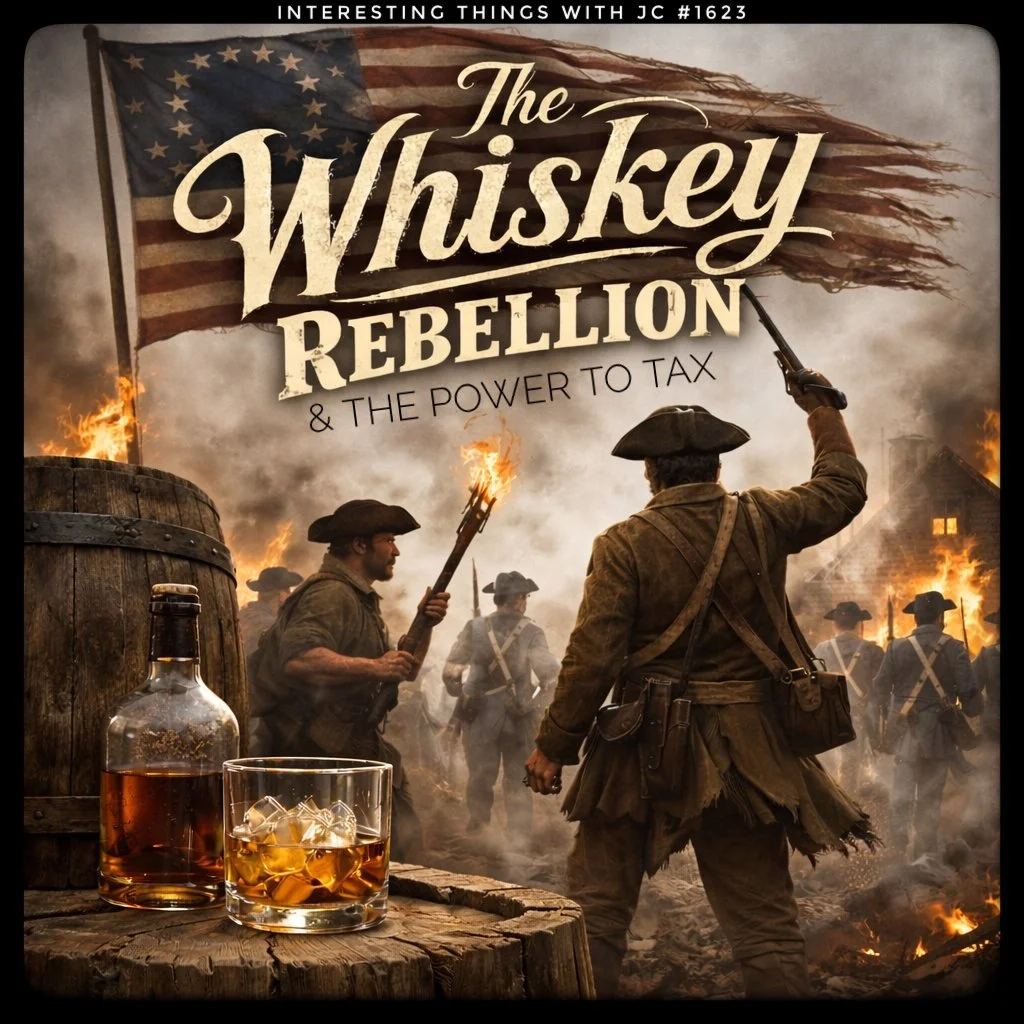
This image illustrates the tension and conflict of the Whiskey Rebellion in 1794. Frontier farmers, dressed in 18th-century clothing and armed with rifles and torches, stand amid burning buildings as smoke fills the air. A large American flag waves above them, symbolizing the young nation facing internal resistance. In the foreground, a bottle and glass of whiskey highlight the central issue, a federal tax that deeply affected rural communities where whiskey functioned as a form of currency. The scene emphasizes the clash between citizens and government authority, capturing a pivotal moment when the United States tested its ability to enforce its laws.
Transcript
Interesting Things with JC #1623:
"The Whiskey Rebellion and the Power to Tax"
A group of farmers across western Pennsylvania in 1794 are holding rifles, not because of a war with another country, but because of a tax on whiskey.
Not land. Not income. Whiskey.
The federal government had decided it needed money, and under the new Constitution, it finally had the power to collect it. That power had been missing before. Under the Articles of Confederation, Congress could ask states for money, but it could not force them to pay. Most of the time, they didn’t.
The Constitution changed that. It gave Congress the authority to lay and collect taxes, duties, imposts, and excises, turning a loose alliance into a functioning government that could fund an army, pay its debts, and operate on its own.
But the way it could tax people was tightly controlled.
If Congress wanted to use a direct tax, something like a head tax or a tax on land, it had to divide that tax among the states based on population. Indirect taxes, things like tariffs or excise taxes on goods like whiskey, had to be applied the same way everywhere, one rate, one rule, coast to coast. And any bill to raise that revenue had to begin in the House of Representatives.
Even with those limits, trust was thin.
When Alexander Hamilton pushed for the whiskey tax in 1791, it worked cleanly on paper. Whiskey was widely produced and predictable as a source of revenue. But on the frontier, whiskey was not just a product. It was how farmers stored value. Grain spoiled. Whiskey did not. It traveled. It traded. It stood in for cash where cash barely existed.
And the structure of the tax hit small distillers harder than large ones, while requiring many to travel long distances to federal courts to challenge it.
So when federal tax collectors showed up, the issue wasn’t abstract policy. It was immediate loss, measured in barrels, time, and survival.
That’s how you end up with the Whiskey Rebellion.
Men refusing to pay. Officials threatened or attacked. A federal inspector’s home burned. Authority pushed back in a way that forced a decision.
President George Washington did not leave it alone. He called up nearly 13,000 militia from multiple states and moved to enforce the law, establishing in real terms that this government could compel compliance, not just request it.
Not because of whiskey.
Because if the government could not collect taxes, it could not function. And if it could not function, the Constitution was just paper.
That tension never really disappears.
It shows up again in conflicts like the Nullification Crisis of the 1830s, where states challenged federal authority over tariffs, and later in the push for the Sixteenth Amendment in 1913, which allowed a federal income tax without dividing it by population.
The argument is never just about money.
It is about how much authority a government can exercise over the people who fund it, and how much those people are willing to accept in return for stability, protection, and order.
The Constitution did not settle that argument. It built the frame around it, set the limits, and left the rest to be tested in real moments across western Pennsylvania, where a tax on whiskey forced a young government to prove, in full view of its own citizens, whether it could hold.
These are interesting things, with JC.
Student Worksheet
Comprehension Questions:
What problem existed under the Articles of Confederation regarding taxation?
What are the two main types of taxes described?
Why was whiskey important to frontier farmers?
What triggered the Whiskey Rebellion?
How did the federal government respond?
Analysis Questions:
Why did the whiskey tax affect small producers more than large ones?
How did the Constitution attempt to make taxation fair?
What does the federal response reveal about government power?
Reflection Prompt:
Should citizens always comply with taxes they believe are unfair? Explain with reasoning
Difficulty Scaling:
Basic: Define terms and summarize events
Intermediate: Explain cause-and-effect relationships
Advanced: Evaluate legitimacy of resistance vs authority
Student Output:
Written responses (1–2 paragraphs for analysis)
Evidence-based reasoning required
Academic Integrity Guidance:
Use original wording
Support answers with transcript evidence
Teacher Guide
Quick Start: Play audio, pause at key moments, guide discussion
Pacing Guide:
Bell Ringer (5 min)
Audio Listening (10 min)
Discussion (10 min)
Worksheet (15 min)
Wrap-up (5 min)
Bell Ringer: What would you do if taxed on something essential to your livelihood?
Audio Guidance: Pause after explanation of tax types and before rebellion escalation
Audio Fallback: Provide printed transcript for silent reading
Time on Task: 45 minutes total
Materials: Audio device, transcript, worksheet
Vocabulary Strategy: Pre-teach key terms before listening
Misconceptions:
Taxes are always unfair → clarify purpose of revenue
Rebellion equals revolution → distinguish scale and outcome
Discussion Prompts:
Why is taxation necessary?
What limits should exist on government power?
Formative Checkpoints:
Ask students to define direct vs indirect taxes mid-lesson
Differentiation:
Provide sentence starters for struggling students
Extend with historical comparisons for advanced learners
Assessment Differentiation:
Oral responses allowed
Written depth adjusted by level
Time Flexibility: Can extend analysis or shorten discussion
Substitute Readiness: Transcript-based lesson fully functional
Engagement Strategy: Relate to modern taxes students know
Extensions: Compare to modern tax debates
Cross-Curricular Connections: Economics, government, law
SEL Connection: Understanding fairness and responsibility
Skill Value Emphasis: Critical thinking, civic literacy
Answer Key:
Worksheet – Comprehension Questions:
Congress could not enforce tax collection under the Articles of Confederation
Direct taxes are applied to people/property; indirect taxes are applied to goods/transactions
Whiskey stored value and functioned as a currency substitute
Protesters refused taxes, threatened officials, and used violence
The federal government enforced the law using militia forces
Worksheet – Analysis (Expected Elements):
Geographic isolation and lack of cash economy
Disproportionate burden on small producers
Demonstration of federal enforcement power
Quiz – Correct Answers:
B. Collect taxes
C. Indirect
C. Currency substitute
C. Militia
B. Federal authority
Quiz
What power did the Constitution give Congress?
A. Declare war
B. Collect taxes
C. Print money
D. Regulate statesWhat type of tax was the whiskey tax?
A. Direct
B. Property
C. Indirect
D. IncomeWhy was whiskey important to farmers?
A. Luxury good
B. Religious use
C. Currency substitute
D. Export onlyWho enforced the law during the rebellion?
A. Congress
B. Local police
C. Militia
D. CourtsWhat principle did the rebellion test?
A. Free speech
B. Federal authority
C. Voting rights
D. Trade policy
Assessment
Open-Ended Questions:
Explain how the Whiskey Rebellion demonstrated federal power under the Constitution
Analyze the balance between citizen resistance and government authority
Rubric (3–2–1):
3: Clear explanation, evidence, strong reasoning
2: Partial explanation, limited evidence
1: Minimal understanding
Exit Ticket:
One sentence: Why must governments be able to collect taxes?
Standards Alignment
CCSS.ELA-LITERACY.RH.11-12.1: Cite specific textual evidence to support analysis of primary and secondary sources (students use transcript evidence)
CCSS.ELA-LITERACY.RH.11-12.2: Determine central ideas and summarize complex historical events (Whiskey Rebellion analysis)
CCSS.ELA-LITERACY.WHST.11-12.1: Write arguments focused on discipline-specific content using valid reasoning
C3.D2.Civ.3.9-12: Analyze the role of constitutions in defining government powers (taxation authority)
C3.D2.Civ.5.9-12: Evaluate citizens’ and institutions’ roles in maintaining democratic systems (rebellion vs enforcement)
ISTE 1.3 Knowledge Constructor: Evaluate information and build knowledge about civic systems
CTE Career Ready Practice 2: Apply appropriate academic and technical skills (economic reasoning, policy analysis)
Career Readiness: Analyze taxation systems and compliance in public and private sectors
Homeschool/Lifelong Learning: Develop independent civic literacy and critical evaluation of government systems
Show Notes
This lesson explores how a tax on whiskey became a defining test of federal authority in early U.S. history. Students examine the structure of taxation under the Constitution and how real-world resistance shaped government power. It highlights the ongoing balance between citizen rights and national stability.
References
National Archives. (n.d.). The Constitution of the United States: A transcription. https://www.archives.gov/founding-docs/constitution-transcript
Library of Congress. (n.d.). Whiskey Rebellion, 1794. https://guides.loc.gov/this-month-in-business-history/august/whiskey-rebellion
IRS history timeline. Taxes and Revolution. https://www.irs.gov/irs-history-timeline#:~:text=Taxes%20and%20Revolution,Loading%20Image
Mount Vernon Ladies’ Association. (n.d.). The Whiskey Rebellion. https://www.mountvernon.org/library/digitalhistory/digital-encyclopedia/article/whiskey-rebellion/