1622: "The Morgan Horse"
Interesting Things with JC #1622: "The Morgan Horse" – A compact stallion stands in a field and moves like nothing is wasted. Horses built larger keep losing to him without clear reason. The same build appears again in his foals, unchanged across distance and time.
Curriculum - Episode Anchor
Episode Title: The Morgan Horse
Episode Number: 1622
Host: JC
Audience: Grades 9–12, Introductory College, Homeschool, Lifelong Learners
Subject Area: Agricultural Science / Animal Science / American History
Lesson Overview
Objectives:
Explain how a single foundation sire can establish a breed through inherited traits
Analyze the relationship between conformation and functional performance in working animals
Evaluate the role of selective breeding in early American agriculture and transportation systems
Assess why versatility and endurance are critical traits in workforce animals
Essential Question:
How can inherited traits from one animal shape an entire breed and influence human productivity?
Success Criteria:
Students accurately describe at least three defining Morgan horse traits and their functions
Students explain how selective breeding contributed to consistency across generations
Students connect animal traits to efficiency in real-world labor systems
Students support claims using evidence from the transcript
Student Relevance Statement:
Trait selection, performance reliability, and efficiency are concepts used today in fields like genetics, engineering, sports science, and workforce training.
Real-World Connection:
Modern agriculture, livestock breeding, and even product design rely on consistency, durability, and multi-function performance.
Workforce Reality:
Professionals in animal science, veterinary fields, and agriculture must prioritize reliability, structural soundness, and long-term performance over appearance or short-term output.
Key Vocabulary
Morgan Horse (MOR-guhn hors): A versatile American breed known for strength, endurance, and consistency
Stallion (STAL-yuhn): An uncastrated male horse used for breeding
Foal (fohl): A young horse
Gait (gayt): A horse’s pattern of movement
Selective Breeding (suh-LEK-tiv BREE-ding): Intentional reproduction to preserve desired traits
Endurance (en-DOOR-uhns): Ability to sustain prolonged effort
Conformation (kon-fer-MAY-shun): Physical structure and build
Draft Work (draft werk): Heavy pulling labor
Cavalry (KAV-uhl-ree): Soldiers mounted on horseback
Lineage (LIN-ee-ij): Direct descent from an ancestor
Narrative Core
Open:
A small stallion stands in a Vermont field in the late 1700s. Not the biggest. Not the fastest. But everything about him works.
Info:
That horse, Figure, owned by Justin Morgan, begins to outperform larger and more specialized horses in multiple roles.
Details:
Figure demonstrates strength, endurance, and rare consistency. His offspring inherit these same traits with unusual reliability, forming the Morgan horse breed. These horses become essential in farming, transportation, and military operations, including the American Civil War.
Reflection:
The Morgan horse shows that reliability and adaptability can outperform specialization when real-world demands require consistency across conditions.
Closing:
These are interesting things, with JC.
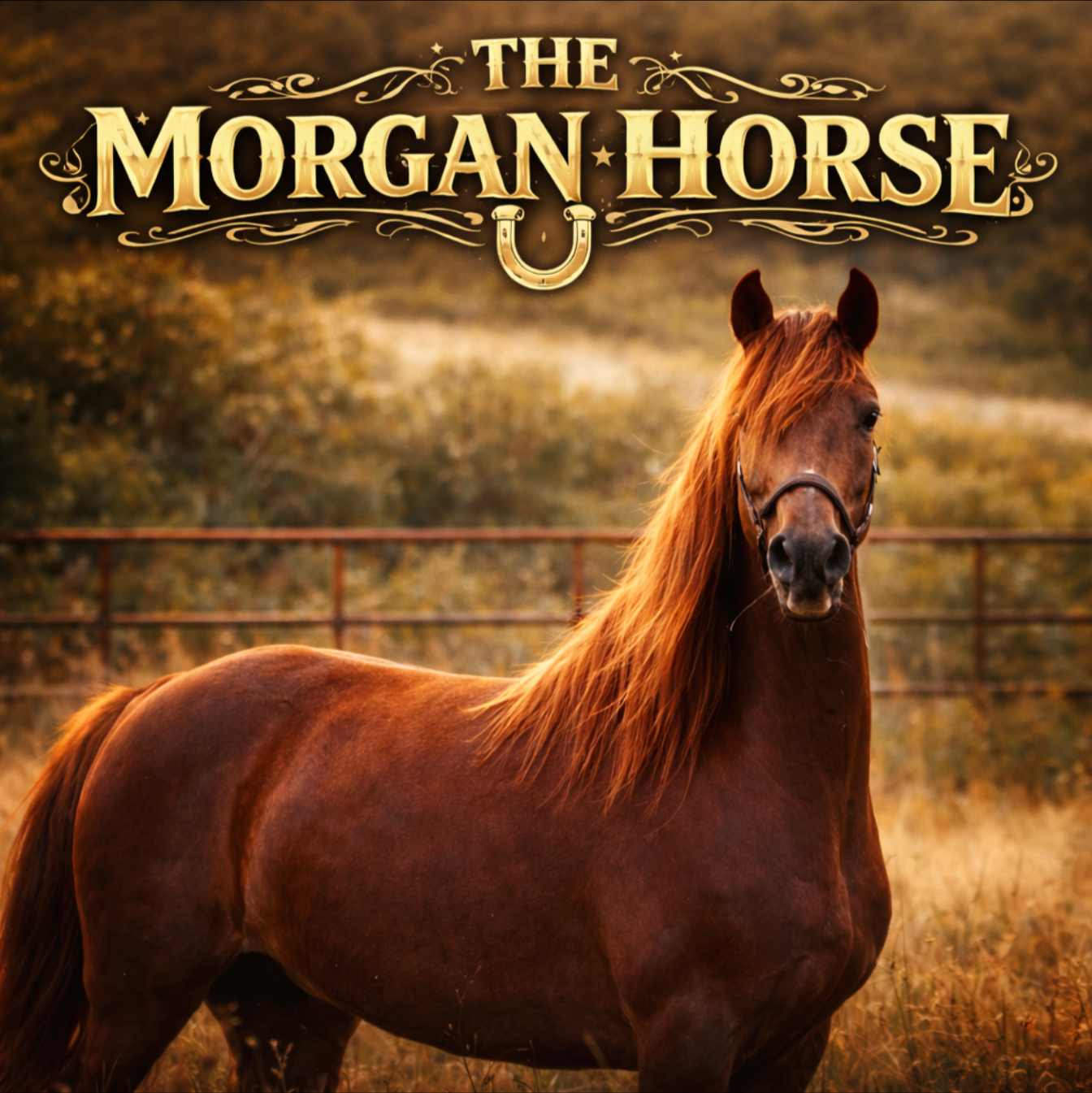
Chestnut Morgan horse standing in a field with “The Morgan Horse” title above.
Transcript
Interesting Things with JC #1622:
"The Morgan Horse"
A small, compact stallion stands in a Vermont field in the late 1700s. Not especially tall. Not especially flashy. But when he moves, everything about him holds together like it was built with intent.
His name, as history would later record it, is Figure.
He belongs to a schoolteacher named Justin Morgan, and at first, he’s just a payment for a debt. Nothing about that exchange suggests what’s coming next.
Figure doesn’t look like the biggest horse in New England, but he starts beating them anyway. Pulling contests, racing, farm work, it doesn’t seem to matter. He outworks larger horses, outperforms horses bred specifically for speed, and does it without breaking down. Same horse, same build, same result.
People start noticing something that isn’t easy to explain at first. It’s not just strength or speed. It’s consistency. He can pull all day, race the next, and still carry himself like nothing’s been spent.
And then something more unusual shows up. His foals start looking like him. Not just similar, but strikingly consistent. Same compact frame, strong neck, deep chest, and a gait that stays balanced under load. In a time before modern genetics, that kind of reliability stands out fast.
By the early 1800s, that one horse becomes a line. That line becomes a type. And that type becomes what we now call the Morgan horse.
They’re not the tallest horses, usually around 14.1 to 15.2 hands, about 57 to 62 inches or 145 to 157 centimeters at the shoulder, but they’re built dense for their size, often weighing between 900 and 1,200 pounds, roughly 410 to 545 kilograms. Their hooves are known for being strong and well-formed, often holding up well on rough ground, and their shorter backs give them real pulling strength while still keeping them agile under saddle. A well-conditioned Morgan typically eats about 1.5 to 2 percent of its body weight in forage each day, maintaining steady energy across long work without the same breakdown often seen in larger draft breeds.
Farmers use them. Riders trust them. The military eventually turns to them, especially during the American Civil War, where Morgan horses are used for cavalry and artillery work because they can endure long marches, carry gear, and stay responsive under pressure. One of Figure’s most influential sons, Sherman Morgan, helps spread that same build and temperament across early American breeding programs, locking those traits in place generation after generation.
What started as one horse in Vermont spreads across the country because it solves a problem people keep running into. You need a horse that can do more than one job, and keep doing it.
One animal, shaped by function, passing that shape forward with unusual precision, long before anyone could explain why.
A horse that didn’t need to be the biggest or the fastest, just the one that kept showing up, the same way, every time.
These are interesting things, with JC.
Student Worksheet
Comprehension Questions:
Who was Figure and what role did he play in history?
List three physical traits of Morgan horses described in the episode.
What evidence shows that Figure’s traits were passed to his offspring?
Analysis Questions:
Explain how conformation affects a horse’s ability to perform work.
Why would farmers prefer a versatile horse over a specialized one?
Reflection Prompt:
Describe a system, tool, or person where consistency is more valuable than peak performance. Explain why.
Difficulty Scaling:
Level 1: Identify and recall traits
Level 2: Explain relationships between traits and function
Level 3: Evaluate impact on society and agriculture
Student Output:
Written responses (complete sentences, evidence-based)
Optional: diagram labeling horse traits and functions
Academic Integrity Guidance:
Use transcript evidence
Paraphrase ideas
Avoid copying directly
Teacher Guide
Quick Start:
Play audio → guided discussion → worksheet → review
Pacing (Audio-First):
Bell ringer (5 min)
Audio (5–7 min)
Guided discussion (10 min)
Worksheet (20 min)
Closure (5–8 min)
Bell Ringer:
What qualities make something dependable over time?
Audio Guidance + Fallback:
Listen for repeated emphasis on “consistency”; if unavailable, read transcript aloud or assign silent reading
Materials:
Audio/transcript, worksheet, writing tools
Misconceptions:
Larger animals always perform better
Speed equals usefulness
Appearance determines function
Discussion Prompts:
What problem did Morgan horses solve?
Why is consistency difficult to achieve in breeding?
Formative Checks:
Identify one trait and its function
Explain selective breeding in one sentence
Differentiation:
Sentence starters for support
Extended written analysis for advanced learners
Engagement Strategy:
Compare Morgan horses to modern multi-purpose machines
Extensions:
Research another breed and compare specialization vs versatility
Cross-Curricular:
Biology: heredity and genetics
History: Civil War logistics
Engineering: design efficiency
SEL:
Reliability, discipline, and long-term performance
Answer Key:
Figure = foundation sire
Traits = endurance, compact build, strength, consistency
Selective breeding = passing traits intentionally across generations
Versatility = ability to perform multiple tasks efficiently
Quiz
What was Figure known for?
A. Size
B. Color
C. Consistency
D. SpeedWhat is selective breeding?
A. Random mating
B. Choosing traits intentionally
C. Natural disaster
D. Training animalsMorgan horses were valuable because they:
A. Specialized in one task
B. Were decorative
C. Performed multiple roles
D. Were the largestWhat does endurance refer to?
A. Speed
B. Strength
C. Ability to sustain effort
D. SizeMorgan horses were used in the Civil War for:
A. Farming only
B. Cavalry and artillery
C. Racing
D. Entertainment
Assessment
Open-Ended Questions:
Explain how Figure’s traits led to the development of the Morgan horse breed.
Analyze why consistency and versatility are important in both animals and modern systems.
Rubric (3–2–1):
3: Clear, evidence-based, accurate vocabulary
2: Partial explanation, some evidence
1: Limited understanding
Exit Ticket:
Identify one Morgan horse trait and explain how it improves performance.
Standards Alignment
NGSS HS-LS3-1: Apply concepts of heredity to explain how traits are passed from parent to offspring; students analyze how Figure’s traits persisted across generations
NGSS HS-LS4-2: Construct explanations for how advantageous traits increase in frequency; students evaluate why Morgan traits became dominant
CCSS.ELA-LITERACY.RST.9-10.2: Determine central ideas; students summarize how one horse influenced a breed
CCSS.ELA-LITERACY.RST.11-12.7: Integrate quantitative and descriptive data; students interpret size, weight, and feeding data
C3 D2.His.14.9-12: Analyze multiple factors influencing historical development; students examine agricultural and military use of Morgan horses
ISTE 1.1.c: Students use technology/resources to deepen understanding of real-world systems (breeding, agriculture)
Career Readiness Standard: Evaluate performance traits and efficiency in applied systems such as agriculture and animal science
Homeschool/Lifelong Learning: Apply observational reasoning and real-world problem solving to biological and historical contexts
Show Notes
This lesson examines how one horse influenced an entire breed through consistent, functional traits. Students explore connections between biology, agriculture, and history while understanding how reliability and adaptability solve real-world problems across time.
References
American Morgan Horse Association. (2024). History of the Morgan horse. https://www.morganhorse.com/about_the_morgan/history/
University of Vermont Libraries. (n.d.). The Justin Morgan horse collection. https://specialcollections.uvm.edu/collections/getCollection.xql?collection=justinmorgan
Oklahoma State University. (n.d.). Breeds of livestock: Morgan horse. https://breeds.okstate.edu/horses/morgan-horses
Encyclopaedia Britannica. (n.d.). Morgan horse. https://www.britannica.com/animal/Morgan-horse
National Museum of American History, Smithsonian Institution. (n.d.). Horse-powered America. https://americanhistory.si.edu/america-on-the-move/horse-power
Kentucky Horse Park. (n.d.). Morgan horse breed profile. https://kyhorsepark.com/wp-content/uploads/2023/08/horse-breeds-of-the-world-packet.pdf