1621: "The Blue Room"
Interesting Things with JC #1621: "The Blue Room" – A sealed room inside Wright-Patterson is treated as routine. The name used for it does not exist in any confirmed record, but it keeps appearing anyway. The descriptions do not match, yet they repeat the same materials that should not be there. The crazy part is this setting is real.
Curriculum - Episode Anchor
Episode Title: The Blue Room
Episode Number: 1621
Host: JC
Audience: Grades 9–12, Introductory College, Homeschool, Lifelong Learners
Subject Area: History / Aerospace Studies / Intelligence Analysis / Media Literacy
Lesson Overview
Students deepen their understanding of how classified environments, Cold War operations, and narrative formation intersect by applying structured evidence evaluation and analytical reasoning.
Distinguish primary, secondary, and anecdotal sources in historical contexts
Analyze how restricted environments influence narrative creation
Evaluate credibility using evidence-based frameworks
Apply structured reasoning to ambiguous or incomplete information
Essential Question: How can we evaluate claims when evidence is limited or controlled?
Success Criteria: Students categorize information types, justify credibility rankings, and construct evidence-based conclusions.
Student Relevance Statement: Students strengthen decision-making skills used in evaluating news, social media, and real-world claims.
Real-World Connection: Intelligence analysts, engineers, and investigators regularly interpret incomplete data under controlled conditions.
Workforce Reality: Many careers require making decisions without full visibility, using evidence, logic, and verification standards.
Key Vocabulary
Compartmentalization (kuhm-part-muhn-tl-uh-ZAY-shun): Restricted separation of information
Classified (KLAS-uh-fied): Protected information for security purposes
Avionics (ay-vee-ON-iks): Aircraft electronic systems
Anecdotal (an-ik-DOH-tuhl): Based on personal accounts
Verification (vair-uh-fi-KAY-shun): Confirming accuracy through evidence
Corroboration (kuh-ROB-uh-ray-shun): Supporting evidence from multiple sources
Intelligence Analysis (in-TEL-uh-juhns uh-NAL-uh-sis): Evaluating information for reliability and meaning
Materials Science (muh-TEER-ee-uhlz SY-uhns): Study of material properties and structure
Narrative Core
Open: A room without a record, a name without confirmation, and a story shaped by the environment around it.
Info: Wright-Patterson Air Force Base was a verified center for analyzing foreign technology under strict security during the Cold War.
Details: The Blue Room emerges later in accounts, with descriptions of unusual materials and restricted study conditions, but lacks consistent documentation.
Reflection: When access is limited, interpretation fills the gaps. The environment is real, but meaning evolves through repetition and assumption.
Closing: These are interesting things, with JC.
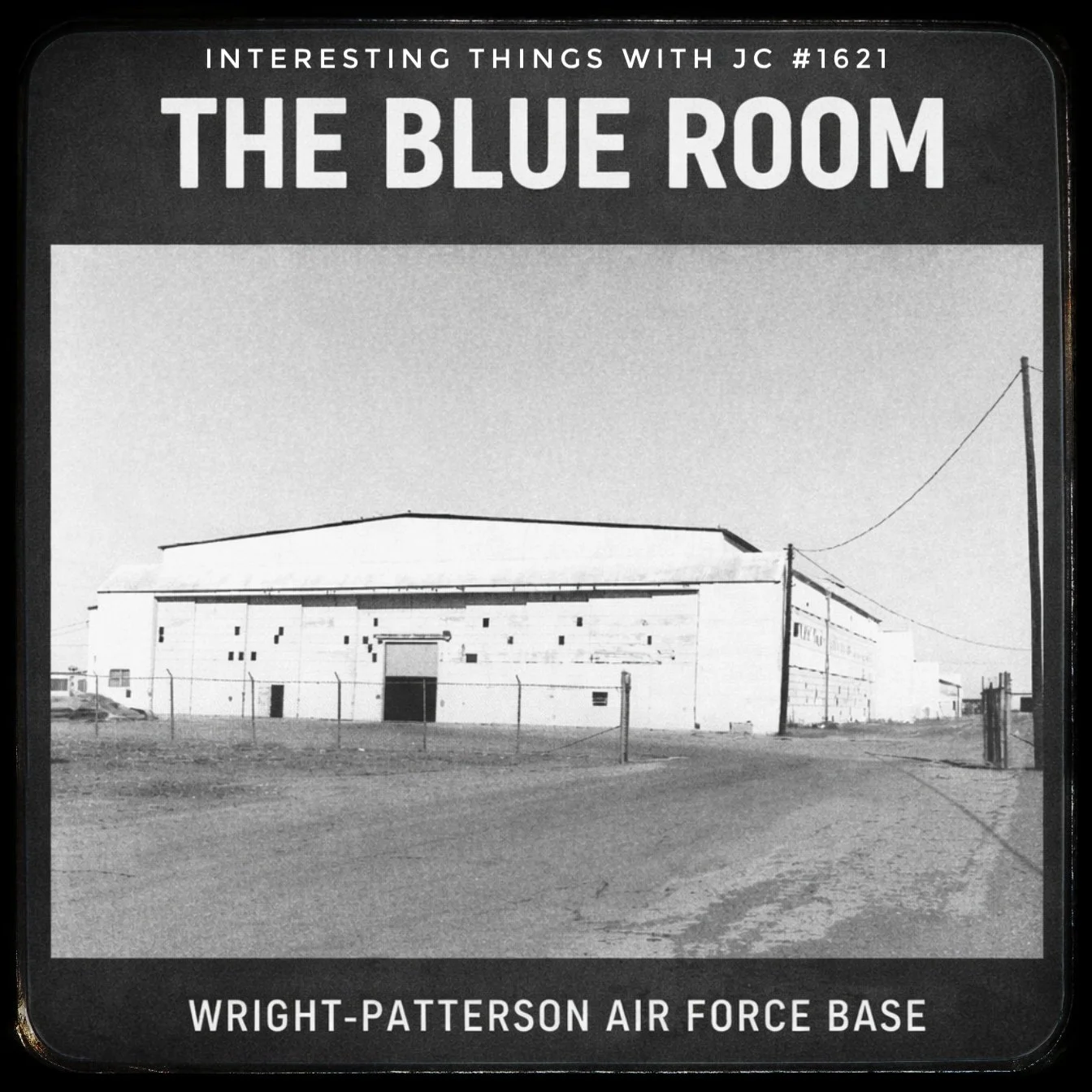
This archival-style image shows a secured industrial hangar at Wright-Patterson Air Force Base, a location historically used for classified research and foreign technology analysis during the Cold War. The stark, fenced environment reflects the type of controlled facilities where sensitive materials were handled. The image supports the discussion of the “Blue Room,” a term that appears in later accounts describing restricted spaces associated with analysis of unknown or advanced materials.
Transcript
Interesting Things with JC #1621:
"The Blue Room"
There was a room at Wright-Patterson Air Force Base that people referred to without ever agreeing on what it was.
It wasn’t public, and it wasn’t labeled for visitors. It was part of a base that handled classified research, foreign technology, and technical intelligence. The name that stuck in later accounts was the Blue Room.
Wright-Patterson, outside Dayton, Ohio, became a primary Air Force center for analyzing captured foreign equipment during the Cold War. That included Soviet aircraft, radar systems, and avionics. These were transported, disassembled, and studied in controlled environments. That function is documented and explains why secure, environmentally controlled rooms existed there.
The Blue Room itself does not appear in confirmed, declassified records tied to those operations. Instead, it shows up later, attached to them.
One version describes it as exactly what the base required, a secure chamber for handling sensitive aerospace materials under controlled conditions. In that sense, the idea fits the environment, even if the name does not appear in official documentation.
The other version comes from later accounts and UFO research, and this is where the story expands. Beginning in the 1950s and growing through the 1970s and beyond, Wright-Patterson became a focal point in UFO literature. Former military personnel, researchers, and writers began pointing to the base as a destination for recovered material from unexplained aerial incidents. In those accounts, the Blue Room is described as a controlled space where that material was examined under isolation.
Some descriptions focus on physical debris, fragments said to be unusually light, resistant to cutting or heat, or structured in ways that did not match known manufacturing techniques of the time. Others describe layered materials or memory-like metals that appeared to return to their original shape after being bent. A few accounts extend further, claiming the room was used not just for storage but for ongoing analysis, including attempts to understand structure, composition, and possible function.
These descriptions do not come from a single source. They appear across decades of interviews, books, and secondhand reports, often with different details, different timelines, and different levels of technical explanation. In some cases, the Blue Room is treated as a specific location. In others, it blends into broader Wright-Patterson lore, especially stories tied to recovered craft and later references like Hangar 18.
What they share is a pattern of description, not a consistent record.
No physical sample tied to these claims has been publicly verified through Wright-Patterson. No official report confirms the presence of unknown materials of nonhuman origin in a Blue Room facility. The accounts rely on testimony, repetition, and association, and while some are presented as firsthand, they do not align cleanly enough to establish a single, verifiable sequence of events.
What is consistent is the setting.
Wright-Patterson operated under strict compartmentalization. Teams worked in isolation, often without full knowledge of parallel projects. Material could be moved, studied, and reassigned without most personnel ever seeing the full chain. In that kind of system, a name like the Blue Room could attach to something real, be partially understood, or shift in meaning as it moved between people and over time.
There is no publicly verified documentation that confirms a Blue Room used for extraterrestrial analysis. There are no released records that establish that function.
It is also true that not all classified programs are fully visible in public records, even decades later. That leaves open the possibility that some facilities or projects were more narrowly held than what has been released, but that possibility is not the same as confirmation.
There is, however, overlap with other Wright-Patterson claims, especially those tied to recovered craft and the later story known as Hangar 18. These narratives reinforce each other but rely on testimony rather than confirmed documentation.
So the boundary holds.
Wright-Patterson handled foreign and sensitive technology in secure environments. That is established. The Blue Room remains a name that appears in later accounts, sometimes grounded in real operational context, sometimes extended beyond it.
What remains is the pattern. Material arrives that requires isolation, access is restricted, and information does not move beyond the system that contains it.
These are interesting things, with JC.
Student Worksheet
Comprehension Questions:
What confirmed role did Wright-Patterson serve during the Cold War?
Where does the Blue Room appear in the historical record?
What types of materials are described in anecdotal accounts?
Analysis Questions:
Classify the Blue Room accounts as primary, secondary, or anecdotal evidence. Explain.
How does compartmentalization increase uncertainty?
Why do repeated stories gain credibility over time?
Reflection Prompt:
When information is restricted, how should individuals responsibly interpret unknowns?
Difficulty Scaling:
Basic: Identify fact vs. claim
Intermediate: Classify evidence types
Advanced: Write a credibility assessment using 2–3 criteria
Student Output:
CER Paragraph (Claim, Evidence, Reasoning) evaluating whether the Blue Room is historically supported
Academic Integrity Guidance:
Use transcript evidence only
No external speculation
Clearly separate claim and reasoning
Teacher Guide
Quick Start: Play audio → students list facts vs. claims → begin analysis
Pacing Guide (audio-first):
Listen (5 min)
Fact/claim sorting (5 min)
Worksheet (15 min)
CER writing (10 min)
Discussion (10 min)
Bell Ringer: “What makes a source trustworthy?”
Audio Guidance: Pause after key sections to identify evidence
Audio Fallback: Annotated transcript highlighting claims vs. facts
Time-on-task: 40–50 minutes
Materials: Audio, worksheet, CER template
Vocabulary Strategy: Pre-teach corroboration and intelligence analysis
Misconceptions:
Lack of evidence equals hidden truth
Multiple sources equal verification
Discussion Prompts:
What is the strongest confirmed fact?
What is the weakest claim? Why?
Formative Checkpoints:
Students label evidence types correctly
Students justify reasoning
Differentiation:
Sentence starters for CER
Advanced: require counterargument
Assessment Differentiation:
Oral CER or written essay
Time Flexibility: Extend into research project
Substitute Readiness: Fully transcript-based lesson
Engagement Strategy: Mystery → investigation → evidence breakdown
Extensions: Compare to another historical myth tied to real location
Cross-Curricular:
Science: material properties
ELA: argument writing
History: Cold War context
SEL: Builds responsible skepticism and reasoning
Skill Emphasis: Evidence evaluation, structured reasoning
Answer Key:
Confirmed: Wright-Patterson analyzed foreign tech
Unverified: Blue Room extraterrestrial claims
Evidence type: anecdotal
CER: Claim unsupported due to lack of verifiable evidence
Quiz
Wright-Patterson was used for:
A. Tourism
B. Foreign technology analysis
C. Agriculture
D. RetailThe Blue Room is found in:
A. Official records
B. Declassified documents
C. Later accounts
D. Public archivesAnecdotal evidence is:
A. Scientifically proven
B. Based on personal accounts
C. Government verified
D. Experimentally testedCompartmentalization results in:
A. Full transparency
B. Limited knowledge sharing
C. Public reporting
D. Faster communicationCredibility increases with:
A. Repetition alone
B. Evidence and verification
C. Popularity
D. Speculation
Assessment
Open-Ended Questions:
Analyze how real classified environments contribute to the formation of myths.
Construct a CER argument evaluating the Blue Room claims.
Rubric (3–2–1):
3: Strong claim, multiple evidence points, clear reasoning
2: Partial evidence and reasoning
1: Limited or unclear response
Exit Ticket:
Write one sentence explaining why evidence matters more than repetition.
Standards Alignment
NGSS HS-ETS1-1: Analyze complex real-world problems by defining criteria and constraints; students evaluate how classified environments influence interpretation of evidence
NGSS HS-ETS1-3: Evaluate solutions based on prioritized criteria and trade-offs; students assess credibility of competing Blue Room explanations
CCSS.ELA-LITERACY.RH.9-10.1: Cite specific textual evidence; students identify and support distinctions between fact and anecdote
CCSS.ELA-LITERACY.RH.11-12.8: Evaluate reasoning and evidence in historical texts; students critique reliability of repeated claims
CCSS.ELA-LITERACY.WHST.11-12.1: Write arguments focused on discipline-specific content; students construct CER-based evaluations
ISTE 3a: Students evaluate accuracy, perspective, credibility, and relevance of information sources
ISTE 4d: Students use data and reasoning to solve authentic problems; applied through evidence classification tasks
C3 D2.His.12.9-12: Use questions to evaluate historical sources for credibility and bias
C3 D3.1.9-12: Gather relevant information from multiple sources and assess strengths and limitations
Career Readiness: Apply critical thinking, evidence validation, and decision-making under uncertainty in technical and intelligence-based fields
Lifelong Learning: Develop independent evaluation skills for media, claims, and information credibility in everyday contexts
Show Notes
This enhanced lesson strengthens analytical rigor by guiding students through evidence classification, credibility assessment, and structured argumentation. Using the Blue Room as a case study, students learn how real environments can generate persistent narratives when information is limited, reinforcing the importance of disciplined thinking.
References
U.S. Air Force. (2023). Air Force Materiel Command fact sheet. https://www.af.mil/About-Us/Fact-Sheets/Display/Article/104523/air-force-materiel-command/
National Museum of the U.S. Air Force. (2024). Cold War gallery overview. https://www.nationalmuseum.af.mil/Visit/Museum-Exhibits/Cold-War/
Office of the Director of National Intelligence. (2023). What is intelligence analysis? https://www.dni.gov/index.php/what-we-do/analysis
National Academies of Sciences. (2019). Reproducibility and replicability in science. https://nap.nationalacademies.org/catalog/25303/reproducibility-and-replicability-in-science