
1620: "The Danger of Media Spin"
Interesting Things with JC #1620: "The Danger of Media Spin" – A camera is already rolling when the first window breaks. The clip spreads before the rest of the street even reacts. What gets shown first starts standing in for everything else.
Curriculum - Episode Anchor
Episode Title: The Danger of Media Spin
Episode Number: 1620
Host: JC
Audience: Grades 9–12, Introductory College, Homeschool, Lifelong Learners
Subject Area: Media Literacy / Communication Studies
Lesson Overview
Objectives:
Analyze how framing and sequencing influence audience perception
Evaluate the impact of language choices on interpretation of events
Identify missing context and its effect on understanding
Apply media literacy strategies to real-world information sources
Essential Question: How does media framing shape what people believe about the same event?
Success Criteria:
Students explain framing with examples
Students identify bias through structure, not just content
Students compare two interpretations of the same scenario
Student Relevance: Students consume media daily; this builds critical evaluation skills
Real-World Connection: News, social media, and public communication influence decisions
Workforce Reality: Careers in journalism, marketing, and policy require ethical information presentation
Key Vocabulary
Framing (FRAY-ming): The way information is presented to shape perception
Context (KON-tekst): Background information that gives meaning
Narrative (NAIR-uh-tiv): A structured account or story
Bias (BY-us): A tendency that influences neutrality
Omission (oh-MIH-shun): Leaving out key information
Sequencing (SEE-kwen-sing): Order in which information is presented
Interpretation (in-ter-pruh-TAY-shun): How meaning is understood
Perception (per-SEP-shun): How something is viewed or understood
Narrative Core
Open: A moment appears already in motion—a breaking window, rising flames, and a camera capturing only part of the story.
Info: Media does not always distort facts; it selects and orders them. What is shown first, repeated, or omitted shapes understanding.
Details: Language shifts meaning—“clash” versus “crackdown,” “protesters” versus “mob.” Data placement changes tone, and missing context alters cause and effect.
Reflection: When audiences receive different slices of the same event, shared understanding begins to fragment. Decisions follow perception.
Closing: These are interesting things, with JC.
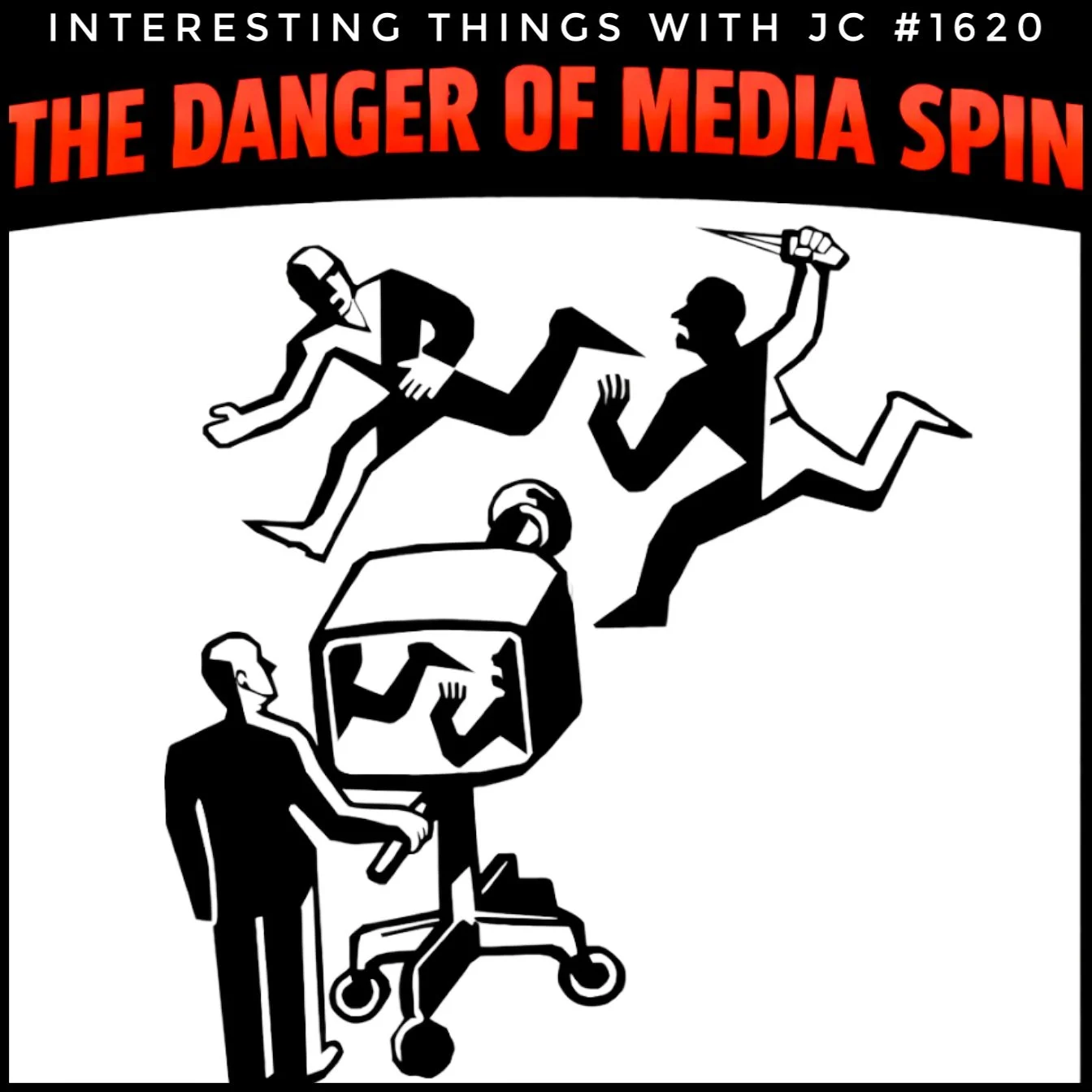
A single moment is captured, but the framing changes what it appears to be. Episode #1620 of Interesting Things with JC, The Dangers of Media Spin.
Transcript
Interesting Things with JC #1620:
"The Danger of Media Spin"
A camera is already rolling when the first window breaks.
Someone runs. Someone else raises a phone. Flames start in the background, small at first, then tall enough to take over the frame if you let them. A few seconds later, that clip is everywhere.
But it’s not the whole scene.
Ten seconds earlier, nothing was burning. Ten seconds later, most of the street is still standing there, watching, unsure what just changed. That full stretch exists, but it rarely survives the cut.
What you’re seeing has already been narrowed.
Not with a lie, but with a slice. What comes first. What gets repeated. What disappears. The same event can be built into something that feels contained or something that feels out of control, depending on which moments are allowed to represent it.
Then the words come in behind it, and they don’t just describe what happened, they shape how it lands. A “clash” suggests both sides pushed. A “crackdown” suggests one side did. Call a group “protesters” and the focus stays on the cause. Call them a “mob” and the focus shifts to the threat. Nothing in the footage changes, but the weight of it does.
Even numbers follow that pattern. Put a statistic at the top, and it reads like proof. Put the same number at the bottom, and it reads like context. Lead with “cases rising” and the trend feels urgent. Lead with “fatalities falling” and the same trend feels controlled. The data hasn’t moved, but the conclusion already has.
And then there’s what never shows up at all.
A timeline left out. A second quote missing. A previous event that would explain why this one happened in the first place. Without those pieces, cause and effect start to slide past each other. A response can look like a beginning. A pattern can look like a one-off. The facts are still technically correct, but they’re no longer doing the same job.
You can watch this happen in real time when coverage splits. One outlet loops the fire. Another shows the crowd before it. One leads with damage. Another leads with numbers. Over a few days, those choices stack up, and two audiences walk away with two versions of the same event, each one feeling complete.
That’s where the picture starts to split.
Decisions get made from those versions. People vote, invest, protest, or stay home based on what they believe they’ve seen. Institutions that depend on shared understanding start to feel less stable because the same facts no longer land the same way across the public.
And once that trust starts to thin out, it doesn’t just affect the stories that were shaped. It affects the ones that weren’t.
Accurate reporting can start to carry doubt with it. Corrections rarely travel as far as first impressions. And the pressure to hold attention pushes coverage further toward what works, not always what holds together.
So the next time something breaks into view already framed, already labeled, already moving fast, it’s worth slowing down just enough to notice what you’re actually being shown.
Not just what happened.
But which part of it you were given first.
These are interesting things, with JC.
Student Worksheet
Comprehension Questions:
What does the episode suggest is the main difference between a “lie” and a “slice”?
How does sequencing affect how an event is understood?
What role does word choice play in shaping perception?
Analysis Questions:
Compare two hypothetical headlines describing the same event using different language. What changes?
How does omission of context alter cause-and-effect understanding?
Reflection Prompt:
Describe a time you saw the same event presented differently. What changed your perception?
Difficulty Scaling:
Basic: Identify examples of framing
Intermediate: Explain impact of framing
Advanced: Create alternate narratives from the same facts
Student Output:
Written paragraph (5–8 sentences) analyzing a media example
Optional: Compare two sources
Academic Integrity Guidance:
Use original analysis
Cite sources if external examples are used
Teacher Guide
Quick Start: Play audio, then begin discussion on first impressions
Pacing (Audio-First):
Play episode (5 min)
Immediate reflection (5 min)
Guided analysis (15 min)
Worksheet completion (15 min)
Bell Ringer: What headline would you write for a chaotic scene?
Audio Guidance: Encourage students to listen for sequencing and word choice
Audio Fallback: Provide transcript for reading and annotation
Materials: Transcript, worksheet, projector
Misconceptions:
Bias always equals false information
Data alone is neutral without framing
Discussion Prompts:
Does order matter more than facts?
Can two true reports still mislead?
Formative Checks:
Identify framing in examples
Explain impact verbally
Differentiation:
Provide sentence starters
Allow verbal responses
Engagement Strategy: Real-world examples from social media
Extensions: Analyze current news coverage
Cross-Curricular: English (rhetoric), Civics (media impact)
SEL: Encourage perspective-taking
Answer Key:
Comprehension: Focus on framing, sequencing, language
Analysis: Emphasis on interpretation differences
Reflection: Subjective but must connect to lesson
Quiz
What is framing?
A. Changing facts
B. Presenting information in a certain way
C. Ignoring all data
D. Removing biasWhat does sequencing influence?
A. Accuracy
B. Order of events
C. Perception
D. Source credibilityWhat does omission do?
A. Adds detail
B. Removes context
C. Clarifies meaning
D. Improves accuracyWhich word suggests threat?
A. Protesters
B. Crowd
C. Mob
D. GroupWhat happens when coverage splits?
A. Facts disappear
B. Audiences align
C. Different interpretations form
D. Events stop
Assessment
Open-Ended Questions:
Explain how media framing can change public understanding without changing facts.
Analyze the role of omission in shaping a narrative.
Rubric (3–2–1):
3: Clear, detailed, accurate explanation with examples
2: Partial explanation with limited detail
1: Minimal or unclear response
Exit Ticket:
What is one way you will evaluate media differently after this lesson?
Standards Alignment
NGSS (Science and Engineering Practices): Analyzing and Interpreting Data — Students evaluate how the same dataset or visual evidence can lead to different conclusions based on framing, sequencing, and omission.
NGSS (Crosscutting Concepts): Cause and Effect — Students examine how missing context alters perceived cause-and-effect relationships in media narratives.
CCSS.ELA-LITERACY.RI.11-12.6: Determine an author’s point of view or purpose — Students analyze how language choices (e.g., “clash” vs. “crackdown”) influence interpretation.
CCSS.ELA-LITERACY.RI.11-12.7: Integrate multiple sources — Students compare different media portrayals of the same event to identify inconsistencies and framing techniques.
CCSS.ELA-LITERACY.SL.11-12.3: Evaluate a speaker’s perspective — Students assess credibility, reasoning, and use of evidence in audio-based reporting.
C3 Framework (D2.Civ.9.9-12): Use appropriate evidence to construct explanations — Students build evidence-based conclusions about how media influences public understanding.
C3 Framework (D2.Civ.10.9-12): Analyze the impact of media on civic life — Students evaluate how differing narratives affect public trust and decision-making.
ISTE Standard 3 (Knowledge Constructor): Students critically curate information from digital sources, identifying bias, framing, and missing context.
ISTE Standard 7 (Global Collaborator): Students examine multiple perspectives to better understand how different audiences interpret the same information.
Career Readiness (Information Analysis): Evaluate and synthesize information from multiple sources to make informed decisions in workplace and civic contexts.
Career Readiness (Communication): Understand how message framing affects audience perception in fields such as journalism, marketing, and public relations.
Lifelong Learning / Homeschool Alignment: Apply critical media literacy skills to everyday information consumption, including news, social media, and public messaging.
Show Notes
This lesson explores how media framing shapes perception without altering facts. Students learn to recognize how sequencing, language, and omission influence understanding, building essential skills for navigating modern information environments.
References
Pew Research Center. (2020). News audience attitudes. https://www.pewresearch.org/journalism/2020/01/24/u-s-media-polarization-and-the-2020-election/
Kahneman, D. (2011). Thinking, fast and slow. https://us.macmillan.com/books/9780374533557/thinkingfastandslow
Stanford History Education Group. (2016). Evaluating information. https://sheg.stanford.edu/upload/V3LessonPlans/Executive%20Summary%2011.21.16.pdf
