1619: "Deer Island"
Interesting Things with JC #1619: "Deer Island" – Men, women, and children are standing on a narrow island with no shelter as winter approaches. They were not supposed to be left exposed after being taken from their homes. The island sits close enough to Boston to be seen but far enough that what is happening there is not being corrected. By the time you can see it… they are already dying in the cold.
Curriculum - Episode Anchor
Episode Title: Deer Island
Episode Number: 1619
Host: JC
Audience: Grades 9–12, Introductory College, Homeschool, Lifelong Learners
Subject Area: History / Early American History
Lesson Overview
Students examine the forced confinement of Native communities on Deer Island during King Philip’s War, analyzing how fear, policy decisions, and wartime pressures shaped outcomes.
Objectives:
Analyze causes and consequences of confinement policies during wartime
Evaluate how fear influences government decision-making
Interpret historical accounts to understand lived experiences
Connect historical events to modern concepts of civil rights and displacement
Essential Question: How do fear and uncertainty influence decisions about control and safety during conflict?
Success Criteria: Students can explain what happened on Deer Island, identify causes, and connect to broader historical patterns
Student Relevance Statement: Students explore how governments make decisions under pressure and how those decisions affect real people
Real-World Connection: Modern refugee camps, detention centers, and emergency policies reflect similar challenges
Workforce Reality: Careers in law, public policy, military leadership, and emergency management require balancing safety with ethical responsibility
Key Vocabulary
Confinement (kuhn-FINE-ment): Forced restriction of movement
Metacom (MEH-tuh-kom): Wampanoag leader central to the war
Puritan (PYUR-i-tuhn): English Protestant settlers in New England
Conversion (kuhn-VUR-zhuhn): Adoption of a new religion
Displacement (dis-PLACE-ment): Forced movement from one’s home
Exposure (ik-SPOH-zhur): Harm caused by environmental conditions
Colonial Authority (kuh-LOH-nee-uhl uh-THOR-i-tee): Governing power of colonies
Starvation (star-VAY-shun): Severe lack of food
Internment (in-TURN-ment): Confinement without trial
Narrative Core
Open: Boats moved across Boston Harbor carrying families away from their homes, toward a narrow island exposed to wind and winter.
Info: During King Philip’s War, colonial authorities in Massachusetts removed Native communities, including those who had cooperated with the English, to Deer Island.
Details: Shelter was inadequate, food was inconsistent, and clothing was insufficient. Accounts describe cold, hunger, and disease. Fear led authorities to treat entire communities as threats, not just combatants. Geography isolated those confined, limiting visibility and accountability.
Reflection: Deer Island shows how decisions made under pressure can expand beyond their original purpose. Distinctions between ally and enemy can collapse when fear dominates judgment.
Closing: These are interesting things, with JC.
A layered, partially obscured image blending textures, text, and scenes—featuring fabric at the top, faint Arabic text, an aerial coastal facility, and an illustrated office environment below.
Transcript
Interesting Things with JC #1619: "Deer Island"
They put them on boats and took them out into Boston Harbor, on the northeastern coast of what is now the United States, just a few miles off the city of Boston.
By the fall of 1675, Native men, women, and children from across southern New England were being forced onto Deer Island, a narrow, exposed piece of land where the wind came hard off the water and winter was already on its way. John Eliot, the Puritan minister who had spent years working to convert Native communities to Christianity, later wrote about their suffering there, describing people left with little shelter and struggling to survive the cold. Some were praying Indians, converts who had lived in English-supervised towns and, in many cases, had tried to stay inside the colonial system. That did not protect them.
The war had started that summer. The English called it King Philip’s War, after Metacom, the Wampanoag leader at the center of the conflict. As fighting spread, fear spread with it, and once that fear took hold, suspicion did not stop at the people who were actually fighting. It widened. Native communities, including those who had not taken up arms, were increasingly treated as potential threats, especially in Massachusetts, where colonial authorities chose removal and confinement as a response.
What happened on Deer Island was not a formal prison in the modern sense, but it was confinement all the same. People were taken from their homes and placed into conditions they were not prepared to endure. Shelter was poor or improvised. Food deliveries were inconsistent and often inadequate. Clothing was not sufficient for the season. The Massachusetts General Court authorized limited provisions, but reports from the time make clear they did not meet the need. Cold, hunger, and disease followed.
Some of the people sent there had worked with the English. Some had converted. Some had believed that staying loyal, or at least staying within the rules the English had established, would spare them. It didn’t. In wartime, those distinctions broke down. Colonial authorities did not consistently separate ally from perceived risk once fear and uncertainty began driving decisions.
That is part of what makes Deer Island difficult to look at clearly. This was not only a battlefield story. It was a decision about control, made under pressure, that extended beyond those actively fighting. The island sat close enough to Boston to be reached easily, but far enough away that once people were placed there, their conditions became distant from daily view. The geography did part of the work.
Many did not survive that winter. The exact number is uncertain, and records from the period are incomplete, but accounts consistently describe death from exposure, starvation, and illness. Survivors came out of the war scattered, weakened, or displaced again. Some were allowed to return. Others were forced into different forms of removal. In the broader aftermath of the war, Native captives were also sold into slavery in places like Bermuda and the Caribbean, part of a wider pattern that extended beyond Deer Island itself.
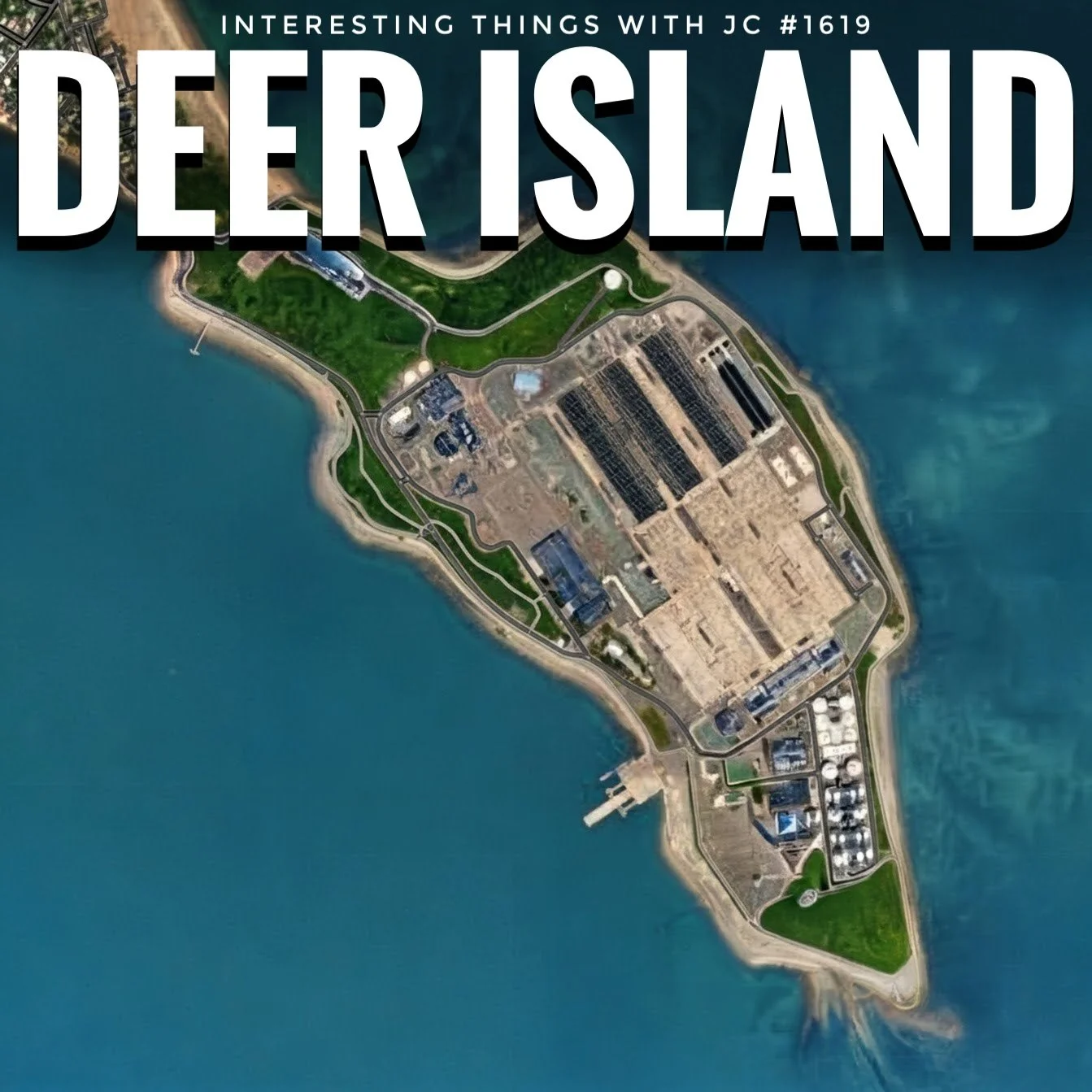
Today the island is known for something entirely different. It holds major wastewater treatment facilities, and most people who see it think of infrastructure, not confinement. But the ground does not forget how it was used. Deer Island became a place where people were sent when they were no longer trusted to remain nearby, and once that decision was made, the conditions that followed were largely out of their control.
Out there in Boston Harbor, the line between neighbor and threat shifted under pressure, and when it did, hundreds were left exposed to the cold to live with the result.
These are interesting things, with JC.
Student Worksheet
Comprehension Questions:
What event led to the confinement of Native communities on Deer Island?
Who were the “praying Indians”?
What conditions did people face on Deer Island?
Why did colonial authorities choose confinement?
Analysis Questions:
How did fear influence colonial decision-making?
Why were even allied Native groups treated as threats?
What role did geography play in the situation?
Reflection Prompt:
How should governments balance safety and fairness during times of crisis?
Difficulty Scaling:
Basic: Identify facts from the text
Intermediate: Explain cause and effect
Advanced: Evaluate ethical implications
Student Output:
Written paragraph (5–8 sentences) or short essay (1–2 pages)
Academic Integrity Guidance:
Use evidence from the transcript
Avoid copying language directly
Support claims with clear reasoning
Teacher Guide
Quick Start: Play audio, then guide discussion on fear and decision-making
Pacing Guide:
Audio listening (5–7 min)
Discussion (10 min)
Worksheet (15–20 min)
Review (10 min)
Bell Ringer: What happens when fear drives decisions?
Audio Guidance: Focus students on conditions and decisions
Audio Fallback: Read transcript aloud
Time on Task: 40–50 minutes
Materials: Audio, transcript, worksheet
Vocabulary Strategy: Pre-teach key terms
Misconceptions:
Not all confined individuals were combatants
Confinement was not a formal prison system
Discussion Prompts:
What alternatives might have existed?
How does fear change judgment?
Formative Checkpoints:
Identify causes
Explain consequences
Differentiation:
Provide summaries for struggling readers
Extend with research for advanced students
Assessment Differentiation:
Oral vs written responses
Time Flexibility: Can expand to multi-day lesson
Substitute Readiness: Fully self-contained
Engagement Strategy: Scenario-based discussion
Extensions: Compare to other historical internments
Cross-Curricular Connections: Civics, ethics, geography
SEL Connection: Empathy and perspective-taking
Skill Value Emphasis: Critical thinking, evidence analysis
Answer Key:
Comprehension: War, praying Indians = converts, harsh conditions, fear
Analysis: Fear broadened suspicion, allies not trusted, isolation increased harm
Quiz
What war led to the events on Deer Island?
A. French and Indian War
B. King Philip’s War
C. Revolutionary War
D. Civil WarWho was Metacom?
A. English governor
B. Puritan minister
C. Native leader
D. SoldierWhat was a major condition on Deer Island?
A. Abundant supplies
B. Strong shelter
C. Harsh exposure
D. Military protectionWhy were people confined?
A. Voluntary relocation
B. Trade agreements
C. Fear and suspicion
D. Religious ceremoniesWhat role did geography play?
A. Made escape easy
B. Increased visibility
C. Created isolation
D. Improved supply access
Assessment
Open-Ended Questions:
Explain how fear influenced colonial actions during King Philip’s War.
Evaluate the impact of Deer Island on Native communities.
Rubric (3–2–1):
3: Clear explanation, strong evidence, thoughtful reasoning
2: Basic explanation, some evidence
1: Limited understanding, minimal detail
Exit Ticket:
What is one lesson modern societies can learn from Deer Island?
Standards Alignment
NGSS (HS-ETS1-1): Analyze a major global challenge (conflict and displacement during wartime) and define criteria and constraints for solutions, including ethical and social impacts
NGSS (HS-ETS1-2): Evaluate competing solutions (e.g., confinement vs. alternative responses) using evidence-based reasoning and trade-offs
CCSS.ELA-LITERACY.RH.9-10.1: Cite specific textual evidence from the transcript to support analysis of primary and secondary historical accounts
CCSS.ELA-LITERACY.RH.9-10.2: Determine central ideas of a historical narrative and summarize key events related to Deer Island and King Philip’s War
CCSS.ELA-LITERACY.WHST.9-10.1: Write arguments focused on discipline-specific content, using evidence to evaluate decisions made by colonial authorities
C3 Framework (D2.His.1.9-12): Evaluate how historical events are shaped by context, including fear, war, and uncertainty
C3 Framework (D2.His.14.9-12): Analyze multiple and complex causes and effects of events such as forced confinement and displacement
ISTE Standard 3 (Knowledge Constructor): Critically curate and evaluate historical information from the transcript and supporting materials
ISTE Standard 1 (Empowered Learner): Use evidence-based reasoning to form conclusions about ethical decision-making in historical contexts
Career Readiness (Critical Thinking & Ethics): Apply decision-making frameworks to real-world scenarios involving risk, safety, and human rights
Career Readiness (Civic Literacy): Understand the role of government authority and responsibility during crises
Homeschool/Lifelong Learning: Develop independent inquiry skills by connecting historical events to modern global issues such as refugee displacement, emergency policy, and civil liberties
Show Notes
This episode explores Deer Island during King Philip’s War, focusing on how fear and uncertainty led to the confinement of Native communities. It highlights the human impact of policy decisions and helps students connect historical events to modern issues of displacement, ethics, and governance.
References
New England Historic Genealogical Society. (2023). King Philip’s War overview. https://newenglandhistoricalsociety.com/tag/king-philips-war/
Partnership of Historic Bostons “From paradise to prison” by Lance Young. https://historicbostons.org/blog-1/deer#:~:text=Deer%20Island%20was%20one%20of%20the%20Boston,of%20those%20who%20belonged%20to%20this%20place.
National Park Service. (2021). King Philip’s War history. https://www.nps.gov/places/deer-island.htm