1618: "Signals Intelligence in Commercial Radio"
Interesting Things with JC #1618: "Signals Intelligence in Commercial Radio" – You hold on one AM station and notice it fading in and out every few seconds. The transmitter isn’t doing that. Someone else is using the frequency. By the time you can prove it… the signal may already be gone.
Curriculum - Episode Anchor
Episode Title: Signals Intelligence in Commercial Radio
Episode Number: 1618
Host: JC
Audience: Grades 9–12, introductory college, homeschool, and lifelong learners
Subject Area: Radio science, physics, communications history, and intelligence studies
Lesson Overview
Objectives:
Explain how medium-wave AM broadcasts function as stable reference signals for studying radio propagation
Describe how the ionosphere affects long-distance radio reception, especially at night
Analyze how multipath interference produces measurable fading patterns
Evaluate how public broadcasts can carry both technical and operational significance
Essential Question: How can an ordinary public radio broadcast become a tool for science, engineering, and intelligence?
Success Criteria:
I can describe how the ionosphere affects radio signals
I can explain why fading occurs and what it represents
I can connect signal behavior to real-world monitoring and communication systems
I can support explanations using evidence from the episode
Student Relevance Statement: Everyday wireless systems behave in ways most people never notice. This lesson reveals how careful observation turns ordinary signals into useful data
Real-World Connection: Signal monitoring is used in aviation, maritime systems, broadcasting, emergency response, and telecommunications
Workforce Reality: Careers in RF engineering, communications, defense analysis, and broadcasting require precision, observation, and interpretation of signal behavior
Key Vocabulary
Ionosphere(eye-ON-oh-sfeer): Upper atmospheric region containing charged particles that affect radio waves
Medium wave(MEE-dee-um wayv): AM broadcast frequency range, typically 530–1700 kHz
Carrier wave(KAIR-ee-er wayv): Base signal used to transmit information
Skywave(SKY-wayv): Radio signal reflected back to Earth by the ionosphere
Multipath propagation(MUL-tee-path prop-uh-GAY-shun): Signal arrival via multiple routes
Interference fading(in-ter-FEER-ents FAY-ding): Signal strength variation caused by path differences
Frequency(FREE-kwen-see): Number of wave cycles per second
Signal propagation(SIG-nul prop-uh-GAY-shun): Movement of a signal through space
Reference signal(REF-er-ents SIG-nul): Stable signal used for measurement comparison
Signals intelligence(SIG-nulz in-TEL-uh-jents): Information gained from analyzing signals
Narrative Core
Open: A man sits in a parked car at night, tuning carefully, not listening to content, but observing how a signal behaves
Info: Medium-wave stations provided fixed, known transmissions that could be used as stable references across long distances
Details: Signals often arrive by multiple paths due to ionospheric reflection. When these paths recombine, they create fading patterns that reveal timing, distance, and atmospheric conditions
Reflection: Public broadcasts served dual purposes. They enabled scientific observation and, during wartime, supported precise communication systems without altering the signal itself
Closing: Careful observation transforms ordinary systems into tools for measurement and insight. These are interesting things, with JC.
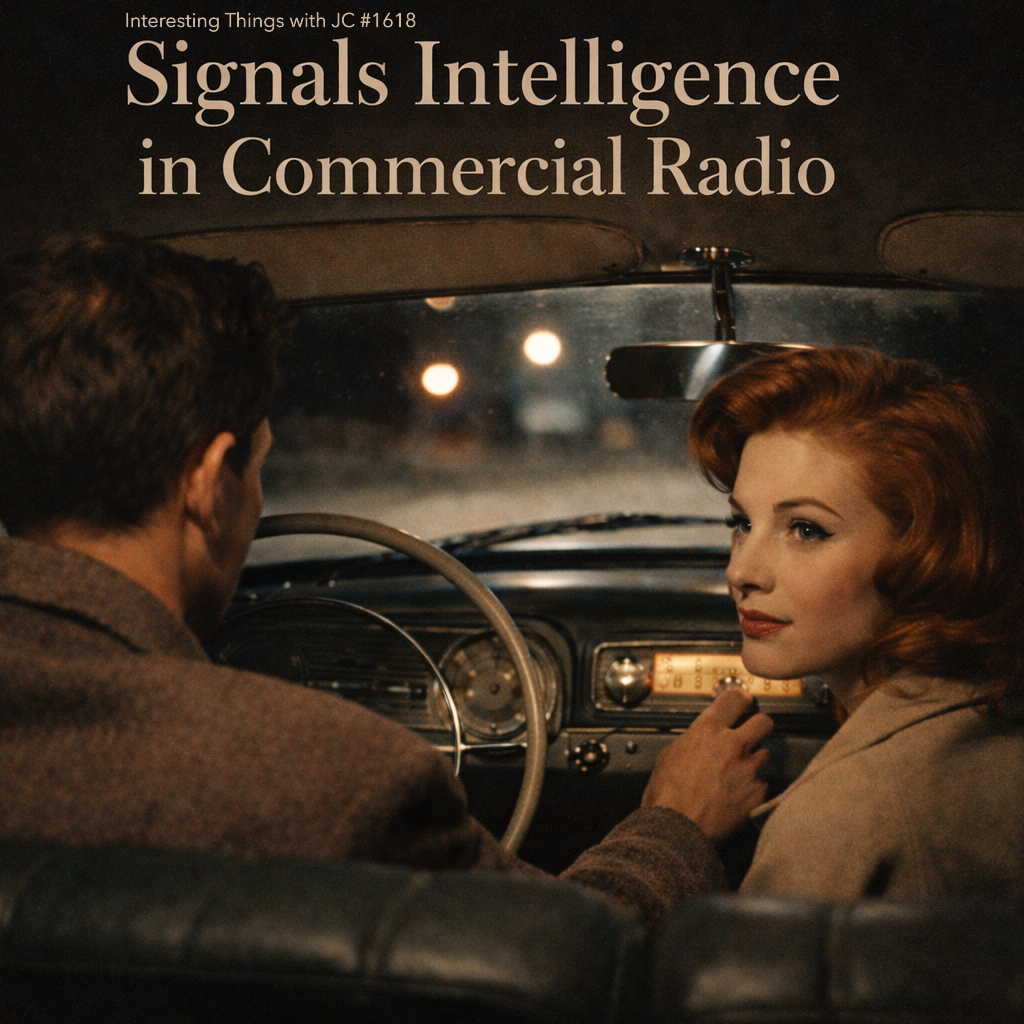
Late 1950s style car interior at night, viewed from the back seat, with a driver adjusting a glowing AM radio while a woman in the passenger seat turns toward the camera beneath the title “Signals Intelligence in Commercial Radio.”
Transcript
Interesting Things with JC #1618:
"Signals Intelligence in Commercial Radio"
A man sits in a parked car at night, headphones pressed tight, the tuning dial moving in small, deliberate steps, stopping on a clear AM frequency that rises and falls every few seconds, not because the station is changing anything, but because the signal is arriving along more than one path at the same time.
He’s not listening to the program. He’s watching what the signal does on the way to him.
By the 1930s, powerful medium-wave stations, operating roughly between 530 and 1700 kilohertz, were transmitting at fixed frequencies and known power. Some, like WLW in Cincinnati, reached 500 kilowatts for a period, pushing signals that could travel hundreds to over a thousand miles at night as the ionosphere reflected them back toward Earth.
To most listeners, that meant clearer reception after sunset. To engineers and intelligence analysts, it meant something far more controlled. A constant signal moving through a variable environment.
That signal becomes a reference.
During World War II, Allied monitoring stations tracked how American commercial broadcasts arrived in Britain across the Atlantic. If those signals held steady, long-range circuits were open. If they faded, split, or dropped out, it meant the ionosphere was shifting, sometimes hours before military communication began to fail.
No transmission needed. Just listening to what was already there.
At the same time, those same broadcasts carried one of the most precise message systems of the war. On June 1, 1944, the BBC transmitted a line from a Paul Verlaine poem: “Les sanglots longs des violons de l’automne…” To most listeners, it was just literature. To the French Resistance, it was instruction. Prepare. Days later, the next line signaled that action was imminent ahead of the Normandy invasion. The signal had to arrive on time, on frequency, and intact, or the instruction didn’t exist.
The signal never changed. The meaning did.
Technically, every broadcast was also revealing the structure of the air itself. A carrier wave leaves the transmitter clean, but it rarely arrives that way. It reflects at different ionospheric layers, often between about 60 and 300 kilometers above the Earth, and returns along multiple paths. When those paths recombine, they interfere, sometimes reinforcing, sometimes canceling, producing the steady rise and fall every few seconds as those paths slip in and out of phase by fractions of a wavelength.
That pattern isn’t noise. It’s geometry.
From the timing and rhythm of that fading, engineers could estimate reflection height, distance traveled, and changes in atmospheric density. Commercial radio became a continuous calibration system, always on, always measurable, always tied to a known source.
In that parked car, the man holds on one station as it pulses in a slow, repeating cycle. Two paths, slightly out of phase. From that, he can approximate how far the signal has traveled, how high it reflected, and how those conditions are shifting above him.
He turns the dial again, not chasing content, but comparing behavior, because every station is a fixed point, and every variation is information.
Every station was fixed, known, and always on, which made it useful long after the program ended.
The broadcast was public.
The intelligence never was.
These are interesting things, with JC.
Student Worksheet
Directions: Listen first, then answer using evidence. Use complete sentences unless noted
Comprehension Questions:
What was the man actually observing while listening?
Why were AM stations useful as reference signals?
What role does the ionosphere play?
What causes signal fading?
What was the purpose of the BBC broadcast line?
Analysis Questions:
Why is fading described as geometry?
How can a signal carry both public and hidden meaning?
Why is a fixed frequency important for measurement?
What evidence shows signals reveal atmospheric change?
Reflection Prompt:
Select one sentence that shows the importance of observation and explain why
Difficulty Scaling:
Core: Questions 1–5
Standard: Questions 1–8
Extension: All questions plus diagram of signal paths
Student Output:
Core: Short responses
Standard: 6–8 sentences
Extension: Paragraph plus labeled diagram
Academic Integrity Guidance:
Use original wording.
Quote only when necessary and clearly identify it.
Teacher Guide
Quick Start: Play audio once. Ask students what changed: the station or the signal
Pacing Guide:
Bell ringer: 5 min
First listen: 5 min
Vocabulary: 10 min
Second listen: 5 min
Worksheet: 15–20 min
Discussion: 10 min
Exit ticket: 3 min
Bell Ringer: “What can change in a signal if the transmitter stays the same?”
Audio Guidance: Focus on signal behavior, not content
Audio Fallback: Use transcript reading or paired reading
Time on Task: 45–60 minutes
Materials:
Audio or transcript
Worksheet
Board
Vocabulary Strategy: Preteach ionosphere, multipath, carrier wave
Misconceptions:
Fading is equipment failure
Signals travel in straight lines only
Hidden messages require secret channels
Discussion Prompts:
Why ignore program content?
What makes a signal reliable for measurement?
Why does interpretation matter?
Formative Checkpoints:
Define purpose after first listen
Explain fading after vocabulary
Differentiation:
Sentence starters
Visual diagrams
Partner discussion
Assessment Differentiation:
Oral responses
Diagram alternatives
Time Flexibility: 30–60 minutes
Substitute Readiness: Transcript-based delivery works
Engagement Strategy: Present as a technical mystery
Extensions:
Map signal paths
Compare to modern systems
Cross-Curricular: Physics, history, engineering
SEL: Emphasize patience and observation
Skill Emphasis: Analysis, evidence, systems thinking
Answer Key:
Q1: Observing signal behavior
Q2: Fixed frequency and known power
Q3: Reflects signals for long distance
Q4: Multipath interference
Q5: Coded wartime instruction
Q6: Caused by path differences and phase
Q7: Meaning depends on interpretation
Q8: Enables consistent comparison
Q9: Fading indicates atmospheric change
Q10: Accept supported reasoning
Quiz
Why does the man stay on one station?
A. Entertainment
B. Signal observation
C. Volume testing
D. RecordingWhat enables long-distance AM reception at night?
A. Speaker power
B. Batteries
C. Ionosphere
D. Antennas aloneMultipath propagation means:
A. Multiple broadcasts
B. Multiple routes
C. Multiple stations
D. Multiple receiversBBC message example shows:
A. Noise
B. Failure
C. Coding
D. AdvertisingFixed broadcasts help because:
A. They are popular
B. They are stable references
C. They are louder
D. They are local
Assessment
Open-Ended Questions:
Explain how one broadcast can serve science and intelligence
Describe how signal paths affect what is received
Rubric:
3: Accurate, detailed, evidence-based
2: Mostly accurate, partial detail
1: Limited or unclear
Exit Ticket:
Explain the difference between public signal and hidden meaning
Standards Alignment
NGSS HS-PS4-1: Use mathematical and conceptual models to describe how wave interference and superposition produce observable patterns such as fading in radio signals
NGSS HS-PS4-5: Communicate technical information about how wave-based technologies transmit and receive information through varying media including the ionosphere
NGSS HS-ESS2-2: Analyze how energy transfer within Earth systems, including ionospheric activity, affects communication systems
NGSS HS-ETS1-2: Design and evaluate solutions to complex problems by breaking down signal reliability and propagation challenges into manageable components
CCSS.ELA-LITERACY.RST.11-12.2: Determine central ideas in a technical audio/text and provide accurate summaries of signal behavior and communication systems
CCSS.ELA-LITERACY.RST.11-12.7: Integrate multiple sources of information (audio, text, diagrams) to understand radio propagation systems
CCSS.ELA-LITERACY.SL.11-12.1: Initiate and participate in collaborative discussions using evidence-based reasoning about scientific and historical concepts
CCSS.ELA-LITERACY.WHST.11-12.2: Write explanatory texts that clearly describe technical processes such as multipath propagation and ionospheric reflection
ISTE 1.3 Knowledge Constructor: Critically evaluate information from audio and technical sources to build accurate explanations of signal systems
ISTE 1.4 Innovative Designer: Apply understanding of signal systems to model or diagram real-world communication scenarios
C3 Framework D2.His.1.9-12: Evaluate how technological systems such as radio broadcasting influenced historical events and decision-making
C3 Framework D2.His.14.9-12: Analyze the role of communication systems in shaping outcomes during major historical events such as World War II
Career Readiness – Communications & Engineering Pathways: Demonstrate ability to interpret signal data, understand transmission systems, and apply technical reasoning to real-world communication challenges
Career Readiness – Information Analysis: Evaluate observable data (signal variation) to make informed conclusions about system performance and environmental conditions
Homeschool/Lifelong Learning: Apply interdisciplinary thinking to connect physics, history, and communication systems while developing independent analysis and observation skills
Show Notes
This lesson demonstrates how ordinary radio broadcasts can be used as tools for scientific measurement and historical communication. Students learn that careful observation of signal behavior reveals hidden layers of information, connecting physics, engineering, and history in a single system.
References
Federal Communications Commission. (2020). AM broadcast station database. https://www.fcc.gov/media/radio/am-query
National Endowment for the Humanities. (2015). WLW superpower station history. https://www.neh.gov/article/wlw-americas-super-station
National Oceanic and Atmospheric Administration. (n.d.). Ionosphere overview. https://www.swpc.noaa.gov/phenomena/ionosphere
National Institute of Standards and Technology. (1965). Ionospheric radio propagation. https://nvlpubs.nist.gov/nistpubs/Legacy/MONO/nbsmonograph80.pdf
International Telecommunication Union. (1998). Ionospheric effects on radiowaves. https://www.itu.int/dms_pub/itu-r/opb/hdb/R-HDB-32-1998-PDF-E.pdf
Comité du Débarquemenz. (n.d.). Radio messages and D-Day preparation. https://www.comitedudebarquement.fr/en/operation-overlord/la-preparation-de-loperation-overlord/messages-radio/
D-Day Overlord. (n.d.). BBC coded messages and Normandy. https://www.dday-overlord.com/en/bbc-messages-announcing-d-day