1617: "Catfish Have Venom"
Interesting Things with JC #1617: "Catfish Have Venom" – A fisherman grabs what feels harmless. The reaction does not begin until after the contact is over. The pain spreads beyond the wound and overrides control in ways that escalate without warning. By the time you can see it… your body may already be shutting down. Inspired by Stephen Fultz
Curriculum - Episode Anchor
Episode Title: Catfish Have Venom
Episode Number: 1617
Host: JC
Audience: Grades 9–12, Introductory College, Homeschool, Lifelong Learners
Subject Area: Biology / Zoology / Evolutionary Science
Lesson Overview
Learning Objectives:
Explain how venom delivery systems function in certain fish species
Describe the anatomical structure of catfish spines and venom glands
Analyze how evolution can produce similar traits independently (convergent evolution)
Evaluate risk and safety considerations when interacting with wildlife
Essential Question: How do defensive adaptations like venom improve survival in aquatic organisms?
Success Criteria:
Students can describe how catfish venom is delivered
Students can explain why venom evolved in multiple catfish lineages
Students can connect structure to function in biological systems
Student Relevance Statement:
Students encounter animals in everyday environments (fishing, aquariums, outdoor recreation), and understanding hidden biological defenses builds awareness and safety.
Real-World Connection:
Fishing, wildlife handling, and aquatic fieldwork require knowledge of venomous species to prevent injury.
Workforce Reality:
Marine biologists, environmental scientists, and fisheries workers must understand animal defense mechanisms and risk management in field conditions.
Key Vocabulary
Venom (VEN-uhm): a toxic substance delivered through a wound
Spine (spīn): a sharp, rigid structure used for defense or support
Dorsal Fin (DOR-suhl fin): the fin located on the back of a fish
Pectoral Fin (PEK-tuh-rul fin): paired fins located on the sides near the head
Venom Gland (VEN-uhm gland): specialized tissue that produces venom
Sheath (sheeth): a covering structure that encloses another part
Convergent Evolution (kuhn-VUR-jent ev-uh-LOO-shun): independent evolution of similar traits
Enzymes (EN-zymes): proteins that speed up chemical reactions
Tissue Damage (TISH-oo DAM-ij): harm to body cells or structures
Narrative Core
Open:
A fisherman reaches into the water expecting nothing unusual, but in seconds, pain shoots through his hand.
Info:
Catfish possess hardened spines on their dorsal and pectoral fins that are capable of delivering venom.
Details:
These spines are covered by a sheath containing venom glands. When the spine punctures skin, the sheath breaks, releasing venom into the wound. There are over 3,000 species of catfish, many of which have venom systems. The venom contains proteins and enzymes that cause intense pain, swelling, and sometimes tissue damage. This adaptation evolved multiple times, indicating strong survival pressure.
Reflection:
Slow-moving bottom-dwelling fish needed protection against predators. Venom provided a powerful deterrent, making them dangerous to attack or handle.
Closing:
These are interesting things, with JC.
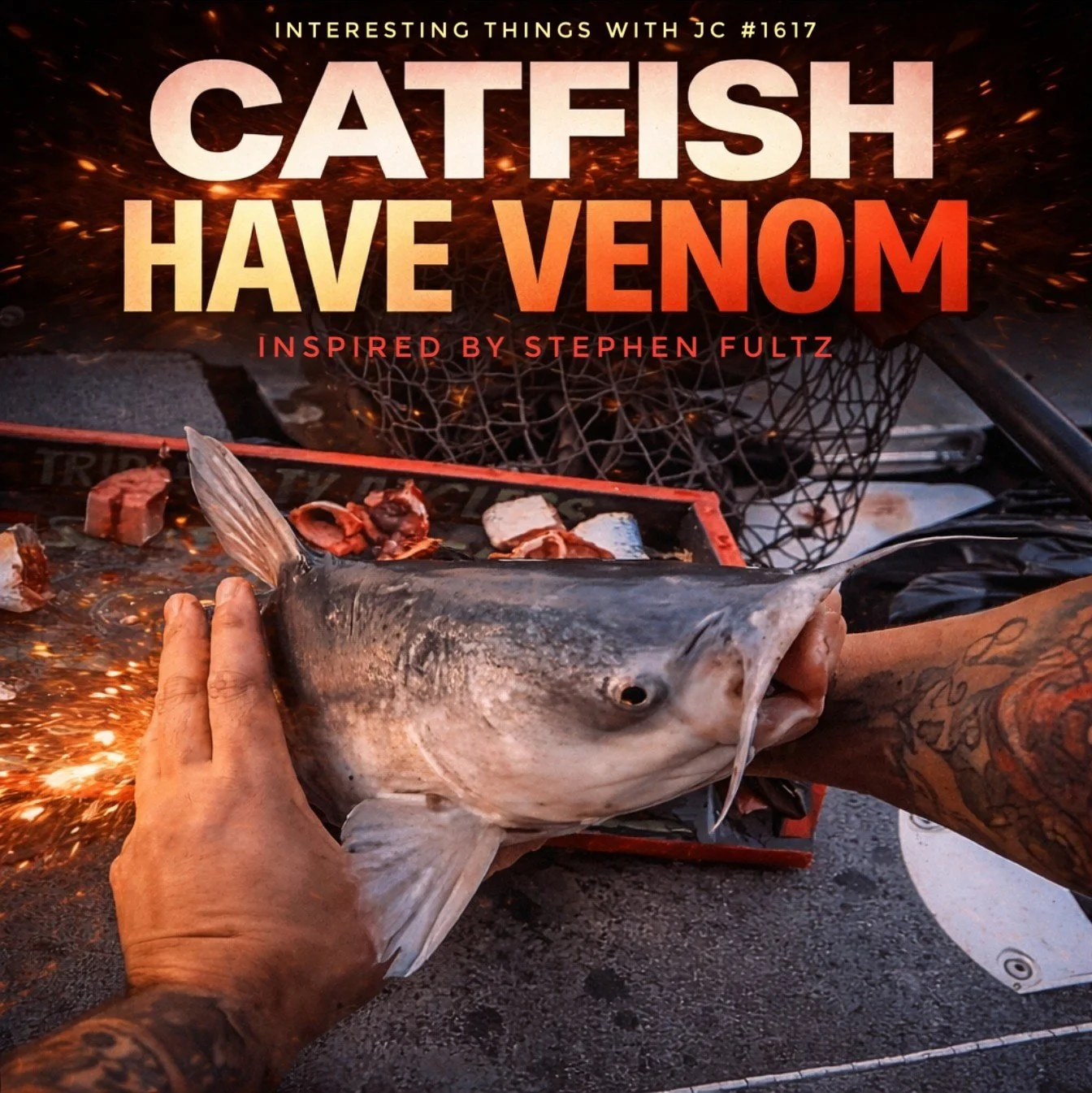
A person is holding a large catfish on a cutting surface, with both hands positioned near the fish’s head and dorsal area. The fish’s whiskers and fin spines are clearly visible, and fishing gear and cut bait appear in the background. Bold text at the top reads “Interesting Things with JC #1617” and “Catfish Have Venom,” with a subtitle stating it is inspired by Stephen Fultz. The image suggests a routine moment of handling a fish, but highlights the risk associated with contact, especially near the spines.
Transcript
Interesting Things with JC #1617: "Catfish Have Venom"
A fisherman reaches down, grabs what he thinks is just another smooth, whiskered fish, and a second later he’s bleeding, shaking, and pulling his hand back like he touched a live wire.
It wasn’t the bite.
It was the spine on the fishes fin, cutting into his hand.
Catfish carry a set of hardened, needle-like spines along their dorsal fin and each pectoral fin, and those spines are not just for defense in the mechanical sense. They are built with a sheath that houses venom glands, and when the spine punctures skin, that sheath breaks and releases venom directly into the wound.
There are more than 3,000 species of catfish, and a large portion of them carry some level of venom. Most are not life-threatening to humans, but they are built to send a very clear message. The venom contains a mix of proteins and enzymes that trigger intense pain, swelling, and in some cases tissue damage. People describe it as immediate, sharp, and spreading, like the pain is moving outward from the puncture point.
In shallow water, that reaction can be enough to make someone lose control for a moment, and in the wrong situation, that moment matters.
What makes it more interesting is that this system evolved more than once. Different catfish lineages developed venom independently, which tells you something about the pressure they were under. Slow-moving fish, often bottom dwellers, needed a way to survive predators that were faster, stronger, and already adapted to swallow them whole.
So they became something you only grab once.
Even dead catfish can still sting, because the venom remains active in the spines for a period of time after death.
And once you know it’s there, you don’t see a catfish the same way again.
These are interesting things, with JC.
Student Worksheet
Comprehension Questions:
What structure delivers venom in catfish?
Where are the venomous spines located?
What happens when the spine punctures skin?
Analysis Questions:
4. Why would venom be beneficial for a slow-moving fish?
5. What does it mean that venom evolved multiple times in catfish?
Reflection Prompt:
6. Describe how hidden defenses in animals can change human behavior around wildlife.
Difficulty Scaling:
Basic: Identify structures and functions
Intermediate: Explain evolutionary advantage
Advanced: Evaluate convergent evolution in other species
Student Output:
Written responses (short answer + paragraph)
Optional diagram of catfish spine structure
Academic Integrity Guidance:
Use your own words
Support answers with evidence from the lesson
Do not copy from peers
Teacher Guide
Quick Start:
Play audio → discuss reaction → introduce anatomy → complete worksheet
Pacing Guide (Audio-First):
0–3 min: Bell ringer
3–6 min: Play audio
6–15 min: Direct instruction
15–30 min: Worksheet
30–40 min: Discussion
Bell Ringer:
Ask: “What animals do you think are dangerous to touch, and why?”
Audio Guidance:
Students listen for cause-and-effect (what causes the injury and why)
Audio Fallback:
Read transcript aloud with emphasis on key terms
Time-on-Task:
~40 minutes
Materials:
Audio or transcript
Worksheet
Diagram (optional)
Vocabulary Prep:
Pre-teach “venom,” “spine,” and “convergent evolution”
Misconceptions:
Catfish bite is dangerous (clarify it is the spine)
All venom is deadly (clarify severity varies)
Discussion Prompts:
Why is pain an effective defense?
How does structure relate to function?
Formative Checkpoints:
Identify venom delivery method
Explain evolutionary advantage
Differentiation:
Visual learners: diagrams
Advanced: research other venomous fish
Assessment Differentiation:
Oral explanation option
Written or illustrated responses
Time Flexibility:
Can be shortened to 25 minutes or expanded with research
Substitute Readiness:
Transcript-based lesson fully functional without audio
Engagement Strategy:
Use real-world scenario (fishing injury) to anchor interest
Extensions:
Compare with stingrays or lionfish
Research aquatic safety guidelines
Cross-Curricular:
Chemistry: protein effects
Health: injury response
SEL Connection:
Risk awareness
Decision-making in unfamiliar situations
Skill Value Emphasis:
Observation
Cause-effect reasoning
Safety awareness
Answer Key:
Venomous spines
Dorsal and pectoral fins
Sheath breaks and releases venom
Protects from predators
Independent evolution due to similar pressures
Answers will vary (awareness, caution, respect for wildlife)
Quiz
What delivers venom in catfish?
A. Teeth
B. Scales
C. Spines
D. GillsWhere are catfish spines located?
A. Tail only
B. Head only
C. Dorsal and pectoral fins
D. MouthWhat triggers venom release?
A. Movement
B. Spine puncture
C. Water pressure
D. LightWhat type of evolution is described?
A. Divergent
B. Convergent
C. Artificial
D. RandomWhat is a main effect of the venom?
A. Sleepiness
B. Pain and swelling
C. Cooling sensation
D. Color change
Assessment
Open-Ended Questions:
Explain how the structure of a catfish spine supports its function as a دفاع mechanism.
Describe why convergent evolution is important in understanding catfish venom.
Rubric (3–2–1):
3: Accurate, detailed, clear reasoning
2: Partial explanation, some accuracy
1: Minimal or unclear response
Exit Ticket:
What is one reason catfish venom is effective for survival?
Standards Alignment
NGSS HS-LS1-2: Develop and use a model to illustrate the hierarchical organization of interacting systems within multicellular organisms. Students can model how catfish dorsal and pectoral spines, venom glands, and sheath structures work together as a defensive system.
NGSS HS-LS4-2: Construct an explanation based on evidence that the process of evolution primarily results from four factors: population growth, heritable variation, competition, and differential survival. Students can explain why venom-bearing structures improved survival in catfish lineages facing predation pressure.
NGSS HS-LS4-4: Construct an explanation based on evidence for how natural selection leads to adaptation of populations. Students can connect venomous spines to environmental pressures faced by slow-moving, bottom-dwelling fish.
NGSS HS-LS4-5: Evaluate evidence supporting claims that changes in environmental conditions may result in species adaptation. Students can evaluate how predator-prey interactions may have shaped repeated evolution of venom systems in different catfish groups.
CCSS.ELA-LITERACY.RST.9-10.2: Determine the central ideas or conclusions of a science text and trace the explanation. Students can identify the central claim that catfish venom is a defensive adaptation and explain how the episode builds that claim.
CCSS.ELA-LITERACY.RST.9-10.4: Determine the meaning of symbols, key terms, and domain-specific words and phrases. Students can accurately use terms such as venom, sheath, pectoral fin, dorsal fin, and convergent evolution in discussion and writing.
CCSS.ELA-LITERACY.RST.11-12.1: Cite specific textual evidence to support analysis of science texts. Students can support their answers with details from the transcript about anatomy, venom delivery, and evolutionary pressure.
CCSS.ELA-LITERACY.WHST.9-10.2: Write informative/explanatory texts to examine and convey complex ideas clearly. Students can write a short scientific explanation describing how catfish venom delivery works.
CCSS.ELA-LITERACY.SL.9-10.1: Initiate and participate effectively in collaborative discussions. Students can discuss how defensive traits affect survival and compare catfish with other venomous animals.
C3 Framework D2.Sci.6.9-12: Analyze the benefits, costs, and consequences of scientific explanations. Students can evaluate why venom is an effective survival trait and how scientists infer its repeated evolution.
C3 Framework D3.1.9-12: Gather relevant information from multiple sources while using the origin, authority, structure, context, and corroborative value of the sources. Students can compare the podcast narrative, transcript evidence, and supporting scientific references.
C3 Framework D4.1.9-12: Construct arguments using precise and knowledgeable claims, with evidence from sources. Students can defend the claim that catfish venom is primarily a defensive rather than predatory adaptation.
ISTE 1.3a Knowledge Constructor: Students plan and employ effective research strategies to locate information and other resources for intellectual or creative pursuits. Students can research additional venomous fish and compare adaptations across species.
ISTE 1.3d Knowledge Constructor: Students build knowledge by actively exploring real-world issues and problems. Students can investigate how biological knowledge supports fishing safety, wildlife handling, and environmental awareness.
CTE Science, Technology, Engineering, and Mathematics Career Cluster Standard: Apply academic and technical knowledge and skills to solve practical problems. Students can connect anatomical knowledge to fisheries work, environmental science, and field safety.
Career Readiness Practice: Act responsibly and contribute to workplace safety. Students can explain why proper fish handling procedures matter in outdoor recreation, aquaculture, and wildlife professions.
Homeschool / Lifelong Learning Alignment: Strengthens scientific literacy through close listening, vocabulary development, evidence-based reasoning, and real-world safety awareness. Learners can transfer the lesson to everyday outdoor experiences and independent study.
UK National Curriculum (Key Stage 4 Science, Biology): Develop understanding of adaptations, interdependence, and competition in ecosystems. Learners can explain how catfish defensive structures support survival in predator-rich environments.
IB MYP Sciences: Use scientific knowledge to explain observable phenomena and analyze interactions between organisms and environment. Learners can connect anatomy, ecology, and evolution through a real biological example.
Show Notes
This episode explores a surprising biological reality: catfish are not just passive bottom-dwellers but animals equipped with venom-delivering spines that can cause intense pain and rapid physical reaction. The lesson is especially effective for classrooms because it begins with a vivid, memorable scenario and then opens into deeper study of anatomy, adaptation, predator-prey relationships, and convergent evolution. Students examine how a physical structure can serve multiple functions, how natural selection shapes survival tools, and why hidden defenses in common animals matter in real life. The episode also supports strong cross-curricular teaching through science vocabulary, explanatory writing, close listening, and safety awareness related to fishing, wildlife handling, and environmental fieldwork. This episode is inspired by Stephen Fultz, whose curiosity-driven prompt helps turn an overlooked animal fact into a meaningful study of biology, risk, and evolution.
References
National Geographic. (2023). Catfish facts. https://www.nationalgeographic.com/animals/fish/facts/catfish
Smith, W. L., & Wheeler, W. C. (2006). Venom evolution in catfish. https://academic.oup.com/sysbio/article/55/4/659/1653165
Encyclopaedia Britannica. (2024). Catfish. https://www.britannica.com/animal/catfish