1652: "Facebook’s Emotional Contagion Experiment"
Interesting Things with JC #1652: "Facebook’s Emotional Contagion Experiment" – Facebook changed the News Feeds of nearly 690,000 users to test whether emotions could spread online without telling them first, and the users’ own posts shifted after the feed was altered.
Curriculum - Episode Anchor
Episode Title: Facebook’s Emotional Contagion Experiment
Episode Number: 1652
Host: JC
Audience: Grades 9–12, introductory college, homeschool, lifelong learners
Subject Area: Media literacy, psychology, research ethics, digital technology
Lesson Overview
Learning Objectives:
Explain what Facebook’s 2012 emotional contagion experiment tested and how it was conducted.
Analyze why a statistically small effect can still matter when applied across a large digital platform.
Evaluate ethical concerns involving informed consent, algorithmic influence, and research responsibility.
Connect the episode to real-world decisions made by data scientists, researchers, designers, and users.
Essential Question: How can algorithms influence human emotion, and what responsibilities come with testing that influence?
Success Criteria:
I can summarize the experiment accurately using key evidence.
I can explain the difference between statistical significance and real-world significance.
I can identify ethical concerns without exaggerating the study’s findings.
I can support a claim about digital responsibility with evidence.
Student Relevance Statement: Students use platforms that rank, filter, and personalize information every day, making it important to understand how invisible design choices can affect attention, mood, and behavior.
Real-World Connection: Social media companies, app designers, advertisers, researchers, and public health communicators all make decisions about what people see, when they see it, and how those choices may influence behavior.
Workforce Reality: Careers involving data, psychology, marketing, software design, journalism, or user research require technical skill, ethical discipline, transparency, and accountability.
Key Vocabulary
Emotional Contagion: ee-MOH-shuh-nul kuhn-TAY-jun; the spread of emotional states from one person or group to another.
Algorithm: AL-guh-rith-um; a set of rules or calculations used by a computer system to sort, rank, recommend, or filter information.
News Feed: NOOZ feed; the stream of posts, updates, and content shown to a user on a social media platform.
Informed Consent: in-FORMD kuhn-SENT; permission given by a participant after understanding the purpose, risks, and procedures of a study.
Research Ethics: REE-surch ETH-iks; standards that guide responsible studies involving people, data, risk, and consent.
Statistical Significance: stuh-TIS-tih-kul sig-NIF-ih-kunts; evidence that a result is unlikely to be due only to chance.
Effect Size: ih-FEKT size; a measure of how large or meaningful a difference is in practical terms.
Terms of Service: termz uhv SUR-vis; rules users agree to when using a digital platform.
Algorithmic Curation: AL-guh-rith-mik kyur-AY-shun; the process of selecting and arranging content through automated systems.
Narrative Core
Open: In 2014, people learned that Facebook had tested whether emotion could spread through a social network by changing what nearly 690,000 users saw in their News Feeds.
Info: For one week in 2012, researchers reduced either positive or negative emotional content for different groups of users, then measured whether the emotional language in users’ own posts changed afterward.
Details: The results suggested that emotional tone online could influence later expression. The effect was small, but the scale of the platform made the finding important. A small shift across hundreds of thousands, or billions, of users raises serious questions about influence.
Reflection: The controversy centered on consent, transparency, and responsibility. The study showed not only that online emotion can spread, but also that algorithmic systems can shape what people feel and express without users noticing the process.
Closing: These are interesting things, with JC.
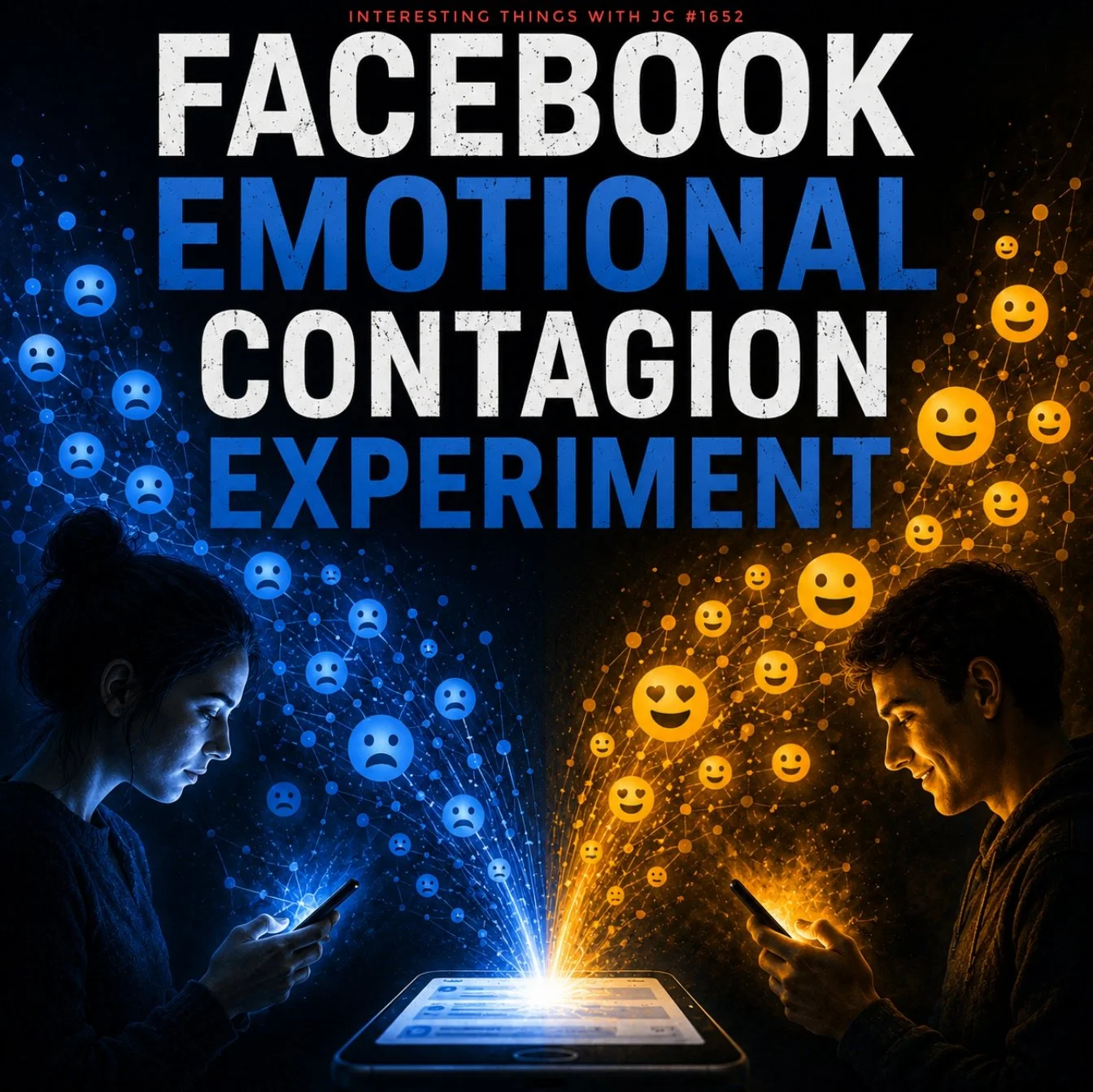
Digital podcast cover art for “Interesting Things with JC #1652” titled “Facebook Emotional Contagion Experience.” The image shows a dark split-color scene with blue tones on the left and orange-yellow tones on the right. A person on the left looks down at a phone while surrounded by sad face icons. A person on the right looks down at a phone while surrounded by smiling face icons. In the center, a glowing tablet emits streams of emoji-like reactions, suggesting social media algorithms influencing emotional tone. Large distressed text reads “Facebook Emotional Contagion Experience.”
Transcript
Interesting Things with JC #1652:
“Facebook’s Emotional Contagion Experiment”
In 2014, the internet learned something unsettling.
For nearly a week in 2012, Facebook altered the News Feeds of almost 690,000 users without their knowledge to study whether emotions could spread online.
The experiment was called “emotional contagion.”
Researchers reduced positive posts for some users. Others saw fewer negative posts. Then they measured whether people subconsciously changed the emotional tone of their own updates afterward.
They did.
Users exposed to more negative content posted more negative language. Users exposed to more positive content became slightly more positive themselves.
The effect was statistically small, but enormous in implication.
For decades, psychologists had debated whether emotions could spread through crowds the way viruses spread through populations. Facebook demonstrated that algorithms could influence emotional states at planetary scale without direct human interaction.
And most users never knew it was happening.
The study was conducted with researchers from Cornell University and the University of California, San Francisco, and published in the journal Proceedings of the National Academy of Sciences. Facebook argued users had technically consented through terms-of-service agreements covering research activities.
The backlash was immediate.
Critics accused the company of psychological manipulation, informed consent violations, and treating users like lab subjects inside the largest social experiment in human history.
What disturbed many people was not simply the experiment itself.
It was the realization that social media algorithms were already shaping emotion, attention, outrage, anxiety, and behavior every day through invisible mathematical decisions determining what billions of people see and do not see.
The conspiracy theory was not that platforms manipulated emotions.
The reality was that they openly tested whether they could.
And the answer was yes…
These are interesting things, with JC.
Student Worksheet
Comprehension Questions:
What did Facebook change during the emotional contagion experiment?
How many users were involved in the study, approximately?
What did researchers measure after altering the News Feeds?
What does the phrase “statistically small, but enormous in implication” mean in this episode?
Why did many people object to the experiment?
Analysis Questions:
Explain how an algorithm can influence a person without directly speaking to them.
Why might informed consent matter more in a psychological experiment than in ordinary platform testing?
What is the difference between changing what users see for convenience and changing what users see to study emotion?
Should a platform be allowed to rely on terms of service as consent for behavioral research? Defend your answer with one reason.
Reflection Prompt: Write one paragraph explaining how this episode changes, confirms, or complicates your view of social media platforms.
Difficulty Scaling: Level 1 students may answer using direct evidence from the transcript; Level 2 students should explain cause and effect; Level 3 students should evaluate the ethical tradeoff between research value and user consent.
Student Output: Submit complete-sentence answers, one paragraph reflection, and one claim-evidence-reasoning response to an analysis question.
Academic Integrity Guidance: Use the episode and class sources only. Do not invent study details, exaggerate harm, or copy outside commentary without attribution.
Teacher Guide
Quick Start: Begin with the podcast audio, then move into vocabulary, comprehension, ethics analysis, and a short written response. This follows the required audio-first curriculum structure.
Pacing Guide Audio-First:
0–3 minutes: Bell ringer on social media influence.
3–7 minutes: Play the episode audio without interruption.
7–10 minutes: Students mark three details they remember.
10–18 minutes: Vocabulary and comprehension questions.
18–32 minutes: Small-group analysis discussion.
32–42 minutes: Written reflection or claim-evidence-reasoning response.
42–45 minutes: Exit ticket.
Bell Ringer: Ask students: “Can a platform influence how you feel without showing you anything false?” Students write three sentences before discussion.
Audio Guidance: Tell students to listen for the experiment’s purpose, method, result, and controversy. Play once for the story and once for evidence if time allows.
Audio Fallback: If audio is unavailable, read the transcript aloud first, then have students silently annotate the method, finding, and ethical concern.
Time on Task: Standard lesson length is 45 minutes; extended discussion can expand to 60 minutes.
Materials:
Episode audio or transcript
Student worksheet
Writing paper or LMS response box
Board or shared document for vocabulary
Vocabulary Prep: Preview informed consent, algorithm, emotional contagion, statistical significance, and effect size before analysis.
Misconceptions:
Students may think the experiment proved Facebook could fully control emotions; clarify that the reported effect was small.
Students may think algorithms are neutral; clarify that ranking systems reflect human design goals.
Students may think terms of service are the same as informed consent; clarify the ethical difference.
Discussion Prompts:
What made this experiment controversial?
Does scale change ethical responsibility?
What should users reasonably know before being included in behavioral research?
How should companies balance research, product improvement, and user autonomy?
Formative Checkpoints:
Ask students to identify the independent variable: emotional content shown in News Feed.
Ask students to identify the measured outcome: emotional language in later posts.
Ask students to state one ethical concern and one possible defense.
Differentiation: Provide sentence starters for emerging writers, allow partner discussion before written work, and offer extension readings for advanced students.
Assessment Differentiation: Students may show understanding through a paragraph, oral explanation, concept map, or claim-evidence-reasoning response.
Time Flexibility: For a 25-minute version, use audio, three comprehension questions, one discussion prompt, and the exit ticket. For a 60-minute version, add a structured debate.
Substitute Readiness: The lesson can run from the transcript alone. The substitute should read the transcript, assign the worksheet, and collect the exit ticket.
Engagement Strategy: Use a “silent vote” before discussion: students choose whether the study was acceptable, unacceptable, or complicated, then revisit their answer after evidence review.
Extensions: Students can compare platform testing, advertising A/B tests, public health messaging, and academic research ethics.
Cross-Curricular Connections: Psychology connects to emotional contagion; computer science connects to algorithms; English connects to argument analysis; civics connects to rights and responsibilities.
SEL Connection: Students examine how digital environments may affect mood and attention while practicing calm, evidence-based discussion.
Skill Emphasis: The lesson builds media literacy, ethical reasoning, evidence evaluation, and responsible technology awareness.
Answer Key:
Comprehension:
1. Facebook reduced positive or negative emotional content in users’ News Feeds.
2. About 689,000 users.
3. Researchers measured emotional language in users’ later posts.
4. The measurable change was small, but the platform scale made the implication significant.
5. Critics objected to lack of clear consent, psychological manipulation, and users being studied without knowing.
Quiz: 1. B; 2. C; 3. B; 4. D; 5. C.
Quiz
What was the main purpose of Facebook’s emotional contagion experiment?
A. To test whether users preferred photographs over text
B. To study whether emotional content online could influence users’ own emotional expression
C. To determine which users posted most often
D. To remove harmful content from the platformWhat part of Facebook was altered during the experiment?
A. User passwords
B. Profile pictures
C. News Feed content
D. Private messagesWhat did researchers examine after changing what users saw?
A. Whether users deleted their accounts
B. The emotional language in users’ own posts
C. The number of friend requests sent
D. The amount of time users spent watching videosWhy did the study create a backlash?
A. It used too few participants to matter
B. It was never published
C. It only studied adults who volunteered
D. Many users did not know they were part of the experimentWhat is the best interpretation of the episode’s main concern?
A. Social media has no measurable influence on people
B. All online research should be banned
C. Algorithmic systems can shape experience in ways users may not see or understand
D. Emotional contagion only happens in face-to-face crowds
Assessment
Open-Ended Questions:
Was Facebook’s emotional contagion experiment ethically acceptable, unacceptable, or complicated? Support your answer with two pieces of evidence from the episode.
Explain why a small statistical effect can still matter when a technology platform operates at massive scale.
3–2–1 Rubric:
3: Response is accurate, uses clear evidence, explains both method and ethical concern, and avoids exaggeration.
2: Response is mostly accurate, includes some evidence, and explains either the method or the ethical concern.
1: Response is incomplete, vague, or inaccurate, with little evidence from the episode.
Exit Ticket: In one sentence, explain one responsibility a technology company has when testing features that may affect users’ emotions.
Standards Alignment
NGSS HS-ETS1-1: Students define the ethical and technical problem raised by the Facebook emotional contagion experiment by identifying the research question, affected users, platform constraints, and potential social consequences.
NGSS HS-ETS1-2: Students break the experiment into system components, including News Feed ranking, emotional-content filtering, user behavior, data collection, and measured language outcomes.
NGSS HS-ETS1-3: Students evaluate the experiment by weighing benefits, risks, ethical concerns, informed consent issues, and the social impact of algorithmic decision-making.
NGSS HS-ETS1-4: Students explain how a small measurable effect can become significant when applied across a large-scale digital platform.
CCSS.ELA-LITERACY.RI.9-10.1: Students cite evidence from the transcript to explain what the experiment tested, how it was conducted, and why it became controversial.
CCSS.ELA-LITERACY.RI.9-10.2: Students determine the central idea that algorithms can shape emotional experience and behavior through invisible content-ranking decisions.
CCSS.ELA-LITERACY.RI.9-10.3: Students analyze the relationship between the study’s method, its findings, and the public backlash that followed.
CCSS.ELA-LITERACY.RI.9-10.6: Students examine how word choice, framing, and emphasis influence audience understanding of technology ethics.
CCSS.ELA-LITERACY.RI.9-10.8: Students evaluate claims about emotional manipulation, consent, and algorithmic influence by distinguishing evidence-based conclusions from exaggeration or unsupported claims.
CCSS.ELA-LITERACY.W.9-10.1: Students write an evidence-based argument about whether terms-of-service consent is sufficient for behavioral research involving emotional influence.
CCSS.ELA-LITERACY.W.9-10.2: Students produce an explanatory response describing emotional contagion, algorithmic curation, informed consent, and research ethics.
CCSS.ELA-LITERACY.W.9-10.9: Students draw evidence from the transcript and lesson materials to support analysis, reflection, and written claims.
CCSS.ELA-LITERACY.SL.9-10.1: Students participate in structured discussion by listening to peers, building on evidence, and responding respectfully to different views about platform responsibility.
CCSS.ELA-LITERACY.SL.9-10.4: Students present a clear explanation of the experiment’s method, result, and ethical concern using organized evidence.
CCSS.ELA-LITERACY.RST.9-10.3: Students follow and explain a technical research procedure by identifying how content was altered and how user responses were measured.
CCSS.ELA-LITERACY.RST.9-10.8: Students assess whether the reasoning behind the experiment’s conclusions is supported by the described method and evidence.
ISTE Digital Citizen 1.2: Students analyze how digital platforms collect data, personalize content, and influence user experience, then explain why privacy, transparency, and consent matter.
ISTE Knowledge Constructor 1.3: Students evaluate information about the experiment and synthesize evidence to form a responsible conclusion about algorithmic influence.
ISTE Computational Thinker 1.5: Students explain how algorithmic systems use inputs, rules, and outputs to shape what users see and how those outputs may affect behavior.
ISTE Global Collaborator 1.7: Students discuss technology ethics with attention to multiple perspectives, including users, researchers, platform designers, and the public.
C3 D2.Civ.10.9-12: Students analyze how individual rights, institutional responsibility, and ethical principles apply when private technology platforms conduct research involving users.
C3 D2.Civ.14.9-12: Students evaluate how people, institutions, researchers, and companies can respond to public problems involving technology, privacy, consent, and algorithmic influence.
C3 D2.Psy.1.9-12: Students explain how human behavior and emotion can be influenced by social environments, including online environments.
C3 D2.Psy.2.9-12: Students analyze how individual behavior may be affected by social cues, group dynamics, and exposure to emotional content.
C3 D2.Soc.13.9-12: Students examine how institutions and technologies shape social interaction, communication, and behavior at scale.
CTE / Career Readiness — Data Ethics: Students identify why professionals working with user data must consider consent, transparency, risk, and unintended consequences.
CTE / Career Readiness — Technology Design: Students explain how product-design choices can influence user experience and why design teams need ethical review processes.
CTE / Career Readiness — Research Responsibility: Students connect the episode to workplace expectations in behavioral research, user testing, software development, marketing, and platform governance.
CTE / Career Readiness — Communication: Students explain a complex technology ethics issue clearly for a non-specialist audience using accurate evidence and neutral language.
CTE / Career Readiness — Critical Thinking: Students compare possible benefits of large-scale platform research with risks involving privacy, consent, emotional influence, and public trust.
Homeschool / Lifelong Learning — Media Literacy: Learners identify how algorithms influence attention, emotion, and behavior in everyday digital environments.
Homeschool / Lifelong Learning — Ethical Reasoning: Learners evaluate whether a digital action can be technically legal but still ethically questionable.
Homeschool / Lifelong Learning — Practical Digital Citizenship: Learners apply the lesson to their own platform use by recognizing personalization, managing emotional exposure, and questioning invisible ranking systems.
Introductory College Readiness: Students practice interdisciplinary analysis by connecting psychology, computer science, ethics, communication, and civic responsibility.
Workforce Readiness: Students demonstrate the ability to evaluate real-world technology decisions using evidence, ethical reasoning, and awareness of human impact.
Show Notes
This episode examines Facebook’s emotional contagion experiment, a 2012 study revealed publicly in 2014 that tested whether emotions could spread through online News Feeds. For classrooms, the topic connects psychology, media literacy, research ethics, and technology design in a concrete case students can understand. It matters because digital platforms do not simply display information; they organize attention, shape experience, and create responsibilities for the people who design and study them.
References
Electronic Privacy Information Center. (2014). In re: Facebook (psychological study). https://epic.org/documents/in-re-facebook-psychological-study/
Klitzman, R., & Appelbaum, P. S. (2014). Facebook’s emotion experiment: Implications for research ethics. The Hastings Center. https://www.thehastingscenter.org/facebooks-emotion-experiment-implications-for-research-ethics/
Kramer, A. D. I., Guillory, J. E., & Hancock, J. T. (2014). Experimental evidence of massive-scale emotional contagion through social networks. Proceedings of the National Academy of Sciences, 111(24), 8788–8790. https://www.pnas.org/doi/10.1073/pnas.1320040111
Segelken, H. R., & Shackford, S. (2014). News feed: “Emotional contagion” sweeps Facebook. Cornell Chronicle. https://news.cornell.edu/stories/2014/06/news-feed-emotional-contagion-sweeps-facebook
Verma, I. M. (2014). Editorial expression of concern: Experimental evidence of massive-scale emotional contagion through social networks. Proceedings of the National Academy of Sciences, 111(29), 10779. https://www.pnas.org/doi/10.1073/pnas.1412469111