Interesting Things with JC #1651: "The NERVA Program" – A rocket engine fires in the Nevada desert without burning fuel the normal way, and a uranium reactor heats liquid hydrogen until it blasts through the nozzle; the tests work, the engine restarts, but the Mars rocket never leaves Earth.
Curriculum - Episode Anchor
Episode Title: The NERVA Program
Episode Number: 1651
Host: JC
Audience: Grades 9–12, introductory college, homeschool, lifelong learners
Subject Area: Space science, nuclear physics, engineering, Cold War technology
Lesson Overview
Learning Objectives:
Explain how nuclear thermal propulsion differs from chemical rocket propulsion.
Describe why specific impulse matters for deep-space missions.
Analyze how NERVA connected physics, engineering, risk management, and mission planning.
Evaluate why successful technology may still be canceled due to funding, priorities, or mission changes.
Essential Question: How can a rocket engine use nuclear fission for propulsion without functioning as a nuclear weapon?
Success Criteria: Students can accurately describe the NERVA engine process, compare chemical and nuclear thermal efficiency, and explain one technical benefit and one program-management challenge.
Student Relevance Statement: This lesson shows how science ideas become real hardware only when engineering, safety, funding, and public responsibility all work together.
Real-World Connection: Modern deep-space planning still examines nuclear thermal propulsion because Mars missions require careful tradeoffs among travel time, payload, fuel mass, and astronaut exposure.
Workforce Reality: Aerospace and nuclear careers require disciplined testing, documentation, safety culture, teamwork, and patience; dramatic ideas only matter when they can survive real operating conditions.
Key Vocabulary
NERVA(NUR-vuh): Nuclear Engine for Rocket Vehicle Application, a U.S. program that tested nuclear thermal rocket engines.
Nuclear Thermal Propulsion(NOO-klee-er THUR-muhl proh-PUL-shun): A propulsion method that uses reactor heat to warm propellant and produce thrust.
Fission(FISH-un): The splitting of atomic nuclei, releasing energy as heat.
Propellant(proh-PEL-unt): Material pushed out of a rocket nozzle to create thrust.
Liquid Hydrogen(LIK-wid HY-droh-jin): Very cold hydrogen used as a lightweight rocket propellant.
Specific Impulse(spuh-SIF-ik IM-puls): A measure of rocket efficiency showing how much thrust is produced per amount of propellant.
Reactor Core(ree-AK-ter kor): The part of a nuclear reactor where fission occurs.
Thrust(thrust): The force that moves a rocket forward.
Trajectory(truh-JEK-tuh-ree): The planned path of a spacecraft through space.
Restart Capability(REE-start kay-puh-BIL-uh-tee): The ability of an engine to shut down and fire again during a mission.
Narrative Core
Open: In the Cold War desert, engineers tested a rocket engine that replaced combustion with reactor heat.
Info: NERVA used controlled fission to heat liquid hydrogen, then pushed that hot gas through a nozzle to create thrust.
Details: The program mattered because nuclear thermal propulsion could offer much higher efficiency than chemical upper-stage rockets, allowing more payload, longer range, or shorter travel times.
Reflection: NERVA shows that engineering success does not guarantee flight. Technology must also fit national priorities, budgets, mission plans, and safety expectations.
Closing: These are interesting things, with JC.
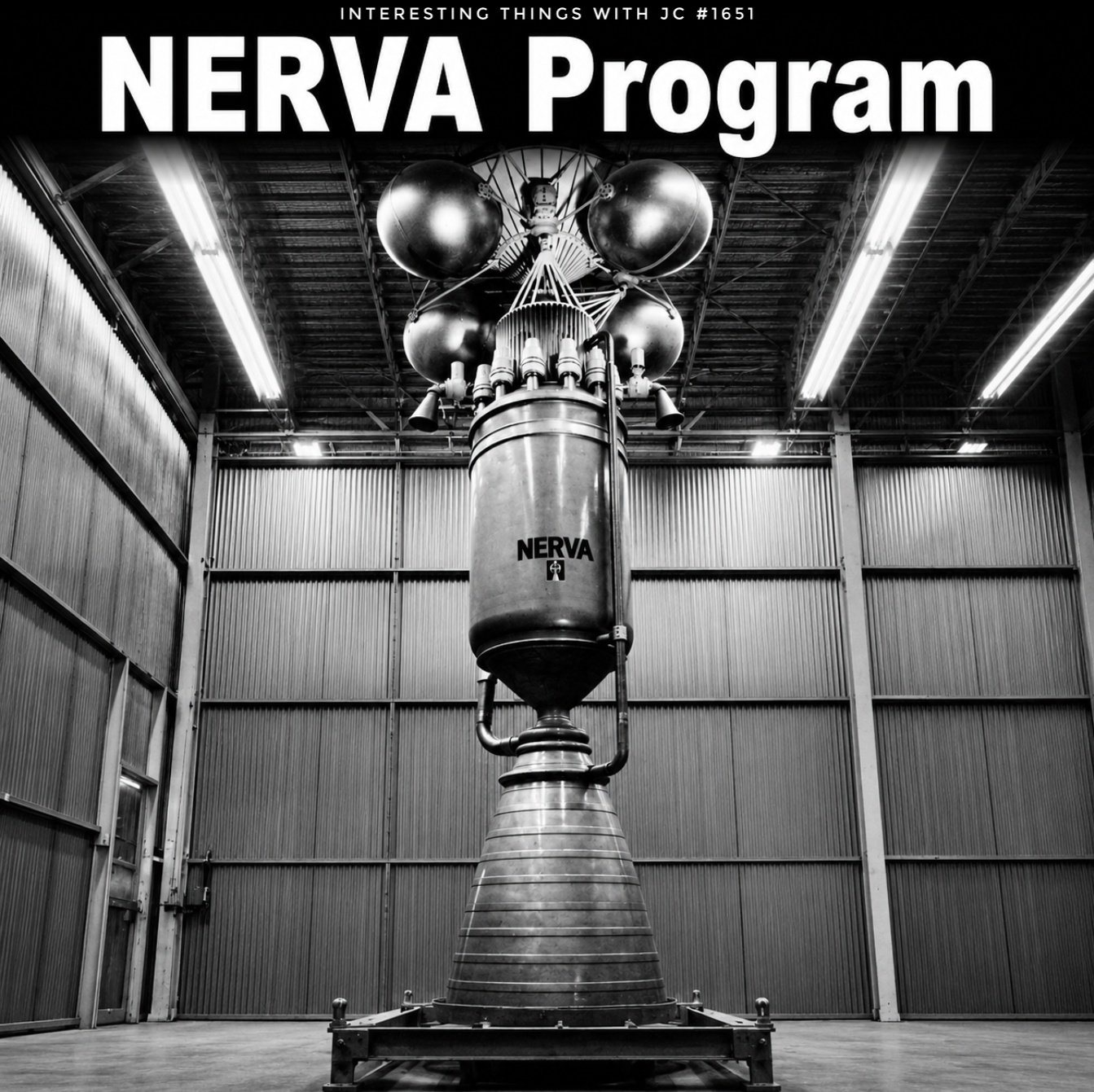
Black-and-white episode cover for “NERVA Program.” A large experimental nuclear rocket engine stands upright inside an industrial hangar beneath bold white title text reading “NERVA Program,” with smaller text at the top reading “Interesting Things with JC #1651.” The engine has a cylindrical reactor section labeled “NERVA,” exposed upper components, spherical tanks, piping, and a wide rocket nozzle at the bottom. The image emphasizes Cold War aerospace engineering, nuclear thermal propulsion, and the scale of the tested rocket system.
Transcript
Interesting Things with JC #1651:
“The NERVA Program”
In the Nevada desert during the Cold War, engineers built a rocket engine that did not burn fuel the normal way.
It used a nuclear reactor.
The program was called NERVA, short for Nuclear Engine for Rocket Vehicle Application. Beginning in 1955 under the Atomic Energy Commission and NASA, the goal was simple: build a rocket powerful and efficient enough to push humans to Mars.
Chemical rockets work by combustion. NERVA worked by splitting atoms.
Inside the engine, a compact uranium reactor heated liquid hydrogen to temperatures approaching 4,500 degrees Fahrenheit, about 2,480 degrees Celsius. The superheated hydrogen expanded violently and blasted through the nozzle to produce thrust.
No explosion. No nuclear detonation. Just heat from controlled fission.
The advantage was efficiency.
The Saturn V’s chemical upper stages achieved roughly 450 seconds of specific impulse. NERVA tested near 850 seconds, nearly double the fuel efficiency of the best chemical rockets of the era.
That was a big deal in space.
Every pound saved on fuel meant more cargo, more range, or shorter travel times. Some mission studies suggested nuclear thermal rockets could reduce a Mars trip from roughly 8 or 9 months to closer to 3 or 4 months depending on trajectory and mission design, lowering astronaut exposure to cosmic radiation and prolonged weightlessness.
And unlike paper concepts, NERVA actually worked.
At Jackass Flats, Nevada, engineers successfully test-fired multiple reactors through the 1960s. Some engines operated for nearly 2 hours cumulatively and restarted multiple times, proving they could survive real mission conditions.
Then politics changed.
After Apollo, budgets collapsed. Mars missions were postponed indefinitely. In 1973, despite successful tests, NERVA was canceled before ever flying in space.
Today, nuclear thermal propulsion has returned to serious discussion. NASA and DARPA are again studying reactor-powered spacecraft for future deep-space missions.
Because chemical rockets are good at leaving Earth.
But nuclear rockets may be what finally carry humans to another planet.
These are interesting things, with JC.
Student Worksheet
Comprehension Questions:
What does NERVA stand for?
What material did the reactor heat to create thrust?
How did NERVA differ from a chemical rocket?
Why was specific impulse important for Mars mission planning?
What happened to the NERVA program in 1973?
Analysis Questions:
Explain why NERVA was not a nuclear bomb, even though it used a nuclear reactor.
Compare the tradeoffs between chemical propulsion and nuclear thermal propulsion for deep-space travel.
Why might a technology that works in testing still never be used in an actual mission?
What does NERVA reveal about the relationship between science, engineering, and national priorities?
Reflection Prompt: In 6–8 sentences, explain whether NERVA should be seen mainly as a canceled project, a successful test program, or a foundation for future space exploration. Use at least two details from the episode.
Difficulty Scaling:
Support Level: Draw and label the engine process: reactor, liquid hydrogen, heat, nozzle, thrust.
Standard Level: Write one paragraph comparing chemical and nuclear thermal propulsion.
Advanced Level: Evaluate whether faster Mars travel justifies the technical complexity of nuclear propulsion.
Student Output: Students should submit written answers, one labeled diagram or comparison chart, and one paragraph reflection.
Academic Integrity Guidance: Use your own words. Facts may come from the transcript or teacher-provided sources, but explanations must show your own reasoning.
Teacher Guide
Quick Start: Begin with the podcast audio. Ask students to listen for the difference between combustion and fission-based propulsion.
Pacing Guide Audio-First:
0–3 minutes: Bell ringer and prediction.
3–8 minutes: Play audio once without interruption.
8–13 minutes: Replay key portions; students annotate vocabulary and propulsion steps.
13–25 minutes: Mini-lesson on fission, propellant heating, and specific impulse.
25–38 minutes: Worksheet comprehension and analysis.
38–45 minutes: Discussion, exit ticket, and collection.
Bell Ringer: “A rocket engine needs energy and something to push out the back. Does the energy always have to come from burning fuel? Explain.”
Audio Guidance: Tell students to listen for three numbers: 4,500°F, 850 seconds, and 1973. After listening, have them connect each number to its meaning.
Audio Fallback: If audio is unavailable, read the transcript aloud once, then have students reread silently and underline technical claims.
Time on Task: Standard lesson length is 45 minutes; expandable to 60–75 minutes with diagramming and debate.
Materials:
Episode transcript
Student worksheet
Projector or board
Simple rocket-engine diagram
Calculator for Fahrenheit/Celsius comparison if desired
Vocabulary Prep: Preteach fission, propellant, thrust, and specific impulse before deeper analysis.
Misconceptions:
Students may think “nuclear rocket” means nuclear explosion; clarify that NERVA used controlled reactor heat.
Students may assume higher thrust and higher efficiency are the same; distinguish thrust force from propellant efficiency.
Students may think canceled programs are failures; emphasize test success versus mission adoption.
Discussion Prompts:
Why is hydrogen useful as a propellant in nuclear thermal propulsion?
What risks would engineers need to control before flying a reactor-powered spacecraft?
Why does shorter travel time matter for astronaut health?
Should proven technology be preserved even when budgets change?
Formative Checkpoints:
Students can state what the reactor heats.
Students can define specific impulse in plain language.
Students can explain why NERVA produced thrust without combustion.
Students can identify one reason the program was canceled.
Differentiation:
Emerging Learners: Provide sentence frames and a labeled diagram.
On-Level Learners: Require paragraph answers with transcript evidence.
Advanced Learners: Add mission-design tradeoff analysis involving payload, travel time, and risk.
Assessment Differentiation: Allow diagram-plus-caption responses for students who need visual output options; require evidence-based paragraphs for advanced students.
Time Flexibility: For a 30-minute version, use audio, vocabulary, three comprehension questions, and exit ticket. For a longer version, add a structured debate on nuclear propulsion.
Substitute Readiness: The lesson can run from the transcript alone. Have students complete comprehension, diagram the propulsion process, and answer the exit ticket.
Engagement Strategy: Use the question “Is this a rocket engine or a nuclear reactor?” to create productive curiosity, then show how it is both.
Extensions:
Research modern nuclear thermal propulsion concepts.
Compare NERVA with ion propulsion or chemical propulsion.
Create a one-page mission-planning brief for a Mars transfer vehicle.
Cross-Curricular Connections:
Physics: Energy transfer, thrust, and motion.
Chemistry: Hydrogen properties and combustion comparison.
History: Cold War research priorities and post-Apollo budget changes.
Engineering: Testing, restarts, materials, and safety.
SEL Connection: Emphasize responsible decision-making: powerful technologies require caution, transparency, and evidence-based judgment.
Skill Emphasis: Students practice technical reading, systems thinking, cause-and-effect reasoning, and evidence-based explanation.
Answer Key:
NERVA stands for Nuclear Engine for Rocket Vehicle Application.
It heated liquid hydrogen.
Chemical rockets use combustion; NERVA used reactor heat from fission.
Specific impulse matters because higher efficiency can reduce propellant needs or improve mission capability.
It was canceled in 1973 before flying in space.
NERVA was not a nuclear bomb because it used controlled fission to heat propellant, not an uncontrolled nuclear detonation.
A strong analysis should mention efficiency, payload, travel time, safety, complexity, and funding.
A strong reflection may classify NERVA as both a successful test program and an unfinished operational system.
Quiz
What was the main purpose of the NERVA program?
A. To build a nuclear weapon for space
B. To develop a nuclear thermal rocket engine for space missions
C. To replace all chemical rockets launched from Earth
D. To generate electricity for cities in NevadaWhat did NERVA use as its main propellant?
A. Liquid hydrogen
B. Gasoline
C. Liquid oxygen only
D. Water vaporHow did NERVA produce thrust?
A. By detonating a nuclear device
B. By burning uranium in open flame
C. By heating hydrogen in a reactor and exhausting it through a nozzle
D. By using solar panels to spin a turbineWhy was NERVA’s specific impulse important?
A. It showed the engine was quieter than chemical rockets
B. It measured how efficiently the engine used propellant
C. It proved the rocket could launch from Earth’s surface
D. It showed the reactor needed no shieldingWhy was NERVA canceled?
A. It never produced thrust
B. It was replaced by airplanes
C. Budgets and mission priorities changed after Apollo
D. Engineers proved Mars travel was impossible
Assessment
Open-Ended Questions:
Explain the full NERVA propulsion process from reactor heat to thrust. Include at least four vocabulary terms.
Evaluate the statement: “NERVA was a successful technology even though it never flew.” Use evidence from the episode.
3–2–1 Rubric:
3: Accurate explanation, uses evidence, includes key vocabulary, and shows clear reasoning about technical and program factors.
2: Mostly accurate, includes some evidence, but explanation lacks detail or misses one major concept.
1: Limited accuracy, little evidence, unclear reasoning, or major misunderstanding of nuclear thermal propulsion.
Exit Ticket: In one sentence, explain why NERVA was more efficient than chemical rockets. In one second sentence, explain why efficiency matters for Mars missions.
Standards Alignment
NGSS HS-PS1-8 — Nuclear Processes: Students explain that NERVA relied on controlled nuclear fission to release energy as heat, then connect that heat transfer to propulsion rather than explosion.
NGSS HS-PS3-3 — Energy Conversion: Students analyze how reactor heat was transferred to liquid hydrogen and converted into kinetic energy as the propellant exited the nozzle.
NGSS HS-PS3-4 — Energy Flow in Systems: Students model the NERVA engine as an energy system, tracing energy from fission to heated propellant to thrust.
NGSS HS-ETS1-1 — Defining Engineering Problems: Students identify the deep-space mission problem NERVA attempted to solve: increasing propulsion efficiency for long-duration human missions.
NGSS HS-ETS1-2 — Engineering Solutions: Students evaluate nuclear thermal propulsion as a proposed solution using constraints such as safety, efficiency, payload mass, mission duration, and testing reliability.
NGSS HS-ETS1-3 — Comparing Design Solutions: Students compare chemical propulsion and nuclear thermal propulsion using measurable criteria, including specific impulse, fuel efficiency, and mission usefulness.
CCSS RST.9-10.2 — Central Ideas in Technical Texts: Students determine the central idea of the episode and explain how key details about fission, hydrogen, and specific impulse support that idea.
CCSS RST.11-12.3 — Multistep Technical Processes: Students describe the sequence by which NERVA heated liquid hydrogen and produced thrust through a rocket nozzle.
CCSS RST.11-12.7 — Integrating Technical Information: Students connect verbal explanation, vocabulary, and diagrams to explain how a nuclear thermal rocket functions.
CCSS WHST.9-10.2 — Explanatory Writing: Students write a clear explanation comparing chemical rockets and nuclear thermal rockets using accurate technical vocabulary.
CCSS WHST.11-12.9 — Evidence-Based Writing: Students use episode evidence to support claims about whether NERVA should be considered a successful test program.
C3 D2.His.1.9-12 — Historical Context: Students explain how Cold War research priorities and post-Apollo budget changes shaped the development and cancellation of NERVA.
C3 D2.His.14.9-12 — Cause and Consequence: Students analyze why a technically successful program may still end because of shifting national priorities, funding, and mission planning.
C3 D2.SciTech.9-12 — Technology and Society Connection: Students evaluate how advanced propulsion technologies affect human decision-making, risk, and future exploration planning.
ISTE 1.3 Knowledge Constructor: Students gather and synthesize information from the episode and teacher-provided sources to explain a real aerospace technology accurately.
ISTE 1.5 Computational Thinker: Students use systems thinking to trace inputs, processes, outputs, and constraints in the NERVA propulsion system.
CTE STEM Career Cluster — Engineering Design: Students apply engineering reasoning by evaluating performance tradeoffs, testing demands, safety requirements, and mission constraints.
Career Readiness — Technical Communication: Students communicate complex scientific ideas in plain language through diagrams, written explanations, and evidence-based discussion.
Career Readiness — Responsible Innovation: Students explain why high-power technologies require disciplined testing, documentation, risk assessment, and public responsibility.
Homeschool/Lifelong Learning — Scientific Literacy: Learners connect nuclear physics, aerospace history, and engineering design to understand how emerging propulsion systems may affect future space exploration.
Show Notes
This episode introduces students to NERVA, a Cold War nuclear thermal rocket program that successfully tested reactor-powered propulsion but never flew in space. The topic is classroom-relevant because it connects physics, engineering design, mission planning, safety, and historical decision-making in one compact case study. It matters because future deep-space exploration may depend on propulsion systems that go beyond chemical rockets while still requiring careful testing, public responsibility, and disciplined engineering judgment.
References
Defense Advanced Research Projects Agency. (n.d.). DRACO: Demonstration Rocket for Agile Cislunar Operations. https://www.darpa.mil/research/programs/demonstration-rocket-for-agile-cislunar-operations
National Aeronautics and Space Administration. (2025). Rocket Systems Area: Nuclear Rockets. https://www.nasa.gov/rocket-systems-area-nuclear-rockets/
U.S. Department of Energy, Office of Nuclear Energy. (2025). 6 Things You Should Know About Nuclear Thermal Propulsion. https://www.energy.gov/ne/articles/6-things-you-should-know-about-nuclear-thermal-propulsion