Interesting Things with JC #1650: "Ion Drives" – An engine produces less force than a postcard weighs, yet it keeps pushing a spacecraft across billions of miles of space; chemical rockets burn hard and stop quickly, while ion drives keep accelerating atoms through a vacuum long after the violent launch is over.
Curriculum - Episode Anchor
Episode Title: Ion Drives
Episode Number: 1650
Host: JC
Audience: Grades 9–12, introductory college, homeschool, lifelong learners
Subject Area: Physics, aerospace engineering, space science
Framework Note: Lesson structure follows the uploaded Interesting Things with JC curriculum framework.
Lesson Overview
Learning Objectives:
Explain how ion drives use electricity, ionized gas, and electric fields to create thrust.
Compare ion propulsion with chemical rocket propulsion using thrust, exhaust velocity, and specific impulse.
Analyze why low thrust can still produce large mission effects in the near-vacuum of space.
Connect propulsion design choices to real spacecraft missions and satellite operations.
Essential Question: How can a spacecraft engine with extremely small thrust move a spacecraft across billions of miles?
Success Criteria: Students can define specific impulse, describe ionization, compare propulsion systems, and explain why continuous acceleration matters in space.
Student Relevance Statement: This lesson shows how patient, efficient engineering can solve problems that brute force cannot.
Real-World Connection: Ion propulsion has supported missions such as Deep Space 1 and Dawn, and electric propulsion is used for spacecraft maneuvering and satellite operations.
Workforce Reality: Aerospace propulsion requires physics knowledge, careful testing, systems thinking, and responsibility because small design decisions can affect entire missions.
Key Vocabulary
Ion Drive(EYE-ahn drive): A spacecraft engine that uses electricity to accelerate charged particles and produce thrust.
Ionization(eye-uh-nuh-ZAY-shun): The process of adding or removing electrons so an atom becomes electrically charged.
Xenon(ZEE-non): A heavy noble gas often used as propellant in ion engines because it is stable and easy to ionize.
Krypton(KRIP-tahn): A noble gas used in some electric propulsion systems, including earlier Starlink spacecraft applications.
Argon(AR-gahn): A noble gas used in newer Starlink thruster systems for orbit raising, maneuvering, and deorbiting. (Starlink)
Thrust(thrust): The pushing force produced by an engine.
Specific Impulse(spuh-SIF-ik IM-pulse): A measure of how efficiently a rocket or spacecraft engine uses propellant.
Exhaust Velocity(EG-zawst vuh-LAH-suh-tee): The speed at which propellant leaves an engine.
Narrative Core
Open: An engine can be powerful without being forceful. Ion drives begin with a surprising contradiction: less thrust than a postcard’s weight, but enough persistence to move spacecraft across enormous distances.
Info: Ion drives do not burn propellant the way chemical rockets do. They use electricity to ionize gases such as xenon, then accelerate those charged particles through electric fields to produce a fast exhaust stream. NASA describes electric propulsion as using electrical power to increase propellant exhaust velocity, which supports very efficient in-space propulsion.
Details: Chemical rockets are excellent for launch because they produce high thrust quickly. Ion engines produce much less thrust, but their exhaust can move far faster and their specific impulse can be much higher, allowing a spacecraft to stretch a small amount of propellant over long mission durations. Deep Space 1 demonstrated long-duration ion propulsion, while Dawn used ion propulsion to orbit Vesta and Ceres with 425 kilograms of xenon aboard.
Reflection: The lesson is not only about engines. It is about matching a tool to the environment. On Earth, an ion drive cannot overcome gravity. In space, where resistance is extremely low, steady acceleration can become mission-changing.
Closing: These are interesting things, with JC.
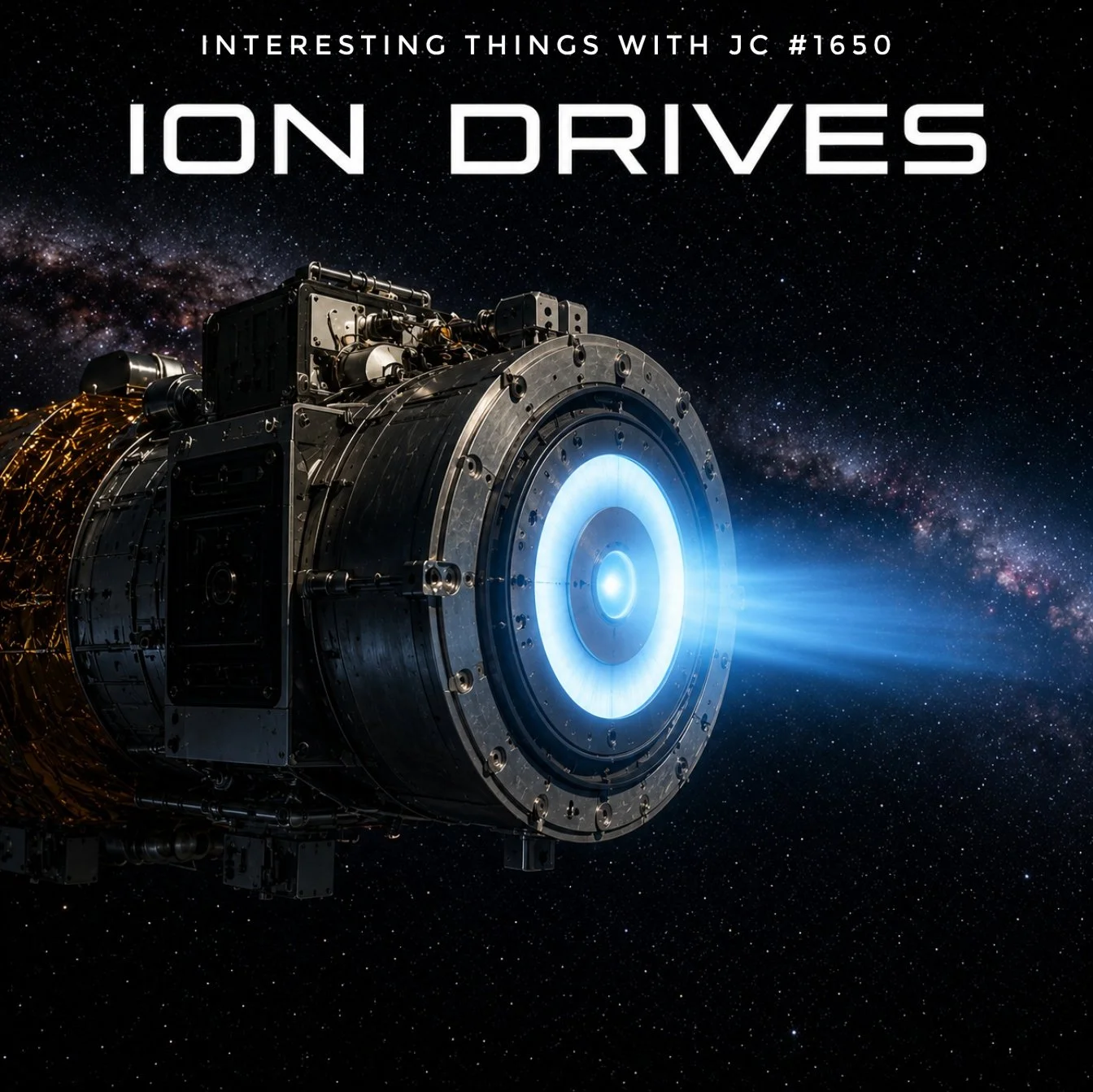
A spacecraft ion drive glows blue as it emits a narrow beam into space, with a star-filled background behind it. Large text reads “Ion Drives,” with “Interesting Things with JC #1650” above it.
Transcript
Interesting Things with JC #1650:
“Ion Drives”
The engine produced less force than the weight of a postcard.
Yet it pushed a spacecraft across nearly 4.9 billion miles, about 7.9 billion kilometers, of space.
Ion drives do not burn fuel like traditional rockets. They use electricity to accelerate charged atoms through a vacuum. Inside the engine, gases like xenon or krypton are ionized, stripped of electrons, then fired out at tremendous velocity using electric fields.
Chemical rockets produce violent thrust but waste fuel quickly. The Saturn V burned roughly 20 tons of propellant per second during launch. Most chemical rocket exhaust exits between 2 and 4.5 kilometers per second, roughly 4,500 to 10,000 miles per hour.
Ion thrusters can exceed 40 kilometers per second, over 90,000 miles per hour.
The advantage is efficiency. Chemical rockets usually achieve a specific impulse between 300 and 450 seconds. Ion engines can exceed 3,000 seconds while using a fraction of the propellant.
The drawback is thrust.
NASA’s NSTAR ion engine aboard Deep Space 1 generated only 92 millinewtons of force, about the weight of a single sheet of paper in your hand. On Earth, gravity would overwhelm it instantly. But in space, where there is almost no resistance, continuous acceleration becomes powerful over time.
That principle carried NASA’s Dawn spacecraft to both Vesta and Ceres, making it the first spacecraft ever to orbit two extraterrestrial worlds while consuming only about 937 pounds, 425 kilograms, of xenon fuel.
Today, ion propulsion powers satellites, deep-space probes, and SpaceX Starlink orbital maneuvering systems.
Chemical rockets escape Earth.
Ion drives cross the darkness between worlds.
These are interesting things, with JC.
Student Worksheet
Student Output Expectations: Write in complete sentences unless a question asks for a phrase, number, or labeled comparison.
Academic Integrity Guidance: Use your own wording. You may use episode facts, class notes, and approved sources, but do not copy full explanations from another student or website.
Comprehension Questions:
What do ion drives use instead of burning fuel like traditional rockets?
What happens to xenon or krypton inside an ion engine?
Why are chemical rockets better suited for escaping Earth?
What was the major advantage of Dawn’s ion propulsion system?
What is the main drawback of ion propulsion?
Analysis Questions:
Explain why low thrust can still be useful in space.
Compare chemical rockets and ion engines using the terms thrust, efficiency, and exhaust velocity.
Why does specific impulse matter for long-distance spacecraft missions?
Use the Dawn example to explain how efficient propulsion can expand mission possibilities.
Reflection Prompt: Describe a real-life situation where steady effort over time can outperform a short burst of force.
Difficulty Scaling:
Support: Complete a T-chart comparing chemical rockets and ion drives.
Core: Answer all comprehension and analysis questions in complete sentences.
Challenge: Create a short explanation using Newton’s third law, specific impulse, and continuous acceleration.
Clear Final Product: Submit one completed worksheet plus a 4–6 sentence summary explaining why ion drives are useful for deep-space missions.
Teacher Guide
Quick Start: Begin with the podcast audio before giving notes. Ask students to listen for one surprising number and one engineering tradeoff.
Pacing Guide Audio-First: 5 minutes bell ringer, 4 minutes first listen, 5 minutes vocabulary, 6 minutes second listen with notes, 15 minutes worksheet, 10 minutes discussion, 8 minutes quiz or exit ticket.
Bell Ringer: Ask students: “Would you rather have a very strong push for one second or a tiny push for one year? Explain.”
Audio Guidance: First listen for story and surprise. Second listen for evidence: thrust, exhaust velocity, specific impulse, and mission examples.
Audio Fallback: If audio is unavailable, read the transcript aloud once, then have students silently annotate the second time.
Time-on-Task: Standard lesson length is 45–55 minutes.
Materials: Episode audio or transcript, student worksheet, calculator, projector or board, optional propulsion diagram.
Vocabulary Prep: Pre-teach ionization, thrust, specific impulse, and exhaust velocity before analysis questions.
Misconceptions:
Ion drives are not useful for launch from Earth because their thrust is too low.
Higher thrust does not always mean better performance for every mission.
Spacecraft still need propulsion in space, even when there is little resistance.
Specific impulse measures propellant efficiency, not engine loudness or size.
Discussion Prompts:
Why does the environment determine whether an engine design is useful?
What tradeoff does ion propulsion make compared with chemical propulsion?
Why might engineers accept low thrust for deep-space travel?
How does Dawn’s mission show the value of efficient design?
Formative Checkpoints:
Students define ionization correctly.
Students identify thrust as the drawback of ion propulsion.
Students explain continuous acceleration without saying the spacecraft moves “for free.”
Students connect specific impulse to propellant efficiency.
Differentiation: Provide sentence stems for emerging learners, a comparison chart for visual learners, and an extension calculation for advanced students.
Assessment Differentiation: Allow oral responses, labeled diagrams, or written paragraphs while keeping the same science targets.
Time Flexibility: For a short class, complete only comprehension questions and exit ticket. For an extended class, add the challenge explanation.
Substitute Readiness: Play or read the transcript, define four vocabulary terms, assign worksheet questions 1–5 and analysis questions 1–2, then give the exit ticket.
Engagement Strategy: Use the “postcard force” comparison to create cognitive surprise, then ask students how weak force can become powerful over time.
Extensions: Have students research another electric propulsion mission and summarize its propulsion tradeoffs.
Cross-Curricular Connections: Physics connects to force and motion; mathematics connects to unit comparison; engineering connects to design constraints; history connects to spacecraft mission development.
SEL Connection: Emphasize patience, persistence, and disciplined problem-solving as habits used in technical work.
Skill Emphasis: Students practice evidence-based comparison, technical vocabulary, systems thinking, and explaining cause and effect.
Answer Key:
Ion drives use electricity to accelerate charged atoms rather than burning propellant chemically.
The gas is ionized, meaning electrons are removed so atoms become charged.
Chemical rockets produce high thrust quickly, which is needed to overcome Earth’s gravity.
Dawn used efficient ion propulsion to travel to and orbit both Vesta and Ceres while using a relatively small xenon supply.
The drawback is very low thrust.
Low thrust works in space because there is very little resistance, so acceleration can build over long periods.
Chemical rockets provide high thrust but use propellant quickly; ion engines provide low thrust but high efficiency and fast exhaust.
Specific impulse matters because higher values mean more useful motion from a given amount of propellant.
Dawn shows that efficient propulsion can allow complex missions, including orbiting more than one extraterrestrial body.
Quiz
What is the main source of energy used to accelerate particles in an ion drive?
A. Wind
B. Electricity
C. Solar heat only
D. Combustion pressureWhat does ionization do to an atom?
A. Makes it electrically charged
B. Freezes it into a solid
C. Turns it into liquid fuel
D. Removes all mass from itWhy are chemical rockets used to escape Earth?
A. They have lower thrust than ion drives
B. They work only in deep space
C. They produce large thrust quickly
D. They require no propellantWhat does higher specific impulse generally indicate?
A. Greater propellant efficiency
B. Louder engine operation
C. Heavier spacecraft structure
D. Shorter mission durationWhy was Dawn’s ion propulsion important?
A. It allowed launch without a rocket
B. It helped the spacecraft orbit both Vesta and Ceres
C. It created artificial gravity
D. It eliminated the need for electricity
Assessment
Open-Ended Questions:
Explain the tradeoff between thrust and efficiency in chemical rockets and ion drives. Use at least two vocabulary terms.
Explain why Dawn’s mission is a strong example of matching propulsion technology to mission goals.
3–2–1 Rubric:
3: Accurate explanation, uses key vocabulary correctly, includes mission evidence, and clearly explains cause and effect.
2: Mostly accurate explanation, uses some vocabulary, includes limited evidence, and shows basic understanding.
1: Incomplete or unclear explanation, limited vocabulary, missing evidence, or major misconception.
Exit Ticket: In one sentence, explain why an engine with tiny thrust can still be valuable in space.
Standards Alignment
NGSS HS-PS2-1: Students use Newton’s laws to explain how ion thrusters create motion by ejecting charged particles at high velocity, connecting action-reaction forces to spacecraft acceleration.
NGSS HS-PS2-2: Students apply mathematical and conceptual reasoning to compare thrust, exhaust velocity, and long-duration acceleration in chemical rockets and ion propulsion systems.
NGSS HS-PS3-3: Students evaluate how ion drives convert electrical energy into kinetic energy, explaining how energy transfer affects propulsion efficiency and mission design.
NGSS HS-ETS1-3: Students analyze propulsion tradeoffs by comparing chemical rockets and ion engines, identifying how engineers choose designs based on constraints such as thrust, fuel efficiency, mission distance, and operating environment.
CCSS RST.9-10.7: Students translate quantitative details from the episode into a comparison of propulsion systems, including force, exhaust velocity, specific impulse, and fuel use.
CCSS RST.11-12.3: Students follow the technical process of ion propulsion by explaining how gases are ionized, accelerated by electric fields, and expelled to produce thrust.
CCSS WHST.9-10.2: Students write clear explanatory responses using domain-specific vocabulary such as ionization, thrust, exhaust velocity, and specific impulse.
CCSS WHST.11-12.9: Students support claims about propulsion efficiency using evidence from the transcript and verified aerospace sources.
ISTE 1.3 Knowledge Constructor: Students gather and organize technical information from audio, transcript, and source material to explain how ion propulsion supports real spacecraft missions.
ISTE 1.5 Computational Thinker: Students compare propulsion variables and reason through cause-and-effect relationships involving force, acceleration, efficiency, and mission duration.
C3 D2.Geo.3.9-12: Students explain how physical environments influence technology choices by analyzing why ion drives are ineffective for Earth launch but useful in space.
C3 D2.Eco.1.9-12: Students evaluate tradeoffs in engineering decisions by comparing high-thrust chemical rockets with low-thrust, high-efficiency ion propulsion.
Career Readiness: Students practice technical comparison, evidence-based explanation, quantitative reasoning, and systems thinking used in aerospace engineering, satellite operations, mission planning, and applied physics.
Homeschool/Lifelong Learning: Learners connect physics principles to real spacecraft missions and explain how disciplined engineering choices allow humans to explore beyond Earth orbit.1
Show Notes
This episode turns a surprising fact into a physics lesson: an engine weaker than everyday objects can move spacecraft across enormous distances when it operates in the right environment. Students examine ionization, thrust, exhaust velocity, and specific impulse while comparing chemical rockets with ion drives. The lesson matters because it shows how engineering is not only about raw power; it is about choosing the right system for the mission, accepting tradeoffs, and understanding how small forces can create major results over time.
References
NASA Jet Propulsion Laboratory. (n.d.). Deep Space 1: Advanced technologies: Solar electric propulsion. https://www.jpl.nasa.gov/nmp/ds1/tech/sep.html
NASA Jet Propulsion Laboratory. (2007). Dawn mission status: Spacecraft tests ion engine. https://www.jpl.nasa.gov/news/dawn-mission-status-spacecraft-tests-ion-engine/
NASA Jet Propulsion Laboratory. (n.d.). Dawn. https://www.jpl.nasa.gov/missions/dawn/
NASA Science. (2024). Deep Space 1. https://science.nasa.gov/mission/deep-space-1/
Goebel, D. M., & Katz, I. (2008). Fundamentals of electric propulsion: Ion and Hall thrusters. NASA Jet Propulsion Laboratory. https://descanso.jpl.nasa.gov/SciTechBook/series1/Goebel__cmprsd_opt.pdf
SpaceX Starlink. (n.d.). Technology. https://starlink.com/technology
Howell, E. (2017). NASA’s mighty Saturn V moon rocket: 10 surprising facts. Space.com. https://www.space.com/38720-nasa-saturn-v-rocket-surprising-facts.html