1657: "The Stonefly of British Columbia"
Interesting Things with JC #1657: "The Stonefly of British Columbia" – Stonefly nymphs cling to rocks in cold British Columbia rivers while scientists check whether the water can still support life; when the insects disappear, the river is usually warming, polluted, or losing oxygen, and the pattern reaches into forestry, mining, salmon habitat, and watershed monitoring.
Curriculum - Episode Anchor
Episode Title: The Stonefly of British Columbia
Episode Number: 1657
Host: JC
Audience: Grades 9–12, introductory college, homeschool, lifelong learners
Subject Area: Biology, ecology, environmental science, freshwater systems
Lesson Overview
Learning Objectives:
Explain why stoneflies are considered biological indicators of freshwater health.
Describe how cold water, dissolved oxygen, stream flow, and pollution affect stonefly populations.
Connect stonefly presence or absence to watershed monitoring, salmon habitat, forestry, and mining impacts.
Evaluate how small organisms can provide evidence about larger ecosystem conditions.
Essential Question: How can a small aquatic insect reveal the health of an entire river system?
Success Criteria: Students can define bioindicator, explain stonefly habitat needs, identify ecosystem warning signs, and support claims using evidence from the episode.
Student Relevance Statement: Students learn how scientists monitor water quality using living organisms, not just chemical tests.
Real-World Connection: Stoneflies help biologists assess watershed health in places where clean, cold water supports fish, wildlife, recreation, and communities.
Workforce Reality: Freshwater monitoring requires discipline, accurate observation, careful sampling, and responsibility because poor data can lead to poor environmental decisions.
Key Vocabulary
Stonefly (STOHN-fly): An aquatic insect in the order Plecoptera whose nymphs often live in clean, cold, fast-moving water.
Plecoptera (plee-KOP-ter-uh): The scientific order that includes stoneflies.
Aquatic nymph (uh-KWA-tik nimf): The immature underwater life stage of insects such as stoneflies.
Bioindicator (BY-oh-in-dih-kay-ter): A living organism used to help judge environmental conditions.
Dissolved oxygen (dih-ZOLVD OK-sih-jen): Oxygen mixed into water that aquatic organisms need to survive.
Watershed (WAW-ter-shed): An area of land where water drains into a shared river, lake, or stream system.
Glacial meltwater (GLAY-shul MELT-waw-ter): Cold water produced by melting glaciers.
Hatch (hach): A seasonal emergence of aquatic insects into adult form.
Narrative Core
Open: In British Columbia’s cold mountain rivers, a small insect can signal whether a stream is healthy enough to support life.
Info: Stoneflies spend most of their lives underwater as nymphs, clinging to rocks in fast, oxygen-rich water.
Details: Because many stoneflies are sensitive to warming, pollution, low oxygen, and habitat disturbance, their disappearance can alert biologists to ecosystem stress.
Reflection: The stonefly shows how careful observation of a tiny organism can reveal the condition of an entire watershed.
Closing: These are interesting things, with JC.
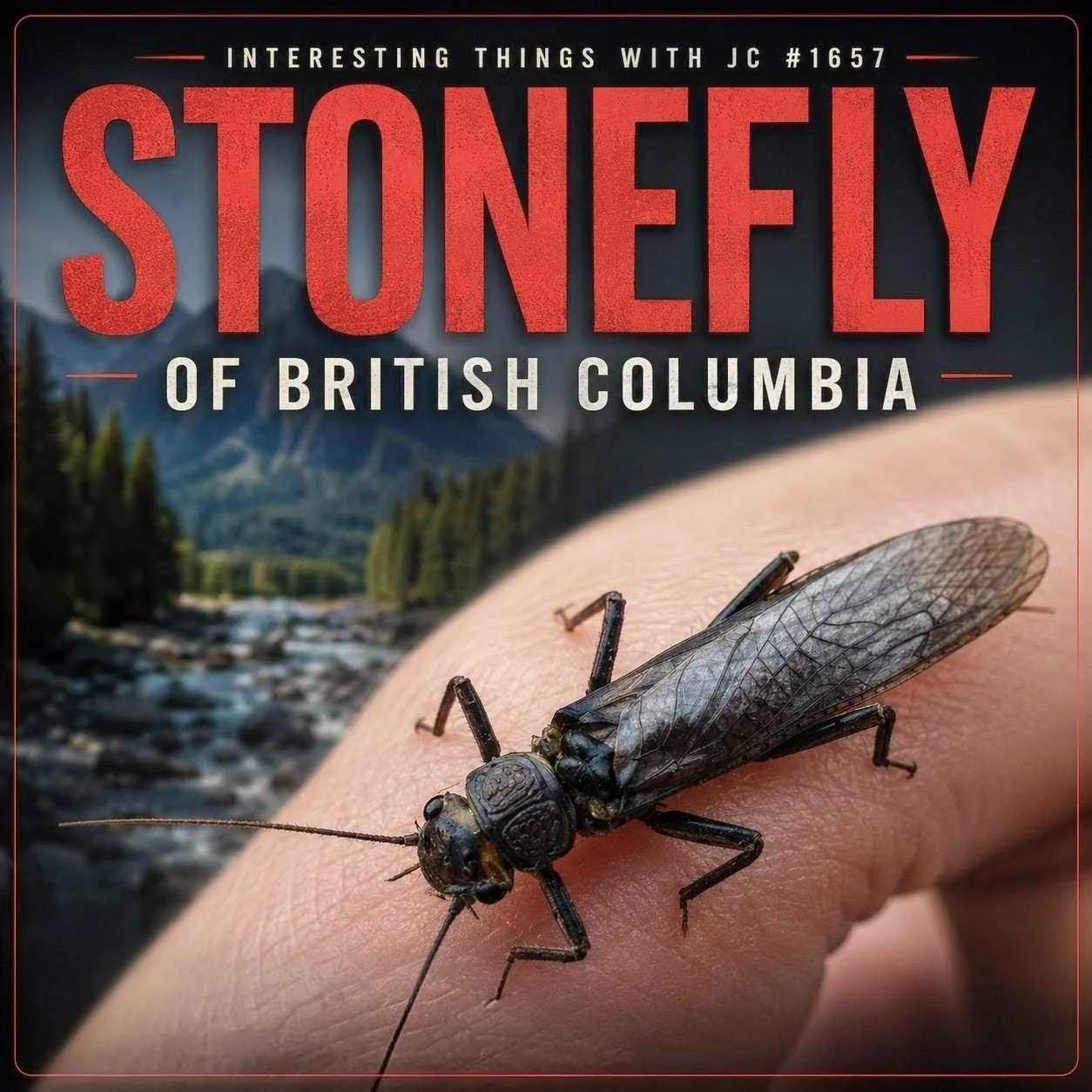
A podcast cover image for Interesting Things with JC #1657 titled “Stonefly of British Columbia.” A large dark stonefly rests on a human finger in the foreground, with a cold mountain river, forest, and mountains blurred in the background. Bold red and white text identifies the episode and subject.
Transcript
Interesting Things with JC #1657:
“The Stonefly of British Columbia”
In the cold mountain rivers of British Columbia, there is an insect that can tell scientists whether water is clean enough to support life.
It is called the stonefly.
Stoneflies spend most of their lives underwater as aquatic nymphs, sometimes for 1 to 4 years depending on species and water temperature. They cling to rocks in fast-moving streams where oxygen levels are high and pollution is low.
That sensitivity is what makes them important.
Stoneflies cannot tolerate warm, stagnant, or contaminated water very well. If a river loses its stoneflies, biologists immediately pay attention because something in the ecosystem is usually going wrong.
In British Columbia, stoneflies are used as biological indicators in freshwater monitoring programs tied to forestry, mining, salmon habitat protection, and watershed health.
Some species are extremely localized, living only in specific river systems fed by glacial meltwater or cold mountain runoff.
And they are ancient.
Stoneflies belong to the order Plecoptera, a lineage that dates back more than 300 million years, long before dinosaurs appeared. Their ancestors lived in the Carboniferous Period when giant dragonflies crossed swamp forests and oxygen levels were much higher than today.
Adult stoneflies look delicate, with folded wings and long antennae, but their survival strategy is remarkably precise. Many species emerge from rivers during narrow seasonal windows tied to snowmelt, temperature, and stream flow.
Trout fishermen know them well.
Large stonefly hatches can trigger aggressive feeding behavior in fish, which is why artificial stonefly lures are common in fly fishing throughout western Canada and the northwestern United States.
But to scientists, the insect represents something larger.
A healthy stonefly population usually means cold water, dissolved oxygen, functioning stream ecology, and an intact watershed.
Tiny insects measuring the health of entire rivers.
These are interesting things, with JC.
Student Worksheet
Comprehension Questions:
Where do stonefly nymphs spend most of their lives?
What water conditions do stoneflies usually need to survive?
Why do biologists pay attention when stoneflies disappear from a river?
What scientific order do stoneflies belong to?
How are stoneflies connected to trout fishing?
Analysis Questions:
Explain why a stonefly is more than just an insect in freshwater science.
How could forestry, mining, or warming water affect stonefly populations?
Why might a cold, fast-moving stream support more stoneflies than a warm, stagnant pond?
Reflection Prompt: Describe one way a small organism can provide important evidence about a large ecosystem. Use stoneflies as your example.
Difficulty Scaling:
Support level: Answer using one complete sentence and one detail from the transcript.
Standard level: Answer using evidence and explain cause and effect.
Advanced level: Connect stoneflies to watershed management, salmon habitat, or field sampling decisions.
Student Output: Students complete written responses, then write a 5–7 sentence evidence-based explanation of why stoneflies are useful bioindicators.
Academic Integrity Guidance: Use your own words. Evidence may come from the episode, class notes, or approved reference material, but copied wording should not be submitted as original work.
Teacher Guide
Quick Start: Begin with the podcast audio. Ask students to listen for the relationship between stoneflies and clean water.
Pacing Guide Audio-First:
Bell ringer: 5 minutes
First audio listen: 4 minutes
Vocabulary check: 6 minutes
Second focused listen or transcript read: 6 minutes
Worksheet: 15 minutes
Discussion: 10 minutes
Quiz or exit ticket: 8 minutes
Bell Ringer: “Would you trust a living organism to help measure water quality? Why or why not?”
Audio Guidance: During the first listen, students circle or write three clues that show stoneflies need specific stream conditions.
Audio Fallback: If audio is unavailable, read the transcript aloud and pause after the sections on nymphs, bioindicators, and watershed health.
Time on Task: 45–55 minutes for a full lesson; 25–30 minutes for a shortened version.
Materials: Episode audio or transcript, worksheet, pencil or digital document, projector or board, optional image of a stonefly nymph.
Vocabulary Strategy: Preview bioindicator, aquatic nymph, dissolved oxygen, and watershed before listening.
Misconceptions:
Stoneflies do not “test” water chemically; their presence helps indicate ecological conditions.
A single missing stonefly does not prove pollution; scientists look for patterns in populations and stream data.
All aquatic insects are not equally sensitive to poor water quality.
Discussion Prompts:
Why are living organisms useful in environmental monitoring?
What might happen to stoneflies if stream temperature rises?
Why would salmon habitat protection and insect monitoring be connected?
Formative Checkpoints:
Students correctly define bioindicator.
Students identify cold, oxygen-rich, flowing water as important stonefly habitat.
Students explain one cause-and-effect relationship involving watershed health.
Differentiation: Provide sentence frames for emerging writers; allow advanced students to compare stoneflies with mayflies or caddisflies.
Assessment Differentiation: Students may respond through a paragraph, labeled diagram, or short oral explanation.
Time Flexibility: Use only comprehension questions and exit ticket for a short lesson; add analysis and extension for a full class period.
Substitute Readiness: Play or read the episode first, assign worksheet questions, then use the quiz as a quiet individual task.
Engagement Strategy: Ask students to imagine they are field biologists deciding whether a stream needs further investigation.
Extensions: Students can research local freshwater bioindicators or design a mock stream-monitoring data sheet.
Cross-Curricular: Biology connects to ecology; geography connects to watersheds; career education connects to environmental fieldwork.
SEL: Emphasize careful observation, patience, and responsibility when interpreting evidence.
Skill Emphasis: Evidence-based reasoning, environmental observation, cause-and-effect analysis, scientific vocabulary.
Answer Key:
Stonefly nymphs live underwater, often clinging to rocks in fast-moving streams.
They usually need cold, clean, oxygen-rich water.
Their disappearance may indicate pollution, warming, low oxygen, or broader ecosystem stress.
Stoneflies belong to the order Plecoptera.
Stonefly hatches can trigger trout feeding, so anglers use artificial stonefly lures.
Strong analysis answers should connect stonefly sensitivity to biological monitoring and watershed health.
Quiz
What is the main reason stoneflies are important to freshwater scientists?
A. They build dams in rivers
B. They indicate stream health
C. They remove salt from water
D. They live only in oceansStonefly nymphs are most often associated with which habitat?
A. Warm stagnant ponds
B. Fast-moving, oxygen-rich streams
C. Dry desert soil
D. Deep ocean ventsWhat does the term Plecoptera refer to?
A. A type of salmon
B. A water-quality machine
C. The insect order that includes stoneflies
D. A kind of glacierIf a stream loses many of its stoneflies, what might scientists investigate?
A. Possible ecosystem stress or pollution
B. Whether the stream has too many rocks
C. Whether adult stoneflies are becoming mammals
D. Whether the river has stopped flowing uphillWhy do trout fishermen pay attention to stonefly hatches?
A. Stoneflies make fishing lines stronger
B. Hatches can trigger fish feeding behavior
C. Stoneflies clean fishing equipment
D. Trout avoid all insects
Assessment
Open-Ended Questions:
Explain how stoneflies can help scientists evaluate watershed health. Use at least two details from the episode.
A stream near a mining or forestry site shows a sudden decline in stonefly populations. What questions should biologists ask next, and why?
Rubric:
3: Clear explanation, accurate vocabulary, strong evidence, and logical cause-and-effect reasoning.
2: Mostly accurate explanation with some evidence, but reasoning needs more detail.
1: Limited or unclear response with little evidence or inaccurate vocabulary.
Exit Ticket: In one sentence, explain why a healthy stonefly population is a good sign for a river.
Standards Alignment
NGSS HS-LS2-2: Students use the stonefly case study to explain how biotic and abiotic factors interact in freshwater ecosystems, including temperature, dissolved oxygen, stream flow, pollution, and habitat structure.
NGSS HS-LS2-6: Students evaluate how changes in water quality or watershed disturbance can affect biodiversity, using stonefly population decline as evidence of possible ecosystem stress.
NGSS HS-LS2-7: Students propose or evaluate solutions for reducing human impacts on freshwater systems by connecting monitoring data to forestry, mining, salmon habitat protection, and watershed management.
NGSS Science and Engineering Practice — Analyzing and Interpreting Data: Students interpret the presence, absence, or decline of stoneflies as biological evidence used in freshwater assessment.
NGSS Crosscutting Concept — Stability and Change: Students explain how stable cold-water stream conditions support stonefly populations and how environmental change can disrupt that balance.
CCSS RST.9-10.2: Students determine the central idea of the episode and explain how details about stonefly habitat, sensitivity, and monitoring support the main concept.
CCSS RST.11-12.7: Students integrate information from the podcast transcript and reference materials to explain how biological indicators are used in environmental science.
CCSS WHST.9-10.2: Students write clear explanatory responses using scientific vocabulary such as bioindicator, dissolved oxygen, aquatic nymph, watershed, and Plecoptera.
CCSS WHST.11-12.9: Students support written claims about freshwater health with evidence from the episode and credible scientific references.
C3 D2.Geo.2.9-12: Students analyze how river systems, mountain runoff, glacial meltwater, and watershed geography shape ecological conditions in British Columbia.
C3 D2.Geo.6.9-12: Students explain how human activities such as forestry, mining, and land use can influence freshwater ecosystems and monitoring priorities.
ISTE 1.3 Knowledge Constructor: Students gather and evaluate information from curated scientific sources to build an evidence-based explanation of stoneflies as bioindicators.
CTE Environmental and Natural Resource Systems: Students connect classroom learning to field-based environmental monitoring skills, including observation, sampling accuracy, data interpretation, and responsible reporting.
Career Readiness: Students practice evidence-based reasoning, precision, scientific communication, and responsible decision-making used by biologists, watershed technicians, fisheries staff, and environmental consultants.
Homeschool/Lifelong Learning: Learners connect local streams or rivers to broader ecological principles by identifying how small organisms can reveal changes in water quality and habitat health.
Show Notes
Stoneflies are small insects with a large scientific role because their presence can reveal whether a river is cold, oxygen-rich, and ecologically functional. This episode helps students connect freshwater biology to real-world monitoring in British Columbia, including watershed health, salmon habitat, forestry, mining, and outdoor recreation. It matters because healthy rivers are measured not only by chemistry, but also by the living organisms that can survive in them.
References
BC Ministry of Environment. (2009). The Canadian Aquatic Biomonitoring Network field manual: Wadeable streams. https://www2.gov.bc.ca/assets/gov/environment/natural-resource-stewardship/nr-laws-policy/risc/cabin_field_manual.pdf
Environment and Climate Change Canada. (2024). Benthic macroinvertebrate metric reference guide. https://www.canada.ca/en/environment-climate-change/services/canadian-aquatic-biomonitoring-network/resources/benthic-macroinvertebrate-metric-reference-guide.html
Government of British Columbia. (n.d.). British Columbia’s Provincial Stream Biomonitoring Program. https://www2.gov.bc.ca/assets/gov/environment/air-land-water/water/waterquality/monitoring-water-quality/biomonitoring/wq_bio_gis_tools_specification.pdf
Missouri Department of Conservation. (n.d.). Stoneflies. https://mdc.mo.gov/discover-nature/field-guide/stoneflies
Tree of Life Web Project. (2002). Plecoptera: Stoneflies. https://tolweb.org/Plecoptera