1656: "Antimatter Propulsion"
Interesting Things with JC #1656: "Antimatter Propulsion" – Antimatter destroys normal matter on contact and converts mass directly into energy, but the fuel powerful enough to push spacecraft toward light speed cannot touch any container around it. Scientists can make positrons and antiprotons, but only in tiny amounts, while magnetic fields must hold the fuel away from everything else.
Curriculum - Episode Anchor
Episode Title: Antimatter Propulsion
Episode Number: 1656
Host: JC
Audience: Grades 9–12, introductory college, homeschool, lifelong learners
Subject Area: Physics, astronomy, aerospace engineering, energy systems, scientific literacy
Curriculum Basis: Interesting Things with JC curriculum framework and locked section structure.
Lesson Overview
Learning Objectives:
Explain what antimatter is and how antimatter differs from ordinary matter.
Describe matter-antimatter annihilation as a process that converts mass into energy.
Use the episode’s one-gram comparison to explain why antimatter is considered an extremely energy-dense theoretical fuel.
Identify the major engineering barriers to antimatter propulsion, including production, containment, storage, energy conversion, and spacecraft safety.
Explain why interstellar travel requires propulsion systems far beyond ordinary chemical rockets.
Describe how time dilation affects travelers moving at a significant fraction of the speed of light.
Essential Question: How can antimatter be one of the most powerful fuels known to physics while still remaining beyond practical spacecraft engineering?
Success Criteria: Students can define antimatter, explain annihilation, interpret the energy comparison in the episode, identify at least three engineering barriers, and explain why astronauts traveling near light speed would experience time differently from observers on Earth.
Student Relevance Statement: This lesson helps students separate scientific possibility from technological readiness. Antimatter is real, but using it as spacecraft fuel requires far more than knowing that it exists.
Real-World Connection: Antimatter particles are produced and studied in accelerator facilities. The same physics that makes antimatter powerful also makes it difficult to store, because contact with ordinary matter causes annihilation.
Workforce Reality: Careers in aerospace, particle physics, accelerator operations, nuclear engineering, robotics, and mission design require disciplined safety habits, careful measurement, systems thinking, and honest communication about uncertainty. Powerful technologies are not judged only by their potential; they are judged by whether they can be produced, controlled, tested, maintained, and used responsibly.
Key Vocabulary
Antimatter(AN-tee-mat-er): Matter made of antiparticles that correspond to ordinary particles but have opposite properties such as electric charge.
Positron(PAH-zih-tron): The antimatter counterpart of the electron; it has the same mass as an electron but positive charge.
Antiproton(AN-tee-PRO-ton): The antimatter counterpart of the proton; it has negative charge.
Annihilation(uh-NY-uh-lay-shun): The process in which matter and antimatter meet and convert their mass into energy and other particles.
Mass-Energy Equivalence(mass EN-er-jee ih-KWIV-uh-lens): The principle that mass and energy are related, commonly represented by E = mc².
Particle Accelerator(PAR-tih-kul ak-SEL-er-ay-ter): A machine that uses electric and magnetic fields to speed up charged particles for research.
Magnetic Containment(mag-NET-ik kun-TAYN-ment): The use of magnetic or electromagnetic fields to hold charged particles away from ordinary matter.
Chemical Rocket(KEM-ih-kul RAH-ket): A rocket that creates thrust through chemical reactions, usually by burning fuel with an oxidizer.
Interstellar Travel(in-ter-STEL-er TRAV-ul): Travel between stars rather than travel only within one solar system.
Relativistic Speed(rel-uh-tiv-IS-tik speed): A speed close enough to the speed of light that the effects of special relativity become important.
Time Dilation(time dye-LAY-shun): The effect in which a moving clock is measured to run slower from another frame of reference.
Light Speed(LITE speed): The speed of light in a vacuum, represented by c, about 300,000 kilometers per second.
Narrative Core
Open: Antimatter sounds like science fiction, but it is part of real particle physics.
Info: When matter and antimatter touch, they annihilate, converting mass into energy with extraordinary efficiency.
Details: That energy density makes antimatter attractive for deep-space propulsion, but the same reaction makes antimatter extremely difficult to produce, store, contain, and control.
Reflection: Antimatter propulsion is not impossible because the physics are fake. It is impractical because the engineering demands are far beyond current capability.
Closing: These are interesting things, with JC.
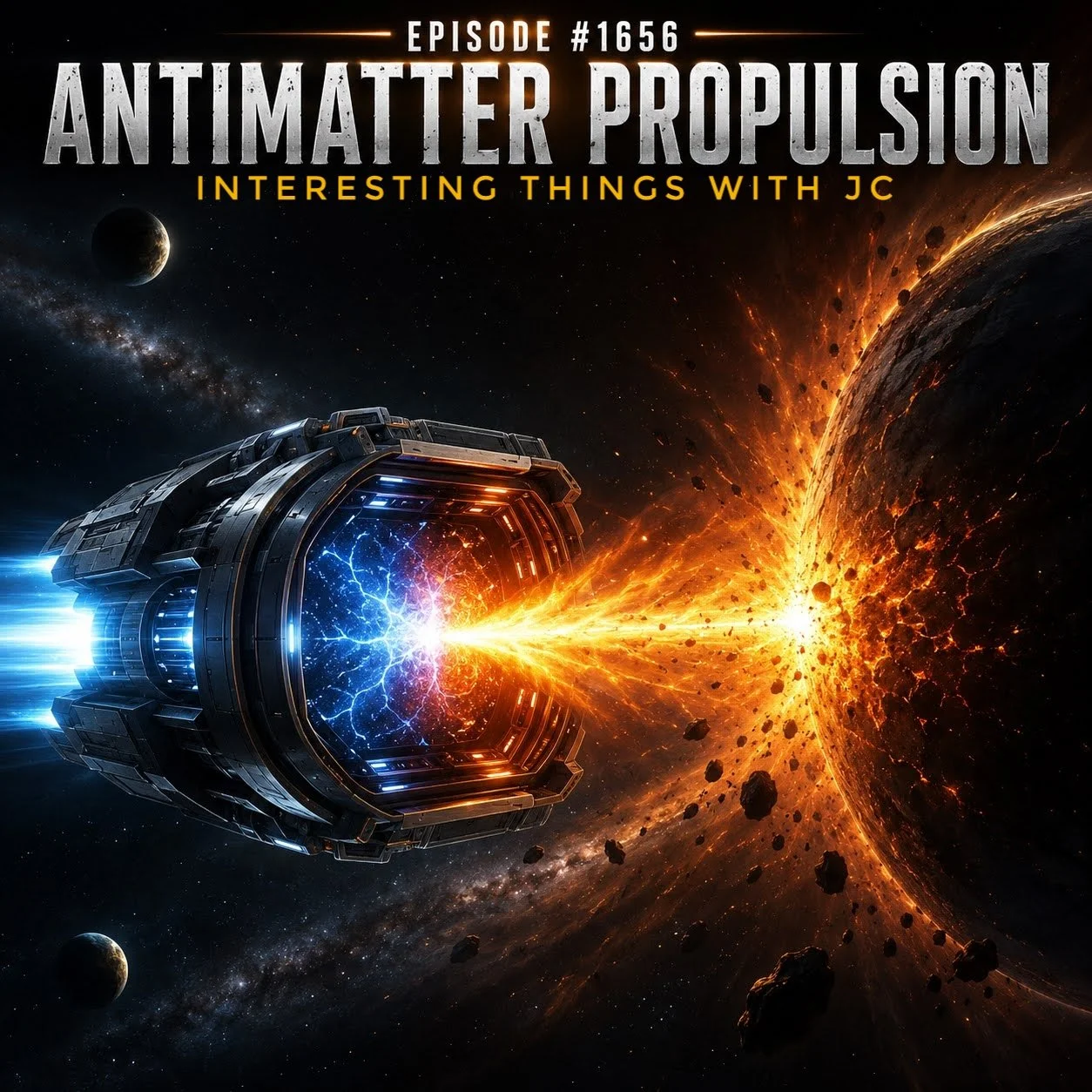
Futuristic spacecraft firing a bright antimatter-style energy beam into a rocky planet in deep space, with the title “Episode #1656 Antimatter Propulsion” across the top.
Transcript
Interesting Things with JC #1656:
“Antimatter Propulsion”
Antimatter is the most energy-dense fuel humans have ever discovered.
When normal matter and antimatter touch, both are annihilated instantly, converting nearly all their mass directly into energy:
One gram of antimatter reacting with one gram of matter could theoretically release energy comparable to roughly 43 kilotons of TNT, several times the energy of the Hiroshima bomb.
That is from a combined mass smaller than a sugar packet.
Physicists have already created antimatter inside particle accelerators. Positrons and antiprotons are real, measurable particles. The problem is quantity. Producing even tiny amounts requires enormous energy, and antimatter must be suspended inside magnetic fields because touching normal matter destroys it immediately.
Still, scientists have seriously studied antimatter propulsion for deep-space travel.
The reason is speed.
Chemical rockets are far too slow for interstellar distances. Even the Voyager probes, moving around 38,000 miles per hour, about 61,000 kilometers per hour, would need tens of thousands of years to reach nearby stars.
Antimatter engines could theoretically reach significant fractions of light speed.
And near light speed, time itself changes.
At 90 percent of light speed, 0.9c, time dilation becomes severe. From Earth’s perspective, about 2.3 years would pass while astronauts onboard experience only about 1 year.
Their clocks slow relative to ours.
Push closer to light speed and the effect grows even larger.
This is not science fiction writing. It comes directly from special relativity, first described in 1905.
Right now, antimatter propulsion remains beyond practical engineering. Humanity has never produced enough antimatter to power even a small spacecraft.
But the physics are real.
And if humans ever attempt true interstellar travel, antimatter remains one of the few known fuels powerful enough to make it remotely possible.
These are interesting things, with JC.
Student Worksheet
Comprehension Questions:
What happens when normal matter and antimatter touch?
Why does the episode describe antimatter as the most energy-dense fuel humans have discovered?
What two examples of antimatter particles are named in the episode?
Why must antimatter be suspended inside magnetic fields?
What problem does the episode identify with producing antimatter?
Why are chemical rockets described as too slow for interstellar travel?
What speed is used in the episode to explain time dilation?
At 0.9c, how much time passes on Earth while astronauts experience about one year?
Analysis Questions:
Explain why the sentence “the physics are real” does not mean antimatter propulsion is ready to use.
The episode says one gram of antimatter reacting with one gram of matter could release energy comparable to roughly 43 kilotons of TNT. What does this comparison help the listener understand?
Why is antimatter both attractive and dangerous as a theoretical fuel?
Explain why antimatter propulsion is a systems problem, not just a fuel problem.
A student says, “If antimatter is so powerful, we should already be using it for spacecraft.” Write a scientific response that corrects this misunderstanding.
Why does the Voyager comparison help explain the challenge of interstellar travel?
How does time dilation change the way astronauts and people on Earth would describe the same trip?
What is the difference between a technology being physically possible and being practically engineerable?
Reflection Prompt: In 5–7 sentences, explain whether antimatter propulsion should be described as impossible, physically possible but currently impractical, or likely to be common soon. Use at least three vocabulary terms from the lesson.
Difficulty Scaling:
Support: Complete the comprehension questions and draw a concept map connecting antimatter, annihilation, energy, magnetic containment, and propulsion.
Core: Complete all comprehension and analysis questions using evidence from the transcript.
Challenge: Use E = mc² to explain why converting two grams of total mass into energy produces an enormous energy release.
Advanced Extension: Compare antimatter propulsion with one other advanced propulsion concept, such as fusion propulsion, nuclear thermal propulsion, ion propulsion, or solar sails.
Student Output Expectations: Students should submit numbered answers, one reflection paragraph, and either a labeled diagram or short engineering memo explaining why antimatter propulsion is not currently practical.
Academic Integrity Guidance: Use your own wording. Scientific terms may match the lesson, but explanations should show your reasoning. If you use outside research for an extension, identify the source clearly.
Teacher Guide
Quick Start: Begin with the podcast audio before any lecture. Ask students to listen for the central tension: antimatter is powerful enough to matter for interstellar travel, but difficult enough that it remains beyond practical engineering.
Pacing Guide Audio-First:
0–3 min: Bell ringer prediction.
3–7 min: Play podcast audio once without interruption.
7–10 min: Students write three claims they heard: one about energy, one about speed, and one about engineering limits.
10–18 min: Teach key vocabulary: antimatter, annihilation, mass-energy equivalence, magnetic containment, and time dilation.
18–30 min: Students complete comprehension questions.
30–42 min: Students complete analysis questions or engineering memo.
42–50 min: Class discussion and formative check.
50–55 min: Quiz, assessment prompt, or exit ticket.
Bell Ringer: A tiny amount of fuel releases a massive amount of energy. What must engineers control before that fuel could safely power a spacecraft?
Audio Guidance + Fallback: Play the audio first and have students listen for the difference between scientific possibility and engineering readiness. If audio is unavailable, read the transcript aloud once at natural pace, then allow students to reread and mark claims about energy, speed, and obstacles.
Time-on-Task: Standard lesson: 50–55 minutes. Condensed lesson: 30 minutes using audio, vocabulary, comprehension questions 1–8, and exit ticket. Extended lesson: 75–90 minutes with calculation, propulsion comparison, and engineering memo.
Materials: Podcast audio or transcript, student worksheet, projector or board, timer, calculator for optional E = mc² extension, optional diagram of matter-antimatter annihilation or spacecraft propulsion system.
Vocabulary Prep: Pre-teach antimatter, positron, antiproton, annihilation, and time dilation before deeper analysis. Clarify that “anti” does not mean imaginary, evil, or opposite in every everyday sense; it refers to specific particle properties.
Mini-Lesson Notes: Matter-antimatter annihilation is powerful because mass can be converted into energy. The episode’s one-gram comparison helps students understand energy scale, but it should also lead to the engineering question: how could that energy be released in a controlled direction to produce thrust?
Misconceptions:
Students may think antimatter is fictional; clarify that antimatter particles are real and measurable.
Students may think antimatter is easy to use because it is powerful; clarify that usable propulsion requires production, storage, containment, controlled energy release, shielding, and mission reliability.
Students may think magnetic containment solves the entire problem; clarify that containment is only one part of a larger engineering system.
Students may think annihilation simply means an ordinary explosion; clarify that annihilation is a particle interaction that converts mass into energy and other particles.
Students may think time dilation means time stops; clarify that different observers measure time differently depending on relative motion.
Students may think near-light-speed travel removes all mission problems; clarify that acceleration, deceleration, navigation, radiation shielding, communication, and structural design remain major challenges.
Discussion Prompts:
Why is antimatter a strong example of the difference between physics and engineering?
Which barrier seems hardest: producing antimatter, storing antimatter, or using annihilation energy as thrust?
Why does the episode compare antimatter propulsion to Voyager’s speed?
What does “responsible optimism” mean when discussing future space technology?
How should students evaluate dramatic claims about advanced propulsion?
Why might interstellar travel require new kinds of thinking about fuel, time, and risk?
Formative Checkpoints:
Students can define antimatter without calling it fictional.
Students can explain annihilation without describing it only as a normal explosion.
Students can identify production and containment as separate problems.
Students can explain why chemical rockets are poorly suited for interstellar distances.
Students can correctly interpret 0.9c as ninety percent of the speed of light.
Students can explain that astronauts and Earth observers may measure different elapsed times.
Differentiation:
Support: Provide sentence frames: “Antimatter is powerful because…” and “It is not practical yet because…”
Language Support: Pair vocabulary with sketches and pronunciation practice.
Visual Support: Have students draw a flowchart: create antimatter → contain antimatter → release energy → direct thrust → protect spacecraft.
Extension: Ask students to research antimatter trapping, accelerator facilities, or another proposed interstellar propulsion system.
Advanced: Assign the E = mc² calculation and have students compare the result with the episode’s TNT comparison.
Assessment Differentiation: Allow students to answer assessment questions as a written paragraph, labeled diagram with explanation, oral response, or one-page engineering memo. Use the same criteria for all formats: accuracy, evidence, reasoning, and clarity.
Time Flexibility: For a shorter class, skip the challenge calculation and assign only comprehension, reflection, and exit ticket. For a longer class, add a structured debate: “Is antimatter propulsion a realistic long-term goal or mostly a theoretical benchmark?”
Substitute Readiness: Play or read the transcript, assign the worksheet, collect the reflection prompt, and use the answer key for review. No specialized physics background is required if the vocabulary list and answer key are provided.
Engagement Strategy: Frame the lesson around a problem engineers must solve: “The fuel is powerful enough. The question is whether humans can ever produce, store, and control it safely enough.”
Extensions: Students can investigate particle accelerators, Penning traps, antimatter storage, Voyager travel times, relativistic travel, fusion propulsion, or why deceleration is as important as acceleration in interstellar missions.
Cross-Curricular:
Math: Scientific notation, unit conversion, proportional reasoning, E = mc².
Engineering: Systems design, constraints, risk analysis, propulsion tradeoffs.
History of Science: Einstein’s 1905 special relativity work and the development of modern particle physics.
English Language Arts: Evidence-based explanation and technical writing.
Career Education: Aerospace engineering, accelerator operations, research physics, systems safety, and mission planning.
SEL: Emphasize intellectual humility. Students should be able to say, “This is real physics,” and “This is not ready technology,” without treating those statements as contradictions.
Skill Emphasis: Evidence-based explanation, scientific skepticism, technical vocabulary, systems thinking, responsible risk evaluation, and clear communication of uncertainty.
Answer Key:
Worksheet Comprehension:
1. They annihilate and convert mass into energy.
2. A very small amount of antimatter reacting with matter can release an enormous amount of energy.
3. Positrons and antiprotons.
4. Because contact with normal matter destroys antimatter immediately through annihilation.
5. Producing even tiny amounts requires enormous energy.
6. Interstellar distances are so large that chemical rockets would take extremely long times to reach nearby stars.
7. 0.9c, or ninety percent of the speed of light.
8. About 2.3 years pass on Earth while astronauts experience about one year.
Worksheet Analysis:
1. It means the underlying physics is supported, but the technology is not practical yet.
2. It shows the huge energy scale of matter-antimatter annihilation in a familiar comparison.
3. It is attractive because it is energy dense and dangerous or difficult because it annihilates on contact with ordinary matter.
4. A spacecraft would need systems for production, containment, release, thrust direction, shielding, cooling, reliability, and safety.
5. Strong answers should explain that energy density alone does not solve production, containment, cost, and control.
6. Voyager shows that even fast spacecraft are extremely slow compared with the distance to nearby stars.
7. Astronauts would experience less elapsed time than observers on Earth at relativistic speeds.
8. Physical possibility means the laws of physics allow it; practical engineering means humans can build, operate, and control it reliably.
Quiz Answers: 1. B; 2. C; 3. A; 4. A; 5. B.
Quiz
What is antimatter?
A. Matter that has no mass
B. Matter made of particles with opposite properties from ordinary matter
C. Matter that exists only inside black holes
D. Matter that cannot be measuredWhat happens when matter and antimatter meet?
A. They freeze into a solid
B. They become ordinary rocket fuel
C. They annihilate and convert mass into energy
D. They stop moving completelyWhy is antimatter difficult to store?
A. It must be kept from touching ordinary matter
B. It only exists at the center of stars
C. It cannot be affected by fields
D. It has no measurable particlesWhy does the episode mention Voyager?
A. To show how slow current spacecraft are compared with interstellar distances
B. To prove Voyager uses antimatter propulsion
C. To show that chemical rockets already travel near light speed
D. To explain how astronauts survive inside particle acceleratorsWhat does time dilation mean in this lesson?
A. Time disappears completely near light speed
B. Moving clocks can be measured to run slower from another frame of reference
C. Time becomes identical for all observers
D. Rockets travel into the past
Assessment
Open-Ended Questions:
Explain why antimatter propulsion is scientifically plausible but technologically impractical today. Use at least three vocabulary terms.
Use the 0.9c example to explain how near-light-speed travel changes the relationship between astronaut time and Earth time.
3–2–1 Rubric:
3: Accurate explanation, correct vocabulary, clear distinction between physics and engineering, strong evidence from the episode, and thoughtful discussion of time dilation or propulsion limits.
2: Mostly accurate explanation with minor gaps; uses some vocabulary correctly; includes evidence but may not fully explain engineering constraints.
1: Limited or unclear explanation; vocabulary is missing or incorrect; response confuses antimatter, propulsion, or relativity.
Exit Ticket: In two sentences, explain one reason antimatter could matter for interstellar travel and one reason antimatter propulsion is not practical today.
Standards Alignment
NGSS HS-PS1-8: Students connect nuclear and particle-scale processes to energy release by explaining how matter-antimatter annihilation converts mass into energy.
NGSS HS-PS3-1: Students use quantitative and conceptual reasoning to explain how a small amount of mass can correspond to a very large amount of energy.
NGSS HS-PS3-3: Students evaluate energy conversion in a proposed propulsion system by identifying where energy must be produced, transferred, directed, and controlled.
NGSS HS-PS2-1: Students analyze motion at extreme speeds by explaining why interstellar travel requires propulsion far beyond ordinary chemical rockets.
NGSS HS-PS2-4: Students connect charged particles and fields by explaining why magnetic or electromagnetic containment is relevant to antimatter storage.
NGSS HS-ETS1-1: Students define the engineering problem of antimatter propulsion by identifying criteria and constraints, including production, containment, safety, thrust control, and mission reliability.
NGSS HS-ETS1-2: Students design or evaluate a systems-level explanation for how antimatter could theoretically support propulsion while identifying unresolved barriers.
NGSS HS-ETS1-3: Students compare tradeoffs by weighing antimatter’s energy density against cost, risk, storage difficulty, and technical readiness.
CCSS RST.9-10.2: Students determine the central idea of a science-based narrative and explain how details about energy, speed, and containment develop that idea.
CCSS RST.9-10.4: Students interpret technical vocabulary such as antimatter, annihilation, particle accelerator, time dilation, and relativistic speed in context.
CCSS RST.11-12.7: Students integrate numerical examples, such as one gram of antimatter and 0.9c time dilation, into a coherent scientific explanation.
CCSS WHST.9-12.1: Students write evidence-based arguments about whether antimatter propulsion is impossible, impractical, or likely in the future.
CCSS WHST.9-12.2: Students produce explanatory writing that uses accurate scientific vocabulary and logical sequencing to describe a complex technology.
CCSS SL.9-10.1: Students participate in evidence-based discussion about how scientific possibility differs from engineering readiness.
ISTE 1.3 Knowledge Constructor: Students evaluate claims about antimatter propulsion by distinguishing verified physics from unsupported assumptions.
ISTE 1.5 Computational Thinker: Students use proportional reasoning, systems thinking, and optional calculation to model energy release and time dilation.
CTE STEM Career Cluster: Students identify how physicists, aerospace engineers, accelerator technicians, safety specialists, and mission designers use precision, modeling, containment, and risk analysis.
C3 D1.5.9-12: Students develop questions about evidence, feasibility, and technological limits by investigating why antimatter propulsion remains impractical.
C3 D2.Sci/Inquiry Connection: Students explain how scientific observations and models can support future technology while still requiring engineering validation.
C3 D4.1.9-12: Students construct arguments using evidence from the transcript to evaluate the promise and limits of antimatter propulsion.
Career Readiness: Students practice technical communication, disciplined reasoning, safety awareness, and responsible interpretation of emerging technologies.
Homeschool/Lifelong Learning: Learners connect a short audio narrative to independent scientific inquiry by explaining energy density, space travel limits, and relativity.
General Open Education: Learners demonstrate transferable scientific literacy by distinguishing observation, theory, engineering design, and speculative application.
Show Notes
This lesson uses antimatter propulsion to help students explore the boundary between real physics and future engineering. Antimatter particles exist, and matter-antimatter annihilation can release enormous energy from very small amounts of mass, but producing, storing, and controlling antimatter remains far beyond current spacecraft capability. The episode connects particle physics, interstellar distance, propulsion design, and time dilation, giving learners a practical framework for evaluating powerful scientific claims with curiosity, evidence, and discipline.
References
CERN. (n.d.). Antimatter. https://home.cern/science/physics/antimatter/
CERN. (n.d.). The Antiproton Decelerator. https://home.cern/science/accelerators/antiproton-decelerator/
CERN. (2023). ALPHA experiment at CERN observes the influence of gravity on antimatter. https://home.cern/news/news/physics/alpha-experiment-cern-observes-influence-gravity-antimatter
National Aeronautics and Space Administration. (2020). Deceleration of interstellar spacecraft utilizing antimatter. https://www.nasa.gov/general/deceleration-of-interstellar-spacecraft-utilizing-antimatter/
National Aeronautics and Space Administration. (2024). Voyager 1. https://science.nasa.gov/mission/voyager/voyager-1/
Einstein, A. (1905). On the electrodynamics of moving bodies. https://www.fourmilab.ch/etexts/einstein/specrel/specrel.pdf
Georgia State University. (n.d.). Relativistic time dilation. https://hyperphysics.phy-astr.gsu.edu/hbase/Relativ/tdil.html
Particle Data Group. (2024). Review of particle physics. https://pdg.lbl.gov/2024/reviews/contents_sports.html