1660: "The Adams Event"
Interesting Things with JC #1660: "The Adams Event" – A 42,000-year-old kauri tree held a carbon record from the Laschamps Excursion, when Earth’s magnetic field weakened, cosmic rays increased, and the upper atmosphere may have changed while the tree kept the evidence ring by ring.
Curriculum - Episode Anchor
Episode Title: The Adams Event
Episode Number: 1660
Host: JC
Audience: Grades 9–12, introductory college, homeschool, lifelong learners
Subject Area: Earth science, paleoclimatology, space weather, archaeology
Lesson Overview
Learning Objectives:
Explain how Earth’s magnetic field helps reduce the flow of charged particles into the atmosphere.
Describe how carbon-14 in ancient tree rings can preserve evidence of past cosmic-ray changes.
Distinguish between evidence, model-based interpretation, and debated scientific claims.
Evaluate why the Adams Event matters for understanding environmental stress, ancient life, and scientific uncertainty.
Essential Question: How can a preserved tree help scientists reconstruct a period when Earth’s magnetic shield weakened?
Success Criteria: Students can connect the Laschamps Excursion, increased cosmic rays, carbon-14 production, and kauri tree-ring evidence in a clear cause-and-effect explanation.
Student Relevance Statement: This lesson shows how scientists use natural archives to study events no human wrote down.
Real-World Connection: Magnetic-field research connects to satellite safety, aviation radiation exposure, electrical-grid planning, navigation systems, and space-weather monitoring.
Workforce Reality: Careers in geoscience, atmospheric science, archaeology, and aerospace require careful data handling, uncertainty labeling, and responsible communication rather than dramatic claims.
Key Vocabulary
Kauri Tree(KOW-ree tree): A long-lived tree from New Zealand; preserved ancient kauri can hold annual growth-ring records.
Laschamps Excursion(lah-SHOMP ek-SKUR-zhun): A short-lived event about 41,000–42,000 years ago when Earth’s magnetic poles shifted and briefly reversed before returning.
Adams Event(AD-umz ih-VENT): A proposed window of environmental stress linked to the weakened magnetic field around the Laschamps Excursion.
Magnetosphere(mag-NEE-tuh-sfeer): The region around Earth shaped by its magnetic field that helps deflect charged particles from space.
Cosmic Rays(KAHZ-mik rayz): High-energy particles from space that can interact with Earth’s atmosphere.
Carbon-14(KAR-bun for-TEEN): A radioactive form of carbon produced partly when cosmic rays interact with the atmosphere.
Radiocarbon Dating(RAY-dee-oh-KAR-bun DAY-ting): A method that uses carbon-14 to estimate the age of once-living material.
Ozone(OH-zone): A molecule made of three oxygen atoms that helps absorb harmful ultraviolet radiation in the atmosphere.
Megafauna(MEG-uh-FAW-nuh): Large animals, especially large Ice Age mammals.
Scientific Uncertainty(SY-un-TIF-ik un-SER-tun-tee): The careful recognition of what evidence supports, what remains debated, and what cannot yet be proven.
Narrative Core
Open: A preserved New Zealand kauri tree becomes more than an ancient piece of wood; it becomes a natural recorder of Earth’s sky.
Info: Around 42,000 years ago, Earth’s magnetic field weakened during the Laschamps Excursion, allowing more cosmic rays to affect the atmosphere.
Details: Those cosmic rays increased carbon-14 production, and the growing kauri tree absorbed that carbon into its rings year by year. Scientists used the tree-ring record to study timing, radiation changes, atmospheric chemistry, and possible environmental stress.
Reflection: The evidence is powerful, but not simple. It supports a period of unusual atmospheric conditions while leaving room for debate about links to climate, megafauna, Neanderthals, and cave art.
Closing: These are interesting things, with JC.
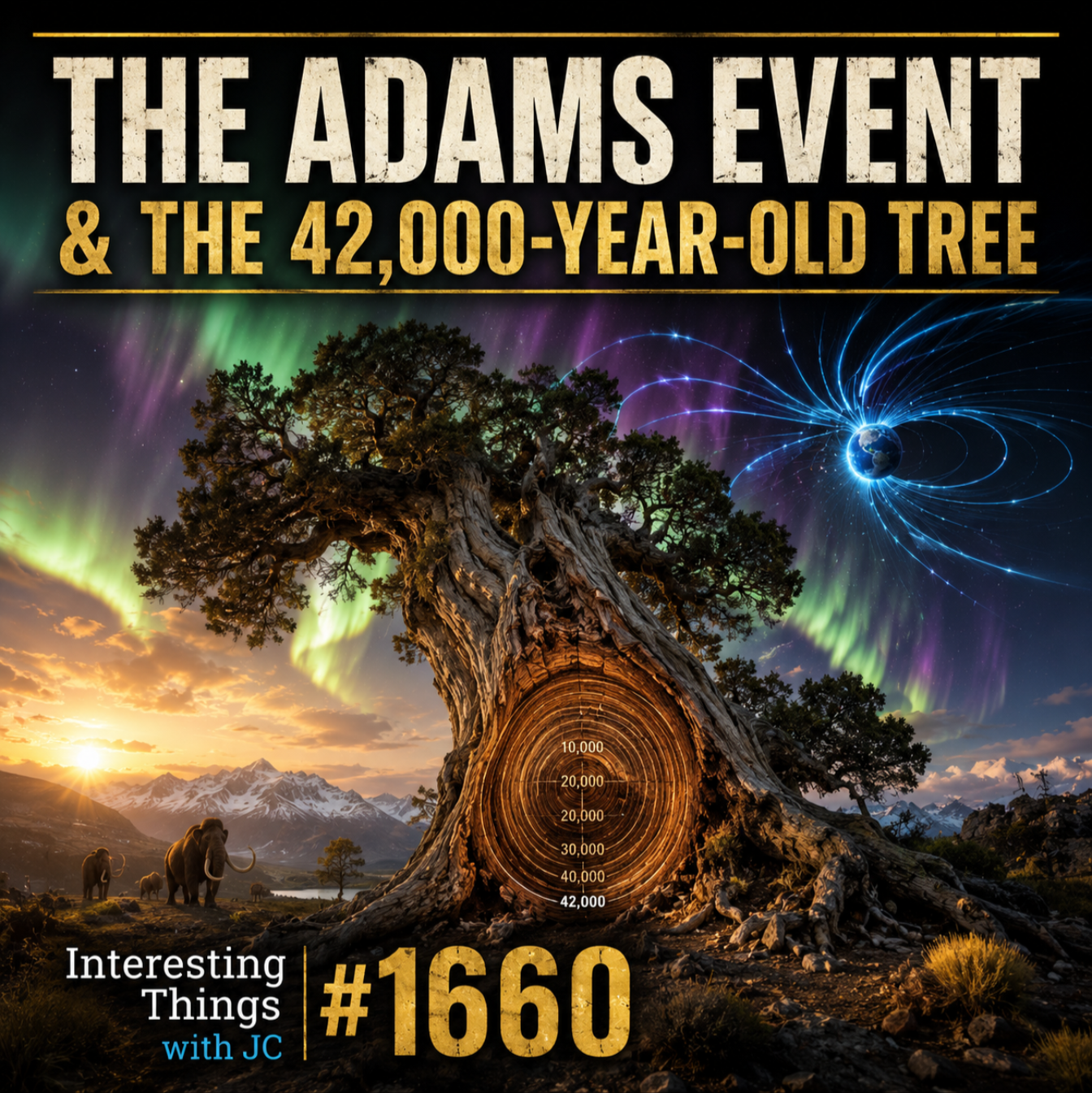
Promotional image for “The Adams Event & The 42,000-Year-Old Tree,” episode 1660 of Interesting Things with JC. A massive ancient tree stump fills the center, with visible growth rings labeled up to 42,000 years. Behind it, auroras glow across a dark sky while Earth’s magnetic field lines arc from the planet in the upper right. Mammoths walk through a prehistoric landscape at sunset, suggesting Ice Age environmental change. The title appears in large white and gold text across the top, with the Interesting Things with JC logo and episode number at the bottom.
Transcript
Interesting Things with JC #1660:
"The Adams Event"
A kauri tree was lying under a New Zealand swamp with its bark still attached after 42,000 years.
When scientists cut into it, the rings held a record of the sky.
Around 42,000 years ago, Earth’s magnetic poles started wandering badly. North and south did not just drift. During the Laschamps Excursion, they briefly swapped places, and in the lead-up, the planet’s magnetic field weakened to a tiny fraction of its usual strength. That mattered because Earth’s magnetic field is part of what keeps charged particles from space from pouring straight into the atmosphere.
The tree recorded it in carbon.
As cosmic rays hit the atmosphere, they created extra carbon-14. The kauri absorbed that carbon as it grew, ring by ring, year by year. So when researchers studied the wood, they were not just dating an old tree. They were reading a timestamp from a period when the planet’s shield was failing.
The researchers called this window the Adams Event, after Douglas Adams, because the number 42 keeps showing up in the timing, and Adams made 42 famous as the answer to life, the universe, and everything.
But this was not a joke in the atmosphere.
With the magnetic field weakened, more radiation reached the upper air. Chemical reactions may have damaged ozone. Auroras could have spread far beyond the poles. Electrical storms may have become more common. Climate patterns shifted in the models, and the timing overlaps with major changes in the ancient world, including stress on megafauna, the disappearance of Neanderthals, and a noticeable rise in cave art.
That last part is still debated. The evidence does not prove one clean cause. It does not say the magnetic field killed the Neanderthals or forced humans into caves by itself. It says something stranger and more careful: for a few centuries, Earth may have become a much harsher place from the top of the atmosphere down.
And the witness was not a monument, or a skeleton, or a written warning.
It was a tree in a swamp, holding the sky in its rings.
These are interesting things, with JC.
Student Worksheet
Comprehension Questions:
What was unusual about the kauri tree described in the episode?
What happened to Earth’s magnetic poles during the Laschamps Excursion?
Why did a weakened magnetic field matter for Earth’s atmosphere?
How did carbon-14 become part of the tree-ring record?
Why did researchers connect the name “Adams Event” to Douglas Adams?
Analysis Questions:
Create a cause-and-effect chain using these terms: magnetic field, cosmic rays, atmosphere, carbon-14, kauri rings.
Why is the kauri tree evidence stronger for timing than for proving every possible environmental effect?
The episode says the link to Neanderthals and cave art is debated. What makes that statement scientifically responsible?
How are direct evidence and computer models different in this topic?
Reflection Prompt: Explain why a tree can be considered a scientific “witness” even though it cannot describe events in words.
Difficulty Scaling:
Level 1: Write a five-sentence summary using at least four vocabulary terms.
Level 2: Build a labeled diagram showing how cosmic rays can lead to carbon-14 in tree rings.
Level 3: Write a short evidence paragraph explaining what the Adams Event does and does not prove.
Student Output: Submit answers in complete sentences, one cause-and-effect chain, and one reflection paragraph of 5–7 sentences.
Academic Integrity Guidance: Use the episode and class sources only; do not claim certainty where the evidence is debated.
Teacher Guide
Quick Start: Begin with the podcast audio before any lecture. Ask students to listen for one natural object, one atmospheric process, and one debated claim.
Pacing Guide Audio-First:
Podcast listening: 3–5 minutes.
Silent recall: 2 minutes.
Vocabulary preview: 6 minutes.
Mini-lesson on magnetic field and carbon-14: 10 minutes.
Worksheet work time: 15–20 minutes.
Discussion and formative check: 8–10 minutes.
Exit ticket: 3 minutes.
Bell Ringer: Before listening, ask: “What kinds of natural objects can store information about the past?”
Audio Guidance: Tell students to mark any phrase that shows evidence, uncertainty, or cause and effect.
Audio Fallback: If audio is unavailable, read the transcript aloud while students annotate the same three categories.
Time on Task: Standard lesson: 45–55 minutes; extended discussion version: 70–80 minutes.
Materials: Episode audio or transcript, worksheet, projector or board, vocabulary list, blank paper for cause-and-effect diagram.
Vocabulary Prep: Pre-teach magnetosphere, cosmic rays, carbon-14, radiocarbon dating, and scientific uncertainty.
Misconceptions:
A magnetic excursion is not the same as Earth physically flipping over.
The Adams Event does not prove one simple cause for Neanderthal disappearance.
Carbon-14 in tree rings is evidence of atmospheric change, not a written message.
Models can support explanations but should not be treated as direct observation.
Discussion Prompts:
Why is it important that the tree had annual rings?
What makes a claim stronger: timing overlap, direct evidence, or repeated independent evidence?
Why might scientists disagree about ancient environmental causes?
Formative Checkpoints:
Students correctly define Laschamps Excursion.
Students connect cosmic rays to carbon-14 production.
Students identify at least one debated claim.
Students avoid overstating cause and effect.
Differentiation: Provide sentence starters for emerging learners, diagram templates for visual learners, and source-evaluation prompts for advanced students.
Assessment Differentiation: Allow written paragraph, labeled diagram with explanation, or oral explanation recorded by the teacher.
Time Flexibility: Shorten by assigning only comprehension questions and exit ticket; extend with a claim-evidence-reasoning paragraph.
Substitute Readiness: Use transcript reading, vocabulary matching, worksheet completion, and exit ticket without requiring specialized background knowledge.
Engagement Strategy: Frame the kauri tree as a “data archive” and ask students to decode what kind of information it stored.
Extensions: Students can compare tree rings, ice cores, sediment layers, and cave records as natural archives.
Cross-Curricular Connections: Earth science connects with chemistry through carbon-14, history through Neanderthals and cave art, and language arts through evidence-based claims.
SEL Connection: Emphasize intellectual humility: strong thinkers can explain evidence while admitting uncertainty.
Skill Emphasis: Students practice causal reasoning, evidence evaluation, uncertainty language, and responsible scientific communication.
Answer Key:
Comprehension: The kauri tree was preserved under a New Zealand swamp with bark attached after about 42,000 years.
Comprehension: The magnetic poles wandered and briefly swapped places during the Laschamps Excursion.
Comprehension: A weaker magnetic field allowed more charged particles and cosmic-ray effects in the atmosphere.
Comprehension: Cosmic rays helped create extra carbon-14, which the tree absorbed as it grew.
Comprehension: The name refers to Douglas Adams because of the repeated appearance of the number 42.
Analysis: Correct chains should show weakened magnetic field → more cosmic-ray interaction → more carbon-14 → absorption by kauri → tree-ring record.
Analysis: The tree gives strong timing evidence but cannot alone prove all climate, extinction, or cultural effects.
Analysis: The episode is responsible because it separates overlap from proof.
Analysis: Direct evidence is measured from natural records; models simulate possible effects using data and assumptions.
Quiz
What did the ancient kauri tree preserve in its rings?
A. A written human message
B. A record linked to atmospheric carbon-14 changes
C. A map of New Zealand’s rivers
D. A fossilized animal skeletonDuring the Laschamps Excursion, Earth’s magnetic poles:
A. Became permanently fixed
B. Briefly shifted and reversed before returning
C. Stopped affecting navigation forever
D. Moved only a few centimetersWhy can cosmic rays increase carbon-14 levels?
A. They interact with the atmosphere
B. They grow directly inside tree bark
C. They come only from volcanoes
D. They remove all carbon from airWhich statement best reflects the episode’s caution?
A. The Adams Event definitely killed all Neanderthals
B. Cave art proves the magnetic field disappeared forever
C. The timing overlaps with major changes, but causation is debated
D. Trees cannot record environmental informationWhat is the best description of the kauri tree in this lesson?
A. A natural archive of atmospheric evidence
B. A modern weather station
C. A human-made monument
D. A magnetic pole itself
Assessment
Open-Ended Questions:
Explain how the kauri tree helped scientists study a time when Earth’s magnetic field weakened. Use at least four vocabulary terms.
Evaluate the claim that the Adams Event caused major changes in ancient life. What evidence supports concern, and what remains uncertain?
Rubric:
3: Response accurately explains the science, uses evidence, includes vocabulary, and clearly separates proven evidence from debated interpretation.
2: Response explains the main idea but misses some detail, uses limited vocabulary, or only partly addresses uncertainty.
1: Response gives an incomplete explanation, confuses key processes, or makes unsupported claims.
Exit Ticket: In two sentences, explain one thing the kauri tree shows clearly and one thing it does not prove by itself.
Standards Alignment
NGSS HS-ESS2-2: Students analyze geoscience evidence from ancient kauri tree rings to explain how Earth’s magnetic-field changes can be reconstructed from natural records.
NGSS HS-ESS2-4: Students use cause-and-effect reasoning to connect Earth’s magnetic field, cosmic rays, atmospheric chemistry, carbon-14 production, and tree-ring evidence.
NGSS HS-ESS3-1: Students evaluate how natural Earth-system changes may create environmental stress and affect living systems over time.
NGSS Science and Engineering Practice — Analyzing and Interpreting Data: Students interpret tree-ring and radiocarbon evidence as data that can reveal past atmospheric conditions.
NGSS Crosscutting Concept — Stability and Change: Students explain how a temporary weakening of Earth’s magnetic field could disrupt atmospheric conditions for a limited period.
CCSS RST.9-10.1: Students cite specific textual evidence from the transcript to explain the relationship between the Laschamps Excursion and carbon-14 changes.
CCSS RST.11-12.7: Students integrate information from narrative text, vocabulary, and scientific explanation to understand how natural archives preserve evidence.
CCSS WHST.9-12.2: Students write explanatory responses that use accurate scientific vocabulary and organize ideas through cause-and-effect structure.
CCSS WHST.9-12.9: Students draw evidence from informational text to support analysis of what the Adams Event may show and what remains debated.
C3 D2.Geo.2.9-12: Students use geographic and environmental data to explain relationships among Earth processes, atmospheric change, and human or ecological history.
C3 D2.His.14.9-12: Students distinguish between historical correlation and causation when evaluating claims about Neanderthals, megafauna, and cave art.
ISTE 1.3 Knowledge Constructor: Students evaluate scientific claims, identify uncertainty, and build a reasoned explanation from evidence rather than unsupported conclusions.
ISTE 1.5 Computational Thinker: Students examine how models can help test possible atmospheric and climate effects while recognizing the limits of modeled conclusions.
CTE STEM Career Cluster: Students practice evidence interpretation, data-based explanation, and scientific communication used in geoscience, atmospheric science, archaeology, aerospace, and environmental monitoring.
Career Readiness — Critical Thinking: Students separate observation, inference, model-based prediction, and debated interpretation in a real scientific case study.
Career Readiness — Communication: Students explain complex scientific processes clearly, accurately, and without overstating certainty.
Career Readiness — Responsibility: Students recognize that scientific work requires discipline, precision, peer review, and careful public communication.
Homeschool/Lifelong Learning: Learners connect a short science narrative to independent inquiry, source evaluation, natural history, and responsible interpretation of dramatic claims.
Show Notes
This episode turns an ancient New Zealand kauri tree into a classroom entry point for Earth’s magnetic field, cosmic rays, carbon-14, and scientific uncertainty. Students learn how tree rings can preserve atmospheric evidence from deep time while also practicing a critical habit of science: separating strong evidence from debated interpretation. The topic matters because it connects natural archives, space weather, climate modeling, archaeology, and the responsibility scientists have when explaining dramatic events from the ancient past.
References
NASA. (2021). Earth’s magnetosphere: Protecting our planet from harmful space energy. https://science.nasa.gov/science-research/earth-science/earths-magnetosphere-protecting-our-planet-from-harmful-space-energy/
NASA. (2021). Flip flop: Why variations in Earth’s magnetic field aren’t causing today’s climate change. https://science.nasa.gov/science-research/earth-science/flip-flop-why-variations-in-earths-magnetic-field-arent-causing-todays-climate-change/
National Institute of Water and Atmospheric Research. (2021). Ancient kauri trees reveal a turning point in Earth’s history 42,000 years ago. https://niwa.co.nz/news/ancient-kauri-trees-reveal-turning-point-earths-history-42000-years-ago
UNSW Sydney. (2021). Ancient relic points to a turning point in Earth’s history 42,000 years ago. https://www.unsw.edu.au/newsroom/news/2021/02/ancient-relic-points-to-a-turning-point-in-earth-s-history-42-00
GFZ Helmholtz Centre for Geosciences. (2024). Sound of Earth’s magnetic flip 41,000 years ago. https://www.gfz.de/en/section/geomagnetism/overview/detailpage-section-news/sound-of-earths-magnetic-flip-41-000-years-ago