1659: "Overmodulating the Carrier"
Interesting Things with JC #1659: "Overmodulating the Carrier" – WMEX engineers pushed AM modulation to the edge so the station sounded louder and denser than nearby signals, with audio processing that helped 1510 punch through static, car noise, fading, and crowded nighttime dial conditions.
Curriculum - Episode Anchor
Episode Title: Overmodulating the Carrier
Episode Number: 1659
Host: JC
Audience: Grades 9–12, introductory college, homeschool, lifelong learners
Subject Area: Physics, communications technology, radio broadcasting, audio engineering
Lesson Overview
Learning Objectives:
Explain how AM radio uses amplitude changes in a carrier wave to transmit audio.
Define overmodulation and describe how it can create distortion, clipping, and adjacent-frequency interference.
Describe how compressors, limiters, clippers, and asymmetrical processing affected AM loudness.
Evaluate the tradeoff between strong station identity, intelligibility, distortion control, and broadcast responsibility.
Essential Question: How can audio engineering make a radio station sound more powerful while still operating near technical and legal limits?
Success Criteria: Students can define AM modulation, explain overmodulation, identify key audio-processing tools, and support a claim about why WMEX sounded louder and more recognizable.
Student Relevance Statement: Students learn that the loudness and clarity of media are shaped by engineering choices, not just by volume controls.
Real-World Connection: Radio, podcasting, streaming, public address systems, and video platforms all use audio processing to improve intelligibility and consistency.
Workforce Reality: Broadcast and audio engineers must balance competitive sound with accurate monitoring, technical discipline, and responsibility to avoid distortion or interference.
Key Vocabulary
Amplitude Modulation / AM (AM-plih-tood MOD-yuh-LAY-shun): A radio method that carries sound by varying the strength of a carrier wave.
Carrier Wave (KAIR-ee-er wayv): A steady radio-frequency signal that is changed to carry audio information.
Modulation (MOD-yuh-LAY-shun): The process of changing a signal so it can carry information.
Overmodulation (OH-ver-MOD-yuh-LAY-shun): Driving modulation beyond safe or legal limits, often causing distortion or splatter.
Compression (kum-PRESH-un): Audio processing that reduces the difference between loud and soft sounds.
Limiter (LIM-it-er): A processor that prevents audio peaks from rising above a set level.
Clipper (KLIP-er): A processor or circuit that cuts off peaks above a threshold, increasing loudness but risking distortion.
Asymmetrical Processing (ay-sih-MET-rih-kul PRO-ses-ing): Audio processing that treats positive and negative peaks differently.
Skywave (SKY-wayv): Radio propagation in which signals travel upward and return to Earth after interacting with the ionosphere.
Heterodyne (HET-er-oh-dyne): A whistle or tone caused when nearby radio signals mix.
Narrative Core
Open: In 1972, WMEX had a sound that jumped out of radios across noisy beaches, cars, and crowded AM dials.
Info: AM radio works by changing the amplitude of a carrier wave. When modulation is pushed too far, the waveform can distort, flatten, and spread into nearby frequencies.
Details: WMEX engineers used compression, limiting, clipping, and asymmetrical processing to keep the station’s average audio level high while controlling distortion enough to hold the signal together.
Reflection: The episode shows that a radio station’s identity can come from engineering as much as programming. Loudness can help listeners recognize a station, but it also demands technical responsibility.
Closing: These are interesting things, with JC.
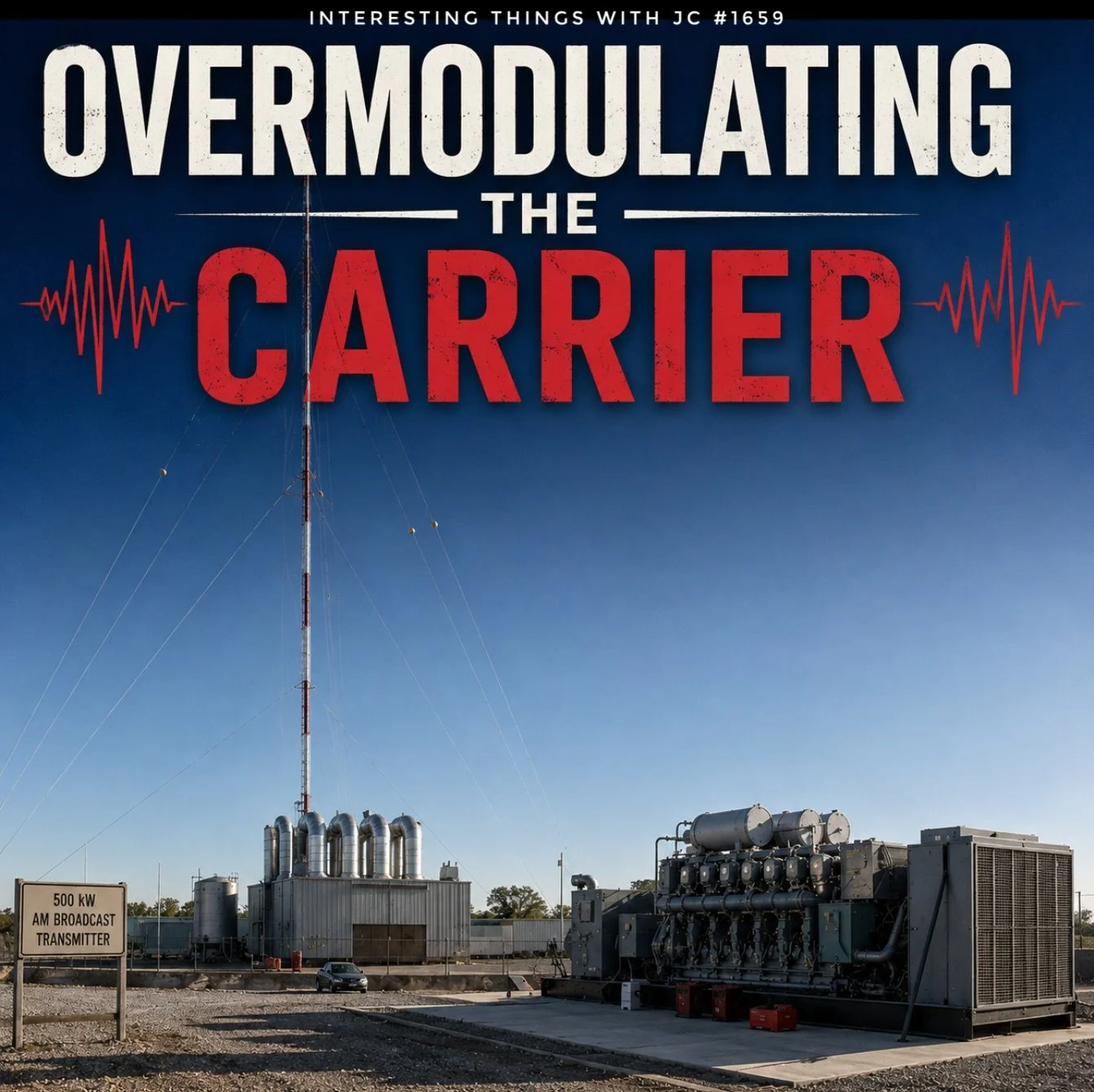
Promotional graphic for Interesting Things with JC episode 1659, titled “Overmodulating the Carrier.” The image shows a large AM broadcast transmitter site under a blue sky, with a tall antenna tower, industrial transmitter equipment, and a small sign reading “500 kW AM Broadcast Transmitter.” Large distressed text across the top reads “Overmodulating the Carrier,” with red audio waveform graphics on both sides.
Transcript
Interesting Things with JC #1659:
“Overmodulating the Carrier”
1972, had a sound that jumped out of the radio.
Whether it was coming through a transistor radio at Revere Beach or a dashboard speaker rolling down the Southeast Expressway, the station sounded loud, dense, and aggressive. It cut through static, engine noise, nighttime fading, and crowded dial conditions in a way listeners recognized instantly.
Part of that was programming.
Part of it was engineering.
AM radio works by varying the amplitude of a carrier wave with audio. At 100 percent modulation, the carrier is being driven to its legal and technical limit. Push beyond that point and distortion begins. The waveform starts flattening, splattering, and spreading into nearby frequencies.
That is overmodulation.
Most stations tried to stay safely below it.
WMEX engineers rode right on the edge.
Using compressors, limiters, clippers, and asymmetrical audio processing, they kept average modulation levels extremely high while controlling distortion just enough to hold the signal together. Positive peaks were pushed especially hard because many AM transmitters could tolerate larger positive modulation peaks more cleanly than negative ones.
The result was a carrier loaded with dense, sustained audio energy that stayed present on weak receivers and inside noisy cars.
That mattered in crowded RF environments because the human ear tends to lock onto the strongest consistent audio envelope. In practical terms, WMEX could often sound louder than nearby stations even when transmitter power was similar. On crowded nighttime dials, where overlapping skywave signals created whistles, fading, and heterodynes, that dense modulation helped the station punch through long enough for listeners to recognize the music, the jocks, and the station identity before fading conditions shifted again.
And after sunset, when AM skywave signals from across the eastern United States started bouncing off the ionosphere and crashing together on the dial, that extra loudness helped WMEX remain intelligible inside the noise.
The processing chain became part of the station’s identity. Listeners may not have understood the engineering behind it, but they knew the sound the second they landed on 1510.
These are interesting things, with JC.
Student Worksheet
Comprehension Questions:
What does AM radio vary in order to carry audio?
What is overmodulation?
What can happen to a waveform when modulation is pushed too far?
Name two audio-processing tools mentioned in the episode.
Why did dense modulation help WMEX inside noisy cars or weak receivers?
Analysis Questions:Explain why WMEX could sound louder than another station even if transmitter power was similar.
How did compression, limiting, clipping, and asymmetrical processing help shape the station’s identity?
Why does pushing a signal close to the limit require careful engineering judgment?
Reflection Prompt: Describe a modern example where audio is processed to stand out, such as podcasts, music streaming, online video, sports broadcasts, or public address systems. What is gained, and what might be lost?
Difficulty Scaling:
Support level: Answer using one complete sentence and one vocabulary term.
Standard level: Answer using evidence from the transcript and explain cause and effect.
Advanced level: Connect overmodulation to broadcast rules, interference risk, or modern loudness processing.
Student Output: Students complete written responses, then write a 5–7 sentence explanation of how engineering helped WMEX sound distinctive.
Academic Integrity Guidance: Use your own words. Evidence may come from the episode, class notes, or approved reference material, but copied wording should not be submitted as original work.
Teacher Guide
Quick Start: Begin with the podcast audio. Ask students to listen for the difference between programming choices and engineering choices.
Pacing Guide Audio-First:
Bell ringer: 5 minutes
First audio listen: 4 minutes
Vocabulary check: 6 minutes
Second focused listen or transcript read: 6 minutes
Worksheet: 15 minutes
Discussion: 10 minutes
Quiz or exit ticket: 8 minutes
Bell Ringer: “Why might two radio stations with similar power sound different inside a moving car?”
Audio Guidance: During the first listen, students write three words or phrases that describe WMEX’s sound. During the second listen, they identify the engineering tools that helped create that sound.
Audio Fallback: If audio is unavailable, read the transcript aloud and pause after the sections on AM modulation, overmodulation, and nighttime skywave interference.
Time on Task: 45–55 minutes for a full lesson; 25–30 minutes for a shortened version.
Materials: Episode audio or transcript, worksheet, pencil or digital document, projector or board, optional diagram of an AM carrier wave.
Vocabulary Strategy: Preview carrier wave, modulation, overmodulation, limiter, clipper, and skywave before listening.
Misconceptions:
Louder audio does not always mean higher transmitter power.
Overmodulation is not the same as turning up a radio receiver.
Distortion can come from signal processing, not only from a bad speaker.
Nighttime AM interference often comes from long-distance skywave signals, not from local station failure.
Discussion Prompts:
Why would a station want to sound louder than nearby competitors?
What is the risk of pushing audio processing too far?
How can technical choices become part of a media brand?
What responsibilities do engineers have when many users share the same spectrum?
Formative Checkpoints:
Students correctly define overmodulation.
Students identify at least two audio-processing tools.
Students explain one cause-and-effect link between processing and perceived loudness.
Students distinguish transmitter power from perceived audio loudness.
Differentiation: Provide sentence frames for emerging writers; allow visual learners to sketch a carrier wave; allow advanced students to compare positive and negative modulation peaks.
Assessment Differentiation: Students may respond through a paragraph, labeled diagram, or short oral explanation.
Time Flexibility: Use only comprehension questions and exit ticket for a short lesson; add analysis questions and open-ended assessment for a full class period.
Substitute Readiness: Play or read the episode first, assign worksheet questions, then use the quiz as a quiet individual task.
Engagement Strategy: Ask students to imagine they are broadcast engineers trying to make a station audible in a noisy car without causing interference.
Extensions: Students can compare waveform images of quiet, compressed, limited, and clipped audio, or research how loudness normalization works in modern media.
Cross-Curricular: Physics connects to waves; media studies connects to station identity; history connects to 1970s AM radio competition; career education connects to broadcasting and audio production.
SEL: Emphasize responsible decision-making, patience, careful listening, and respect for shared technical systems.
Skill Emphasis: Cause-and-effect reasoning, technical vocabulary, evidence-based explanation, signal analysis, and responsible engineering judgment.
Answer Key:
AM radio varies the amplitude of a carrier wave.
Overmodulation is driving modulation beyond safe or legal limits.
The waveform can flatten, distort, splatter, and spread into nearby frequencies.
Accept compressors, limiters, clippers, or asymmetrical processing.
Dense modulation kept audio energy present on weak receivers and inside noisy cars.
Strong analysis answers should explain that high average modulation can increase perceived loudness without necessarily increasing transmitter power.
Strong reflection answers should identify both a benefit, such as clarity, and a risk, such as distortion or listener fatigue.
Quiz
What does AM radio change to carry audio information?
A. The color of light
B. The amplitude of a carrier wave
C. The temperature of the antenna
D. The shape of the receiver cabinetWhat is overmodulation?
A. Turning a radio receiver too loud
B. Broadcasting only at night
C. Driving modulation beyond safe or legal limits
D. Changing a station’s music formatWhich tool helps reduce the difference between loud and soft audio?
A. Compressor
B. Ground wire
C. Tuning dial
D. Battery terminalWhy did WMEX’s processing help listeners recognize the station?
A. It eliminated all static permanently
B. It made the antenna physically taller
C. It changed AM into FM
D. It kept audio energy dense and present in noisy conditionsWhat can happen when AM signals overlap at night?
A. All stations become silent
B. Fading, whistles, and heterodynes can occur
C. Receivers stop needing antennas
D. Frequencies disappear from the dial
Assessment
Open-Ended Questions:
Explain how AM modulation, overmodulation, and audio processing worked together to shape WMEX’s sound. Use at least three vocabulary terms.
A station wants to sound louder in cars but must avoid interference. What engineering choices should it make, and what should it monitor?
Rubric:
3: Clear explanation, accurate vocabulary, strong evidence, and logical cause-and-effect reasoning.
2: Mostly accurate explanation with some evidence, but reasoning needs more detail.
1: Limited or unclear response with little evidence or inaccurate vocabulary.
Exit Ticket: In one sentence, explain why “louder” is not always the same as “more transmitter power.”
Standards Alignment
NGSS HS-PS4-2: Students explain how wave properties and signal transmission apply to AM radio, carrier waves, and modulation.
NGSS HS-ETS1-3: Students evaluate tradeoffs in engineered systems by comparing loudness, intelligibility, distortion, and interference risk.
NGSS Science and Engineering Practice — Analyzing and Interpreting Data: Students interpret signal behavior and audio-processing effects as evidence of engineering decisions.
NGSS Crosscutting Concept — Cause and Effect: Students explain how changes in modulation and processing affect perceived loudness and signal quality.
CCSS RST.9-10.4: Students determine the meaning of technical vocabulary such as carrier wave, modulation, overmodulation, limiter, and skywave.
CCSS RST.11-12.2: Students determine the central idea of the episode and explain how engineering details support it.
CCSS WHST.9-10.2: Students write clear explanatory responses using accurate technical vocabulary and evidence.
C3 D2.Geo.12.9-12: Students explain how physical systems such as the ionosphere affect human communication systems after sunset.
ISTE 1.3 Knowledge Constructor: Students gather and apply technical information to explain how audio processing shapes communication.
CTE Arts, A/V Technology, and Communications: Students connect classroom learning to broadcast engineering, audio production, monitoring, and responsible signal management.
Career Readiness: Students practice precision, technical communication, evidence-based reasoning, and responsible decision-making used in communications careers.
Homeschool/Lifelong Learning: Learners connect everyday listening experiences to physics, media history, and practical engineering.
Show Notes
WMEX’s loud, dense AM sound was not just a matter of music or personality; it was also the result of engineering choices made at the edge of modulation limits. This episode helps students understand how carrier waves, overmodulation, audio processing, and nighttime skywave conditions shaped what listeners heard in cars, on beaches, and across crowded radio dials. It matters because the same basic challenge still exists in modern media: making audio clear and recognizable without sacrificing quality or responsibility.
References
Federal Communications Commission. (2026). 47 CFR § 73.1570 — Modulation levels: AM and FM. https://www.ecfr.gov/current/title-47/chapter-I/subchapter-C/part-73/subpart-H/section-73.1570
Federal Communications Commission. (2015). Why AM stations must reduce power, change operations, or cease broadcasting at night. https://www.fcc.gov/media/radio/am-stations-at-night
National Oceanic and Atmospheric Administration. (2023). Learning lesson: AM in the PM. https://www.noaa.gov/jetstream/learning-lesson-am-in-pm
Orban, R. (2003). Broadcast transmission audio processing. https://www.orban.com/s/Broadcast-Transmission-Audio-Processing.pdf