1658: "HAVOC: The Airship of Venus"
Interesting Things with JC #1658: "HAVOC: The Airship of Venus" – NASA engineers studied a crewed airship that would float above Venus instead of landing on its deadly surface, because the planet’s upper atmosphere becomes far less extreme while the ground remains hot enough to destroy normal exploration hardware.
Curriculum - Episode Anchor
Episode Title: HAVOC: The Airship of Venus
Episode Number: 1658
Host: JC
Audience: Grades 9–12, introductory college, homeschool, lifelong learners
Subject Area: Space science, planetary science, aerospace engineering
Lesson Overview
Learning Objectives:
Explain why Venus’s surface is hostile while parts of its upper atmosphere are comparatively Earth-like.
Describe the HAVOC concept and how a buoyant airship could operate in Venus’s dense carbon dioxide atmosphere.
Analyze how engineers use environmental constraints to design mission concepts.
Evaluate the scientific value and practical limits of human exploration concepts for Venus.
Essential Question: How can an environment that is deadly at the surface become a possible target for exploration higher in the atmosphere?
Success Criteria: Students can accurately compare Venus surface conditions with conditions near 50 kilometers altitude, explain buoyancy in a dense atmosphere, and identify at least two scientific investigations a Venus airship could support.
Student Relevance Statement: This lesson shows how engineering often begins with a problem that seems impossible, then uses physics, chemistry, and disciplined design thinking to find workable options.
Real-World Connection: NASA’s HAVOC work examined a 30-day crewed mission concept at about 50 kilometers in Venus’s atmosphere, using an airship rather than a lander.
Workforce Reality: Aerospace careers require careful modeling, testing, risk analysis, teamwork, and responsibility; unusual concepts still need evidence, calculations, materials testing, and mission discipline.
Key Vocabulary
Venus (VEE-nuhs): The second planet from the Sun, similar in size to Earth but with extreme heat, pressure, and a carbon dioxide atmosphere.
Atmospheric Pressure (at-muhs-FAIR-ik PRESH-er): The force exerted by the weight of gases in an atmosphere; Venus’s surface pressure is about 93 times Earth sea-level pressure.
Carbon Dioxide (KAR-bun dye-OK-side): A gas made of carbon and oxygen; it dominates Venus’s atmosphere and contributes to the planet’s greenhouse effect.
Sulfuric Acid Clouds (sul-FYUR-ik AS-id klowdz): Corrosive cloud layers in Venus’s atmosphere that create major material challenges for spacecraft.
Buoyancy (BOY-un-see): The upward force that lets objects float in a fluid, including gases in an atmosphere.
Dirigible (DIR-uh-juh-bul): A steerable airship that gains lift from a gas or from a gas mixture lighter than the surrounding atmosphere.
HAVOC (HAV-uk): High Altitude Venus Operational Concept, a NASA-studied mission architecture involving airships in Venus’s atmosphere.
Extremophile (ek-STREE-muh-file): An organism that can survive in extreme conditions; scientists have considered whether Venus’s cloud layers could host microbial life, though no evidence confirms life there.
Mission Architecture (MISH-un AR-kuh-tek-cher): The overall design plan for how a space mission travels, operates, gathers data, and returns or communicates results.
Narrative Core
Open: Venus is often called Earth’s twin because it is close in size and structure, but its surface conditions are far more extreme than Earth’s.
Info: NASA describes Venus as the hottest planet in the solar system, with surface temperatures around 872 degrees Fahrenheit, or 467 degrees Celsius, and pressure about 93 times Earth’s sea-level pressure.
Details: About 30 miles, or 50 kilometers, above Venus’s surface, NASA reports temperatures of roughly 86 to 158 degrees Fahrenheit, or 30 to 70 degrees Celsius, with pressure similar to Earth’s surface.
Reflection: HAVOC turns the usual idea of planetary exploration upside down. Instead of landing on a deadly surface, the concept explores how astronauts might float in a safer atmospheric layer while studying weather, chemistry, clouds, and geology from above.
Closing: These are interesting things, with JC.
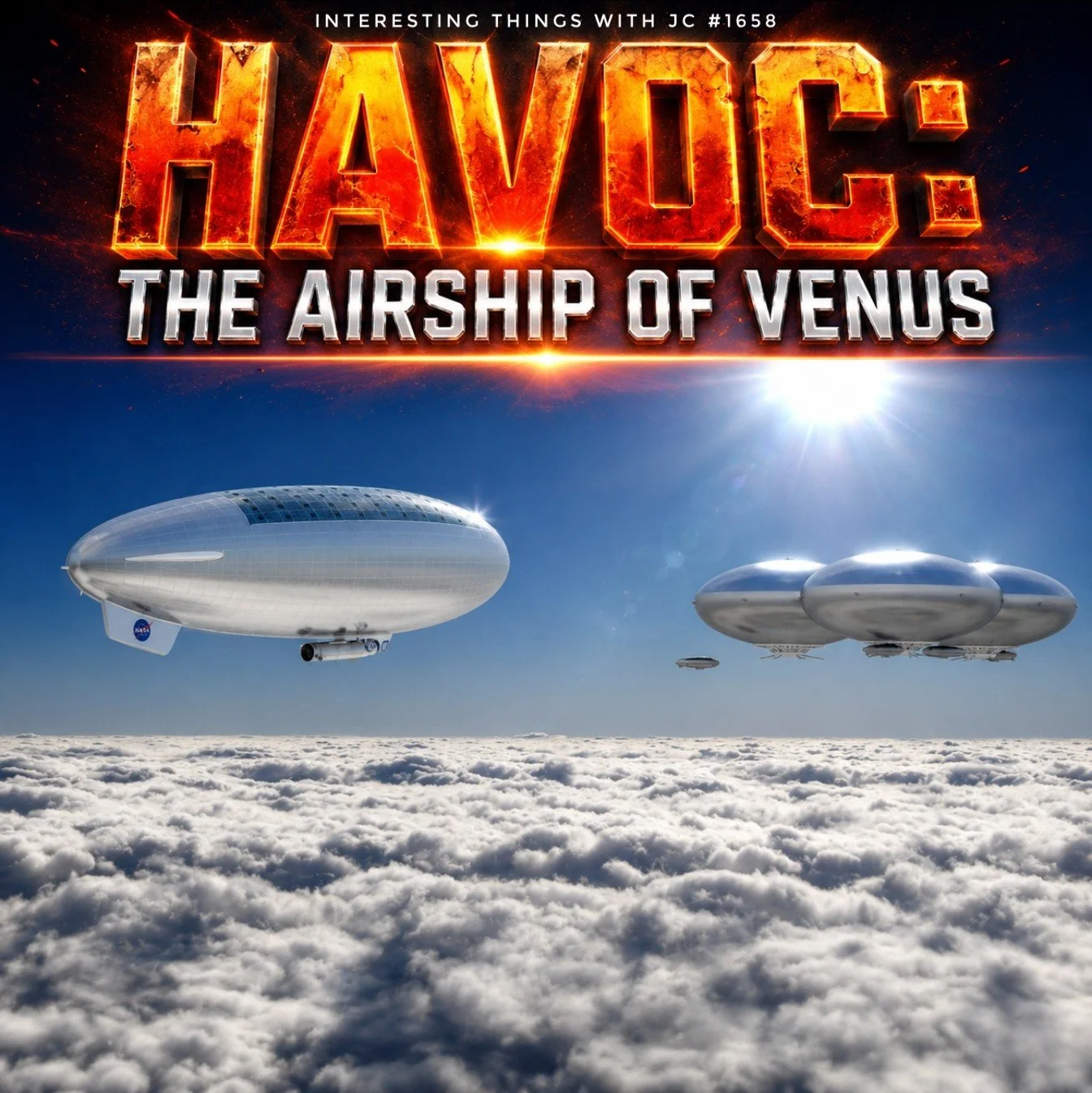
Episode artwork for “HAVOC: The Airship of Venus.” Large fiery orange text reading “HAVOC:” appears above metallic text reading “THE AIRSHIP OF VENUS.” A small header at the top says “INTERESTING THINGS WITH JC #1658.” Below the title, futuristic airships float above a thick cloud layer under a bright sun, suggesting a high-altitude Venus exploration concept.
Transcript
Interesting Things with JC #1658:
“HAVOC: The Airship of Venus”
Venus is often called Earth’s twin.
But at the surface, it is closer to hell.
Temperatures reach about 900 degrees Fahrenheit, roughly 475 degrees Celsius. Atmospheric pressure is more than 90 times greater than Earth’s, strong enough to crush many submarines. The sky is filled with carbon dioxide and sulfuric acid clouds.
Yet about 30 miles, nearly 50 kilometers, above the surface, conditions change dramatically.
At that altitude, pressure and temperature become surprisingly Earth-like.
And that led NASA engineers to study something unusual.
Not a Mars rover…Not a lunar base.
An airship floating through the atmosphere of Venus.
The concept was called HAVOC, short for High Altitude Venus Operational Concept. Researchers at NASA explored the idea during the early 2010s as a possible crewed exploration mission.
The idea sounds backward at first. Venus is deadly, so instead of landing, astronauts would live inside a massive helium-filled dirigible floating high above the planet.
And strangely enough, the physics work.
Venus’s atmosphere is so dense that breathable air itself acts as a lifting gas there. A habitat filled with oxygen and nitrogen could naturally float in the carbon dioxide atmosphere much like helium floats in Earth’s air.
At roughly 50 kilometers altitude, temperatures range around 75 degrees Celsius down to more manageable levels depending on altitude and time of day, far cooler than the inferno below.
The airship would drift through thick golden clouds while studying weather, atmospheric chemistry, lightning, volcanism, and the possibility that microbial life could exist in the temperate cloud layers.
No mission has been approved. HAVOC remains a concept study.
But among all the ideas for human exploration of other worlds, floating cities above Venus may be one of the strangest concepts NASA has ever seriously examined.
These are interesting things, with JC.
Student Worksheet
Comprehension Questions:
Why is Venus sometimes called Earth’s twin?
What makes Venus’s surface dangerous for spacecraft or humans?
What changes about Venus’s atmosphere around 50 kilometers above the surface?
What does HAVOC stand for?
Why could breathable air provide lift in Venus’s atmosphere?
Analysis Questions:
Explain why an airship might be more practical than a lander for exploring Venus.
Compare the engineering challenges of a Venus airship with those of a Mars rover.
Identify one scientific question a Venus airship could investigate and explain why that question matters.
Reflection Prompt: In 5–7 sentences, explain how HAVOC shows the relationship between imagination and disciplined engineering. Include one benefit and one limitation of the concept.
Difficulty Scaling:
Support: Use a T-chart comparing Venus surface conditions and upper-atmosphere conditions.
Standard: Write a paragraph explaining how buoyancy makes the HAVOC idea possible.
Challenge: Create a short mission briefing that identifies risks, scientific goals, and required technologies.
Student Output: Students should submit answered questions, one labeled comparison chart, and a completed reflection paragraph.
Academic Integrity Guidance: Use the episode and provided references for evidence. Do not invent mission details, claim HAVOC was approved, or present speculation about life as confirmed fact.
Teacher Guide
Quick Start: Begin with the podcast audio before any lecture. Ask students to listen for one “impossible-sounding” idea that becomes more reasonable after explanation.
Pacing Guide:
0–3 minutes: Bell ringer prediction.
3–7 minutes: Play episode audio.
7–12 minutes: Students annotate transcript for surface conditions, atmospheric conditions, and engineering solution.
12–25 minutes: Mini-lesson on Venus atmosphere and buoyancy.
25–38 minutes: Worksheet comprehension and analysis.
38–45 minutes: Discussion, formative check, and exit ticket.
Bell Ringer: Ask: “Would Venus be easier to explore by landing on it or floating above it? Defend your first guess in two sentences.”
Audio Guidance: Play the full podcast first without pausing. On a second pass, pause after the 50-kilometer altitude explanation and after the breathable-air buoyancy explanation.
Audio Fallback: If audio is unavailable, read the transcript aloud with students following silently, then have pairs underline the problem, solution, and limitation.
Time-on-Task: Most students should spend 5 minutes listening, 8 minutes annotating, 15 minutes answering, 7 minutes discussing, and 5 minutes completing the exit ticket.
Materials:
Episode transcript
Student worksheet
Projector or board
Venus comparison chart
Optional: balloon or simple buoyancy diagram
Vocabulary Prep: Pre-teach buoyancy, atmospheric pressure, carbon dioxide, sulfuric acid clouds, and dirigible. Emphasize that “lighter than the surrounding gas” is the key idea.
Misconceptions:
Students may think Venus is safer than Mars because it is closer to Earth; clarify that surface conditions are far harsher.
Students may think HAVOC is an approved mission; clarify that it remains a concept study.
Students may think possible microbial life means confirmed life; clarify that it is only a scientific question.
Discussion Prompts:
Why does altitude matter so much on Venus?
What makes HAVOC scientifically interesting even if it has not been approved?
What risks would engineers need to solve before sending humans into Venus’s atmosphere?
Formative Checkpoints:
Students can define HAVOC.
Students can explain why 50 kilometers is important.
Students can connect buoyancy to atmospheric density.
Students can distinguish concept study from approved mission.
Differentiation:
Provide sentence starters for emerging readers.
Allow oral responses before writing.
Give advanced students a design constraint: protect solar cells from sulfuric acid droplets.
Assessment Differentiation: Students may complete the assessment as a written response, labeled diagram, or short recorded explanation, as long as they address evidence, engineering reasoning, and limitations.
Time Flexibility: For a 30-minute lesson, skip the extension and complete only comprehension questions 1–5 plus the exit ticket. For a 60-minute lesson, add a design challenge for an airship habitat.
Substitute Readiness: The lesson can run from the transcript alone. The substitute should read the audio fallback directions, assign the worksheet, and collect the exit ticket.
Engagement Strategy: Present the central puzzle: “Why might astronauts avoid landing on a planet and still explore it from inside the atmosphere?”
Extensions:
Design a labeled concept sketch of a Venus airship.
Compare HAVOC with a Mars habitat or lunar base.
Research sulfuric-acid-resistant materials used in aerospace testing.
Cross-Curricular: Physics connects through buoyancy and pressure; chemistry connects through carbon dioxide and sulfuric acid; engineering connects through design constraints; English connects through concise science communication.
SEL: Emphasize intellectual humility: strong ideas still need testing, revision, and evidence before they become missions.
Skill Emphasis: Evidence-based reasoning, systems thinking, scientific caution, and technical communication.
Answer Key:
Venus is called Earth’s twin because it is similar in size and structure.
Its surface has extreme heat, crushing pressure, carbon dioxide, and sulfuric acid clouds.
At about 50 kilometers, temperature and pressure become closer to Earth-like conditions.
HAVOC means High Altitude Venus Operational Concept.
Breathable air can lift because oxygen-nitrogen air is lighter than Venus’s surrounding carbon dioxide atmosphere.
An airship avoids the most dangerous surface conditions while still allowing atmospheric science.
A Mars rover must survive cold, dust, and terrain; a Venus airship must survive acid clouds, entry, buoyancy control, and atmospheric operations.
Valid answers include weather, atmospheric chemistry, lightning, volcanism, cloud chemistry, or possible microbial life, as long as students explain the scientific value.
Quiz
What does HAVOC stand for?
A. High Atmosphere Vehicle Orbital Colony
B. High Altitude Venus Operational Concept
C. Human Airborne Venus Observation Craft
D. Helium Atmospheric Vehicle Over CloudsWhy is Venus’s surface difficult to explore?
A. It has almost no gravity.
B. It is extremely cold and airless.
C. It has intense heat and crushing pressure.
D. It is covered by liquid water oceans.Around what altitude do Venus’s temperature and pressure become more Earth-like?
A. 5 kilometers
B. 15 kilometers
C. 50 kilometers
D. 500 kilometersWhy could breathable air act as a lifting gas on Venus?
A. It is hotter than helium.
B. It is lighter than the surrounding carbon dioxide atmosphere.
C. It reacts with sulfuric acid to make thrust.
D. It blocks ultraviolet radiation.Which statement best describes HAVOC today?
A. It is an approved NASA crewed mission.
B. It is a completed Venus landing mission.
C. It is a concept study for high-altitude Venus exploration.
D. It is a telescope orbiting Earth.
Assessment
Open-Ended Questions:
Explain how Venus can be both extremely hostile and scientifically attractive for exploration. Use at least three details from the episode.
Evaluate the HAVOC concept as an engineering response to environmental constraints. What problem does it solve, and what major challenges remain?
3–2–1 Rubric:
3: Response uses accurate science, explains buoyancy or altitude clearly, and includes a realistic limitation.
2: Response is mostly accurate but lacks detail, evidence, or a clear explanation of the engineering tradeoff.
1: Response gives minimal facts, confuses surface and atmospheric conditions, or treats speculation as confirmed.
Exit Ticket: In one sentence, explain why a Venus airship might make more sense than a Venus lander.
Standards Alignment
NGSS HS-ESS1-3: Students evaluate how technology enables investigation of solar system environments by connecting HAVOC to Venus atmospheric exploration.
NGSS HS-ETS1-2: Students design or evaluate a solution to a complex problem by identifying Venus mission constraints and possible airship advantages.
CCSS RST.11-12.2: Students determine central ideas from a science text by summarizing why altitude changes the exploration problem.
CCSS WHST.9-12.9: Students draw evidence from informational sources to support analysis of a space mission concept.
ISTE 1.3 Knowledge Constructor: Students gather and organize evidence from credible scientific information to explain a planetary engineering idea.
C3 D2.Geo.3.9-12: Students analyze spatial patterns by explaining how conditions change with altitude in Venus’s atmosphere.
Career Readiness: Students practice technical reasoning by weighing safety, materials, mission goals, and uncertainty in a realistic aerospace concept.
Homeschool/Lifelong Learning: Learners build science literacy by connecting planetary facts, engineering design, and responsible interpretation of speculative concepts.
Show Notes
This classroom lesson explores NASA’s HAVOC concept, an unusual idea for studying Venus with an airship floating high in the planet’s atmosphere instead of landing on its deadly surface. Students examine why Venus is so extreme, why conditions improve around 50 kilometers altitude, and how buoyancy could make an airship habitat possible. The lesson matters because it shows how science and engineering work together: bold ideas become serious only when they are tested against physics, chemistry, risk, and evidence.
References
National Aeronautics and Space Administration. (n.d.). Venus facts. https://science.nasa.gov/venus/venus-facts/
Jones, C. A., & Arney, D. C. (2015). High Altitude Venus Operational Concept (HAVOC). NASA Technical Reports Server. https://ntrs.nasa.gov/api/citations/20160006580/downloads/20160006580.pdf
National Aeronautics and Space Administration. (n.d.). Venus. NASA Science. https://science.nasa.gov/venus/
National Aeronautics and Space Administration. (n.d.). Venus overview. NASA Solar System Exploration. https://science.nasa.gov/solar-system/planets/venus/