1662: "Ames Laboratory"
Interesting Things with JC #1662: "Ames Laboratory" – Frank Spedding’s team in Ames, Iowa turned rare uranium metal into wartime production material, using the Ames Process to supply purified uranium for the Manhattan Project while the better-known atomic sites depended on that chemistry.
Curriculum - Episode Anchor
Episode Title: Ames Laboratory
Episode Number: 1662
Host: JC
Audience: Grades 9–12, introductory college, homeschool, lifelong learners
Subject Area: Chemistry, materials science, engineering design, World War II history, scientific responsibility
Lesson Overview
Lesson Purpose: Students analyze how a university chemistry team in Ames, Iowa solved a major materials-production problem during World War II by developing the Ames Process for producing purified uranium metal. The lesson connects chemistry, engineering scale-up, historical context, and responsible scientific work.
Learning Objectives:
Explain why purified uranium metal was difficult to produce and why it mattered to the Manhattan Project.
Describe the basic purpose of the Ames Process using accurate chemistry and materials-science vocabulary.
Analyze how a laboratory breakthrough became useful only after it was scaled into reliable production.
Evaluate why Ames Laboratory deserves attention within the broader history of scientific problem-solving.
Essential Question: How can a focused chemistry breakthrough in a quiet laboratory become essential to a major historical event?
Success Criteria:I can identify the technical problem Frank Spedding and Harley Wilhelm worked to solve.
I can explain how uranium tetrafluoride and magnesium were used in the Ames Process.
I can distinguish between a laboratory experiment and industrial-scale production.
I can support a claim about Ames Laboratory’s importance using evidence from the episode.
Student Relevance Statement: Students encounter materials every day in phones, batteries, buildings, vehicles, medical devices, and energy systems. This lesson shows that modern technology depends on people who can purify, test, scale, and safely produce materials under real constraints.
Real-World Connection: Materials scientists, chemists, engineers, technicians, safety specialists, and quality-control workers still solve problems where purity, repeatability, cost, and production scale matter. The same mindset applies to semiconductors, batteries, aerospace metals, medical implants, and energy technologies.
Workforce Reality: Scientific work requires discipline, documentation, safety procedures, teamwork, and ethical awareness. The Ames story should not be treated as glamor or spectacle; it is a case study in technical responsibility, wartime pressure, and the consequences of applied science.
Key Vocabulary
Uranium Metal(yoo-RAY-nee-um MET-ul): A metallic form of uranium needed in purified form for early atomic research and reactor development.
Uranium Tetrafluoride(yoo-RAY-nee-um tet-ruh-FLOOR-ide): A uranium compound used as a starting material in the Ames Process.
Greensalt(GREEN-salt): A common name for uranium tetrafluoride, referenced in the episode as the material mixed with magnesium.
Magnesium(mag-NEE-zee-um): A reactive metal used in the Ames Process to help strip fluorine from uranium tetrafluoride.
Chemical Reduction(KEM-ih-kul ree-DUK-shun): A reaction process in which a substance gains electrons or loses a bonded component such as oxygen or a halogen.
Purity(PYOOR-ih-tee): The degree to which a material is free from unwanted substances or impurities.
Industrial Scale(in-DUS-tree-ul skayl): Production large enough to meet practical operational needs rather than small laboratory demonstrations.
Metallurgy(MET-uhl-ur-jee): The science and engineering of metals, including extraction, purification, casting, and performance.
Manhattan Project(man-HAT-un PRAH-jekt): The secret World War II research and production program that developed atomic weapons and required specialized materials.
Materials Science(muh-TEER-ee-uhlz SY-ens): The study of how materials are made, structured, tested, and used.
Narrative Core
Open: A major scientific problem does not always begin in a famous desert laboratory or a guarded mountain site. Sometimes it begins with a professor, a small team, and a question that sounds impossible: can a rare, expensive, difficult material be made pure enough and fast enough to change history?
Info: In 1942, Frank Spedding and Harley Wilhelm worked at Iowa State in Ames, Iowa. Their team was asked to help produce uranium metal for a secret wartime program. At the time, uranium metal was scarce, costly, and difficult to make in usable quantities.
Details: The Ames Process used uranium tetrafluoride, known as greensalt, and powdered magnesium inside sealed steel containers. Heat triggered a strong chemical reaction that removed fluorine and left behind uranium metal. The breakthrough mattered because the team moved beyond a small experiment and made production practical.
Reflection: The Ames story shows that major historical events often depend on technical bottlenecks. Before reactors, weapons designs, and chain reactions could move forward, someone had to solve the materials problem. That work required chemistry, safety, teamwork, judgment, and responsibility.
Closing: These are interesting things, with JC.
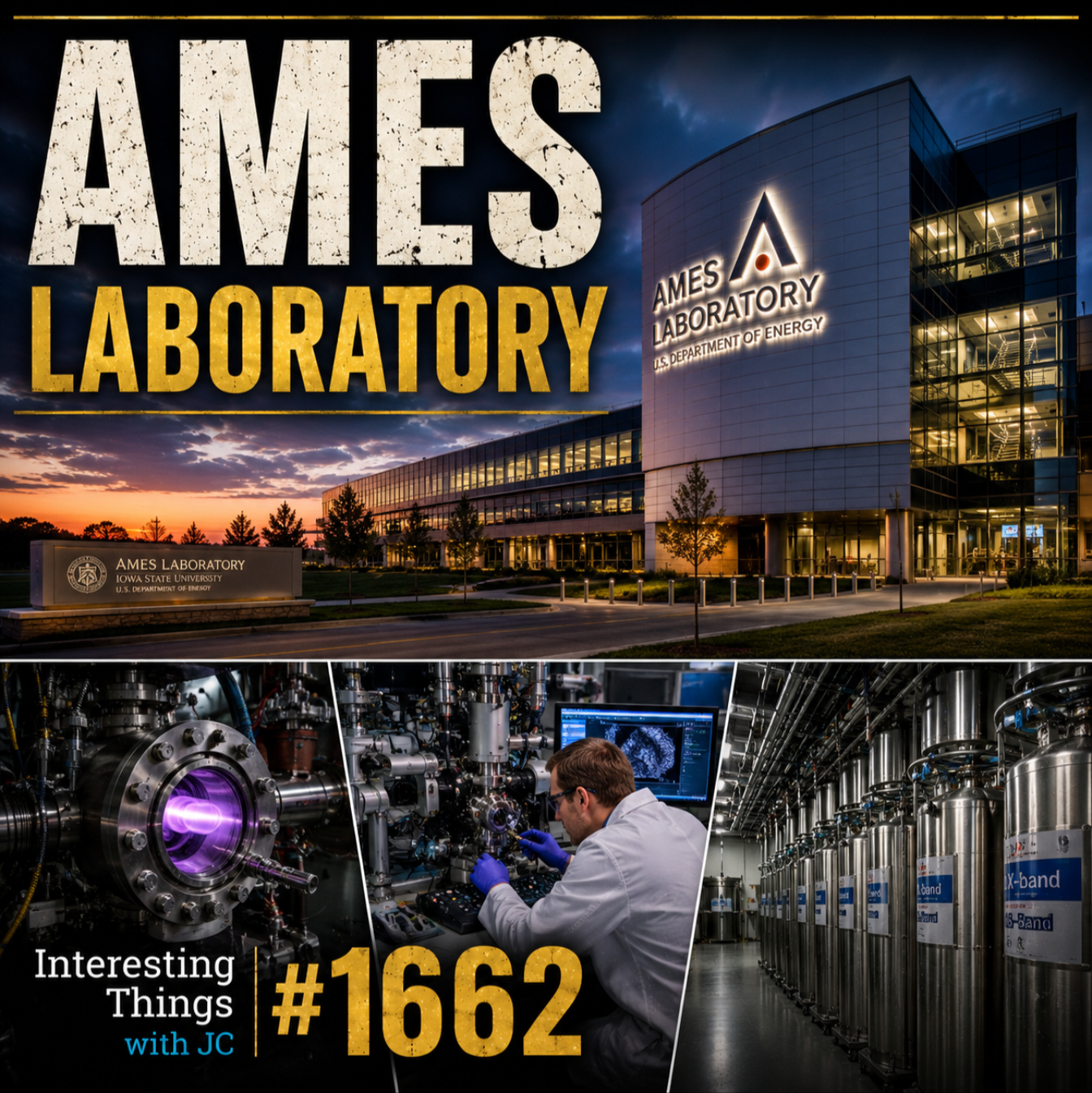
Promotional graphic for “Ames Laboratory.” Large distressed text on the left reads “AMES LABORATORY,” with “AMES” in white and “LABORATORY” in yellow. The background shows the Ames Laboratory building at dusk with illuminated signage reading “Ames Laboratory, U.S. Department of Energy.” Along the bottom are three images: a purple-lit laboratory device, a scientist working at equipment, and a row of large industrial tanks. Lower-left text reads “Interesting Things with JC,” and large yellow text reads “#1662.”
Transcript
Interesting Things with JC #1662:
"Ames Laboratory"
In the summer of 1942, a chemistry professor in Iowa was handed a problem that sounded almost impossible. The United States needed uranium metal for a secret wartime project, but nobody knew how to make enough of it, cheaply enough, or pure enough.
The professor's name was Frank Spedding. His laboratory sat in Ames, Iowa, far from the places most people associate with the Manhattan Project. There were no desert test sites here. No dramatic mountain compounds. Just scientists, furnaces, and a race against time.
At the start of World War II, uranium metal was rare. Researchers could make tiny amounts, but the process was slow and expensive. The emerging atomic program needed something completely different. It needed production on an industrial scale. Spedding and chemist Harley Wilhelm set out to solve that problem.
Their breakthrough became known as the Ames Process. They mixed uranium tetrafluoride, sometimes called "greensalt," with powdered magnesium inside sealed steel containers. When heated, a violent chemical reaction stripped away the fluorine and left behind a solid mass of remarkably pure uranium metal. What had once been difficult suddenly became practical.
Then came the real challenge: scaling it up.
Within months, the team moved from laboratory experiments to production. By the end of the war, the Ames Project had produced more than two million pounds of purified uranium metal, more than one thousand tons. About a third of the uranium used in the world's first controlled nuclear chain reaction beneath the stands of the University of Chicago came from Ames.
What's remarkable is that most Americans have never heard of it.
When people tell the story of the Manhattan Project, they usually mention Los Alamos, Oak Ridge, or Hanford. Those places earned their place in history. But none of them could move forward without materials. Before there could be reactors, bomb designs, or chain reactions, somebody had to solve the basic chemistry. Somebody had to turn a scarce laboratory curiosity into a usable metal.
That happened in Iowa.
The work was so important that Iowa State received the Army-Navy "E" Award for Excellence in Production in 1945, an honor usually reserved for industrial manufacturers, not universities.
After the war, the success of the Ames Project led directly to the creation of Ames Laboratory in 1947. The laboratory would go on to become a national center for materials science and rare-earth research, but its origin story remains tied to a moment when a small group of scientists solved one of the biggest technical bottlenecks of the atomic age.
The atomic era is often remembered through explosions, treaties, and geopolitics. Yet one of its most important chapters began with chemists standing around hot steel containers in the middle of Iowa, figuring out how to make a metal that the world suddenly needed.
These are interesting things, with JC.
Student Worksheet
Student Name: ______________________________
Date: ______________________________
Class/Group: ______________________________
Listening Focus: Track the problem, people, process, scale-up challenge, result, and historical significance.
Academic Integrity Guidance: Use your own words unless directly quoting the transcript. When using evidence, identify the part of the episode that supports your answer.
Student Output Expectations: Complete all required questions in full sentences. Analysis answers must use evidence from the episode. Reflection answers must connect the episode to science, history, or responsibility.
Comprehension Tasks:
What problem was Frank Spedding asked to help solve in the summer of 1942?
Where was Spedding’s laboratory located?
Why was that location surprising compared with the better-known Manhattan Project sites?
What was difficult about producing uranium metal at the start of World War II?
What two materials were mixed in the Ames Process?
What happened when the sealed steel containers were heated?
How much purified uranium metal had the Ames Project produced by the end of the war?
What honor did Iowa State receive in 1945?
Analysis Tasks:Explain why tiny laboratory amounts of uranium metal were not enough for the Manhattan Project.
The episode says, “Then came the real challenge: scaling it up.” What does this mean?
Why can scaling a process be harder than proving that the process works once?
Why does the episode argue that Los Alamos, Oak Ridge, and Hanford could not move forward without materials?
What does this story reveal about the connection between chemistry and history?
Why might Ames Laboratory be less famous even though its contribution was important?
Reflection Task: Write 6–8 sentences explaining why a quiet laboratory in Iowa could be considered one of the most consequential places on Earth for a brief moment. Include one scientific reason and one historical reason.
Difficulty Scaling:
Support Level: Answer comprehension questions 1–6 and write a 4–5 sentence reflection using the terms uranium metal, Ames Process, and industrial scale.
Core Level: Complete all comprehension, analysis, and reflection tasks with evidence from the transcript.
Extension Level: Add a comparison to a modern materials challenge such as batteries, semiconductors, medical implants, rare-earth magnets, or aerospace alloys.
Claim-Writing Task: Write one paragraph answering this question: Was Ames Laboratory’s contribution mainly scientific, industrial, or historical? Choose one as your main claim, but explain how the other two categories still connect.
Evidence Sentence Frames:“The central problem was…”
“The Ames Process mattered because…”
“Scaling up was important because…”
“Ames Laboratory deserves attention because…”
Teacher Guide
Quick Start: Begin with the podcast audio. Do not start with a lecture. Ask students to listen for the central problem: the need to make uranium metal pure enough, affordable enough, and available in large enough quantities to matter.
Pacing Guide, Audio-First:
0–5 minutes: Bell ringer and listening focus.
5–9 minutes: First full audio listen without interruption.
9–14 minutes: Students write the central problem, key people, and key material.
14–22 minutes: Second listen or transcript read-aloud with pauses at “Ames Process,” “scaling it up,” and “That happened in Iowa.”
22–35 minutes: Student Worksheet comprehension and analysis tasks.
35–45 minutes: Small-group discussion and formative check.
45–55 minutes: Quiz or assessment response.
55–60 minutes: Exit ticket.
Bell Ringer: “A scientific idea is not useful unless people can make it work reliably. What is one modern product that depends on producing a material safely and consistently?” Students write 3–4 sentences.
Audio Guidance: During the first listen, students should focus on the storyline, not every detail. During the second listen, students should mark evidence related to the problem, process, scale-up, and significance.
Audio Fallback: If audio is unavailable, read the transcript aloud. Pause after each paragraph and have students label it as problem, people, process, scale-up, recognition, legacy, or reflection.
Time on Task: The full lesson fits 45–60 minutes. A compressed lesson can be completed in 30 minutes using one listen, comprehension questions 1–5, analysis questions 1–2, and the exit ticket.
Materials:
Episode audio or transcript
Student Worksheet
Quiz
Assessment prompt
Board or projector
Optional periodic table
Optional process-diagram template
Vocabulary Preparation: Preview uranium metal, uranium tetrafluoride, greensalt, magnesium, purity, and industrial scale before listening. Introduce chemical reduction, metallurgy, Manhattan Project, and materials science after the first listen.
Common Misconceptions:Students may think the Manhattan Project happened only at Los Alamos.
Students may assume a process is complete once it works once in a laboratory.
Students may confuse uranium ore, uranium compounds, and uranium metal.
Students may treat the story as a celebration of weapons development rather than a study of chemistry, materials production, and responsibility.
Discussion Prompts:
Why do famous historical stories often leave out materials, logistics, and production work?
What makes a technical bottleneck historically important?
Why might a university receive an award usually associated with industrial production?
How should scientists think about responsibility when their work has powerful consequences?
What modern technology might depend on an “Ames-like” materials breakthrough?
Formative Checkpoints:
After first listen: Students write the episode’s central problem in one sentence.
After vocabulary review: Students explain industrial scale to a partner.
During worksheet: Students underline one piece of evidence showing Ames Laboratory’s importance.
Before quiz: Students complete this sentence: “The Ames Process mattered because…”
Differentiation:Emerging Readers: Provide vocabulary before listening and allow transcript tracking during audio.
Advanced Learners: Require a process-flow explanation and a discussion of scale-up challenges.
English Learners: Pre-teach pure, scale, compound, reaction, production, laboratory, and metal.
Students Needing Support: Allow oral rehearsal before written responses and reduce analysis tasks to three required questions.
Assessment Differentiation: Students may respond through a paragraph, concept map, oral explanation, or process diagram if they accurately include the problem, process, scale-up, and significance.
Time Flexibility: For 30 minutes, use the bell ringer, one audio listen, four comprehension questions, one analysis question, and the exit ticket. For 90 minutes, add a modern materials-science comparison activity.
Substitute Readiness: The lesson can run with only the transcript and worksheet. The substitute should read the transcript aloud, assign the worksheet, administer the quiz, and collect the exit ticket.
Engagement Strategy: Use a “hidden contribution” frame. Ask students to name behind-the-scenes roles that make major events possible, then connect their examples to chemists, technicians, metallurgists, machinists, safety staff, and production teams.
Extensions:Create a labeled process diagram of the Ames Process.
Compare Ames Laboratory with Los Alamos, Oak Ridge, or Hanford by role rather than fame.
Research a modern national laboratory and identify one materials problem it studies.
Write a short profile of Frank Spedding or Harley Wilhelm.
Investigate a modern material where purity strongly affects performance.
Cross-Curricular Connections:Chemistry: Reduction reactions, compounds, metals, purity, reaction products.
Engineering: Scale-up, production design, safety constraints, quality control.
History: World War II, Manhattan Project, wartime research networks.
Career Readiness: Documentation, laboratory safety, teamwork, process control.
English Language Arts: Evidence-based explanation, informational listening, claim development.
SEL Connection: Students consider how disciplined work by people outside the spotlight can still matter. The lesson supports humility, responsibility, collaboration, and thoughtful discussion of consequences.
Skill Emphasis: Listening comprehension, technical vocabulary, cause-and-effect reasoning, process explanation, evidence use, systems thinking, and responsible interpretation of high-impact science.
Answer Key, Comprehension Tasks:
He was asked to help solve how to make enough uranium metal cheaply enough and pure enough for a secret wartime project.
His laboratory was in Ames, Iowa.
It is surprising because the Manhattan Project is more often associated with Los Alamos, Oak Ridge, and Hanford.
Uranium metal was rare, slow to produce, expensive, and not available in the quantities needed.
Uranium tetrafluoride, or greensalt, and powdered magnesium.
A violent reaction stripped away fluorine and left behind a solid mass of pure uranium metal.
More than two million pounds, or more than one thousand tons.
Iowa State received the Army-Navy “E” Award for Excellence in Production.
Answer Key, Analysis Tasks:The project needed enough material for major research and production needs, so tiny laboratory samples were not practical.
Scaling up means moving from small experiments to larger, repeatable, reliable production.
Larger production introduces added problems such as heat control, safety, contamination, equipment design, consistency, and quality control.
Those sites needed usable materials before reactors, bomb designs, and chain reactions could move forward.
The story shows that basic chemistry can shape major historical events when it solves a practical bottleneck.
Ames may be less famous because public memory often focuses on dramatic sites, weapons design, and major facilities rather than materials production.
Answer Key, Claim-Writing Task: Strong responses should make one clear claim while recognizing that Ames Laboratory’s contribution was scientific because it solved a chemistry problem, industrial because it scaled production, and historical because it supported the Manhattan Project and led to Ames Laboratory’s creation.
Answer Key, Quiz:B
C
B
A
D
Quiz
Directions: Choose the best answer for each question.
What was the main problem Frank Spedding and Harley Wilhelm worked to solve?
A. How to build a desert test site
B. How to produce pure uranium metal at practical scale
C. How to design aircraft engines
D. How to mine magnesium in IowaWhat was uranium tetrafluoride also called in the episode?
A. Whitesalt
B. Redcake
C. Greensalt
D. BlackmetalWhat role did magnesium play in the Ames Process?
A. It cooled the uranium after casting.
B. It helped remove fluorine from uranium tetrafluoride.
C. It replaced uranium in the reaction.
D. It made the steel containers stronger.Why was scaling up the Ames Process important?
A. The Manhattan Project needed industrial quantities, not tiny laboratory samples.
B. The university wanted to build a larger classroom.
C. The process only worked when performed outdoors.
D. The Army-Navy “E” Award required a larger building.What happened after the success of the Ames Project?
A. Ames stopped all chemistry research permanently.
B. Iowa State became Los Alamos.
C. The Manhattan Project moved entirely to Iowa.
D. Ames Laboratory was created in 1947.
Assessment
Open-Ended Assessment Questions:
Explain how the Ames Process changed uranium metal production from a difficult laboratory problem into a practical production process. Use at least two vocabulary terms from the lesson.
Why might Ames Laboratory be considered historically important even though it is less famous than Los Alamos, Oak Ridge, or Hanford? Support your answer with evidence from the episode.
3–2–1 Rubric:
3 — Proficient: Response accurately explains the scientific problem and historical significance, uses evidence from the episode, includes relevant vocabulary, and connects chemistry to scale-up or production.
2 — Developing: Response shows basic understanding but may be general, missing one important detail, or using limited evidence. Vocabulary may be present but not fully explained.
1 — Beginning: Response is incomplete, inaccurate, or mostly unsupported. It may mention Ames or uranium without explaining the process or significance.
Exit Ticket: In one sentence, explain why materials can be as important as designs or ideas in a major scientific project.
Standards Alignment
NGSS HS-PS1-2: Students explain how a chemical process can transform reactants into a desired material by describing how uranium tetrafluoride and magnesium were used to produce uranium metal.
NGSS HS-ETS1-3: Students analyze an engineering scale-up problem by identifying constraints such as purity, cost, production quantity, safety, and reliability.
CCSS.ELA-LITERACY.RST.11-12.3: Students follow a technical process by explaining the sequence of materials, reaction, product, and production challenge described in the episode.
CCSS.ELA-LITERACY.RI.9-10.2: Students determine and explain the central idea of an informational text by identifying how Ames Laboratory solved a technical bottleneck.
CCSS.ELA-LITERACY.WHST.9-10.2: Students write an evidence-based explanatory paragraph connecting chemistry, production, and historical significance.
C3 Framework D2.His.14.9-12: Students analyze how a specific scientific site contributed to a broader historical development by connecting Ames Laboratory to the Manhattan Project.
C3 Framework D2.His.2.9-12: Students evaluate historical significance by explaining why lesser-known contributors may be essential to major events.
ISTE 1.3 Knowledge Constructor: Students gather evidence from an audio/text source, organize key information, and construct an explanation of a scientific process.
CTE Career Readiness: Students identify workplace skills used in laboratory and production environments, including safety awareness, process control, documentation, collaboration, and technical communication.
Homeschool/Lifelong Learning: Learners practice independent listening, vocabulary development, historical reasoning, and responsible interpretation of scientific work.
Show Notes
This lesson explores how Ames Laboratory grew out of a wartime chemistry challenge: producing purified uranium metal for the Manhattan Project. Students learn how Frank Spedding, Harley Wilhelm, and the Ames Project team helped turn a difficult laboratory process into industrial-scale production through the Ames Process. The episode matters in the classroom because it shows that history is shaped not only by famous sites and dramatic events, but also by disciplined scientific work, materials production, safety, and technical problem-solving carried out by people who are often left out of the larger story.
References
Ames National Laboratory. (n.d.). Manhattan Project roots. https://www.ameslab.gov/about-ames-laboratory/manhattan-project-roots
American Chemical Society. (n.d.). Ames Laboratory and uranium production in World War II. https://www.acs.org/education/whatischemistry/landmarks/ames-uranium-production.html
Atomic Heritage Foundation. (n.d.). Ames, IA. National Museum of Nuclear Science & History. https://ahf.nuclearmuseum.org/ahf/location/ames-ia/
Iowa State University News Service. (2022). Science for a sustainable future. https://www.news.iastate.edu/news/science-sustainable-future
National Park Service. (2023). Ames, IA during the Manhattan Project. https://www.nps.gov/articles/000/ames-ia-during-the-manhattan-project.htm
Office of Scientific and Technical Information. (2012). The Ames Project, 1942–1946. U.S. Department of Energy. https://www.osti.gov/biblio/1082315