1663: "Kyle Busch"
Interesting Things with JC #1663: "Kyle Busch" – Kyle Busch is steering a go-kart while his father works the throttle because his feet cannot reach the pedals, and the Las Vegas kid who built racetracks from crushed soda cans grows into one of the most successful drivers in NASCAR history.
Curriculum - Episode Anchor
Episode Title: Kyle Busch
Episode Number: 1663
Host: JC
Audience: Grades 9–12, introductory college, homeschool, lifelong learners
Subject Area: Sports history, engineering, health literacy, career readiness, ethics, media literacy
Lesson Type: Audio-first biographical analysis with evidence-based writing
Estimated Time: 50 minutes standard; 30-minute abbreviated option; 75-minute extended option
Primary Skills: Listening comprehension, source-based reasoning, legacy analysis, technical-career awareness, balanced evaluation
Lesson Overview
Learning Objectives:
Students will summarize Kyle Busch’s development from childhood racing practice to elite NASCAR competition using accurate evidence from the episode.
Students will explain how technical knowledge, family mentorship, discipline, and repeated practice contributed to Busch’s career.
Students will analyze how injury, controversy, public criticism, philanthropy, and health events shaped a complex public legacy.
Students will connect motorsports to real-world careers in engineering, mechanics, safety, media, health awareness, team operations, and leadership.
Essential Question: How can a public figure’s legacy include achievement, conflict, resilience, responsibility, and service at the same time?
Success Criteria: Students can identify at least five accurate facts from the episode, explain one major turning point, evaluate Busch’s legacy with balanced reasoning, and complete a written response using transcript evidence.
Student Relevance Statement: Students often encounter famous people through highlights, headlines, or social media clips. This lesson helps them examine the fuller story behind public success, including training, setbacks, mistakes, responsibility, and service.
Real-World Connection: NASCAR is not only a driving competition. It involves mechanics, aerodynamics, safety engineering, physical endurance, sponsorship, public communication, data analysis, and team coordination.
Workforce Reality: High-performance careers require discipline, technical skill, emotional control, coachability, preparation, public accountability, and the ability to recover from setbacks without glamorizing risk.
Teacher Note on Accuracy: Current NASCAR and major news sources report Kyle Busch’s death on May 21, 2026, after severe illness, with later reporting stating that severe pneumonia progressed into sepsis. His NASCAR driver profile lists him as a two-time Cup Series champion with 63 Cup wins and a record-setting career across NASCAR’s national series.
Key Vocabulary
Cul-de-sac(KUHL-duh-sak): A short street closed at one end, often used as a neighborhood space.
Go-kart(GOH-kart): A small motorized vehicle often used to teach basic racing skills.
Legends car(LEJ-undz kar): A small race car used in developmental and short-track racing.
NASCAR(NAS-kar): A major American stock car racing organization with national racing series.
Stock car(stok kar): A race car built for competition while resembling a production automobile.
Truck Series(truk SEER-eez): One of NASCAR’s national series, using race trucks rather than Cup-style cars.
Xfinity Series(eks-FIN-ih-tee SEER-eez): A NASCAR national series often connected to driver development and veteran competition.
Superspeedway(SOO-per-SPEED-way): A very large oval racetrack designed for high-speed racing.
Playoffs(PLAY-awfs): A postseason format used to determine a season champion.
Sepsis(SEP-sis): A life-threatening reaction to infection that can damage tissues and organs.
Infertility(in-fer-TIL-uh-tee): Difficulty conceiving a child after a period of trying.
Philanthropy(fuh-LAN-thruh-pee): Organized giving or service intended to help others.
Legacy(LEG-uh-see): The lasting impact a person leaves through actions, choices, achievements, and influence.
Narrative Core
Open: Before Kyle Busch was known as “Rowdy,” he was a child in Las Vegas drawing racetracks in a cul-de-sac and learning how speed, steering, practice, and imagination could become a pathway into competition.
Info: Busch’s career grew from neighborhood layouts and go-karts into Legends cars, NASCAR’s Truck Series, the Xfinity Series, and the Cup Series. His story shows how early exposure to mechanics, family teaching, and repeated practice can develop into elite skill.
Details: Busch became one of NASCAR’s most successful drivers, winning the 2009 Xfinity Series championship and Cup Series championships in 2015 and 2019. His 2015 title followed a major crash at Daytona that caused serious leg and foot injuries and forced him to miss 11 races before returning to win the championship.
Reflection: The episode presents Busch as a complex figure: highly skilled, intensely competitive, sometimes controversial, and also connected to charitable work through infertility support and family-focused giving. Students should evaluate his legacy with evidence rather than simple praise or criticism.
Closing: These are interesting things, with JC.
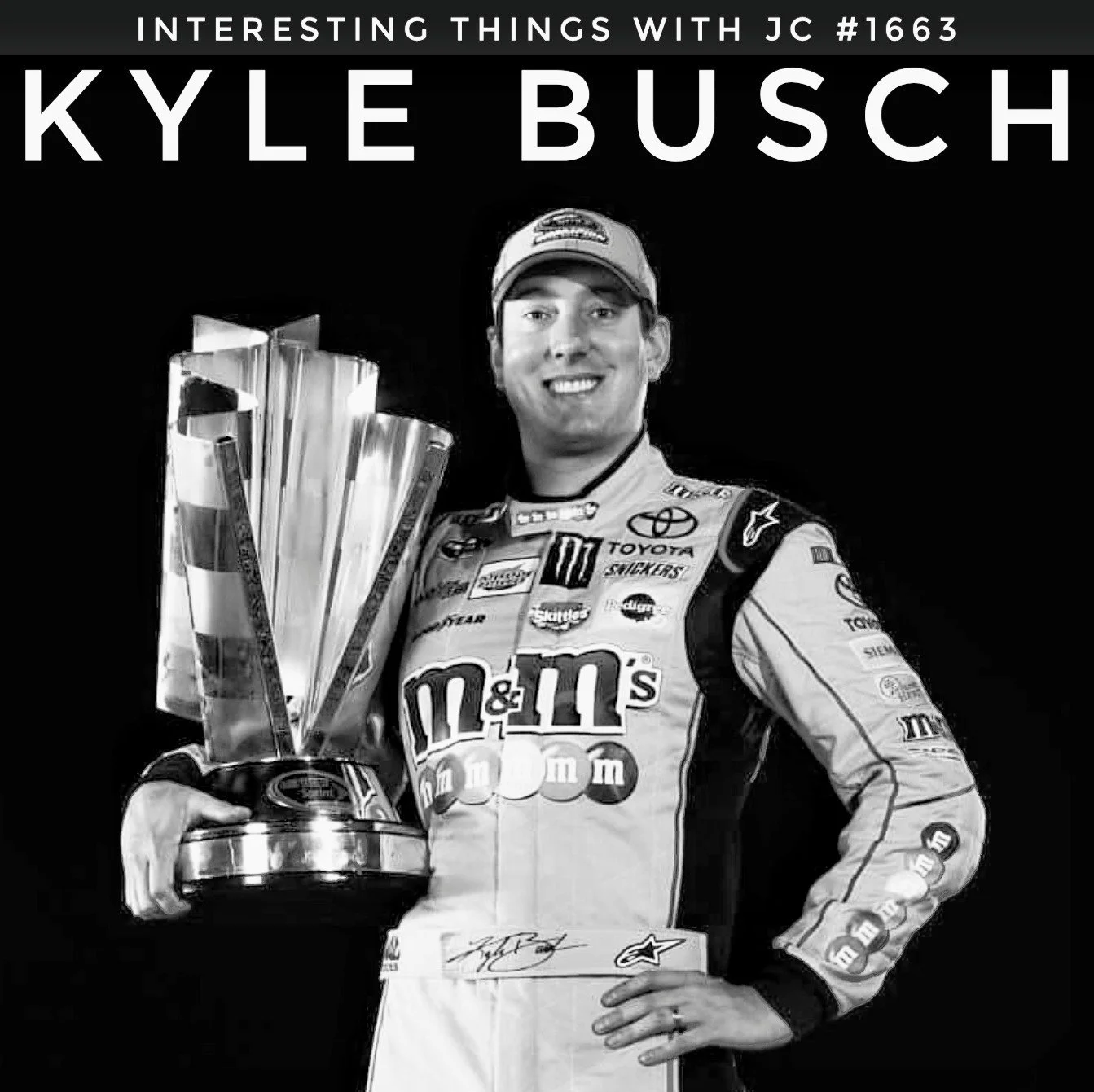
Black-and-white promotional image for Interesting Things with JC episode 1663 featuring Kyle Busch standing in a racing suit and cap while holding a large championship trophy. Large text across the image reads “KYLE BUSCH,” with “INTERESTING THINGS WITH JC #1663” at the top.
Transcript
Interesting Things with JC #1663:
"Kyle Busch"
Before Kyle Busch ever sat in a NASCAR stock car, he was drawing racetracks in a Las Vegas cul-de-sac.
He and his brother Kurt would crush soda cans to outline turns and straightaways, then spend hours racing through layouts they designed themselves. Their father, Tom, was a mechanic and racer who taught both boys how to work on cars long before they were old enough to drive them. In one of Kyle's earliest go-karts, his feet could not reach the pedals, so his father helped control the throttle while he learned to steer.
By age 13, Kyle was winning Legends car races.
By 16, he was competing in NASCAR's Truck Series.
The kid from Las Vegas was moving fast.
Over the next two decades, Kyle Busch became one of the most successful drivers the sport has ever seen. Nicknamed "Rowdy" for his aggressive driving style and willingness to speak his mind, he accumulated 234 victories across NASCAR's Cup, Xfinity, and Truck Series, more than any driver in history.
He won the 2009 Xfinity Series championship and NASCAR Cup Series championships in 2015 and 2019.
Along the way, he became the all-time wins leader in both the Xfinity Series and Truck Series, won races in 19 consecutive Cup seasons, and built Kyle Busch Motorsports into one of the most successful team operations in Truck Series history.
The 2015 championship almost never happened.
During the season-opening weekend at Daytona, Busch suffered a violent crash that left him with a broken right leg and fractured left foot. He missed the first 11 races of the season. Most championship hopes would have ended there.
Instead, he returned, won four races, qualified for the playoffs, and captured the NASCAR Cup Series championship in one of the greatest comeback seasons the sport has ever seen.
Busch also became known for moments that showed his personality off the track. After winning an Xfinity race at Nashville in 2009, he shocked fans by smashing the custom Gibson Les Paul guitar trophy in Victory Lane. Busch later explained that he wanted members of his crew to take pieces of the trophy home rather than keeping it for himself.
Away from racing, a different challenge shaped his life.
Kyle and his wife Samantha openly shared their struggles with infertility, failed IVF treatments, and miscarriage. Rather than keeping the experience private, they used their platform to help others facing the same obstacles. Their Bundle of Joy Fund helped families pay for fertility treatments and contributed to the births of more than 100 children.
His charitable efforts extended through the Kyle Busch Foundation, which supported children, educational opportunities, and families facing difficult circumstances.
Busch was not always universally loved.
He was fined, criticized, booed by crowds, and occasionally found himself at the center of controversy. In 2011, he lost his driver's license for 45 days after being stopped driving a Lexus LFA at 128 miles per hour, approximately 206 kilometers per hour, in a 45 mile per hour, 72 kilometer per hour zone in North Carolina.
Yet even many of his critics respected his ability behind the wheel.
Few drivers have demonstrated the same versatility across stock cars, short tracks, superspeedways, road courses, and multiple generations of race cars. Whether fans cheered him or booed him, they watched.
On May 21, 2026, Kyle Busch passed away at age 41. His family later revealed that severe pneumonia had progressed into sepsis, leading to rapid and overwhelming complications.
He is survived by his wife Samantha, their children Brexton and Lennix, extended family, friends, former teammates, competitors, and millions of racing fans.
His legacy lives on through championship trophies, record-setting victories, Kyle Busch Motorsports, the families helped through the Bundle of Joy Fund, and a generation of drivers who measured themselves against one of NASCAR's fiercest competitors.
For many fans, he was "Rowdy."
For NASCAR, he was one of the greatest drivers the sport has ever produced.
These are interesting things, with JC.
Student Worksheet
Student Name: ____________________
Date: ____________________
Directions: Listen to the podcast first. Do not answer during the first listen unless your teacher instructs you to take notes. After listening, use the transcript to complete your answers with clear evidence.
Part A — First Listen Notes:
One detail about Busch’s childhood: ____________________
One detail about Busch’s racing career: ____________________
One detail about a challenge or setback: ____________________
One detail about service, family, or responsibility: ____________________
Part B — Comprehension Questions:
Where did Kyle and Kurt Busch design early racetrack layouts?
What did they use to outline turns and straightaways?
What role did Tom Busch play in Kyle’s early development?
By what age was Kyle Busch winning Legends car races?
Which NASCAR national series did Busch compete in by age 16?
What nickname did Busch become known by?
Which championships are identified in the episode?
What injuries did Busch suffer during the 2015 Daytona crash?
How did the Bundle of Joy Fund help families?
What medical condition did the episode say developed from severe pneumonia?
Part C — Analysis Questions:
How did Busch’s childhood experiences connect to later racing success?
Why is the 2015 championship described as a comeback?
What does the episode suggest about the difference between being popular and being respected?
How does the episode show that Busch’s legacy was more than his win total?
What responsibilities come with being a public figure in a competitive field?
Part D — Reflection Prompt: Write one paragraph explaining how Kyle Busch’s life shows the connection between skill, discipline, setbacks, and responsibility. Use at least three details from the transcript.
Part E — Difficulty Scaling:
Support Level: Write 5–6 sentences using these starters: “Kyle Busch developed skill when…,” “One setback he faced was…,” “His legacy includes…”
Standard Level: Write one complete paragraph of 6–8 sentences with at least three transcript details.
Advanced Level: Write two paragraphs. First, evaluate Busch’s racing legacy. Second, evaluate his off-track legacy and explain how the two connect.
Part F — Student Output Expectations: Your final work should include complete sentences, accurate episode evidence, and a balanced explanation that avoids exaggeration.
Part G — Academic Integrity Guidance: Use the episode transcript and class materials. Do not invent statistics, copy online biographies, or present opinions as facts. When uncertain, write “the episode states” or “the transcript suggests.”
Teacher Guide
Quick Start: Play the podcast first. Ask students to listen for four categories: early development, achievement, setback, and responsibility. Then distribute or display the transcript for evidence-based work.
Pacing Guide — Audio First:
0–5 minutes: Bell ringer, vocabulary preview, and listening purpose.
5–12 minutes: Play the full podcast audio without interruption.
12–17 minutes: Students complete first-listen notes independently.
17–27 minutes: Students answer comprehension questions using the transcript.
27–40 minutes: Small groups complete analysis questions and prepare one evidence-based comment.
40–47 minutes: Whole-class discussion and clarification.
47–50 minutes: Exit ticket or quiz collection.
30-Minute Option: Bell ringer for 3 minutes, audio for 7 minutes, comprehension for 8 minutes, discussion for 7 minutes, exit ticket for 5 minutes.
75-Minute Option: Add a mini-research activity on NASCAR safety, sepsis awareness, motorsports engineering, or athlete philanthropy.
Bell Ringer: What makes someone’s legacy strong: records, character, resilience, service, or the way they respond to mistakes? Explain in two sentences.
Audio Guidance: Tell students not to focus only on racing statistics. They should listen for cause-and-effect relationships: childhood practice leading to skill, injury leading to comeback, public visibility leading to responsibility.
Audio Fallback: If audio is unavailable, read the transcript aloud. Pause after the childhood section, the championship section, the philanthropy section, and the death/legacy section for brief student notes.
Time-on-Task: Most students should spend 10–12 minutes listening and note-taking, 15 minutes on comprehension, 10–15 minutes on analysis, and 5 minutes on closure.
Materials: Podcast audio, printed or digital transcript, student worksheet, quiz, board or projector, writing paper or LMS submission form.
Vocabulary Prep: Pre-teach sepsis, philanthropy, legacy, playoffs, and superspeedway. These terms support comprehension across health, civic, and technical-career parts of the lesson.
Misconceptions:
Students may think racing is only about driving fast; emphasize mechanics, engineering, safety, teamwork, and judgment.
Students may think controversy cancels achievement or achievement cancels controversy; emphasize balanced evaluation.
Students may think philanthropy must erase mistakes; clarify that service is part of a legacy but does not remove accountability.
Students may underestimate pneumonia and sepsis; clarify that infections can become medical emergencies.
Discussion Prompts:
How did Kyle Busch’s early environment help build racing skill?
Why does the 2015 championship stand out as a resilience story?
What makes a competitor polarizing?
How should students evaluate a public figure who was both admired and criticized?
How can families and personal challenges influence public service?
What careers besides driver are visible in this story?
Formative Checkpoints:
Ask students to identify one childhood influence, one career achievement, one setback, and one example of service.
Ask students to explain the 2015 comeback in exactly one sentence.
Ask students to define legacy and apply it to Busch using one transcript detail.
Differentiation:
Emerging readers: Provide vocabulary cards and allow students to answer comprehension questions with sentence frames.
English learners: Preview racing terms visually and allow oral rehearsal before written responses.
Advanced students: Require a two-sided legacy evaluation with a claim, counterclaim, and conclusion.
Students needing writing support: Allow a graphic organizer with evidence boxes before paragraph writing.
Assessment Differentiation: Students may demonstrate understanding through a paragraph, short recorded response, annotated transcript, or teacher-approved organizer.
Time Flexibility: For limited time, use only Part A, five comprehension questions, and the exit ticket. For extended time, add comparison to another athlete, engineer, mechanic, or public figure.
Substitute Readiness: The lesson can run without additional preparation: play or read the transcript, assign the worksheet, administer the quiz, and collect the exit ticket.
Engagement Strategy: Create a four-column board labeled “Skill,” “Setback,” “Controversy,” and “Service.” Students place episode evidence into the correct column before discussion.
Extensions:
Research how NASCAR vehicles are engineered for safety.
Investigate how sepsis develops from infection and why early treatment matters.
Compare Kyle Busch’s career path with another motorsports figure.
Create a timeline of Busch’s major career turning points.
Analyze how media coverage shapes public memory after a famous person dies.
Cross-Curricular Connections:
Science: Forces, impact, safety design, infection, sepsis.
Engineering: Vehicle design, materials, pit strategy, mechanical systems.
English: Evidence-based writing, tone, biography, central idea.
Health: Pneumonia, infection response, emergency symptoms.
Business: Sponsorship, team ownership, brand management.
Civics: Public responsibility, philanthropy, community impact.
SEL Connection: Students examine resilience, grief, accountability, empathy, family stress, and how people respond to pressure.
Skill Value Emphasis: This lesson develops careful listening, fair judgment, evidence use, technical-career awareness, and respectful discussion of complex lives.
Answer Key — Comprehension:
Kyle and Kurt Busch designed early racetrack layouts in a Las Vegas cul-de-sac.
They used crushed soda cans to outline turns and straightaways.
Tom Busch taught the boys how to work on cars and helped Kyle control the throttle in an early go-kart.
Kyle Busch was winning Legends car races by age 13.
He was competing in NASCAR’s Truck Series by age 16.
His nickname was “Rowdy.”
The episode identifies the 2009 Xfinity Series championship and NASCAR Cup Series championships in 2015 and 2019.
He suffered a broken right leg and a fractured left foot.
The Bundle of Joy Fund helped families pay for fertility treatments.
The episode states that severe pneumonia progressed into sepsis.
Answer Key — Analysis Guidance: Strong answers should use transcript evidence, explain cause and effect, and present Busch as complex rather than entirely heroic or entirely flawed.
Answer Key — Reflection Guidance: Strong reflections should mention early training, technical learning, the 2015 injury comeback, controversy or criticism, philanthropy, and legacy.
Quiz
What childhood activity helped Kyle Busch begin thinking like a racer?
A. Designing racetracks in a cul-de-sac
B. Announcing races on local radio
C. Building model airplanes
D. Playing professional baseballWho helped Kyle and Kurt Busch learn about cars when they were young?
A. Their school principal
B. Their father, Tom
C. A television announcer
D. A NASCAR sponsorWhy was Busch’s 2015 Cup Series championship especially remarkable?
A. He won without entering the playoffs
B. He missed 11 races after serious injuries and still won the title
C. He won every race that season
D. He switched to open-wheel racing midseasonWhat was the purpose of the Bundle of Joy Fund described in the episode?
A. To pay for new racing helmets
B. To support families seeking fertility treatments
C. To build racing simulators for schools
D. To sponsor only professional driversWhich statement best describes the episode’s portrayal of Kyle Busch?
A. A driver remembered only for controversy
B. A driver remembered only for charity
C. A complex competitor with major achievements, setbacks, criticism, and service
D. A person with little influence outside one race
Assessment
Open-Ended Questions:
Explain how Kyle Busch’s early life helped prepare him for a career in NASCAR. Use at least two details from the episode.
Evaluate Kyle Busch’s legacy. Include one racing achievement, one challenge or controversy, and one example of responsibility or service.
3–2–1 Rubric:
3 — Strong: Uses accurate evidence, explains cause and effect, acknowledges complexity, and writes clearly with a balanced conclusion.
2 — Developing: Uses some accurate evidence but needs more explanation, balance, or detail.
1 — Beginning: Gives limited evidence, includes unclear reasoning, or summarizes without evaluating.
Exit Ticket: In two sentences, identify one reason Kyle Busch was respected and one reason his legacy requires careful, balanced discussion.
Standards Alignment
NGSS HS-ETS1-3 — Engineering Design and Optimization: Students evaluate how motorsports performance depends on engineering choices, safety constraints, materials, aerodynamics, mechanical reliability, and trade-offs between speed and risk.
NGSS HS-ETS1-2 — Designing Solutions Under Constraints: Students explain how racing teams solve complex problems within limits such as time, safety rules, vehicle specifications, track conditions, and human performance demands.
NGSS HS-LS1-2 — Body Systems and Health Response: Students connect the episode’s reference to pneumonia and sepsis to the broader concept that body systems interact and severe infection can affect multiple organs.
CCSS.ELA-LITERACY.RI.9-10.1 — Textual Evidence: Students cite transcript evidence to support claims about Busch’s training, accomplishments, setbacks, controversy, philanthropy, and legacy.
CCSS.ELA-LITERACY.RI.9-10.2 — Central Idea: Students determine how the episode develops central ideas about discipline, resilience, technical skill, public responsibility, and complex legacy.
CCSS.ELA-LITERACY.RI.9-10.3 — Development of Ideas: Students analyze how key events, including childhood racing practice, the 2015 injury comeback, charitable work, and public controversy, shape the narrative.
CCSS.ELA-LITERACY.W.9-10.1 — Argument Writing: Students write evidence-based claims evaluating Busch’s legacy while acknowledging both achievement and complexity.
CCSS.ELA-LITERACY.W.9-10.2 — Informative Writing: Students explain how motorsports requires technical knowledge, preparation, teamwork, risk management, and public accountability.
CCSS.ELA-LITERACY.SL.9-10.1 — Collaborative Discussion: Students participate in respectful discussion by building on peers’ ideas, referencing the transcript, and distinguishing evidence from opinion.
CCSS.ELA-LITERACY.SL.9-10.3 — Evaluating Point of View: Students evaluate how the episode presents Busch’s life through selected details, tone, structure, and emphasis.
C3 D2.His.1.9-12 — Historical Context: Students explain Busch’s career within NASCAR’s competitive culture, media environment, safety concerns, and public expectations.
C3 D2.His.14.9-12 — Historical Memory and Interpretation: Students analyze how public memory is shaped by records, setbacks, controversies, philanthropy, death, and the stories people preserve.
C3 D2.Civ.10.9-12 — Civic Responsibility: Students examine how public figures can use influence, resources, and visibility to respond to community needs, including family health and fertility challenges.
C3 D4.2.9-12 — Constructing Explanations: Students construct explanations using podcast evidence to describe how Busch’s legacy includes athletic, technical, personal, and charitable dimensions.
ISTE 1.3 — Knowledge Constructor: Students gather, evaluate, and organize information from the episode and verified sources to form accurate conclusions rather than relying on rumor, fandom, or unsupported claims.
ISTE 1.6 — Creative Communicator: Students present their interpretation of Busch’s legacy through a paragraph, discussion contribution, timeline, graphic organizer, or short multimedia explanation.
CTE Career Ready Practice 2 — Apply Academic and Technical Skills: Students identify how motorsports careers require data use, mechanical understanding, safety knowledge, communication, and decision-making under pressure.
CTE Career Ready Practice 4 — Communicate Clearly and Effectively: Students explain a complex public legacy using precise language, balanced tone, and evidence-based reasoning.
CTE Career Ready Practice 8 — Use Critical Thinking: Students evaluate trade-offs in racing, including speed, risk, safety, preparation, teamwork, and accountability.
Career Readiness — Professional Responsibility: Students identify workplace habits shown in high-performance careers, including discipline, preparation, technical learning, teamwork, recovery from setbacks, and responsible conduct.
Career Readiness — Technical Career Awareness: Students connect NASCAR to careers in engineering, mechanics, data analysis, safety inspection, sports medicine, communications, logistics, sponsorship, and team management.
Health Literacy — Risk Recognition and Response: Students explain why severe infection, pneumonia, and sepsis require timely recognition and medical attention, without treating the lesson as medical advice.
Media Literacy — Public Image and Evidence: Students distinguish between reputation, fan reaction, documented achievement, controversy, and verified biographical evidence.
Homeschool/Lifelong Learning — Interdisciplinary Inquiry: Learners connect biography, engineering, health, ethics, family responsibility, and service through independent reflection and discussion.
Homeschool/Lifelong Learning — Personal Application: Learners reflect on how practice, mentorship, setbacks, accountability, and service can shape long-term goals.
Show Notes
This lesson uses the story of Kyle Busch to help students examine how a public legacy is built through talent, practice, discipline, setbacks, controversy, service, and responsibility. Students begin with the podcast audio, then use the transcript to analyze Busch’s development from childhood racing practice to NASCAR championships, his 2015 comeback, his charitable work, and the complicated nature of public memory. The lesson matters because it teaches students to evaluate achievement carefully, recognize the technical and human demands behind competitive careers, and discuss real people with accuracy and respect.
References
Associated Press. (2026). Richard Childress Racing is retiring Kyle Busch’s No. 8 car until his son is ready to take over.https://apnews.com/article/200880317c943523957143ac8f035af9
Bundle of Joy Fund. (n.d.). Samantha and Kyle Busch Bundle of Joy Fund.https://bundleofjoyfund.org/
Guardian Sport. (2026). Kyle Busch died after severe pneumonia progressed into sepsis, family says.https://www.theguardian.com/sport/2026/may/23/kyle-busch-nascar-cause-of-death-pneumonia-sepsis
Guardian Sport. (2026). Kyle Busch, two-time Nascar champion, dies aged 41. https://www.theguardian.com/us-news/2026/may/21/kyle-busch-dead
NASCAR. (2023). Spire bolsters Truck Series operations, purchases Kyle Busch Motorsports. https://www.nascar.com/news-media/2023/09/27/spire-bolsters-truck-series-operations-purchases-kyle-busch-motorsports/
NASCAR. (2026). Kyle Busch NASCAR driver page: Stats, results, bio. https://www.nascar.com/drivers/kyle-busch/
People. (2026). Kyle Busch remembered 3 days after his death during Indy 500 with sentimental nods from fellow race car drivers. https://people.com/kyle-busch-remembered-after-death-at-indy-500-by-romain-grosjean-dale-coyne-racing-11982872