1664: "Rob Base"
Interesting Things with JC #1664: "Rob Base" – Rob Base passed away four days after his 59th birthday, but the 1988 record he made with DJ E-Z Rock still moves crowds nearly four decades later; “It Takes Two” climbed the charts, then kept showing up at weddings, cookouts, games, and parties long after the charts moved on.
Curriculum - Episode Anchor
Episode Title: Rob Base
Episode Number: 1664
Host: JC
Audience: Grades 9–12, introductory college, homeschool, lifelong learners
Subject Area: Music history, media literacy, cultural studies, career readiness
Curriculum Framework: Structured according to the uploaded Interesting Things with JC curriculum system, including the required section order, audio-first lesson design, transcript fidelity, worksheet, teacher guide, quiz, assessment, standards alignment, show notes, and references.
Lesson Overview
Learning Objectives:
Students will explain how Rob Base and DJ E-Z Rock helped move hip-hop from local performance spaces into broader popular culture.
Students will analyze how sampling, collaboration, and production choices shaped the success and legacy of “It Takes Two.”
Students will evaluate how friendship, persistence, and cultural context contributed to Rob Base’s long-term influence.
Students will connect the episode to modern media literacy by examining how older songs continue through sampling, sports, film, social media, and public celebrations.
Essential Question: How can one song become both a commercial hit and a lasting piece of cultural memory?
Success Criteria: Students can accurately summarize the episode, define key vocabulary, cite specific details from the transcript, explain the significance of sampling, and write a supported response about legacy in music.
Student Relevance Statement: Students hear sampled music, remixes, throwback songs, viral sounds, and arena anthems regularly. This lesson helps them recognize how music carries history, authorship, memory, and community identity.
Real-World Connection: The story of Rob Base connects to music production, copyright awareness, performance careers, media industries, event entertainment, sports culture, and how creative work can outlast its original release period.
Workforce Reality: Music and entertainment careers require discipline, collaboration, technical skill, business awareness, legal understanding, audience awareness, and long-term professionalism. Success is not only about fame; it also depends on reliability, adaptation, and responsibility.
Key Vocabulary
Hip-Hop: HĬP-hop; a cultural movement that includes rap music, DJing, breakdancing, graffiti, style, and community-based performance traditions.
Pioneer: py-uh-NEER; a person who helps develop or popularize something early in its history.
Sample: SAM-puhl; a portion of an existing sound recording reused in a new musical work.
Demo: DEM-oh; an early recording used to test, pitch, or develop a song.
Platinum: PLAT-n-um; a music industry certification indicating major sales or equivalent units.
Mainstream: MAYN-streem; widely accepted or popular among a broad public audience.
Legacy: LEG-uh-see; the lasting impact a person, work, or idea leaves behind.
Collaboration: kuh-lab-uh-RAY-shun; working with others to create, solve problems, or complete a shared project.
Chart: chart; a ranked music industry list measuring song or album performance.
Cultural Memory: KUL-chur-uhl MEM-uh-ree; the way communities remember people, events, art, and shared experiences across time.
Narrative Core
Open: Hip-hop lost one of its pioneers when Rob Base, born Robert Ginyard, passed away in May 2026 at age 59 after a private battle with cancer. His music with DJ E-Z Rock became part of everyday celebration culture, from dance floors to sporting events.
Info: Rob Base grew up in Harlem during hip-hop’s formative years, when DJs, block parties, local crews, and cassette tapes helped carry new sounds through neighborhoods. His friendship with Rodney Bryce, later known as DJ E-Z Rock, began in childhood and became the foundation for their music.
Details: Their 1988 breakthrough, “It Takes Two,” used the energy of Lyn Collins’ “Think (About It)” as a central musical force. The track reached the Billboard Hot 100, became a platinum-certified hit, and helped bring hip-hop and dance-oriented rap to wider audiences.
Reflection: The episode’s deeper lesson is not only about chart placement. It is about how creative partnerships, local culture, and memorable sound can leave a lasting imprint long after trends change.
Closing: These are interesting things, with JC.
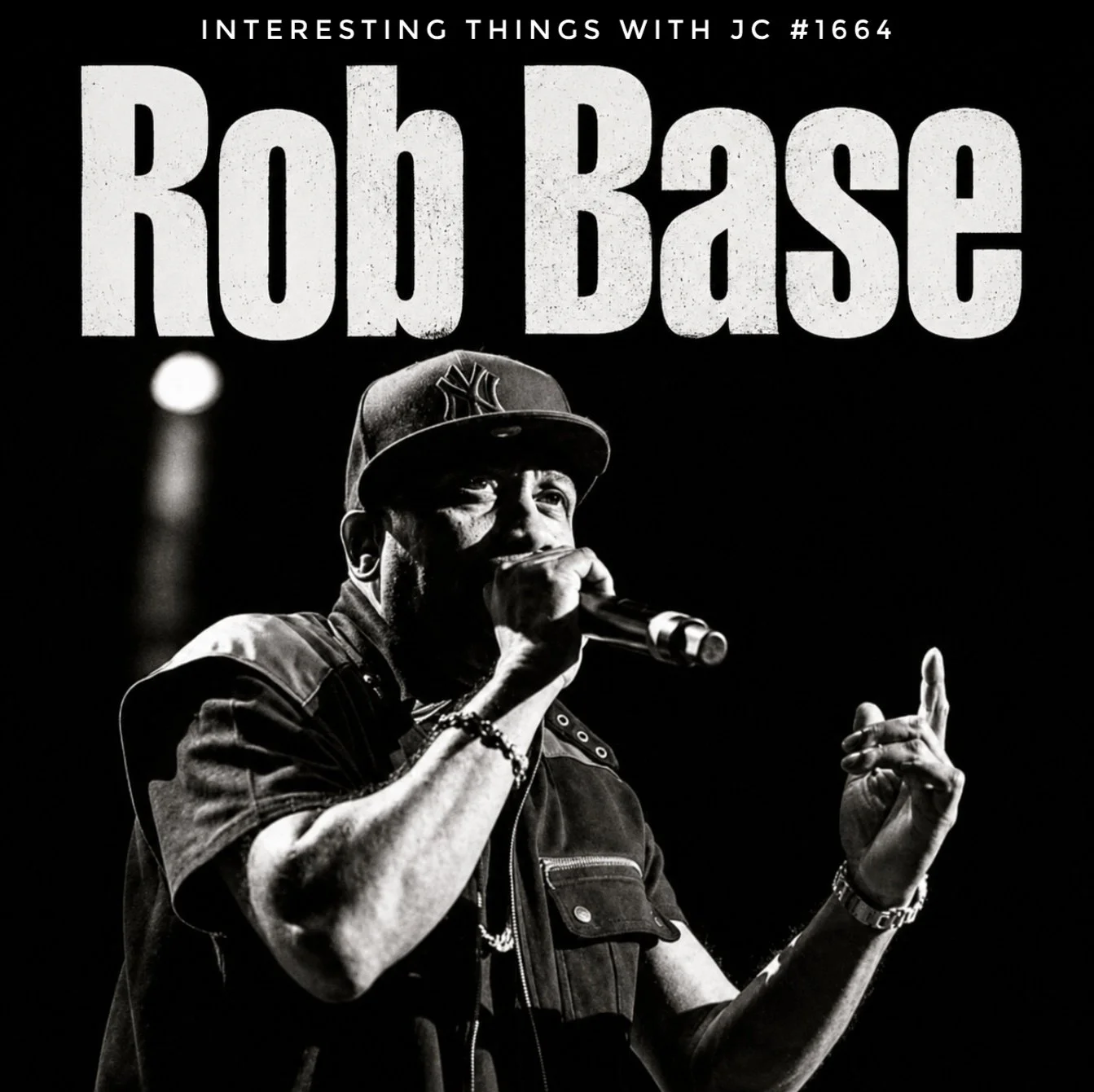
Black-and-white promotional image for Interesting Things with JC #1664 featuring large text reading “Rob Base” above a performer onstage holding a microphone.
Transcript
Interesting Things with JC
#1664: Rob Base
On May 22, 2026, hip-hop lost one of its pioneers.
Rob Base was 59 years old.
For nearly four decades, the music he created with his childhood friend DJ E-Z Rock filled dance floors, wedding receptions, backyard cookouts, sporting events, and celebrations around the world.
But before the platinum records and worldwide recognition, there was a kid from Harlem named Robert Ginyard (JIN-yard).
Born on May 18, 1967, Ginyard grew up during hip-hop's formative years. DJs hauled speakers into parks, block parties filled neighborhood streets, and cassette tapes carried new sounds from one borough to another. Rap music was still local, still evolving, and still finding its audience.
One of the people making it happen was Rodney Bryce, later known as DJ E-Z Rock. The two met in the fifth grade and became lifelong friends. Inspired by local groups like Crash Crew, they believed they could make records of their own.
Their breakthrough arrived in 1988.
Rob Base and DJ E-Z Rock recorded It Takes Two, reportedly assembling the demo in only a couple of nights. Built around a sample from Lyn Collins' 1972 track Think (About It), produced by James Brown, the record took a different approach. Instead of treating the sample as background texture, they made it the centerpiece.
The result became one of the defining songs of its era.
Released in August 1988, It Takes Two became a platinum-selling hit, peaked at No. 36 on the Billboard Hot 100, reached No. 3 on the Dance Club Songs chart, and helped bring hip-hop to audiences far beyond its traditional fan base. The album reached No. 31 on the Billboard 200 and No. 4 on the Top R&B/Hip-Hop Albums chart.
The duo followed with hits including Joy and Pain and Get On the Dance Floor. Rob Base later earned a Gold-certified solo album with The Incredible Base and continued touring and performing for decades.
The charts eventually moved on.
The song didn't.
In April 2014, DJ E-Z Rock passed away at age 46 from complications related to diabetes. Rob Base kept performing. Night after night, he stood before audiences playing music that began with a friendship formed decades earlier in a Harlem classroom.
On May 22, 2026, he passed away following a private battle with cancer, just four days after celebrating his 59th birthday. According to family statements, he passed peacefully at home surrounded by loved ones.
Looking back, the remarkable part is not how high the records climbed on the charts. It is that people are still listening, still dancing, and still introducing those songs to the next generation nearly four decades later.
Through all of that success, Robert Ginyard never seemed to drift far from the kid who started out in Harlem making music with his best friend.
DJ E-Z Rock passed away in 2014. Rob Base followed in 2026. Yet the songs they created together continue to find new audiences, proving that a good record can last a long time, but friendship, loyalty, and staying true to where you came from can leave an even deeper mark.
For two boys who once dreamed of making records after watching local artists succeed in their own neighborhood, that is a remarkable legacy.
These are interesting things, with JC.
Student Worksheet
Student Output Expectations: Answer in complete sentences. Use at least three details from the transcript across the worksheet. For analysis answers, explain the “why” behind your claim, not only the “what.”
Academic Integrity Guidance: Use the transcript and class discussion as your evidence. Do not copy outside summaries. Paraphrase in your own words unless quoting a short phrase from the episode.
Comprehension Questions:
Who was Rob Base, and what was his birth name?
Where did Robert Ginyard grow up, and why was that setting important to the story?
Who was DJ E-Z Rock, and how did he know Rob Base?
What song became the duo’s major breakthrough in 1988?
What earlier song did “It Takes Two” use as a major sample?
What does the episode mean when it says, “The charts eventually moved on. The song didn’t”?
Analysis Questions:How did Rob Base and DJ E-Z Rock’s childhood friendship shape the meaning of their musical success?
Why might making the sample the centerpiece of “It Takes Two” have helped the song stand out?
How does the episode show the difference between short-term popularity and long-term legacy?
What evidence suggests that “It Takes Two” reached audiences beyond traditional hip-hop listeners?
How does this story show the importance of local communities in the development of national culture?
Reflection Prompt: Write one paragraph explaining why a song from 1988 might still matter to people who were born decades later. Include one reference to music, one reference to community, and one reference to legacy.
Difficulty Scaling:
Support Level: Students may answer comprehension questions using sentence starters and a vocabulary bank.
Standard Level: Students answer all questions and include transcript evidence in analysis responses.
Advanced Level: Students compare “It Takes Two” to another song, sample, remix, or cultural artifact that has lasted across generations.
Clear Output Requirement: Submit a completed worksheet with six comprehension answers, five analysis answers, and one reflection paragraph of 6–8 sentences.
Teacher Guide
Quick Start: Begin with the podcast audio. Ask students to listen first for the basic story and second for the larger theme: how music becomes legacy.
Pacing Guide Audio-First:
0–3 minutes: Bell ringer on songs that last across generations.
3–8 minutes: Play the podcast episode without interruption.
8–12 minutes: Silent quick-write: “What made this story about more than one song?”
12–20 minutes: Vocabulary review and transcript annotation.
20–35 minutes: Student worksheet comprehension and analysis.
35–45 minutes: Discussion and formative check.
45–55 minutes: Assessment response or exit ticket.
Bell Ringer: Name one song that people still play years after it was released. Why do you think it lasted?
Audio Guidance: During the first listen, students should track people, places, dates, and songs. During the second listen or transcript review, students should mark evidence about friendship, sampling, popularity, and legacy.
Audio Fallback: If audio is unavailable, read the transcript aloud or assign students to read it silently, then have pairs identify the five most important facts and the two strongest themes.
Time-on-Task: Standard lesson length is 45–55 minutes. The lesson can be shortened to 30 minutes by using only the bell ringer, audio, vocabulary, three worksheet questions, and exit ticket.
Materials:
Podcast audio or transcript
Student worksheet
Projector or printed transcript
Highlighters or digital annotation tools
Optional music-history timeline template
Vocabulary Prep: Preview sample, platinum, mainstream, legacy, collaboration, and cultural memory before the episode. Ask students to predict how each term may connect to music history.
Misconceptions:Students may think hip-hop became mainstream immediately; clarify that the episode describes a gradual movement from local scenes to broader audiences.
Students may think sampling is simple copying; clarify that sampling can involve artistic, technical, legal, and cultural decisions.
Students may assume chart success and legacy are the same; distinguish short-term ranking from long-term public memory.
Students may view performance careers as only glamorous; emphasize discipline, touring demands, business decisions, and professional consistency.
Discussion Prompts:
What makes a song useful at celebrations across different generations?
How can friendship shape creative work?
Why do local scenes often produce national cultural influence?
What responsibilities come with reusing or sampling earlier music?
Is legacy measured more by numbers, memory, influence, or use? Explain.
Formative Checkpoints:
After audio: Students write one sentence summarizing the episode.
After vocabulary: Students correctly use three vocabulary terms in context.
During worksheet: Students identify at least two pieces of transcript evidence.
Before assessment: Students explain the difference between chart success and legacy.
Differentiation:Emerging Learners: Provide sentence frames, reduced question set, and paired reading.
English Learners: Pre-teach vocabulary with pronunciation and examples.
Advanced Learners: Add research comparison on another sampled song or music partnership.
Auditory Learners: Use repeated listening and oral discussion.
Visual Learners: Create a timeline from Harlem childhood to 1988 breakthrough to later legacy.
Assessment Differentiation: Students may demonstrate understanding through a written paragraph, short oral response, annotated timeline, or evidence chart.
Time Flexibility: For a shorter class, omit the advanced extension. For a longer block, add a mini-research task on sampling and legacy songs.
Substitute Readiness: Provide the transcript, worksheet, and answer key. The substitute should play or read the episode, lead the bell ringer, and collect the worksheet or exit ticket.
Engagement Strategy: Use a “legacy test”: students decide what makes a song last—catchy sound, repeated use, emotional memory, community identity, or media exposure—and defend their ranking.
Extensions:Create a timeline of Rob Base and DJ E-Z Rock’s career.
Compare “It Takes Two” with another song built around a recognizable sample.
Research how songs move from radio hits to sports-event or celebration staples.
Write a short profile of a creative partnership in music, film, sports, or technology.
Cross-Curricular Connections:Music: Sampling, rhythm, production, performance.
English Language Arts: Theme, evidence, biographical narrative.
Social Studies: Urban culture, local communities, media history.
Business/Career Studies: Music industry, touring, branding, intellectual property.
Technology: Audio production, remix tools, digital distribution.
SEL Connection: The lesson highlights friendship, loyalty, perseverance, grief, and honoring someone’s contributions without glamorizing fame.
Skill Emphasis: Students practice listening comprehension, evidence-based analysis, media literacy, vocabulary use, cultural interpretation, and concise writing.
Answer Key:
Rob Base was a hip-hop artist born Robert Ginyard.
He grew up in Harlem during hip-hop’s formative years, when local performance culture helped shape the genre.
DJ E-Z Rock was Rodney Bryce, Rob Base’s childhood friend and musical partner.
The breakthrough song was “It Takes Two.”
The song was built around Lyn Collins’ “Think (About It).”
The phrase means the song’s chart run ended, but its public life continued through celebrations, performances, and new listeners.
Their friendship mattered because the music grew from a long personal bond, not only a business partnership.
The sample helped the song stand out because it was central, energetic, recognizable, and memorable.
Short-term popularity is measured by charts; legacy is measured by continued influence, use, memory, and introduction to new audiences.
Evidence of broader reach includes dance floors, weddings, cookouts, sporting events, worldwide celebrations, platinum sales, and chart performance.
Quiz
Multiple Choice Questions:
What was Rob Base’s birth name?
A. Rodney Bryce
B. Robert Ginyard
C. James Brown
D. William HamiltonWhere did Rob Base grow up?
A. Harlem
B. Compton
C. Atlanta
D. PhiladelphiaWho was DJ E-Z Rock?
A. A record executive
B. Rob Base’s childhood friend and musical partner
C. A sports announcer
D. A film producerWhich song became Rob Base and DJ E-Z Rock’s major 1988 breakthrough?
A. “Joy and Pain”
B. “Get On the Dance Floor”
C. “It Takes Two”
D. “The Incredible Base”What earlier song was central to the sound of “It Takes Two”?
A. “Think (About It)” by Lyn Collins
B. “Rapper’s Delight” by The Sugarhill Gang
C. “Fight the Power” by Public Enemy
D. “Planet Rock” by Afrika Bambaataa
Assessment
Open-Ended Questions:
Explain how “It Takes Two” became more than a hit record. Use at least three details from the episode.
How does the episode connect friendship, local culture, and long-term legacy? Write a supported response using transcript evidence.
3–2–1 Rubric:
3: Response gives a clear claim, uses accurate evidence from the episode, explains significance, and connects music to legacy.
2: Response gives a mostly clear claim and some accurate evidence but needs more explanation or stronger connection to the essential question.
1: Response is incomplete, mostly summary, or lacks accurate evidence from the episode.
Exit Ticket: In 2–3 sentences, explain one reason Rob Base’s work still matters and one lesson students can take from his story.
Standards Alignment
NGSS Connection — HS-ETS1-3, Evaluating Solutions and Tradeoffs: Students evaluate how production choices, including the central use of a sample, affected the impact of a musical work. Measurable skill: students explain one creative tradeoff between originality, reuse, audience recognition, and long-term influence.
NGSS Connection — Science and Engineering Practice, Obtaining, Evaluating, and Communicating Information: Students use audio and transcript evidence to communicate an evidence-based explanation of cultural impact. Measurable skill: students cite episode details accurately in written or spoken responses.
CCSS.ELA-LITERACY.RI.9-10.2 / RI.11-12.2, Central Idea and Development: Students determine the central idea of a biographical informational narrative and explain how it develops through details about childhood, collaboration, breakthrough, loss, and legacy. Measurable skill: students write a concise summary that distinguishes key ideas from supporting details.
CCSS.ELA-LITERACY.RI.9-10.3 / RI.11-12.3, Analyze Connections: Students analyze how individuals, events, and ideas interact across the episode, including Harlem’s local music environment, Rob Base’s partnership with DJ E-Z Rock, the release of “It Takes Two,” and the song’s long-term cultural life. Measurable skill: students complete analysis responses connecting at least three episode elements.
CCSS.ELA-LITERACY.SL.9-10.1 / SL.11-12.1, Collaborative Discussion: Students participate in structured discussion about music, sampling, legacy, and cultural memory. Measurable skill: students build on peers’ ideas while using transcript-based evidence.
CCSS.ELA-LITERACY.W.9-10.2 / W.11-12.2, Informative Writing: Students write an explanatory response about how a song can become a lasting cultural artifact. Measurable skill: students produce a paragraph or short response with a claim, evidence, and explanation.
C3 Framework — D2.His.1.9-12, Historical Context: Students evaluate how hip-hop’s formative environment shaped the opportunities and creative choices of Rob Base and DJ E-Z Rock. Measurable skill: students explain how time and place influenced the development of a cultural work.
C3 Framework — D2.His.14.9-12, Multiple Causes and Effects: Students identify causes and effects in the duo’s legacy, including childhood friendship, local influence, sampling, chart success, continued performance, and public memory. Measurable skill: students create a cause-effect explanation using episode evidence.
ISTE Standard — Knowledge Constructor 1.3: Students build knowledge by evaluating media information and organizing evidence from the podcast transcript. Measurable skill: students identify reliable details and use them to support analysis rather than unsupported opinion.
CTE Arts, Media, and Entertainment Connection — Production and Managerial Arts: Students examine how creative products depend on collaboration, audience awareness, production decisions, and professional persistence. Measurable skill: students explain at least two career skills shown in the episode.
Career Readiness — Communication and Professional Responsibility: Students practice concise communication, respectful discussion, evidence use, and realistic understanding of entertainment careers. Measurable skill: students produce a response that separates artistic achievement from glamorized fame.
Homeschool and Lifelong Learning Alignment — Media Literacy and Cultural Understanding: Learners connect a short biographical episode to broader questions about music, memory, technology, and community. Measurable skill: learners explain how a familiar sound can carry historical meaning across generations.
Show Notes
This classroom-ready lesson uses the story of Rob Base to examine hip-hop history, sampling, collaboration, and legacy. Students begin with the podcast audio, then use the transcript to analyze how a Harlem friendship became part of global music culture through “It Takes Two.” The lesson matters because it helps students understand that popular music is not only entertainment; it is also shaped by community, craft, technology, memory, and responsibility.
References
Associated Press. (2026). “It Takes Two” rapper Rob Base, who helped bring hip-hop mainstream, dies at 59. https://apnews.com/article/5048b6d56838fac387c4d1e9cf33bfb1
Billboard. (n.d.). Rob Base chart history. https://www.billboard.com/artist/rob-base/
People. (2026). Rob Base of Rob Base & DJ E-Z Rock dies of cancer at 59. https://people.com/rob-base-dead-age-59-cancer-11982841Pitchfork. (2026). “It Takes Two” rapper Rob Base dies at 59. https://pitchfork.com/news/it-takes-two-rapper-rob-base-dies-at-59
WhoSampled. (n.d.). Rob Base & DJ E-Z Rock’s “It Takes Two” sample of Lyn Collins’s “Think (About It).” https://www.whosampled.com/sample/539/Rob-Base-%26-DJ-E-Z-Rock-It-Takes-Two-Lyn-Collins-Think-%28About-It%29/