1666: "A Billion Seconds"
Interesting Things with JC #1666: "A Billion Seconds" - A million seconds goes by pretty fast. A billion seconds is something else entirely. Once you truly understand the difference, it changes the way you look at time, money, and the scale of the world around you.
Curriculum - Episode Anchor
Episode Title: A Billion Seconds
Episode Number: 1666
Host: JC
Audience: Grades 9–12, introductory college, homeschool, lifelong learners
Subject Area: Mathematics, numeracy, quantitative reasoning, data literacy, science communication
Lesson Overview
Learning Objectives:
Students will convert seconds into days and years using correct unit relationships.
Students will compare one million, one billion, and one trillion as powers-of-ten quantities.
Students will explain why human intuition often underestimates differences at large numerical scales.
Students will apply scale reasoning to science, economics, government data, public planning, technology, and everyday media claims.
Essential Question: Why does understanding the difference between a million and a billion matter in real life?
Success Criteria:
I can calculate that 1,000,000 seconds is about 11.6 days.
I can calculate that 1,000,000,000 seconds is about 31.7 years.
I can explain that one billion is one thousand times larger than one million.
I can use a real-world example to show why scale affects interpretation and decision-making.
Student Relevance Statement: Students regularly encounter large numbers in news stories, social media posts, science reports, sports statistics, public budgets, population data, technology storage, and personal finance. This lesson helps them slow down, check units, and understand whether a number is large, extremely large, or beyond everyday intuition.
Real-World Connection: Scientists, economists, engineers, journalists, analysts, planners, and government agencies use large numbers when measuring time, distance, cost, population, computing power, energy use, and risk. Misreading the difference between millions and billions can distort conclusions.
Workforce Reality: Many careers require disciplined number sense. In data analysis, accounting, engineering, logistics, construction, healthcare, cybersecurity, aviation, manufacturing, and public administration, scale errors can lead to wasted money, incorrect reporting, poor planning, or safety risks.
Key Vocabulary
Million (MIL-yun): One thousand thousands; written as 1,000,000.
Billion (BIL-yun): One thousand millions; written as 1,000,000,000.
Trillion (TRIL-yun): One thousand billions; written as 1,000,000,000,000.
Scale (SKAYL): The relative size of one quantity compared with another.
Order of Magnitude (OR-der uv MAG-ni-tood): A difference based on powers of ten, often used to compare very large or very small quantities.
Approximation (uh-PROK-suh-MAY-shun): A close estimate used when an exact value is not necessary.
Unit Conversion (YOO-nit kun-VER-zhun): Changing a measurement from one unit to another, such as seconds to days.
Quantitative Reasoning (KWON-tuh-tay-tiv REE-zuh-ning): Using numbers, units, logic, and context to interpret information.
Factor (FAK-ter): A multiplier that shows how many times larger or smaller one quantity is than another.
Numerical Literacy (noo-MAIR-ih-kul LIT-er-uh-see): The ability to understand, interpret, and communicate numerical information responsibly.
Narrative Core
Open: A million seconds sounds huge, but when converted into days, it becomes easier to picture.
Info: One million seconds is about 11.6 days, which rounds to about 12 days. One billion seconds is about 31.7 years, which rounds to about 31 years.
Details: The difference is not just a few extra zeros. A billion is one thousand times larger than a million. Seconds make that difference visible because they turn abstract numbers into human-scale time.
Reflection: When numbers reach millions, billions, and trillions, the human brain needs anchors. Conversions, comparisons, graphs, and estimates help people understand what large quantities actually mean.
Closing: These are interesting things, with JC.
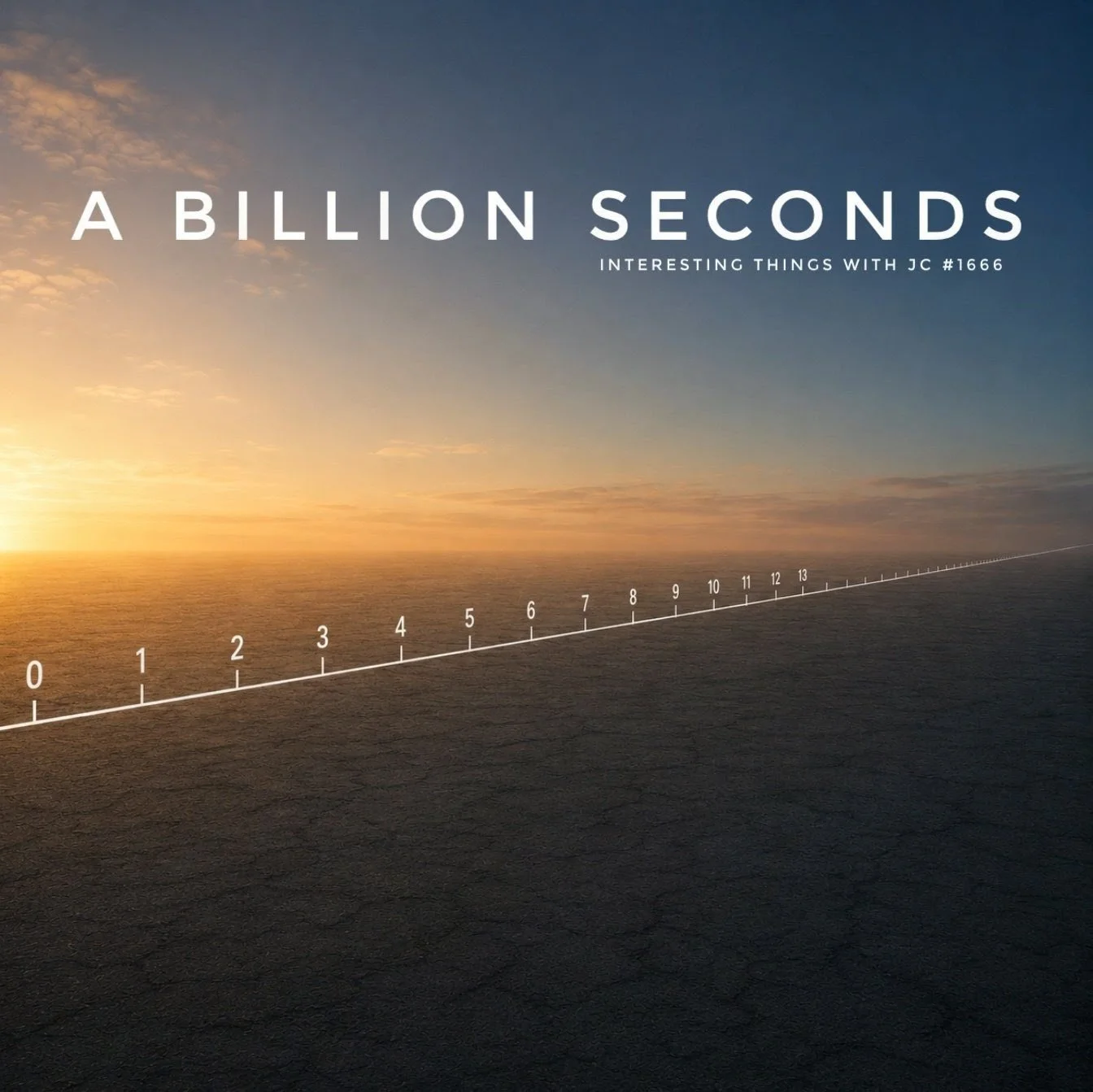
Cover image for “A Billion Seconds,” Interesting Things with JC #1666. A sunrise or sunset stretches across a wide horizon above a dark landscape. Large white title text reads “A BILLION SECONDS,” with smaller text beneath reading “INTERESTING THINGS WITH JC #1666.” A long white timeline runs diagonally across the lower half of the image, marked with numbers beginning at 0 and continuing into the distance, visually suggesting the vast scale of time.
Transcript
Interesting Things with JC #1666:
"A Billion Seconds"
A million seconds sounds like a lot.
But it is only about 12 days.
Now here is the part that catches people off guard.
A billion seconds is about 31 years.
That means if you went back a billion seconds from today, you would land somewhere around 1994.
That is the real difference between a million and a billion.
On paper, both numbers just have extra zeros.
In real life, one is less than two weeks.
The other is a big chunk of a lifetime.
That is why scientists, economists, and governments pay close attention to numbers at that scale. Once you hit billions and trillions, the size of things gets hard for the human brain to picture.
A million seconds passes before you know it.
A billion seconds can raise a child, build a career, or change the world.
These are interesting things, with JC.
Student Worksheet
Student Output: Complete all questions in full sentences unless a calculation is requested. Show work for every conversion. Final answers should include units.
Academic Integrity Guidance: You may compare methods with a partner, but your calculations, explanations, and written examples must be your own. Do not copy another student’s wording.
Part A — Listen and Capture:
What two time comparisons are made in the episode?
What phrase does the episode use to describe the difference between how numbers look “on paper” and how they feel “in real life”?
Why does the episode say large numbers become hard for the human brain to picture?
Part B — Comprehension:
About how long is one million seconds?
About how long is one billion seconds?
What year does the episode use as an approximate landing point if you go back one billion seconds from today?
What groups of people does the episode mention as paying close attention to large-scale numbers?
Part C — Calculation Practice:
Convert one million seconds into days. Use 60 seconds per minute, 60 minutes per hour, and 24 hours per day.
Convert one billion seconds into days.
Convert one billion seconds into years using 365 days per year.
Calculate how many times larger one billion is than one million.
Challenge calculation: Estimate how many years one trillion seconds represents.
Part D — Analysis:
Why does “a few extra zeros” fail to capture the real difference between a million and a billion?
Why is time a useful way to understand large numbers?
Choose one field—science, economics, government, technology, construction, healthcare, or journalism. Explain why confusing millions and billions would matter in that field.
Explain the difference between an exact answer and a useful approximation in this lesson.
Part E — Reflection:
Write 6–8 sentences explaining how this episode changes the way you interpret large numbers.
Include the words scale, unit conversion, and approximation in your response.
End with one real-world situation where you will be more careful when hearing a large number.
Difficulty Scaling:
Support: Use a guided conversion table: seconds → minutes → hours → days → years.
Standard: Complete all calculations independently and explain the meaning of each answer.
Challenge: Add one trillion seconds to the comparison and create a three-level scale model: million, billion, trillion.
Clear Output Expectations: Submit completed listening notes, calculation work, short-answer responses, and one reflection paragraph.
Teacher Guide
Quick Start: Play the podcast before explaining the math. Ask students to write down the two surprising comparisons: one million seconds is about 12 days, and one billion seconds is about 31 years.
Pacing Guide (Audio-First):
0–3 minutes: Bell ringer prediction before audio.
3–5 minutes: Play the episode once without stopping.
5–8 minutes: Students identify the episode’s two central claims.
8–18 minutes: Class verifies the million-second calculation.
18–28 minutes: Class verifies the billion-second calculation.
28–38 minutes: Students complete analysis questions.
38–45 minutes: Exit ticket or short quiz.
Bell Ringer: Ask: “Which is closer to a human lifetime: one million seconds or one billion seconds? Explain your guess without calculating.”
Audio Guidance: Tell students to listen for contrast language: “but,” “now,” “on paper,” and “in real life.” These words mark the episode’s shift from intuition to evidence.
Audio Fallback: If audio is unavailable, read the transcript aloud once for meaning, then a second time while students underline numerical claims.
Time on Task: 25 minutes for a short numeracy activity; 45 minutes for a full class lesson; 60 minutes with trillion-second extension and discussion.
Materials: Episode audio or transcript, calculator, worksheet, pencil or digital document, board or projector, optional number line.
Vocabulary Prep: Review million, billion, trillion, factor, scale, approximation, and unit conversion. Emphasize that one billion equals one thousand millions.
Misconceptions:
Students may think a billion is only slightly bigger than a million because both words are common.
Students may count zeros without understanding the multiplier.
Students may forget that 1 day equals 86,400 seconds.
Students may round too early and create large errors.
Students may think an approximation is “wrong” because it is not exact.
Discussion Prompts:
Why do large numbers become harder to understand as they move farther away from daily experience?
Why does converting seconds into days or years make the comparison easier?
Where do you hear millions, billions, and trillions in public life?
What responsibilities do journalists, scientists, and public officials have when explaining large numbers?
How can a correct number still mislead people if it lacks context?
Formative Checkpoints:
Students identify 60 seconds per minute, 60 minutes per hour, and 24 hours per day.
Students calculate 86,400 seconds in one day.
Students convert 1,000,000 seconds into about 11.6 days.
Students convert 1,000,000,000 seconds into about 31.7 years.
Students explain that a billion is 1,000 times a million.
Differentiation:
For support: Provide a partially completed conversion ladder.
For English learners: Pair vocabulary with numerals and visual comparisons.
For advanced learners: Add trillion seconds, scientific notation, or logarithmic scale.
For verbal learners: Allow oral explanation of the scale comparison.
For visual learners: Use a timeline showing 12 days versus 31 years.
Assessment Differentiation: Accept written calculations, annotated diagrams, oral reasoning, or a short video explanation if the student accurately demonstrates the same mathematical understanding.
Time Flexibility: For a short lesson, use only the audio, one conversion, and the exit ticket. For a full lesson, include worksheet, quiz, assessment, and extension.
Substitute Readiness: Provide the transcript, worksheet, calculator access, and answer key. The lesson can be delivered without additional background knowledge.
Engagement Strategy: Create a physical classroom scale: label one wall “12 days” and the opposite wall “31 years.” Ask students to place other examples—school year, childhood, driver’s license age, career length—between them.
Extensions:
Calculate one trillion seconds and compare it to recorded history.
Research one public number reported in millions, billions, or trillions and explain it in human-scale terms.
Create an infographic comparing million, billion, and trillion using time, money, distance, or population.
Write a short public-service explanation titled “Why Scale Matters.”
Cross-Curricular Connections: Mathematics connects through unit conversion and proportional reasoning; science connects through measurement and scale; economics connects through budgets and markets; civics connects through public spending and population data; English connects through clear explanatory writing.
SEL Connection: Students practice intellectual humility by comparing an initial guess with verified evidence. The lesson encourages careful thinking before reacting to large claims.
Skill Emphasis: Estimation, unit conversion, proportional reasoning, scale interpretation, numerical communication, evidence-based explanation, and responsible data use.
Answer Key:
Part A 1: One million seconds is about 12 days; one billion seconds is about 31 years.
Part A 2: “On paper” both numbers have extra zeros; “in real life” they are very different.
Part A 3: The quantities are too large to picture easily without anchors.
Part B 1: About 12 days.
Part B 2: About 31 years.
Part B 3: Around 1994.
Part B 4: Scientists, economists, and governments.
Part C 1: 1,000,000 ÷ 86,400 ≈ 11.57 days.
Part C 2: 1,000,000,000 ÷ 86,400 ≈ 11,574.07 days.
Part C 3: 11,574.07 ÷ 365 ≈ 31.71 years.
Part C 4: 1,000,000,000 ÷ 1,000,000 = 1,000.
Part C 5: 1,000,000,000,000 seconds ≈ 31,709.8 years.
Part D answers should explain scale, factor of 1,000, usefulness of time as a familiar unit, and real-world consequences.
Quiz
About how long is one million seconds?
A. 12 minutes
B. 12 hours
C. 12 days
D. 12 yearsAbout how long is one billion seconds?
A. 31 days
B. 31 months
C. 31 years
D. 31 centuriesHow many millions are in one billion?
A. 10
B. 100
C. 1,000
D. 10,000What is the main lesson of the episode?
A. Seconds are more accurate than years.
B. Large numbers need context and scale to be understood.
C. A million and a billion are nearly the same.
D. Scientists avoid large numbers.Why are unit conversions important in this lesson?
A. They make abstract numbers easier to interpret.
B. They eliminate the need for multiplication.
C. They make every estimate exact.
D. They prove that seconds are larger than days.
Assessment
Open-Ended Questions:
Use calculations to explain why one million seconds and one billion seconds represent very different amounts of time.
Choose a real-world example involving millions, billions, or trillions. Explain how misunderstanding scale could affect decisions, communication, or public understanding.
3–2–1 Rubric:
3: Calculation is accurate, units are shown, explanation clearly identifies the factor of 1,000, and real-world connection is specific and logical.
2: Calculation is mostly accurate, units are mostly clear, explanation shows basic understanding of scale, and real-world connection is present but general.
1: Calculation is incomplete or inaccurate, units are missing or unclear, and explanation does not fully distinguish million from billion.
Exit Ticket: In one sentence, explain why “extra zeros” can hide the real size difference between large numbers.
Standards Alignment
NGSS — Science and Engineering Practice: Using Mathematics and Computational Thinking: Students use mathematical thinking to convert units, compare quantities, and interpret numerical scale in a scientific context.
NGSS — Science and Engineering Practice: Analyzing and Interpreting Data: Students analyze numerical claims from a short informational text and test those claims through calculation.
NGSS — Crosscutting Concept: Scale, Proportion, and Quantity: Students explain how proportional relationships change when quantities increase from millions to billions to trillions.
CCSS Math — HSN-Q.A.1: Students use units to understand a multi-step problem, convert seconds to days and years, and interpret the meaning of the resulting quantities.
CCSS Math — HSN-Q.A.2: Students define appropriate quantities for descriptive modeling by selecting seconds, days, years, and factors as useful measures.
CCSS Math — HSN-Q.A.3: Students choose appropriate levels of accuracy by distinguishing exact conversions from rounded estimates such as “about 12 days” and “about 31 years.”
CCSS Math — 7.RP.A.2 / High School Readiness: Students recognize and represent proportional relationships by showing that one billion is 1,000 times one million.
CCSS Literacy — RST.9-10.7: Students translate verbal numerical claims into mathematical calculations and compare the results with the episode’s explanation.
CCSS Literacy — WHST.9-10.2: Students write explanatory responses that use calculations, vocabulary, and real-world examples to clarify a quantitative concept.
CCSS Literacy — SL.9-10.1: Students participate in discussion by building on peers’ ideas, checking claims, and explaining reasoning with evidence.
ISTE — 1.3 Knowledge Constructor: Students evaluate numerical information, verify claims through calculation, and construct a more accurate understanding of large-scale quantities.
ISTE — 1.5 Computational Thinker: Students break a large conversion problem into smaller steps, use repeated unit relationships, and interpret the outcome.
CTE — Quantitative Literacy and Data Use: Students demonstrate workplace-ready numeracy by interpreting large values, checking units, and communicating scale clearly.
C3 Framework — D2.Eco.3.9-12: Students explain how large numerical values can affect economic reasoning, including budgets, costs, markets, and resource decisions.
C3 Framework — D2.Civ.14.9-12: Students analyze why accurate interpretation of public numbers matters for civic understanding and responsible communication.
Career Readiness — Information Use: Students verify a numerical claim before drawing conclusions, a measurable skill used in finance, science, technology, logistics, journalism, and public administration.
Career Readiness — Communication: Students translate abstract numbers into understandable comparisons for non-expert audiences.
Homeschool/Lifelong Learning: Learners practice practical numeracy by applying scale reasoning to news, money, technology, timelines, population, and personal decision-making.
Show Notes
This episode uses a simple comparison, one million seconds versus one billion seconds, to make numerical scale visible. Students learn that a million seconds is less than two weeks, while a billion seconds is more than three decades. The lesson matters because large numbers appear everywhere in modern life, and understanding their true size helps learners think more carefully about science, money, public information, technology, and time.
References
National Institute of Standards and Technology. (n.d.). Metric (SI) prefixes. https://www.nist.gov/pml/owm/metric-si-prefixes
National Institute of Standards and Technology. (2023). SI prefix progress. https://www.nist.gov/news-events/news/2023/01/si-prefix-progress
National Institute of Standards and Technology. (n.d.). Metric (SI) program. https://www.nist.gov/pml/owm/metric-si