1668: "History of the Stanley Cup"
Interesting Things with JC #1668: "History of the Stanley Cup" – The Stanley Cup keeps changing hands while its silver bands record winners, mistakes, and accidents. A trophy meant for amateur hockey becomes the NHL championship prize, then survives misspellings, stolen time as a flower vase, hidden names, fires, dogs, babies, and fingerprints.
Curriculum - Episode Anchor
Episode Title: History of the Stanley Cup
Episode Number: 1668
Host: JC
Audience: Grades 9–12, introductory college, homeschool, lifelong learners
Subject Area: Sports history, cultural history, media literacy, craftsmanship, legacy
Lesson Overview
Learning Objectives:
Explain how the Stanley Cup changed from an amateur challenge trophy into the NHL championship trophy.
Analyze how physical objects can preserve history through names, errors, rituals, and repeated use.
Identify examples of discipline, responsibility, and accountability connected to championship traditions.
Evaluate why a trophy’s meaning depends on both official history and human stories.
Essential Question: How can one object carry both formal achievement and the imperfect human history behind it?
Success Criteria: Students can accurately summarize the Cup’s origin, timeline, engraving tradition, and selected anecdotes using evidence from the episode.
Student Relevance Statement: Students encounter awards, records, photos, jerseys, trophies, and digital archives in their own lives; this lesson helps them think about how objects become symbols.
Real-World Connection: Museums, sports leagues, historians, engravers, archivists, and media producers all help preserve public memory through objects and records.
Workforce Reality: Careers connected to sports history require precision, research discipline, craftsmanship, ethical documentation, and responsibility for public trust.
Key Vocabulary
Challenge Cup(CHAL-inj kup): A trophy defended by the current holder against qualified challengers rather than awarded only through a modern playoff system.
Dominion Hockey Challenge Cup(duh-MIN-yun HAH-kee CHAL-inj kup): The original formal name of the Stanley Cup when Lord Stanley donated it for Canadian hockey.
Amateur(AM-uh-cher): A participant who competes without being paid as a professional athlete.
Professional(pruh-FESH-uh-nul): A person paid to perform a specialized skill, including athletes, coaches, managers, and officials.
Engraving(en-GRAY-ving): The process of cutting or stamping names and words into a surface, often metal.
Legacy(LEG-uh-see): Something passed down over time, including reputation, memory, traditions, or physical records.
Artifact(AR-tuh-fakt): An object made or used by people that helps explain history or culture.
Accountability(uh-kown-tuh-BIL-uh-tee): Responsibility for actions, decisions, records, and consequences.
Narrative Core
Open: A small silver bowl purchased in London became one of the most recognizable trophies in sports history.
Info: Lord Stanley donated the Dominion Hockey Challenge Cup in 1892 to honor Canada’s best amateur hockey team. The Montreal Hockey Club became the first champion in 1893.
Details: The Cup began as a challenge trophy, moved with hockey as the sport became professional, and eventually became the NHL’s official championship trophy. Its engraved bands now record generations of players, coaches, and managers.
Reflection: The Stanley Cup matters because it is not only polished history. It carries misspellings, unusual stories, accidents, traditions, and evidence of human imperfection.
Closing: These are interesting things, with JC.
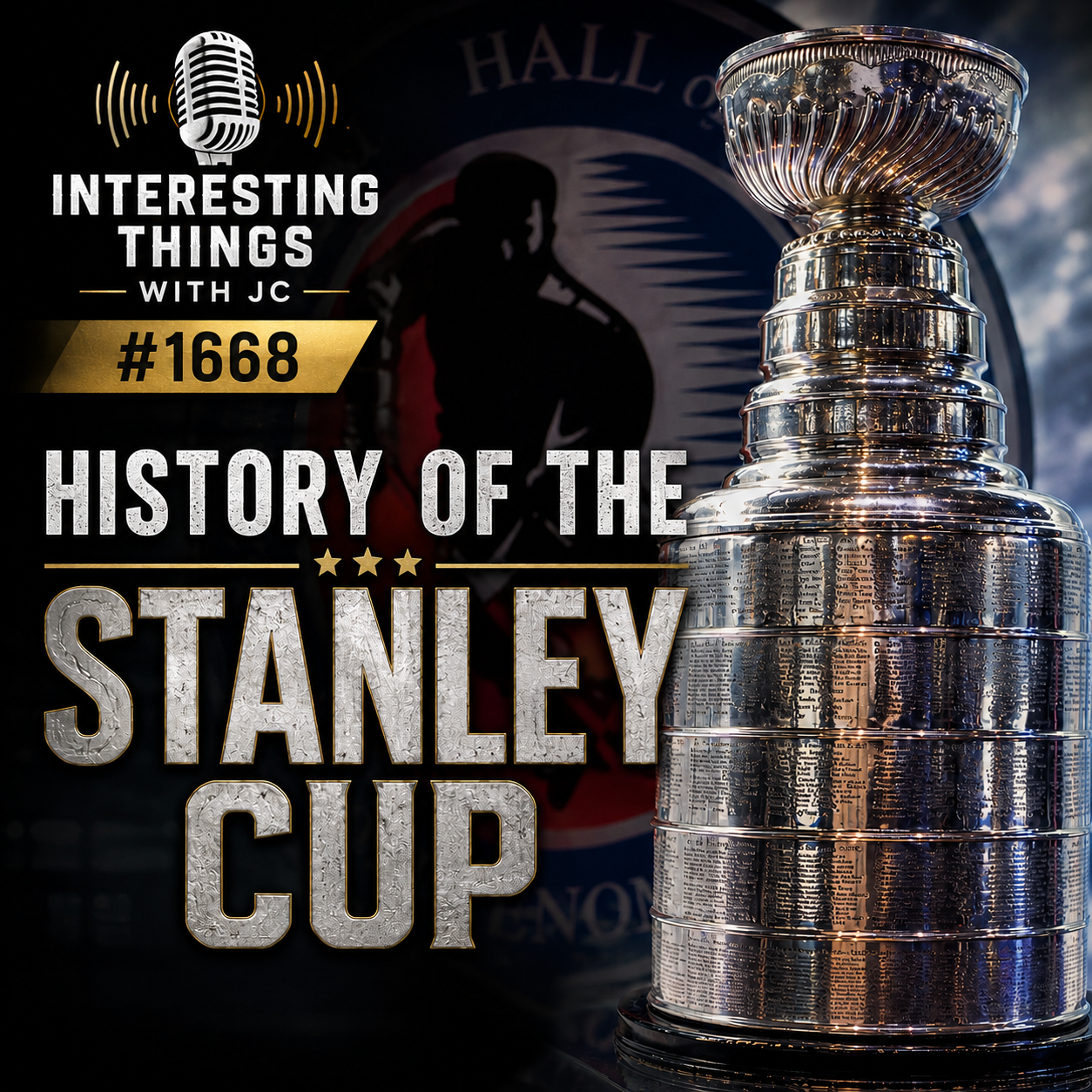
Podcast cover art for “Interesting Things with JC” episode #1668, titled “History of the Stanley Cup.” A bright silver Stanley Cup fills the right side of the image against a dark hockey-themed background. Bold white and metallic lettering appears on the left with a microphone icon above the show title. Stanley Cup Photo Credit: JC - taken in Toronto Ontario
Transcript
Interesting Things with JC #1668
“History of the Stanley Cup”
In 1892, Lord Stanley of Preston, Governor General of Canada, bought a modest silver bowl in London for roughly fifty dollars and donated it as the Dominion Hockey Challenge Cup. It was meant to honor the finest amateur hockey team in the land. From the very beginning it was meant to honor excellence, yet it would come to record far more than that.
The Montreal Hockey Club won the first championship in 1893. In those early years the Cup behaved like a boxing title: reigning champions defended it against challengers in series played from city to city. As hockey turned professional in the early twentieth century, the Cup moved with the game. By 1926 it belonged to the National Hockey League, and in 1947 it became the NHL’s official championship trophy.
What survived all those changes was the Cup itself. The original bowl stands just seven and a half inches tall. Today’s Stanley Cup rises nearly three feet and weighs thirty-five pounds, its silver bands engraved with the names of every player, coach, and manager from each winning team.
In 1907 the Montreal Wanderers left it at a photographer’s studio; a cleaning woman took it home and used it as a flower vase for two months. Engravers have misspelled names for decades. In 1984, Edmonton Oilers owner Peter Pocklington secretly added his father’s name; the league covered it with sixteen Xs still visible today. Players have baptized children in the bowl, let dogs eat from it, and watched one infant use it as a toilet during a photo. The Rangers once extinguished a small fire in it.
Most trophies live behind glass. The Stanley Cup has spent more than 130 years in the hands of its winners, carrying their triumphs along with their mistakes, accidents, and fingerprints. Beneath all the silver bands and engraved names, it is still the same small bowl Lord Stanley donated in 1892, surviving while the game and the people around it kept changing.
These are interesting things, with JC.
Student Worksheet
Student Output Expectations: Write in complete sentences. Use at least two specific details from the episode in each analysis response.
Academic Integrity Guidance: Use your own words unless directly quoting the transcript. Do not invent facts beyond the episode or assigned sources.
Comprehension Questions:
Who donated the original trophy, and what was it first called?
What team won the first championship in 1893?
How did the Cup function in its early years?
What changed as hockey became professional?
What kinds of names are engraved on the Stanley Cup today?
Analysis Questions:
Why does the episode compare the early Cup to a boxing title?
How do engraving errors and unusual stories change the way people understand the trophy?
What does the episode suggest about the difference between official history and lived history?
Why might the Stanley Cup be more meaningful because winners physically handle it?
Reflection Prompt: Describe an object from your school, family, team, community, or personal life that carries a story. Explain what makes it meaningful beyond its physical appearance.
Difficulty Scaling:
Support: Identify three facts from the transcript and explain each in one sentence.
Standard: Answer all questions using evidence from the episode.
Challenge: Compare the Stanley Cup to another historical artifact, award, monument, or record-keeping object.
Clear Output: Submit one completed worksheet with numbered answers and one reflection paragraph of 6–8 sentences.
Teacher Guide
Quick Start: Begin with the podcast audio before discussion. Ask students to listen for how one object changes meaning over time.
Pacing Guide Audio-First:
0–3 minutes: Bell ringer and prediction.
3–8 minutes: Play podcast audio or read transcript aloud.
8–15 minutes: First-listen recall and vocabulary check.
15–30 minutes: Worksheet comprehension and analysis.
30–42 minutes: Discussion and evidence-based reflection.
42–50 minutes: Quiz, exit ticket, or short written assessment.
Bell Ringer: What makes a trophy, medal, certificate, or award valuable: the material it is made from, the people who win it, or the stories attached to it?
Audio Guidance: Students should listen for dates, people, changes in hockey, and examples of human imperfection.
Audio Fallback: If audio is unavailable, read the transcript aloud once for flow, then have students annotate silently.
Time-on-Task: 45–50 minutes for a full class period; 25–30 minutes for a shortened version.
Materials:
Episode audio or transcript
Student worksheet
Writing paper or digital document
Projector or board for vocabulary
Vocabulary Prep: Preview challenge cup, amateur, professional, engraving, artifact, and legacy before listening.
Misconceptions:
Students may think the Cup began as an NHL trophy; clarify that it began as an amateur Canadian challenge trophy.
Students may assume all errors are removed; explain that some visible marks remain part of the Cup’s history.
Students may think trophies only represent victory; guide them toward the idea that objects can also record mistakes and traditions.
Discussion Prompts:
Why do people preserve imperfect historical objects?
Should mistakes on a famous trophy be corrected, hidden, or left visible?
How does physical contact with the Cup shape its meaning?
What responsibilities come with recording names permanently?
Formative Checkpoints:
Students can identify Lord Stanley, 1892, and the Dominion Hockey Challenge Cup.
Students can explain the challenge format.
Students can describe one anecdote and connect it to the larger theme of legacy.
Differentiation:
Support: Provide a timeline template with four dates: 1892, 1893, 1926, 1947.
Extension: Ask students to research another trophy or artifact and compare how it records memory.
Language Support: Pair vocabulary with simple examples and allow oral rehearsal before writing.
Assessment Differentiation: Students may answer assessment questions through a paragraph, audio response, or graphic organizer.
Time Flexibility: For a shorter lesson, assign only comprehension questions and the exit ticket. For a longer lesson, add research on sports artifacts.
Substitute Readiness: The transcript can be read aloud without additional background. Use the worksheet, quiz, and exit ticket as the core lesson.
Engagement Strategy: Ask students to rank which detail from the episode most changed their view of the Cup and defend their choice with evidence.
Extensions:
Create a timeline of the Stanley Cup’s transformation.
Compare the Stanley Cup with the Olympic medals, World Cup trophy, or a school championship plaque.
Write a museum label for the Cup that includes both formal history and human stories.
Cross-Curricular Connections:
History: Canadian sports history and institutional change.
English Language Arts: Theme, symbolism, evidence, and concise explanation.
Career Education: Archiving, engraving, sports management, museum work, journalism.
Art/Design: Metalwork, inscription, object preservation, and display.
SEL Connection: The lesson connects achievement with responsibility, humility, and the reality that public success still includes mistakes.
Skill Value Emphasis: Students practice evidence selection, chronological reasoning, ethical interpretation, and concise explanatory writing.
Answer Key:
Comprehension 1: Lord Stanley of Preston donated it; it was first called the Dominion Hockey Challenge Cup.
Comprehension 2: The Montreal Hockey Club won the first championship in 1893.
Comprehension 3: The Cup worked like a challenge title, with champions defending it against challengers.
Comprehension 4: The Cup moved from amateur competition toward professional hockey and eventually the NHL.
Comprehension 5: Players, coaches, managers, and approved team personnel are engraved.
Analysis 1: The boxing comparison shows that the champion had to defend the title against challengers rather than simply wait for a modern playoff.
Analysis 2: Errors and strange stories make the Cup feel human, used, and historically layered.
Analysis 3: Official history records winners and dates; lived history includes accidents, rituals, mistakes, and personal behavior.
Analysis 4: Physical handling makes the Cup a shared artifact rather than a distant museum object.
Quiz
What was the original name of the Stanley Cup?
A. National Hockey League Trophy
B. Dominion Hockey Challenge Cup
C. Canadian Professional Hockey Bowl
D. Lord Stanley Memorial ShieldWho donated the original trophy?
A. Peter Pocklington
B. The Montreal Wanderers
C. Lord Stanley of Preston
D. The National Hockey LeagueWhat team won the first championship in 1893?
A. Edmonton Oilers
B. New York Rangers
C. Montreal Hockey Club
D. Kenora ThistlesWhat does the episode emphasize about the Cup’s engraved names?
A. They are temporary decorations.
B. They record winning teams and their members.
C. They are added only by fans.
D. They are removed after each decade.Which idea best captures the episode’s main theme?
A. Trophies should always remain untouched behind glass.
B. The Stanley Cup is meaningful because it carries both triumph and human imperfection.
C. Hockey history began only after the NHL was created.
D. Engraving errors make trophies worthless.
Assessment
Open-Ended Questions:
Explain how the Stanley Cup’s history shows the relationship between tradition and change.
Choose one unusual detail from the episode and explain how it supports the idea that the Cup records human behavior, not just athletic achievement.
3–2–1 Rubric:
3: Response uses accurate evidence, explains significance clearly, and connects details to the larger theme of legacy.
2: Response uses at least one accurate detail but needs stronger explanation or clearer connection to the theme.
1: Response is incomplete, inaccurate, or mostly summary without explanation.
Exit Ticket: In 2–3 sentences, explain why the Stanley Cup is more than a sports trophy.
Standards Alignment
NGSS — Science and Engineering Practices: Obtaining, Evaluating, and Communicating Information: Students evaluate how a physical artifact can communicate historical information through materials, design, preservation, engraving, and repeated human use.
NGSS — Science and Engineering Practices: Constructing Explanations: Students construct evidence-based explanations about how the Stanley Cup’s physical form and recorded names help preserve institutional memory.
CCSS ELA-Literacy RI.9-10.1 / RI.11-12.1: Students cite specific textual evidence from the transcript to support comprehension, analysis, and assessment responses.
CCSS ELA-Literacy RI.9-10.2 / RI.11-12.2: Students determine the central idea that the Stanley Cup represents both achievement and human imperfection, then analyze how details develop that idea.
CCSS ELA-Literacy RI.9-10.3 / RI.11-12.3: Students analyze how a sequence of historical events transformed the Cup from an amateur challenge trophy into the NHL championship trophy.
CCSS ELA-Literacy W.9-10.2 / W.11-12.2: Students write explanatory responses that organize facts, examples, and interpretation clearly for an academic audience.
C3 Framework D2.His.1.9-12: Students evaluate how historical events and developments are shaped by specific time periods, including the Cup’s shift from amateur hockey to professional hockey.
C3 Framework D2.His.2.9-12: Students analyze change and continuity by tracing how the Stanley Cup’s purpose, ownership, and symbolic meaning changed while the object itself endured.
C3 Framework D2.His.14.9-12: Students explain how historical objects can preserve multiple perspectives, including official records, public memory, mistakes, and traditions.
ISTE — Knowledge Constructor: Students gather, organize, and interpret evidence from the episode and approved sources to explain the significance of a historical sports artifact.
CTE — Career Readiness: Information Use and Communication: Students practice accurate documentation, ethical interpretation, and clear communication connected to sports media, museum work, archiving, and public history.
Career Readiness — Professional Responsibility: Students examine why precision, accountability, and recordkeeping matter in careers involving engraving, sports administration, historical preservation, and media production.
Homeschool / Lifelong Learning: Learners connect a familiar sports symbol to broader skills in historical thinking, evidence use, cultural literacy, and responsible interpretation.
Show Notes
This episode follows the Stanley Cup from a modest silver bowl donated in 1892 to one of the most recognized trophies in sports. For classrooms, it offers a compact case study in how objects become historical records through official achievement, physical design, engraved names, mistakes, and unusual human stories. Students explore why legacy is not only about victory, but also about responsibility, preservation, and the traces people leave behind.
References
Hockey Hall of Fame. (n.d.). Stanley Cup facts, firsts & faux paus. https://www.hhof.com/thecollection/stanleycup_factsfirstsfauxpaus.html
Hockey Hall of Fame. (n.d.). Stanley Cup history. https://www.hhof.com/thecollection/stanleycup_history.html
National Hockey League. (n.d.). History of the trophy. https://records.nhl.com/awards/stanley-cup/history-of-the-trophy
National Hockey League. (n.d.). Things to know about the Stanley Cup. https://records.nhl.com/awards/stanley-cup/did-you-know
National Hockey League. (2017). How Stanley Cup came to be. https://www.nhl.com/news/how-stanley-cup-came-to-be-287700534
National Hockey League. (2024). Stanley Cup has been stolen, lost, kicked into canal and used for flowers. https://www.nhl.com/news/stanley-cup-has-strange-and-colorful-past
Parks Canada. (n.d.). The Stanley Cup National Historic Event. https://www.pc.gc.ca/apps/dfhd/page_nhs_eng.aspx?id=14315
The Canadian Encyclopedia. (2006). Stanley Cup. https://www.thecanadianencyclopedia.ca/en/article/stanley-cup