1669: "The Rare Blue Moon"
Interesting Things with JC #1669: "The Rare Blue Moon" – A second full Moon rises over May, carrying a rare name it will not appear to deserve. It will not look blue, and it may look completely ordinary, but the calendar has left room for one extra full Moon while the Moon itself is near the farthest edge of its orbit.
Curriculum - Episode Anchor
Episode Title: The Rare Blue Moon
Episode Number: 1669
Host: JC
Audience: Grades 9–12, introductory college, homeschool, lifelong learners
Subject Area: Astronomy, Earth and space science, scientific observation, science communication
Lesson Overview
Learning Objectives:
Explain why the May 31, 2026 full Moon is classified as a Blue Moon under the modern monthly definition.
Compare the modern monthly Blue Moon definition with the older seasonal definition.
Model how the Moon’s roughly 29.5-day phase cycle can fit twice inside a long calendar month.
Explain why a micromoon occurs near apogee and why its visual difference may be subtle.
Essential Question: How can a rare sky event result from the overlap between a natural lunar cycle and a human calendar system?
Success Criteria: Students can identify the two May 2026 full Moons, define Blue Moon and micromoon, explain the Moon-calendar timing relationship, and use evidence from the transcript to support a scientific explanation.
Student Relevance Statement: Students often see Moon names in calendars, apps, news headlines, and social media. This lesson helps them interpret those names accurately instead of assuming the Moon will look dramatically different.
Real-World Connection: Astronomers, science educators, journalists, navigators, and aviation professionals depend on precise timing, careful observation, and clear public communication.
Workforce Reality: Careers connected to science communication, aerospace, navigation, meteorology, media, and education require discipline, accuracy, and responsibility. Dramatic labels must be explained carefully so the public understands what is observable, measurable, and symbolic.
Key Vocabulary
Blue Moon(BLOO moon): Commonly, the second full Moon in one calendar month; historically, the third full Moon in a season with four full Moons.
Full Moon(FUL moon): The Moon phase when the Moon appears fully illuminated from Earth.
Lunar Cycle(LOO-ner SY-kul): The repeating sequence of Moon phases, lasting about 29.5 days from one full Moon to the next.
Calendar Month(KAL-en-der munth): A human-made unit of time with uneven lengths, usually 28, 29, 30, or 31 days.
Seasonal Blue Moon(SEE-zun-ul BLOO moon): The third full Moon in a season that contains four full Moons.
Micromoon(MY-kroh-moon): A full Moon that occurs when the Moon is near its farthest point from Earth, making it appear slightly smaller and dimmer.
Apogee(AP-uh-jee): The farthest point from Earth in the Moon’s orbit.
Perigee(PAIR-uh-jee): The closest point to Earth in the Moon’s orbit.
Orbit(OR-bit): The curved path one object follows around another object in space.
Narrative Core
Open: The Moon rises with a name that may create the wrong expectation. A Blue Moon usually does not look blue, and this one may look like an ordinary full Moon.
Info: The May 31, 2026 full Moon is called a Blue Moon because it is the second full Moon in May 2026, following the full Moon on May 1. The episode’s 4:45 a.m. Eastern time detail matches current reporting on the event.
Details: The Moon’s phase cycle repeats about every 29.5 days, so a full Moon at the beginning of a 31-day month can leave enough time for another full Moon before the month ends. NASA describes the lunar phase cycle as about 29.5 days.
Reflection: The event is rare not because the Moon changes color, but because lunar timing and calendar counting overlap in a particular way. The micromoon detail adds another layer because the full Moon occurs near the Moon’s farther orbital distance from Earth.
Closing: These are interesting things, with JC.
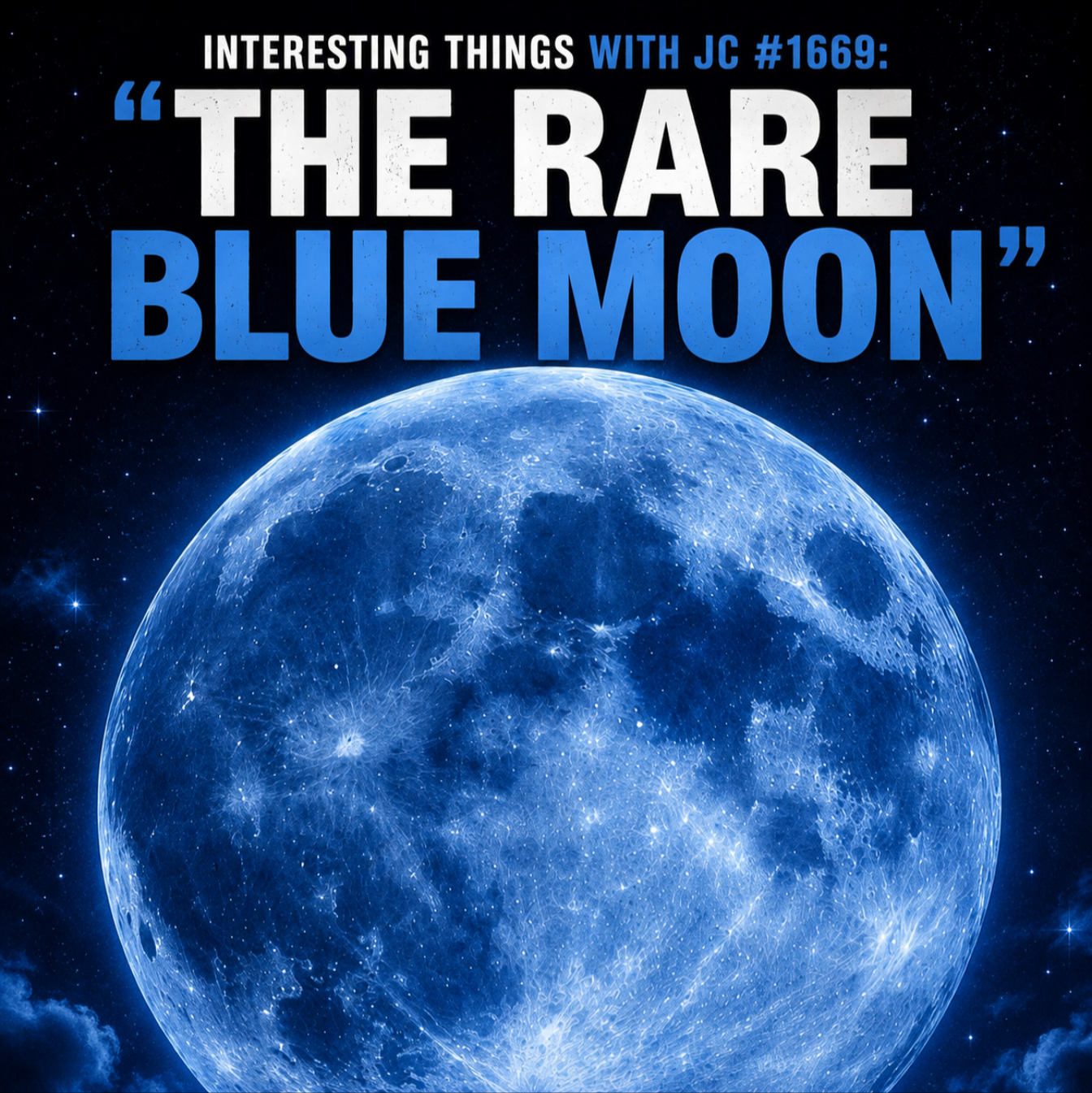
Promotional graphic for Interesting Things with JC #1669: “The Rare Blue Moon.” A large blue-tinted full Moon fills the lower half of the image against a dark starry sky. Bold white and blue text at the top reads: “Interesting Things with JC #1669: ‘The Rare Blue Moon.’”
Transcript
Interesting Things with JC #1669:
"The Rare Blue Moon"
The Moon rises with a name it will not appear to deserve.
It will not look blue. It may come up pale yellow, orange, or white, depending on the horizon and the air. To most people, it will look like an ordinary full Moon. But earlier that morning, at 4:45 a.m. Eastern time, the Moon reached fullness for the second time in May, and that is what gives it the name Blue Moon.
The Moon does not move by our months. It moves through its own cycle, from full Moon to full Moon, in about 29 and a half days. Our calendar months are uneven human containers placed over that rhythm. Most of the time, one full Moon fits neatly inside one month. But when a full Moon lands at the very beginning of a long month, there is just enough room for another one before the month ends.
That is what happens in May 2026. The first full Moon comes on May 1. The second comes on May 31. By the modern monthly definition, that second full Moon is a Blue Moon.
There is an older seasonal definition, too: the third full Moon in a season that has four full Moons. So even the name carries a little history, and a little confusion. The Moon itself has not changed. What changed was the way people counted it.
This one has another distinction. It is also a micromoon, because it comes near apogee, the farthest part of the Moon’s orbit from Earth. That can make it appear slightly smaller and dimmer than usual, though most people would never notice without a comparison.
So this is a rare sky event that does not announce itself. It is named, but not colored. It is measurable, but subtle. The interesting part is not hidden on the Moon’s surface. It is in the overlap between the Moon’s orbit and the calendar on the wall.
The Moon keeps moving. The calendar tries to keep count. And every now and then, the count leaves room for one more full Moon.
These are interesting things, with JC.
Student Worksheet
Comprehension Questions:
What time does the episode say the Moon reached fullness on May 31, 2026?
Why is the May 31, 2026 full Moon called a Blue Moon?
Why will this Blue Moon probably not look blue?
About how long is the Moon’s cycle from full Moon to full Moon?
What does apogee mean?
Analysis Questions:
Explain how May 2026 can contain two full Moons even though most months contain only one.
Compare the modern monthly definition of Blue Moon with the older seasonal definition.
Why does the episode say the interesting part is “in the overlap between the Moon’s orbit and the calendar on the wall”?
Explain why the term micromoon describes position and appearance, not a different kind of Moon.
Reflection Prompt: In 4–6 sentences, describe a time when a name or headline made something sound different from what it actually was. Connect your example to the phrase Blue Moon.
Difficulty Scaling:
Support: Answer each question in 1–2 complete sentences using the vocabulary list.
Core: Include at least one transcript detail in each analysis answer.
Challenge: Create a labeled May 2026 timeline showing May 1, May 31, and the roughly 29.5-day lunar cycle.
Student Output: Submit complete written answers, one reflection paragraph, and either a timeline, diagram, or short explanatory model.
Academic Integrity Guidance: Use your own words. Do not copy from astronomy apps, websites, or AI tools. When using the episode, refer to specific details from the transcript.
Teacher Guide
Quick Start: Begin with the podcast audio. Do not define Blue Moon first; let students listen for the contrast between the name and the actual appearance.
Pacing Guide (audio-first):
0–3 minutes: Bell ringer prediction.
3–7 minutes: Play podcast audio once without interruption.
7–10 minutes: Students write the main claim in one sentence.
10–18 minutes: Vocabulary and calendar modeling.
18–32 minutes: Worksheet comprehension and analysis.
32–42 minutes: Discussion and misconception check.
42–45 minutes: Exit ticket.
Bell Ringer: “When you hear the phrase Blue Moon, what do you expect to see? What else might the name mean?”
Audio Guidance + Fallback: Play the audio first and ask students to mark three lines that explain why the event is rare. If audio is unavailable, read the transcript aloud and pause after each paragraph for a one-sentence student summary.
Time-on-Task: Standard lesson is 45 minutes. Extended version is 60 minutes with timeline modeling and peer explanation.
Materials:
Podcast audio or transcript
Student worksheet
May 2026 calendar
Vocabulary list
Optional Moon phase diagram
Vocabulary Prep: Pre-teach Blue Moon, lunar cycle, micromoon, and apogee. Save seasonal Blue Moon for comparison after students understand the monthly definition.
Misconceptions:
A Blue Moon usually does not appear blue.
The Moon does not follow calendar months.
A micromoon is not a tiny Moon; it is a full Moon near apogee.
Rare does not always mean visually dramatic.
Discussion Prompts:
Why can a scientifically accurate event still be visually subtle?
How do human calendars shape the way we name natural events?
Why should science communicators be careful with dramatic terms?
Formative Checkpoints:
Students identify May 31 as the second full Moon of May 2026.
Students explain the 29.5-day cycle in relation to a 31-day month.
Students distinguish monthly and seasonal Blue Moon definitions.
Students connect micromoon to apogee.
Differentiation:
Support: Provide sentence frames and a partially completed May 2026 timeline.
Core: Require evidence from the transcript in written answers.
Advanced: Ask students to compare Blue Moon, micromoon, and supermoon terminology.
Multilingual Learners: Pair each vocabulary term with a visual cue and oral pronunciation practice.
Assessment Differentiation: Students may demonstrate understanding through written answers, oral explanation, labeled diagram, or short recorded explanation.
Time Flexibility: For a 25-minute class, use the audio, vocabulary, comprehension questions, and exit ticket. For 60 minutes, add timeline modeling and peer review.
Substitute Readiness: The lesson works with only the transcript, worksheet, and answer key. The substitute should begin by reading the transcript aloud.
Engagement Strategy: Show a May 2026 calendar and ask students to count from May 1 to May 31. Then compare that span with the Moon’s roughly 29.5-day phase cycle.
Extensions: Students can create a one-paragraph public skywatching notice explaining what people should and should not expect to see.
Cross-Curricular:
Math: Calculate elapsed days and compare natural cycles with calendar units.
ELA: Analyze how names and expectations affect interpretation.
History: Examine how older naming traditions can persist alongside modern definitions.
Technology: Use a Moon phase simulator or calendar tool to model lunar timing.
SEL: Students practice patience, careful observation, and evidence-based correction of first impressions.
Skill Emphasis: Precise language, evidence-based reasoning, calendar modeling, scientific explanation, and responsible public communication.
Answer Key:
Comprehension 1: 4:45 a.m. Eastern time.
Comprehension 2: It is the second full Moon in May 2026.
Comprehension 3: Blue Moon is a naming convention; the Moon usually does not turn blue.
Comprehension 4: About 29.5 days.
Comprehension 5: Apogee is the Moon’s farthest orbital point from Earth.
Analysis 1: A full Moon at the start of a 31-day month leaves enough time for another full Moon near the end.
Analysis 2: Monthly means the second full Moon in a calendar month; seasonal means the third full Moon in a season with four full Moons.
Analysis 3: The event comes from the interaction between the Moon’s natural cycle and human calendar boundaries.
Analysis 4: A micromoon is a full Moon near apogee, so it may appear slightly smaller or dimmer but is not physically a different Moon.
Quiz Answers: 1-B, 2-C, 3-B, 4-B, 5-B.
Quiz
Why is the May 31, 2026 full Moon called a Blue Moon?
A. It reflects blue sunlight
B. It is the second full Moon in May
C. It is the first full Moon of spring
D. It occurs during a lunar eclipseAbout how long is the Moon’s cycle from full Moon to full Moon?
A. 7 days
B. 14 days
C. 29.5 days
D. 365 daysWhat is the older seasonal definition of a Blue Moon?
A. The first full Moon after winter
B. The third full Moon in a season with four full Moons
C. Any full Moon that appears blue
D. The brightest full Moon of the yearWhat does micromoon mean in this episode?
A. A Moon hidden by clouds
B. A full Moon near apogee
C. A Moon during a solar eclipse
D. A new Moon near EarthWhat is the main scientific idea of the episode?
A. The Moon changes color every month
B. The calendar and lunar cycle sometimes overlap in rare ways
C. The Moon stops moving during a Blue Moon
D. Blue Moons happen every May
Assessment
Open-Ended Questions:
Explain how the Moon’s roughly 29.5-day cycle and the length of May 2026 create a Blue Moon. Use at least two vocabulary terms.
The episode says the Moon is “named, but not colored.” Explain what this means and why it matters for science communication.
3–2–1 Rubric:
3: Clearly explains the monthly Blue Moon, connects lunar cycle to calendar timing, uses vocabulary accurately, and supports the answer with transcript evidence.
2: Explains the basic idea but misses one important detail, such as the seasonal definition, apogee, or micromoon connection.
1: Gives an incomplete explanation or incorrectly claims the Moon turns blue.
Exit Ticket: In one sentence, explain why the May 31, 2026 full Moon is rare even though it may look ordinary.
Standards Alignment
NGSS HS-ESS1-4 — Earth’s Place in the Universe: Students use evidence about repeated lunar patterns to explain how predictable Moon phases can interact with human calendar systems.
NGSS Science and Engineering Practice — Developing and Using Models: Students create or interpret a May 2026 timeline model showing how a 29.5-day lunar cycle can produce two full Moons in one month.
NGSS Crosscutting Concept — Patterns: Students identify the repeating lunar phase pattern and explain how calendar boundaries make one occurrence appear rare.
CCSS.ELA-LITERACY.RST.9-10.2 — Technical Text Central Ideas: Students determine the central idea of the transcript and explain how specific details develop the Blue Moon concept.
CCSS.ELA-LITERACY.RST.11-12.4 — Domain-Specific Vocabulary: Students interpret astronomy terms such as apogee, micromoon, lunar cycle, and Blue Moon in context.
CCSS.ELA-LITERACY.WHST.9-10.2 — Explanatory Writing: Students write clear scientific explanations using accurate vocabulary, relevant evidence, and logical sequencing.
CCSS.ELA-LITERACY.SL.9-10.1 — Collaborative Discussion: Students build on peer observations about Moon names, calendar systems, and scientific accuracy during structured discussion.
ISTE 1.3 Knowledge Constructor: Students gather and organize information from the episode, calendar evidence, and optional astronomy tools to construct an accurate explanation of the event.
ISTE 1.6 Creative Communicator: Students create a timeline, diagram, or public skywatching note that communicates a scientific idea clearly for a nonexpert audience.
C3 D2.Geo.2.9-12 — Human Systems and Spatial Patterns: Students explain how human systems for measuring time influence the way people label and interpret natural events.
C3 D2.His.14.9-12 — Historical Context and Interpretation: Students compare the modern monthly Blue Moon definition with the older seasonal definition to understand how terminology changes over time.
CTE / Career Readiness — Communication and Technical Accuracy: Students practice explaining a public science event without exaggeration, using precise terms and evidence-based reasoning.
Career Readiness — Information Literacy: Students distinguish observable facts from naming conventions and evaluate whether a term describes appearance, timing, or position.
Homeschool / Lifelong Learning: Learners connect direct sky observation, calendar reasoning, and scientific vocabulary to build independent understanding of astronomy events.
Show Notes
This lesson uses the May 31, 2026 Blue Moon to help students understand how a sky event can be rare without appearing visually dramatic. The episode is classroom-relevant because it connects Moon phases, calendars, naming traditions, and careful observation in a way that is easy to model and discuss. Students learn that accurate science communication depends on discipline, evidence, and the ability to explain what a name means before assuming what an event will look like.
References
EarthSky. (2026). What is a micromoon? We have 2 coming in May.https://earthsky.org/astronomy-essentials/micromoon-definition-full-moon-apogee/
NASA. (2026). Moon phases.https://science.nasa.gov/moon/moon-phases/
NASA. (n.d.). Top moon questions.https://science.nasa.gov/moon/top-moon-questions/
The Guardian. (2026). What is a blue micromoon and when is the best time to see it this weekend?https://www.theguardian.com/science/2026/may/30/what-is-rare-blue-micromoon
New York Post. (2026). The only Blue Moon of 2026 rises this weekend — here’s how to get the best view of the “micromoon.”https://nypost.com/2026/05/30/science/how-to-get-the-best-views-of-mays-full-blue-moon-this-weekend/