1682: "Sea Otters Hold Hands when they Sleep"
Interesting Things with JC #1682: "Sea Otters Hold Hands when they Sleep" – A sea otter falls asleep while floating on the Pacific Ocean, but the water beneath it never stops moving; by morning, staying in the same place is a problem it somehow solves.
Curriculum - Episode Anchor
Episode Title: Sea Otters Hold Hands when they Sleep
Episode Number: 1682
Host: JC
Audience: Grades 9–12, Introductory College, Homeschool Learners, Lifelong Learners
Subject Area: Marine Biology, Animal Behavior, Ecology
Lesson Overview
Objectives:
Explain why sea otters face challenges when sleeping in ocean environments.
Describe how kelp forests help sea otters remain stationary while resting.
Distinguish between common public perceptions and observed scientific behaviors of sea otters.
Analyze how animal behaviors develop as practical adaptations to environmental conditions.
Essential Question:
How do sea otters successfully rest in an environment that is constantly moving?
Success Criteria:
I can explain why drifting is a challenge for sea otters.
I can identify the role of kelp in sea otter survival.
I can describe the difference between hand-holding behavior and kelp anchoring behavior.
I can connect animal behavior to environmental adaptation.
Student Relevance Statement:
Students encounter examples of adaptation throughout nature. Understanding how animals solve survival challenges helps develop scientific observation and critical-thinking skills.
Real-World Connection:
Marine biologists study sea otter behavior to better understand coastal ecosystems and conservation needs.
Workforce Reality:
Wildlife biologists, marine ecologists, aquarium professionals, conservation scientists, and environmental educators use behavioral observations to support research and species management.
Key Vocabulary
Sea Otter(SEE OTT-er) — A marine mammal that spends most of its life in the ocean.
Kelp(KELP) — Large brown algae that forms underwater forests in coastal waters.
Raft(RAFT) — A group of sea otters floating together.
Current(CUR-rent) — A continuous movement of ocean water.
Adaptation(ad-ap-TAY-shun) — A characteristic or behavior that improves survival.
Marine Mammal(muh-REEN MAM-uhl) — A mammal that lives primarily in marine environments.
Rehabilitation(ree-huh-bil-ih-TAY-shun) — Care provided to injured or orphaned animals before release.
Ecosystem(EE-koh-sis-tem) — A community of living organisms interacting with their environment.
Behavior(bih-HAYV-yer) — The actions or responses of an organism.
Conservation(kon-ser-VAY-shun) — The protection and management of natural resources and wildlife.
Narrative Core
Open:
The Pacific Ocean never stops moving. Waves, currents, and wind constantly shift the water's surface.
Info:
Sea otters spend much of their lives in the ocean and rarely come ashore to sleep. This creates a unique challenge because they can drift away while resting.
Details:
To prevent drifting, sea otters often gather in groups called rafts and wrap themselves in giant kelp. The kelp acts like a natural anchor. Mothers frequently stay in contact with their pups, and otters may rest close together. In aquariums and rehabilitation centers, sea otters are sometimes observed holding paws while sleeping to avoid drifting apart.
Reflection:
Many people interpret hand-holding as a sign of affection. While social bonds exist, the behavior often serves a practical purpose related to survival and maintaining position in moving water.
Closing:
These are interesting things, with JC.
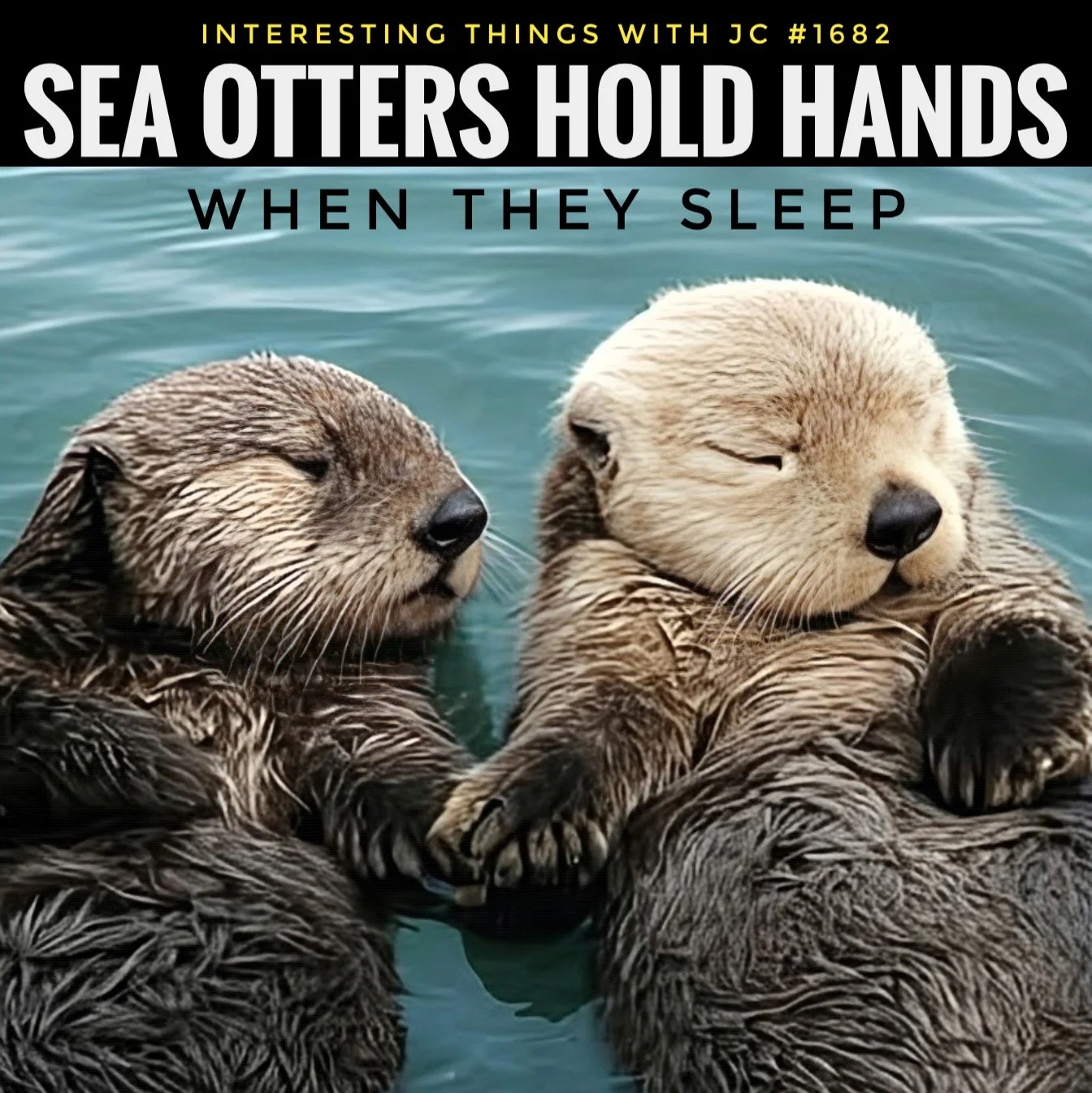
Two sea otters float on calm ocean water while holding paws. The image includes the title “Sea Otters Hold Hands When They Sleep” and identifies it as Interesting Things with JC episode #1682.
Transcript
Interesting Things with JC #1682:
"Sea Otters Hold Hands when they Sleep"
A sea otter can spend the night floating on the surface of the Pacific Ocean while currents and wind slowly push the water around it.
That creates a problem.
Unlike seals, sea otters rarely come ashore to sleep. Most of their lives are spent in the water, so they need a way to rest without drifting away.
Many people have seen photographs of sea otters holding hands while they sleep. The behavior is real, but it's only part of the story.
In the wild, sea otters often gather in groups called rafts. When it's time to rest, they commonly wrap themselves in giant kelp. The kelp acts like a natural anchor, helping keep them from being carried away by currents.
They also sleep close together. Mothers frequently maintain contact with their pups, and otters within a raft may rest against one another as they float.
The famous hand-holding behavior is most often observed in aquariums and rehabilitation settings, where otters sometimes clasp paws while resting to prevent drifting apart.
What looks like a gesture of affection is usually a practical solution to a simple problem.
How do you sleep in a home that never stops moving?
For sea otters, the answer is often kelp, companionship, and whatever helps them stay where they are until morning.
These are interesting things, with JC.
Student Worksheet
Comprehension Questions
Why is drifting a challenge for sea otters?
What is a raft?
How does kelp help sea otters while they sleep?
Where is hand-holding behavior most commonly observed?
Why might sea otters rest close together?
Analysis Questions
Why is kelp considered an adaptation that helps sea otters survive?
How does scientific observation help correct common misconceptions about animal behavior?
Compare sleeping strategies used by sea otters and humans.
Reflection Prompt
Describe a situation in which humans use tools or structures to solve a problem similar to drifting. How is that solution comparable to the sea otter's use of kelp?
Difficulty Scaling
Emerging: Answer comprehension questions using complete sentences.
Proficient: Complete comprehension and analysis questions.
Advanced: Write a paragraph explaining how environmental pressures influence animal behavior.
Student Output Expectations
Minimum: Five complete responses.
Target: One paragraph analysis supported by evidence from the episode.
Advanced: A written explanation connecting adaptation, habitat, and survival.
Academic Integrity Guidance
Use information from the episode and lesson materials.
Write responses in your own words.
Support conclusions with evidence rather than copying text directly.
Teacher Guide
Quick Start
Play the episode.
Discuss the essential question.
Complete worksheet activities.
Review adaptation concepts.
Conduct assessment and exit ticket.
Pacing Guide (Audio-First)
Bell Ringer — 5 minutes
Podcast Listening — 5 minutes
Guided Discussion — 10 minutes
Worksheet Completion — 15 minutes
Assessment and Exit Ticket — 10 minutes
Bell Ringer
Ask students: "How would you sleep if your bed floated in moving water?"
Have students record one possible solution.
Audio Guidance
Encourage students to listen for challenges and solutions.
Have students identify evidence supporting the main idea.
Audio Fallback
Use the transcript if audio is unavailable.
Read aloud or assign partner reading.
Time on Task
Total lesson time: 45–50 minutes.
Materials
Episode audio or transcript
Student worksheet
Writing materials
Projector or display (optional)
Vocabulary Strategy
Pre-teach kelp, raft, adaptation, and current.
Reinforce vocabulary through contextual examples.
Misconceptions
Sea otters do not always hold hands while sleeping.
Hand-holding is not necessarily evidence of human-like emotions.
Kelp forests provide ecological benefits beyond anchoring otters.
Discussion Prompts
Why is adaptation important for survival?
How can observations be misunderstood?
What environmental challenges do marine mammals face?
Formative Checkpoints
Students identify the problem presented in the episode.
Students explain the function of kelp.
Students distinguish between observation and assumption.
Differentiation
Provide vocabulary supports for emerging learners.
Allow verbal responses when appropriate.
Use visual diagrams of kelp forests and sea otter rafts.
Assessment Differentiation
Written responses
Oral presentation
Graphic organizer option
Time Flexibility
Shortened lesson: Focus on audio and comprehension.
Extended lesson: Research kelp forest ecosystems.
Substitute Readiness
Transcript-based instruction can replace audio.
Independent worksheet completion requires minimal preparation.
Engagement Strategy
Show images of sea otters in kelp forests.
Ask students to infer why animals develop specific behaviors.
Extensions
Research kelp forest ecosystems.
Compare sea otter adaptations to those of seals or dolphins.
Investigate conservation efforts involving sea otters.
Cross-Curricular Connections
Biology: Adaptation and ecology
Environmental Science: Coastal ecosystems
Geography: Pacific Ocean habitats
Language Arts: Evidence-based analysis
SEL Connection
Explore the value of cooperation and support within animal groups.
Discuss how observation influences understanding.
Skill Emphasis
Scientific observation
Evidence evaluation
Critical thinking
Informational reading
Scientific communication
Answer Key
Drifting occurs because currents and wind move ocean water.
A raft is a group of sea otters floating together.
Kelp acts as a natural anchor.
Hand-holding is most often observed in aquariums and rehabilitation settings.
Resting together helps reduce separation and drifting.
Adaptations improve survival in changing environments.
Scientific observation helps distinguish facts from assumptions.
Quiz
Multiple Choice Questions
What challenge do sea otters face while sleeping?
A. Finding food
B. Avoiding drifting away
C. Avoiding sunlight
D. Finding freshwater
What is a group of sea otters called?
A. Colony
B. School
C. Raft
D. Herd
What natural feature often helps anchor sea otters?
A. Coral
B. Sand
C. Sea grass
D. Giant kelp
Hand-holding behavior is most commonly observed in:
A. Deep ocean trenches
B. Freshwater rivers
C. Aquariums and rehabilitation settings
D. Arctic ice fields
The episode primarily demonstrates:
A. Migration
B. Adaptation
C. Hibernation
D. Domestication
Assessment
Open-Ended Questions
Explain how kelp helps sea otters survive while sleeping in the ocean.
Describe how the episode demonstrates the relationship between behavior and environmental challenges.
3–2–1 Rubric
3 – Exceeds Expectations
Accurate explanation
Strong supporting evidence
Clear connection between adaptation and survival
2 – Meets Expectations
Mostly accurate explanation
Some supporting evidence
Adequate connection to lesson concepts
1 – Developing
Limited explanation
Minimal evidence
Incomplete understanding of adaptation
Exit Ticket
What is one new fact you learned about sea otters?
What adaptation discussed today helps sea otters survive?
Why is scientific observation important when studying animal behavior?
Standards Alignment
NGSS (Next Generation Science Standards)
HS-LS2-6: Evaluate claims, evidence, and reasoning regarding interactions in ecosystems. Students analyze how kelp forests support sea otter survival through habitat functions and behavioral adaptations.
HS-LS4-2: Construct explanations based on evidence that evolutionary processes result in adaptation. Students explain how sleeping behaviors help sea otters meet environmental challenges.
HS-LS4-5: Evaluate evidence supporting adaptation and survival in changing environments. Students connect ocean currents, kelp forests, and resting behaviors.
CCSS – English Language Arts
CCSS.ELA-LITERACY.RST.9-10.2: Determine central ideas of scientific texts and summarize key supporting details from the episode.
CCSS.ELA-LITERACY.RST.11-12.1: Cite specific evidence to support scientific analysis and conclusions.
CCSS.ELA-LITERACY.WHST.9-12.2: Write explanatory texts that communicate scientific understanding clearly and accurately.
CCSS.ELA-LITERACY.SL.9-12.1: Participate effectively in collaborative discussions using evidence-based reasoning.
C3 Framework for Social Studies
D2.Geo.4.9-12: Analyze relationships between environmental conditions and human or animal activity.
D3.1.9-12: Gather and evaluate evidence from informational sources.
D4.1.9-12: Construct arguments using evidence and reasoning.
ISTE Standards for Students
Knowledge Constructor 3a: Plan and employ research strategies to investigate marine ecosystems.
Knowledge Constructor 3d: Build knowledge by actively exploring real-world environmental issues.
Computational Thinker 5b: Analyze data and observations to identify patterns in animal behavior.
Career and Technical Education (CTE)
Environmental and Natural Resources Career Pathway: Examine ecosystem interactions and species adaptations.
Agriculture, Food, and Natural Resources Standards: Evaluate environmental factors influencing organism survival.
Marine Science Career Readiness: Apply observational skills used by field researchers and conservation professionals.
UK National Curriculum Alignment
Science (Key Stage 4): Relationships between organisms and environments.
Working Scientifically: Use evidence to support explanations and evaluate claims.
Ecology: Understand interdependence and adaptation within ecosystems.
International Baccalaureate (MYP Science)
Criterion B: Inquiring and Designing: Develop questions about biological adaptations.
Criterion C: Processing and Evaluating: Interpret observations and evidence.
Criterion D: Reflecting on the Impacts of Science: Examine how scientific understanding informs conservation efforts.
Homeschool and Lifelong Learning Alignment
Develop scientific literacy through observation and evidence-based reasoning.
Strengthen environmental awareness and ecological understanding.
Practice critical thinking by evaluating common assumptions against observed evidence.
Connect everyday curiosity to formal scientific inquiry.
Measurable Skills Demonstrated
Identify environmental challenges faced by organisms.
Explain adaptive behaviors using scientific evidence.
Distinguish observation from interpretation.
Analyze informational media for accuracy and supporting details.
Communicate scientific concepts through written and verbal responses.
Apply ecological concepts to real-world biological examples.
Show Notes
Sea otters spend much of their lives floating in coastal waters, creating a unique challenge when it is time to sleep. This lesson explores how sea otters use kelp forests, social behavior, and environmental adaptations to remain safe while resting. Students investigate the relationship between habitat and behavior while practicing evidence-based reasoning, scientific observation, and ecological thinking.
References
National Oceanic and Atmospheric Administration. (2026). Creature Feature Sea Otter You Otter Love Them. https://sanctuaries.noaa.gov/magazine/4/sea-otter/
Monterey Bay Aquarium. (2024). Sea otter animal guide. https://www.montereybayaquarium.org/animals/animals-a-to-z/sea-otter
Smithsonian's National Zoo & Conservation Biology Institute. (2019). Evolution Fast Track: Otter Genetic History Provides Clues for Future Recovery https://nationalzoo.si.edu/center-conservation-genomics/news/evolution-fast-track-otter-genetic-history-provides-clues-future
National Geographic Society. (2024). Sea otter. https://www.nationalgeographic.com/animals/mammals/facts/sea-otter