1683: "Is Jell-O Made from Horses?"
Interesting Things with JC #1683: "Is Jell-O Made from Horses?" – People still say Jell-O is made from horses. The rumor has survived for decades, even though the story behind it is something else entirely.
Curriculum - Episode Anchor
Episode Title: Is Jell-O Made from Horses?
Episode Number: 1683
Host: JC
Audience: Grades 9–12, introductory college, homeschool, lifelong learners
Subject Area: Biology, chemistry, food science
Framework Basis: Curriculum structure follows the provided production framework.
Lesson Overview
Objectives:
Explain how collagen becomes gelatin through heating and processing.
Describe how gelatin forms a water-trapping protein network as it cools.
Distinguish rumor, history, and modern food-production evidence.
Connect food texture to molecular structure and chemistry.
Essential Question: How can a familiar food reveal the chemistry of proteins?
Success Criteria: Students can accurately explain gelatin formation, identify modern gelatin sources, and support claims with evidence.
Student Relevance: Students encounter food rumors often; this lesson builds source-checking and science reasoning.
Real-World Connection: Gelatin is used in food, medicine capsules, photography, and biotechnology.
Workforce Reality: Food science requires careful sourcing, sanitation, chemistry knowledge, labeling accuracy, and public trust.
Key Vocabulary
Collagen(KOL-uh-jin): A structural protein found in animal connective tissue.
Gelatin(JEL-uh-tin): A processed form of collagen that can form gels.
Protein(PROH-teen): A molecule made of amino acid chains.
Connective tissue(kuh-NEK-tiv TISH-oo): Tissue that supports or binds body structures.
Hydrolysis(hy-DROL-uh-sis): Chemical breakdown involving water.
Gel network(jel NET-wurk): A microscopic structure that traps liquid.
Acid treatment(AS-id TREET-mint): Processing method that helps release collagen.
Alkali treatment(AL-kuh-ly TREET-mint): Basic chemical treatment used in gelatin production.
Narrative Core
Open: Jell-O has a long-running rumor attached to it: that it is made from horses.
Info: The real story begins with collagen, the main structural protein in mammals.
Details: When collagen from animal connective tissues is cleaned, treated, heated, purified, dried, and ground, it becomes gelatin. In hot water, gelatin protein chains spread apart; as they cool, they reconnect into a loose network that traps water.
Reflection: The “horse” rumor likely comes from older gelatin production, when animal sources varied more widely. Modern commercial gelatin is typically made from pork skin or cattle hides and bones.
Closing: These are interesting things, with JC.
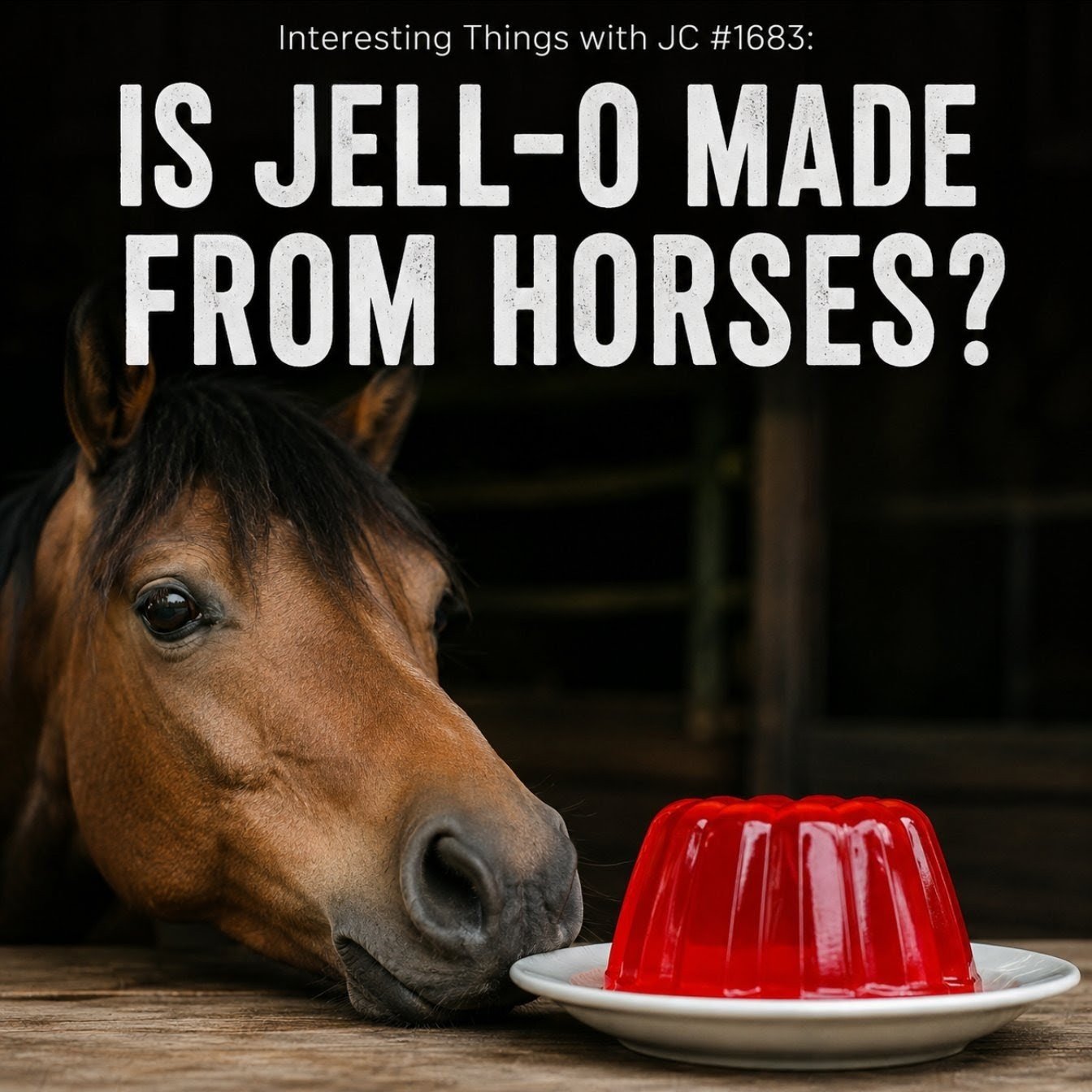
Promotional graphic for Interesting Things with JC #1683. A brown horse rests its head on a wooden table next to a bright red gelatin dessert on a white plate. Large white text reads, “Is Jell-O Made from Horses?” against a dark background.
Transcript
Interesting Things with JC #1683:
“Is Jell-O Made from Horses?”
Jell-O has carried around a strange rumor for decades.
Somewhere along the way, people started saying it was made from horses.
The truth is a little different, and it starts with a protein called collagen.
Collagen is the main structural protein in animals. It's found in skin, bones, tendons, cartilage, and other connective tissues. In fact, it's the most abundant protein in mammals.
When collagen is heated and processed, its tightly wound molecular structure begins to break apart. The result is gelatin.
Gelatin has an unusual property. In hot water, it dissolves into individual protein chains. As it cools, those chains partially reconnect into a microscopic network that traps water. That's what gives Jell-O its familiar wobble.
Modern commercial gelatin is typically produced from pork skin or from cattle hides and bones. The raw materials are cleaned, treated with acids or alkalis to release the collagen, then filtered, purified, dried, and ground into a powder.
Could horses have been used historically? Yes. In earlier eras, gelatin could come from various animal sources depending on what was available. That small historical fact is probably where the rumor began.
But modern Jell-O isn't a horse product.
What's really happening is chemistry. A structural protein is transformed into a substance that can hold many times its weight in water and form a soft solid without any cooking once it's cooled.
The next time a bowl of Jell-O jiggles, you're watching millions of protein strands forming a microscopic three-dimensional network.
These are interesting things, with JC.
Student Worksheet
Comprehension Questions:
What protein is the starting material for gelatin?
Where is collagen found in animals?
What happens to gelatin in hot water?
What happens as gelatin cools?
What are common modern commercial sources of gelatin?
Analysis Questions:
Explain why the horse rumor may have started but why it does not accurately describe modern Jell-O.
Describe how gelatin’s microscopic structure creates its visible wobble.
Why is “made from animals” more accurate than “made from horses”?
Reflection Prompt: Write one paragraph explaining how science can clarify a popular food rumor.
Difficulty Scaling: Emerging students may draw and label the process; advanced students should include collagen structure, processing, and gel-network formation.
Student Output: Submit complete answers plus one labeled diagram or paragraph model.
Academic Integrity Guidance: Use your own wording and cite class sources when making factual claims.
Teacher Guide
Quick Start: Play the podcast first, then ask students to write the claim they heard and the evidence that corrected it.
Pacing Guide: 3 minutes audio, 5 minutes vocabulary, 10 minutes worksheet, 10 minutes discussion, 7 minutes quiz or exit ticket.
Bell Ringer: “What food rumor have you heard, and how would you test whether it is true?”
Audio Guidance: Students listen for three ideas: collagen source, gelatin behavior in water, and rumor correction.
Audio Fallback: Read the transcript aloud and pause after each paragraph for evidence notes.
Time-on-Task: Standard lesson fits 35 minutes; expanded version fits 50 minutes with diagram modeling.
Materials: Transcript, worksheet, projector or board, optional gelatin box label, optional warm/cool water demonstration.
Vocabulary Prep: Pre-teach collagen, gelatin, protein, hydrolysis, and gel network.
Misconceptions: Gelatin is not plant-based; modern commercial gelatin is not accurately described as horse-based; “animal-derived” does not mean “unclean” or unsafe by itself.
Discussion Prompts:
What makes a food claim scientifically testable?
Why do rumors survive when better explanations exist?
How does molecular structure affect texture?
Formative Checkpoints: Ask students to define gelatin, sketch the cooling network, and identify the corrected claim.
Differentiation: Provide sentence starters, vocabulary cards, diagrams, or extension reading depending on readiness.
Assessment Differentiation: Allow written, oral, or diagram-based responses while keeping the same science criteria.
Time Flexibility: Shorten by assigning only comprehension questions; extend by adding food-label research.
Substitute Readiness: Use transcript-first instruction, worksheet completion, and quiz as an independent lesson.
Engagement Strategy: Bring in a sealed gelatin box and ask students to predict which ingredients create the texture.
Extensions: Compare gelatin with pectin, agar, or starch gels.
Cross-Curricular: Biology connects to proteins; chemistry connects to molecular structure; media literacy connects to rumor evaluation.
SEL: Emphasize curiosity, correction without embarrassment, and respectful discussion of food choices.
Skill Emphasis: Evidence-based explanation, careful wording, and responsible scientific communication.
Answer Key: Collagen; skin, bones, tendons, cartilage, connective tissues; hot water separates protein chains; cooling forms a water-trapping network; common sources include pork skin and cattle hides/bones; the rumor likely comes from older variable animal sourcing.
Quiz
What is collagen?
A. A plant sugar
B. A structural animal protein
C. A synthetic dye
D. A mineral saltWhat is gelatin made from?
A. Processed collagen
B. Pure sugar crystals
C. Corn starch only
D. Plant celluloseWhy does gelatin become wobbly when cooled?
A. It freezes solid
B. It releases carbon dioxide
C. Protein strands form a network that traps water
D. Sugar turns into glassWhich source is most typical for modern commercial gelatin?
A. Wheat stems
B. Pork skin or cattle hides and bones
C. Tree bark only
D. Sea saltWhat is the best correction to the horse rumor?
A. Jell-O is always made from horses
B. Jell-O is never related to animal products
C. Gelatin is animal-derived, but modern Jell-O is not accurately described as horse-based
D. Gelatin is a metal
Assessment
Open-Ended Questions:
Explain the process that turns collagen into gelatin and then into a gel.
Use evidence from the episode to explain how a partial historical fact can become a misleading modern rumor.
3–2–1 Rubric:
3: Accurate science, clear explanation, correct vocabulary, evidence included.
2: Mostly accurate, some vocabulary used, explanation partly complete.
1: Limited accuracy, missing process details, unclear evidence.
Exit Ticket: In one sentence, explain why Jell-O jiggles.
Standards Alignment
NGSS — Next Generation Science Standards
HS-LS1-1: Construct an explanation based on evidence for how the structure of proteins contributes to biological function. Students identify collagen as a structural protein, explain its role in connective tissues, and connect molecular structure to observable physical properties.
HS-LS1-6: Construct and revise explanations based on evidence regarding the cycling and transformation of matter in biological systems. Students explain how collagen is processed into gelatin through chemical and physical changes and distinguish between biological structures and manufactured food ingredients.
HS-PS1-3: Plan and conduct investigations to gather evidence comparing molecular structures to infer material properties. Students analyze how gelatin behaves in hot and cool water and connect molecular interactions to gel formation.
Science and Engineering Practice – Constructing Explanations: Students use evidence from the episode to explain why the horse rumor is inaccurate in a modern context and support conclusions with scientific reasoning rather than anecdotal claims.
Crosscutting Concept – Structure and Function: Students evaluate how changes in protein structure create new material properties and recognize that microscopic structures often determine macroscopic behavior.
CCSS — Common Core State Standards for Literacy in Science and Technical Subjects
RST.9-10.2: Determine central ideas of a scientific text and provide an accurate summary of the relationship between collagen and gelatin.
RST.9-10.4: Determine the meaning of domain-specific scientific vocabulary and apply terminology correctly in written and oral responses.
RST.11-12.1: Cite specific textual evidence to support analysis of science and technical information and support claims about gelatin production using evidence from the transcript.
RST.11-12.8: Evaluate hypotheses, data, and conclusions in scientific explanations and assess the validity of claims regarding food production.
WHST.9-12.2: Write informative and explanatory texts that communicate scientific concepts clearly using precise academic language.
WHST.9-12.9: Draw evidence from informational texts to support analysis, reflection, and scientific explanation.
SL.9-12.1: Participate effectively in collaborative discussions involving scientific claims, evidence, and reasoned conclusions.
ISTE Standards
ISTE 1.3 Knowledge Constructor: Critically evaluate information sources, distinguish evidence-based scientific explanations from misinformation, and synthesize information into accurate conclusions.
ISTE 1.1 Empowered Learner: Develop independent learning strategies for investigating scientific questions and evaluating evidence.
ISTE 1.7 Global Collaborator: Engage in evidence-based discussions and communicate findings respectfully and effectively.
Career and Technical Education (CTE) Connections
Food Science Pathway: Analyze ingredient sourcing, processing methods, and the relationship between manufacturing procedures and product characteristics.
Biotechnology Pathway: Examine how biological materials are transformed into commercial products through controlled industrial processes.
Quality Assurance and Safety: Explore sanitation, purification, testing, and regulatory considerations in food production.
Manufacturing and Processing Technologies: Investigate industrial procedures used to extract, refine, and package gelatin products.
Consumer Product Development: Understand how chemistry influences texture, stability, shelf life, and consumer experience.
C3 Framework for Social Studies
D1.5.9-12: Determine useful questions that clarify claims, assumptions, and sources of information.
D3.1.9-12: Gather and evaluate information from multiple sources while assessing relevance and credibility.
D3.2.9-12: Evaluate scientific explanations and evidence to determine the strength of competing claims.
D4.1.9-12: Construct arguments using evidence while addressing alternative viewpoints and interpretations.
Students investigate how historical facts can evolve into persistent public misconceptions and how evidence can correct those misconceptions.
Career Readiness Skills
Develop critical-thinking skills by evaluating claims using verifiable evidence.
Demonstrate scientific literacy through interpretation and communication of scientific information.
Apply problem-solving strategies to explain real-world phenomena using biological and chemical concepts.
Evaluate source reliability and identify misinformation in everyday contexts.
Use precise technical vocabulary when explaining scientific processes and results.
Recognize the importance of accuracy, documentation, and responsible communication in scientific, manufacturing, and food-industry careers.
Homeschool and Lifelong Learning Alignment
Connect everyday experiences with scientific principles through familiar consumer products.
Encourage curiosity-driven inquiry and evidence-based investigation.
Demonstrate how chemistry and biology affect daily life and consumer decision-making.
Strengthen media literacy by evaluating commonly repeated claims against scientific evidence.
Support interdisciplinary learning across science, communication, consumer awareness, and critical thinking.
Reinforce transferable analytical skills that remain valuable beyond formal education and throughout lifelong learning.
Measurable Student Outcomes
Define collagen and gelatin using scientifically accurate terminology.
Describe the process by which collagen is converted into gelatin.
Explain how gelatin forms a three-dimensional network that traps water.
Distinguish between historical gelatin sourcing and modern commercial production methods.
Evaluate a popular claim using evidence from scientific and informational sources.
Communicate scientific explanations using appropriate academic vocabulary and supporting evidence.
Apply critical-thinking skills to separate rumors from evidence-based conclusions.
Show Notes
This classroom-ready lesson uses the familiar question of whether Jell-O is made from horses to teach protein chemistry, food production, and evidence-based reasoning. Students learn how collagen becomes gelatin, how gelatin traps water to create its wobble, and why careful language matters when evaluating rumors about everyday products.
References
Encyclopaedia Britannica. (2025). Gelatin. https://www.britannica.com/science/gelatin
Gelatin Manufacturers Institute of America. (2012). Gelatin handbook. https://nitta-gelatin.com/wp-content/uploads/2018/02/GMIA_Gelatin-Handbook.pdf
Kraft Heinz. (2026). Jell-O products. https://www.kraftheinz.com/jell-o
Kraft Heinz. (2026). Strawberry gelatin dessert mix. https://www.kraftheinz.com/jell-o/products/00043000200018-strawberry-gelatin-dessert-mix
United States Department of Agriculture, Agricultural Marketing Service. (2002). Gelatin technical report. https://www.ams.usda.gov/sites/default/files/media/Gelatin%20Fish%20TR%20Review.pdf