1684: "Gene Shalit"
Interesting Things with JC #1684: "Gene Shalit" – Gene Shalit spent more than seven decades writing for American audiences, from newspapers and magazines to radio and television. Best known for nearly forty years on NBC's Today, he built a career on curiosity, humor, and a belief that culture should be accessible to everyone.
Curriculum - Episode Anchor
Episode Title: Gene Shalit
Episode Number: 1684
Host: JC
Audience: Grades 9–12, Introductory College, Homeschool, Lifelong Learners
Subject Area: Journalism, Media Studies, Broadcasting, Biography
Lesson Overview
Objectives:
Analyze the career development of Gene Shalit across print, radio, and television media.
Explain how communication styles influence audience engagement and public trust.
Evaluate the role of critics in shaping cultural conversations.
Identify personal and professional traits that contributed to Gene Shalit's long-term success.
Essential Question:
How can authenticity, adaptability, and effective communication create a lasting impact across changing forms of media?
Success Criteria:
I can explain how Gene Shalit built a career across multiple media platforms.
I can identify evidence of credibility and audience engagement in his work.
I can evaluate how technological change influenced his career.
I can support my conclusions using evidence from the episode.
Student Relevance Statement:
Students encounter reviews, commentary, influencers, and media personalities every day. Understanding how professional critics communicate helps develop media literacy and critical thinking skills.
Real-World Connection:
Journalism, broadcasting, publishing, communications, public relations, marketing, education, and content creation all rely on audience awareness, credibility, and communication skills.
Workforce Reality:
Long-term career success often depends less on trends and more on consistency, professionalism, adaptability, reliability, and the ability to build trust over time.
Key Vocabulary
Byline (BY-line): A line identifying the author of a published article.
Broadcasting (BRAWD-kast-ing): Delivering audio or video content to a large audience.
Commentary (KOM-en-tair-ee): Spoken or written observations and opinions about a topic.
Critic (KRIT-ik): A person who evaluates creative works such as books, films, or performances.
Journalism (JUR-nuhl-iz-um): The gathering, writing, editing, and presentation of news and information.
Media (MEE-dee-uh): Communication channels used to share information with audiences.
Parody (PAIR-uh-dee): A humorous imitation of a person, style, or work.
Audience (AW-dee-uhns): The group of people receiving a message or presentation.
Credibility (kred-uh-BIL-uh-tee): The quality of being trusted and believed.
Adaptability (uh-dap-tuh-BIL-uh-tee): The ability to adjust successfully to change.
Narrative Core
Open:
Gene Shalit began writing and publishing long before he became one of the most recognizable media personalities in America.
Info:
Born in 1926, Shalit developed an early interest in newspapers, writing, humor, and communication while growing up in New Jersey.
Details:
His professional career moved through magazines, radio, and television. Along the way he became known for making books and films accessible to everyday audiences while maintaining a distinctive personal style and a commitment to audience trust.
Reflection:
Gene Shalit's story demonstrates that authenticity, discipline, curiosity, and adaptability can remain valuable even as technology and media platforms continue to change.
Closing:
These are interesting things, with JC.
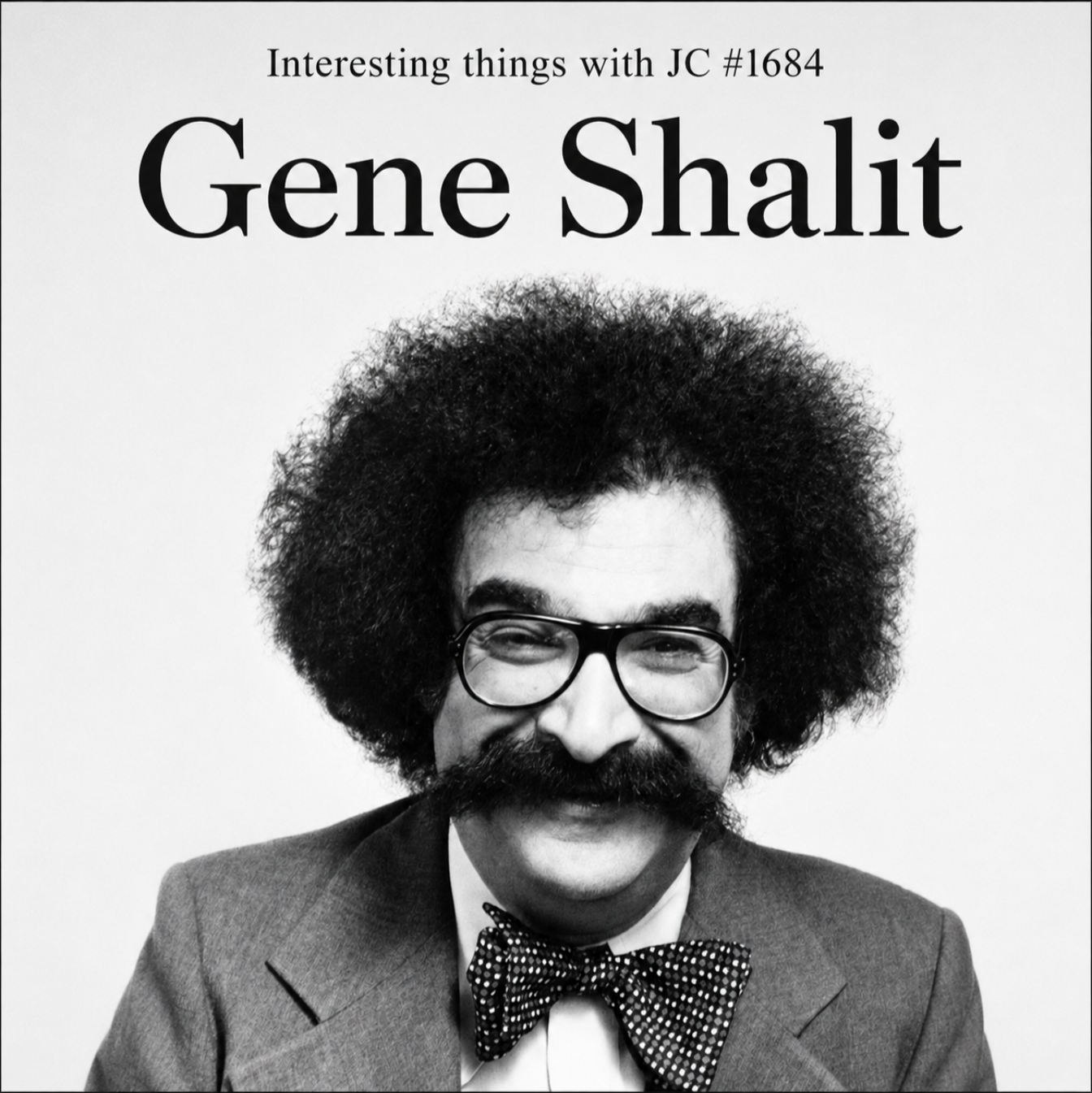
This black-and-white promotional graphic introduces Episode #1684 of Interesting Things with JC, featuring Gene Shalit. The episode title appears prominently at the top. The majority of the image is occupied by a formal portrait of Shalit, who faces the camera with a slight smile. He wears eyeglasses, a suit jacket, and a polka-dot bow tie. His signature large mustache and voluminous curly hair make him instantly recognizable. The plain background and monochrome styling create a classic, archival feel that emphasizes Shalit’s identity and long career in journalism and broadcasting.
Transcript
Interesting Things with JC #1684:
Gene Shalit
Gene Shalit started a newspaper before he was old enough to have a profession.
He was born on March 25, 1926, in New York City and grew up in Morristown, New Jersey. While other kids were reading newspapers, Shalit was putting one together. In high school, he wrote a humor column called The Korn Krib. The title sounds like something the adult Gene Shalit might have written, and in a way it was. The curiosity, the wordplay, and the instinct to connect with an audience were already there.
After graduating from the University of Illinois in 1949, he entered the magazine business and began building a career with words. His byline appeared in Look, Ladies' Home Journal, McCall's, and TV Guide. It wasn't celebrity work. It was the steady discipline of writing, editing, observing, and meeting deadlines. Long before television made him recognizable, he was learning how to earn a reader's attention and keep it.
During those years, he married Nancy Lewis. Together they built a family that would eventually include six children, grandchildren, and great-grandchildren. While millions would come to know Gene Shalit, there was also a private life that never depended on an audience.
By 1970, years of writing had opened another door.
One of the stories from his early days at NBC involves an executive who hired him before ever meeting him in person. When they finally met, the executive reportedly looked at the unruly hair and oversized mustache and suggested he might be better suited for radio.
The timing was almost perfect.
That same year, Shalit began delivering a daily radio feature called Man About Anything. The title fit him. The short commentaries reached stations across the country and became one of NBC Radio's most widely carried features. Long before millions of Americans recognized the face, they were hearing the voice.
Then television arrived.
In 1973, Gene Shalit became a regular critic on NBC's Today. The appearance was impossible to miss. The hair. The glasses. The mustache. The bow ties. In a medium filled with polished television personalities, he looked like nobody else.
But morning television is built on something more demanding than appearance.
People are getting dressed for work. Children are heading to school. Breakfast is on the table. A viewer can change the channel in an instant. For nearly four decades, audiences kept listening because Shalit knew how to talk about books and movies without making culture feel exclusive.
Professional critics often write for other critics. Gene Shalit wrote for viewers.
He believed critics should not spoil stories. A review, in his view, should help someone decide whether a book or film was worth experiencing, not replace the experience itself. He could be funny, sometimes delightfully corny, sometimes sharp, but there was respect underneath it. Respect for the work. Respect for the audience. Respect for the idea that people could make up their own minds.
Away from the camera, there were details that revealed the same streak of individuality. He played the bassoon, reportedly after a music teacher confiscated his clarinet because he wasn't practicing enough. It was an unlikely instrument for a future television personality, but Gene Shalit seemed comfortable taking unusual paths.
The years brought recognition. He received multiple Emmy Awards and became one of the longest-serving and most familiar personalities in American broadcasting. His image became so recognizable that comedians, cartoonists, and television writers turned him into a cultural reference. Television shows parodied him. Animated versions of Gene Shalit appeared on screen. Few critics become recognizable enough to be caricatured.
Fewer still outlast the caricature.
For nearly forty years on Today, and for decades before that in magazines and radio, Gene Shalit kept showing up and doing the work. The platforms changed. Newspapers gave way to magazines. Magazines led to radio. Radio led to television. Technology kept moving.
Gene Shalit kept writing.
He reviewed books and movies, interviewed authors and actors, paid attention to the culture around him, and translated it for audiences who trusted him enough to keep coming back. Generation after generation came to know him, not because he reinvented himself with every passing trend, but because he remained recognizably himself.
Gene Shalit passed away on June 12, 2026, at the age of 100. He was preceded in passing by his wife Nancy, who passed away in 2020, and was survived by his children, grandchildren, and great-grandchildren.
Long before millions of Americans recognized the mustache, before the Emmy Awards, before the radio commentaries, before the television audience, there was a boy in New Jersey putting together a newspaper of his own and trying to find readers.
A century later, he was still doing the same thing.
These are interesting things, with JC.
Student Worksheet
Comprehension Questions
Where did Gene Shalit grow up?
What was the name of his high school humor column?
What magazines published his work?
What was Man About Anything?
Why did audiences continue to trust Gene Shalit?
Analysis Questions
How did Shalit's years in magazine publishing prepare him for radio and television?
Why was audience trust central to his success?
How did his approach differ from critics who primarily write for other critics?
Reflection Prompt
Which quality demonstrated by Gene Shalit would be most valuable in your future career and why?
Difficulty Scaling
Foundational: Identify key facts and events.
Intermediate: Explain cause-and-effect relationships.
Advanced: Evaluate the significance of credibility and authenticity in communication careers.
Student Output Expectations
One-page written response.
Minimum three examples from the episode.
Clear claim supported by evidence.
Academic Integrity Guidance
Use your own words.
Cite evidence from the transcript.
Distinguish facts from opinions.
Avoid copying passages directly.
Teacher Guide
Quick Start
Play the episode and ask students to identify skills that remained valuable throughout Shalit's career despite changing technology.
Pacing Guide (Audio-First)
Bell Ringer – 5 minutes
Vocabulary Preview – 5 minutes
Podcast Listening – 12 minutes
Guided Discussion – 10 minutes
Worksheet Activities – 15 minutes
Assessment and Exit Ticket – 8 minutes
Bell Ringer
What makes someone a trustworthy source of information?
Audio Guidance
Students should listen for examples of:
Adaptability
Communication skills
Audience awareness
Professional credibility
Audio Fallback
Read the transcript aloud or assign small-group reading.
Time-on-Task
Approximately 55–60 minutes.
Materials
Podcast audio
Transcript
Student worksheet
Writing materials
Vocabulary Preparation
Preview vocabulary before listening and revisit during discussion.
Misconceptions
Critics only criticize negatively.
Success depends primarily on appearance.
Career paths are always linear.
Media personalities succeed through popularity alone.
Discussion Prompts
Why did Gene Shalit avoid spoilers in reviews?
How did he make culture accessible to general audiences?
Why is credibility important in communication careers?
How did technology influence his career opportunities?
Formative Checkpoints
Vocabulary understanding
Partner discussion responses
Evidence-based writing checks
Exit ticket review
Differentiation
Provide guided notes.
Use graphic organizers.
Allow verbal responses.
Offer extended time when needed.
Assessment Differentiation
Written essay
Oral presentation
Recorded response
Visual project
Time Flexibility
Can be completed in one class period or expanded across multiple days.
Substitute Readiness
Lesson may be taught entirely from transcript and worksheet.
Engagement Strategy
Compare Gene Shalit with modern online reviewers, podcasters, or content creators.
Extensions
Research another major broadcasting figure.
Compare radio and television communication techniques.
Examine how media criticism has changed since the 1970s.
Cross-Curricular Connections
English Language Arts
Communications
Journalism
Media Studies
History
Career Education
SEL Connection
Students explore authenticity, perseverance, professionalism, and responsible communication.
Skill Emphasis
Critical thinking, communication, audience awareness, media literacy, adaptability, and professionalism.
Answer Key
Comprehension:
Morristown, New Jersey
The Korn Krib
Look, Ladies' Home Journal, McCall's, and TV Guide
A nationally syndicated radio commentary feature
He respected audiences and provided thoughtful reviews
Analysis responses should reference credibility, communication, adaptability, and audience engagement.
Quiz
Gene Shalit graduated from:
A. Rutgers University
B. Northwestern University
C. University of Illinois
D. Columbia UniversityWhich medium came first in Shalit's professional career?
A. Television
B. Radio
C. Internet
D. MagazinesWhat was Man About Anything?
A. A magazine
B. A television segment
C. A radio commentary feature
D. A newspaper columnWhich instrument did Gene Shalit reportedly play?
A. Violin
B. Trumpet
C. Bassoon
D. PianoWhich characteristic was emphasized throughout the episode?
A. Celebrity status
B. Authenticity
C. Wealth
D. Competition
Assessment
Open-Ended Questions
Explain how Gene Shalit's career illustrates adaptability in a changing media landscape.
Evaluate the role that credibility and authenticity played in his long-term success.
3–2–1 Rubric
3 – Proficient
Thorough explanation
Multiple supporting details
Strong use of evidence
2 – Developing
Adequate explanation
Some supporting details
Partial use of evidence
1 – Beginning
Limited explanation
Minimal supporting details
Little or no evidence
Exit Ticket
What is one professional lesson from Gene Shalit's career that you could apply to your own future goals?
Standards Alignment
CCSS.ELA-LITERACY.RI.9-10.2
Determine a central idea of an informational text and analyze its development throughout the episode.
Students trace the development of Gene Shalit's career across multiple communication platforms.
CCSS.ELA-LITERACY.RI.11-12.3
Analyze a complex set of ideas and explain how specific individuals, events, and decisions interact over time.
Students evaluate how journalism, radio, and television shaped Shalit's professional trajectory.
CCSS.ELA-LITERACY.W.11-12.1
Write arguments supported by valid reasoning and relevant evidence.
Students construct evidence-based responses regarding credibility and audience trust.
CCSS.ELA-LITERACY.W.11-12.9
Draw evidence from informational texts to support analysis and reflection.
Students support written conclusions using details from the transcript.
CCSS.ELA-LITERACY.SL.11-12.1
Participate effectively in collaborative discussions.
Students engage in structured conversations regarding media influence and communication.
CCSS.ELA-LITERACY.SL.11-12.4
Present information clearly and logically.
Students communicate conclusions during discussions and assessments.
C3 Framework D2.His.1.9-12
Evaluate how historical developments shape opportunities and careers.
Students examine twentieth-century media evolution through Shalit's experiences.
C3 Framework D2.His.14.9-12
Analyze multiple causes and effects influencing historical developments.
Students investigate how technological change influenced journalism and broadcasting.
ISTE Standard 1.3 Knowledge Constructor
Critically evaluate information sources.
Students examine the role of critics and reviewers in informing public decisions.
ISTE Standard 1.6 Creative Communicator
Communicate effectively for diverse audiences.
Students produce evidence-based written and verbal responses.
Career Readiness Standard
Demonstrate professionalism, adaptability, communication, and credibility.
Students identify transferable workplace skills demonstrated throughout Shalit's career.
Media Literacy Competency
Distinguish between reporting, commentary, opinion, and criticism.
Students evaluate how critics contribute to public understanding of culture.
Homeschool and Lifelong Learning Alignment
Develop independent inquiry, reflection, and evidence-based reasoning.
Connect historical examples to modern communication environments.
Show Notes
Gene Shalit's century-long life and remarkable career provide an opportunity to examine journalism, broadcasting, media criticism, and the importance of audience trust. Students explore how authenticity, adaptability, and communication skills allowed one individual to remain relevant across newspapers, magazines, radio, and television while learning lessons that remain valuable in today's rapidly changing media landscape.
References
Television Academy. (n.d.). Gene Shalit. https://interviews.televisionacademy.com/people/gene-shalit?chapter=4&clip=91655
University of Illinois Alumni Association. (n.d.). Distinguished Alumni: Gene Shalit. https://illinimedia.org/alumni/hall-of-fame/2007-2/gene-shalit/
Today. (n.d.). Show history and contributors. https://www.nbcnews.com/pop-culture/pop-culture-news/gene-shalit-today-show-movie-critic-dies-100-rcna103405
Morristown Green. (2026, June 14). TV, film critic Gene Shalit, a Morristown High alum, dies at 100. https://morristowngreen.com/2026/06/14/tv-film-critic-gene-shalit-a-morristown-high-alum-dies-at-100/
WJW-TV Fox 8 News. (2026, June 13). Gene Shalit, longtime Today Show movie critic, dies at 100. https://fox8.com/news/gene-shalit-longtime-today-show-movie-critic-dies-at-100/