1685: "Lisa del Giocondo"
Interesting Things with JC #1685: "Lisa del Giocondo" – Leonardo da Vinci is painting a merchant’s wife when the commission stops behaving like a commission. He keeps the portrait, carries it for years, and Lisa del Giocondo becomes famous while her own life fades.
Curriculum - Episode Anchor
Episode Title: Lisa del Giocondo
Episode Number: 1685
Host: JC
Audience: Grades 9–12, Introductory College, Homeschool, Lifelong Learners
Subject Area: History, Art History, Renaissance Studies, Cultural Heritage
Lesson Overview
Objectives:
Explain who Lisa del Giocondo was and describe her connection to the Mona Lisa.
Analyze how historians use documentary evidence and surviving artifacts to identify historical figures.
Evaluate why certain individuals become historically significant despite living ordinary lives.
Examine the role of art in preserving memory and shaping historical understanding.
Essential Question: How can an ordinary person's life become extraordinary in the historical record?
Success Criteria:
Identify key facts about Lisa del Giocondo's life.
Explain why Leonardo da Vinci's portrait became historically significant.
Analyze evidence used to confirm Lisa's identity.
Connect historical preservation to modern cultural memory.
Student Relevance Statement: Every day, students create photographs, videos, and digital content that document their lives. This lesson explores how a single image can shape how future generations remember a person.
Real-World Connection: Museums, archives, libraries, and historical organizations preserve artifacts that help people understand the past and protect cultural heritage.
Workforce Reality: Careers in museum studies, conservation, archival science, historical research, education, cultural resource management, and public history depend on evaluating, preserving, and communicating evidence from the past.
Key Vocabulary
Portrait (POR-trit) — A visual representation of a person.
Renaissance (REN-uh-sahns) — A period of artistic, cultural, and intellectual revival in Europe from the 14th through 17th centuries.
Commission (kuh-MISH-un) — A work created at the request of and paid for by a patron.
Patron (PAY-trun) — A person who financially supports an artist or project.
Artifact (AR-tuh-fakt) — An object that provides evidence about human history.
Florence (FLOR-ence) — An Italian city that was a major center of Renaissance culture.
Convent (KON-vent) — A religious community where nuns live and work.
Historical Evidence (his-TOR-i-kul EV-i-dence) — Information used to investigate and understand past events.
Identity (eye-DEN-ti-tee) — The characteristics and background that define a person.
Scholar (SKOL-er) — A person engaged in advanced study or research.
Narrative Core
Open: In Renaissance Florence, wealthy families often commissioned portraits. One such portrait would become the most famous painting in the world, preserving the face of a woman whose life otherwise might have been forgotten.
Info: Lisa Gherardini was born in Florence in 1479 and married merchant Francesco del Giocondo. She lived a comfortable life within Florentine society, raising a family and managing household responsibilities.
Details: Around 1503, Leonardo da Vinci began painting her portrait. Unlike most commissioned works, Leonardo never appears to have delivered the painting. Instead, he continued refining it for years and carried it with him throughout his life. The portrait eventually entered the French royal collection and later became one of the most recognized works in the Louvre.
Reflection: Lisa left behind no famous writings, military victories, or political achievements. Yet a single artwork preserved her image across more than five centuries. Her story demonstrates how historical memory is often shaped by what survives rather than by what once seemed important.
Closing: These are interesting things, with JC.
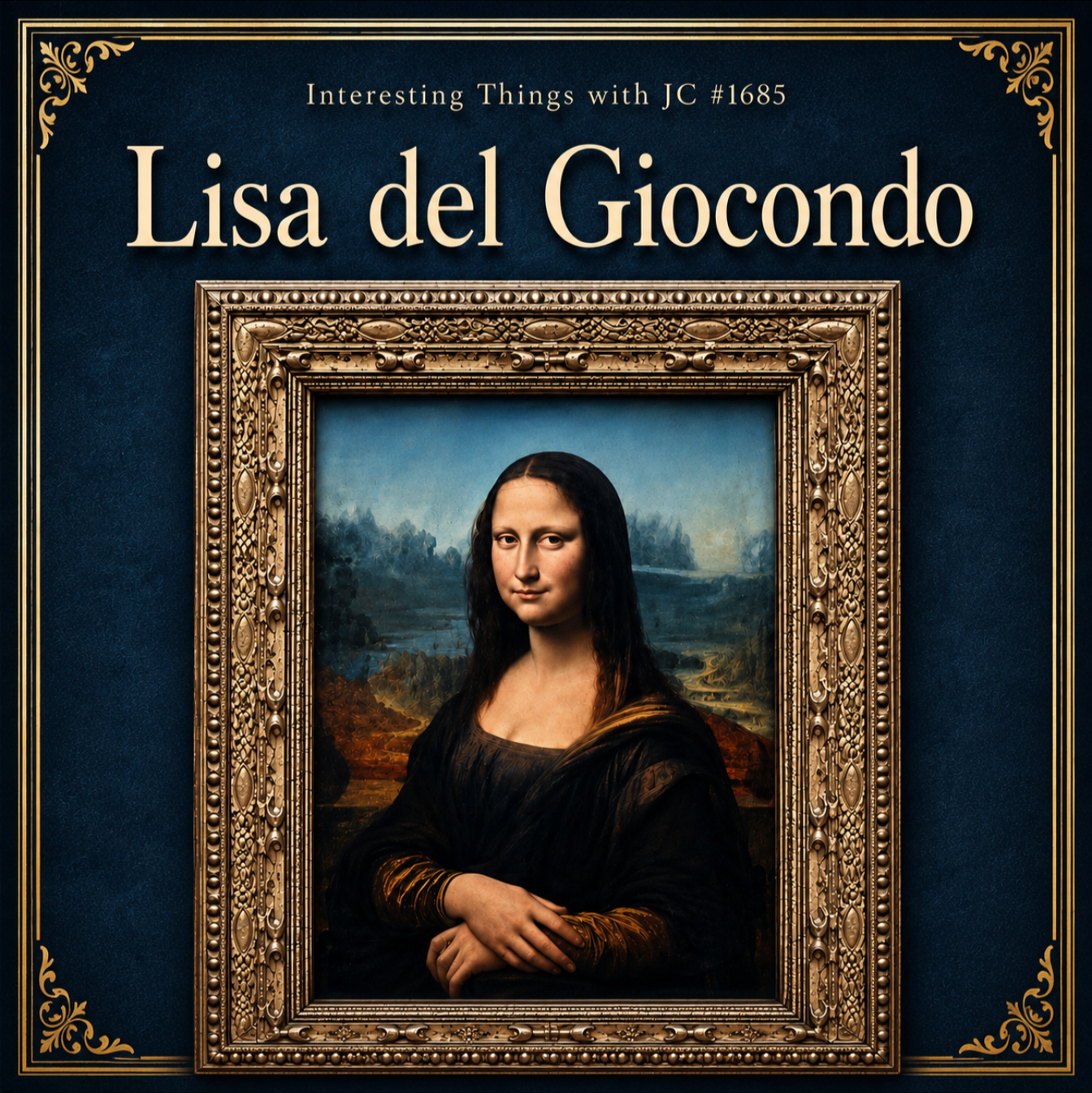
Promotional cover image for Interesting Things with JC #1685. Large cream-colored text reads “Lisa del Giocondo” above a framed portrait resembling Leonardo da Vinci’s Mona Lisa. The woman is shown seated with folded hands against a distant landscape background. The portrait is surrounded by an ornate gold frame on a dark blue background with decorative gold corner accents.
Transcript
Interesting Things with JC #1685:
"Lisa del Giocondo"
In the early years of the sixteenth century, a merchant in Florence commissioned a portrait of his wife. There was nothing unusual about that. Wealthy families did it all the time. The artist was Leonardo da Vinci. The woman was Lisa del Giocondo. The unusual part is that more than five hundred years later, people still stand in line for hours just to look at her face.
Lisa Gherardini was born in Florence on June 15, 1479, into an old Tuscan family whose noble roots ran deeper than its finances. Florence was one of the wealthiest and most influential cities in Europe, a place where banking fortunes, political rivalries, and artistic ambition collided in the narrow streets between churches, workshops, and crowded marketplaces. By the time Lisa was born, the city had already helped shape the careers of Botticelli, Michelangelo, and Leonardo.
At fifteen, she married Francesco del Giocondo, a successful merchant in the cloth and silk trade. The marriage improved the standing of both families. Together they raised children, managed property, and lived a life that was comfortable but not extraordinary by Florentine standards. If history had followed its usual pattern, Lisa would have disappeared into the countless lives recorded only in tax rolls, church records, and family documents.
Around 1503, Francesco appears to have commissioned a portrait of his wife. Leonardo accepted the work, but then something strange happened. He never seems to have delivered it.
Most Renaissance portraits were completed, handed over, and hung in a home. Leonardo kept this one. Years passed. He continued refining it. He carried it with him as he moved between patrons and cities. The painting became less a commission and more a companion. Art historians still debate exactly why. Some believe he considered it unfinished. Others believe it had become a personal experiment in technique. Whatever the reason, the portrait remained with Leonardo until the end of his life.
Meanwhile, Lisa continued living her own life. She raised her family. She endured the deaths of loved ones. She witnessed political upheaval in Florence. Later in life, after the death of her husband, she spent time in a convent where one of her daughters was a nun. Historical records suggest she died in 1542 or possibly 1551, depending on which surviving documents are accepted.
Nothing in those records suggests she imagined she would become famous.
The painting eventually made its way into the French royal collection and, centuries later, into the Louvre. Along the way it became known as the Mona Lisa. Ironically, as the portrait's fame grew, certainty about the woman herself began to fade. Scholars proposed alternative identities for generations. Some suggested noblewomen. Others proposed idealized figures or entirely different sitters.
Then, in 2005, researchers examined a note written by a Florentine official named Agostino Vespucci in 1503. The note described Leonardo working on a portrait of Lisa del Giocondo. It provided powerful contemporary evidence supporting what had long been the traditional identification.
By then, the painting had already become the most famous portrait in the world.
Millions of people know the curve of Lisa's smile. They know the folded hands, the distant landscape, and the sense that the expression changes the longer they look at it. Yet almost everything that made up her actual life remains largely invisible. The woman survived because the image survived.
History does that sometimes. Entire lives disappear while a single object remains. A letter survives a fire. A photograph outlasts a family. A journal is found in an attic. A portrait hangs on a wall. The object keeps moving through time long after the person who once touched it is gone.
Lisa del Giocondo was not a queen, a conqueror, or a revolutionary. She left behind no famous writings and led no armies. What she left was a likeness, preserved first by an artist who could not stop working on it and then by generations who could not stop looking at it.
Five centuries later, one of the most recognizable faces on Earth belongs to a woman whose life was, in many ways, remarkably ordinary.
And perhaps that's part of why the portrait still feels so human.
These are interesting things, with JC.
Student Worksheet
Comprehension Questions
Who commissioned the portrait of Lisa del Giocondo?
Who painted the portrait?
Why is Leonardo's handling of the painting unusual?
What evidence discovered in 2005 helped confirm Lisa's identity?
Where is the Mona Lisa displayed today?
Analysis Questions
Why might Leonardo have continued working on the painting long after accepting the commission?
How does Lisa's story demonstrate the difference between personal significance and historical significance?
What role do artifacts play in preserving history?
Why do historians rely on both physical objects and written records?
Reflection Prompt
If one object from your life survived for 500 years, what would it reveal about you?
Do you think future generations will learn more from physical artifacts or digital records? Explain.
Difficulty Scaling
Emerging: Complete comprehension questions using direct evidence.
Proficient: Complete comprehension and analysis questions.
Advanced: Write a one-page essay evaluating how artifacts influence historical memory.
Student Output Expectations
Complete sentences.
Evidence-based responses.
Accurate use of vocabulary.
Thoughtful reflection supported by reasoning.
Academic Integrity Guidance
Use your own words whenever possible.
Support claims with evidence from the lesson.
Clearly distinguish facts from personal opinions.
Cite information from the transcript when appropriate.
Teacher Guide
Quick Start
Play the podcast episode before beginning discussion. Ask students to listen for evidence explaining why Lisa del Giocondo became historically significant despite living an otherwise ordinary life.
Pacing Guide (Audio-First)
Bell Ringer – 5 minutes
Vocabulary Preview – 5 minutes
Podcast Listening – 8–10 minutes
Discussion – 10 minutes
Worksheet Activities – 15 minutes
Assessment and Exit Ticket – 10 minutes
Bell Ringer
Write the following prompt:
"Can a photograph or image make someone famous long after they are gone? Explain."
Audio Guidance
Encourage students to listen for:
Historical evidence
The role of Leonardo da Vinci
Reasons the Mona Lisa became famous
Differences between Lisa's life and her legacy
Audio Fallback
Use the transcript as a read-aloud or silent reading assignment.
Time-on-Task
50–60 minutes
Materials
Podcast audio
Transcript
Student worksheet
Writing materials
Projector or display device (optional)
Vocabulary Strategy
Preview all vocabulary before listening and have students identify terms during the episode.
Misconceptions
Lisa was not royalty.
The Mona Lisa is the painting, not the woman's original name.
Historical fame is not always connected to extraordinary achievements.
Historical certainty often develops through evidence rather than assumptions.
Discussion Prompts
Why are some people remembered while others are forgotten?
What makes historical evidence trustworthy?
How can a work of art become a historical document?
What responsibilities do museums have to preserve artifacts?
Formative Checkpoints
Vocabulary understanding
Participation in discussion
Evidence-based responses
Completion of worksheet activities
Differentiation
Provide guided notes.
Allow verbal responses.
Use small-group discussion.
Offer vocabulary supports and sentence starters.
Assessment Differentiation
Oral presentation option
Graphic organizer option
Traditional written response option
Time Flexibility
Short Lesson: 30 minutes
Standard Lesson: 60 minutes
Extended Lesson: Research project on Renaissance Florence or Leonardo da Vinci
Substitute Readiness
The transcript and worksheet allow complete lesson delivery without audio equipment.
Engagement Strategy
Compare the Mona Lisa's influence to modern viral photographs and discuss how images shape public memory.
Extensions
Research Renaissance Florence.
Investigate Leonardo da Vinci's inventions.
Examine how museums authenticate artifacts.
Explore famous portraits from other cultures and eras.
Cross-Curricular Connections
History
Art
Literature
Media Studies
Information Science
SEL Connection
Students examine themes of identity, legacy, memory, and the human desire to be remembered.
Skill Emphasis
Historical analysis
Source evaluation
Evidence-based reasoning
Communication
Critical thinking
Answer Key
Francesco del Giocondo
Leonardo da Vinci
He kept the painting and continued refining it rather than delivering it.
A 1503 note written by Agostino Vespucci.
The Louvre Museum in Paris.
Quiz
Who painted the portrait of Lisa del Giocondo?
A. Raphael
B. Botticelli
C. Michelangelo
D. Leonardo da VinciIn what city was Lisa born?
A. Venice
B. Rome
C. Florence
D. MilanWhat was Francesco del Giocondo's occupation?
A. Banker
B. Merchant
C. Soldier
D. ArchitectWhat was unusual about Leonardo's treatment of the portrait?
A. He destroyed it.
B. He sold it immediately.
C. He kept working on it for years.
D. He gave it to a church.What evidence strengthened the identification of Lisa del Giocondo in 2005?
A. A royal inventory
B. A church ledger
C. A merchant contract
D. A note written by Agostino Vespucci
Assessment
Open-Ended Questions
Explain how the survival of the Mona Lisa influenced Lisa del Giocondo's place in world history.
Analyze why historians place great value on artifacts and documentary evidence when reconstructing the past.
3–2–1 Rubric
3: Thorough analysis, strong evidence, accurate historical understanding, insightful conclusions.
2: Adequate analysis with supporting evidence and generally accurate understanding.
1: Limited analysis with little evidence and incomplete understanding.
Exit Ticket
What is one new fact you learned about Lisa del Giocondo?
Why do you think the Mona Lisa remains one of the most famous paintings in the world?
Standards Alignment
NGSS Science and Engineering Practices
Analyzing and Interpreting Data: Students evaluate documentary evidence and surviving artifacts to determine historical identity.
Obtaining, Evaluating, and Communicating Information: Students assess source reliability and communicate evidence-based conclusions.
CCSS.ELA-LITERACY.RH.9-10.1
Cite specific textual evidence to support analysis of primary and secondary historical sources.
CCSS.ELA-LITERACY.RH.9-10.2
Determine central ideas of historical texts and summarize supporting details accurately.
CCSS.ELA-LITERACY.RH.11-12.1
Cite strong and thorough textual evidence to support analysis of historical events and developments.
CCSS.ELA-LITERACY.RH.11-12.6
Evaluate authors' claims, interpretations, and perspectives regarding historical evidence and identity.
CCSS.ELA-LITERACY.WHST.9-12.1
Write discipline-specific arguments using valid reasoning and relevant evidence.
CCSS.ELA-LITERACY.WHST.9-12.9
Draw evidence from informational texts to support analysis, reflection, and research.
C3 Framework
D2.His.1.9-12: Evaluate how historical events and developments were shaped by unique circumstances of time and place.
D2.His.4.9-12: Analyze complex interactions among historical developments.
D2.His.14.9-12: Analyze multiple causes and effects of events in the past.
D3.1.9-12: Gather and evaluate sources while considering credibility and reliability.
D4.1.9-12: Construct arguments using historical evidence.
ISTE Standards
1.3 Knowledge Constructor: Critically evaluate information from multiple sources.
1.6 Creative Communicator: Present evidence-based conclusions clearly.
1.7 Global Collaborator: Explore cultural heritage through inquiry and discussion.
Career Readiness Competencies
Historical research methodology
Information literacy
Evidence evaluation
Written communication
Oral communication
Archival awareness
Museum and cultural heritage literacy
Critical thinking and analysis
Homeschool and Lifelong Learning Alignment
Independent inquiry and research
Historical literacy development
Media literacy through visual analysis
Understanding preservation and cultural memory
Lifelong appreciation of art and history
Show Notes
This lesson explores the life of Lisa del Giocondo, the woman widely believed to be the subject of the Mona Lisa. Through an examination of Renaissance Florence, Leonardo da Vinci's artistic process, and the historical evidence supporting Lisa's identification, students learn how artifacts preserve human stories across centuries. The lesson encourages critical thinking about memory, identity, historical evidence, and the ways ordinary lives can become extraordinary through the survival of a single object.
References
Encyclopaedia Britannica. (2024). Lisa del Giocondo. https://www.britannica.com/question/Who-was-the-Mona-Lisa-in-real-life
Encyclopaedia Britannica. (2024). Mona Lisa. https://www.britannica.com/topic/Mona-Lisa-painting
Encyclopaedia Britannica. (2024). Leonardo da Vinci. https://www.britannica.com/biography/Leonardo-da-Vinci
Mona Lisa Foundation. (2012, September 5). Francesco del Giocondo & his wife Lisa Gherardini. https://monalisa.org/2012/09/05/francesco-del-giocondo-his-wife-lisa-gherardini/
Study.com. (n.d.). Lisa del Giocondo: Overview, life & painting (Gherardini). https://study.com/academy/lesson/lisa-del-giocondo-overview-life-painting-gherardini.html
Italian Art Society. (2017, June 15). Lisa Gherardini, aka Mona Lisa, the wife of Florentine cloth merchant Francesco del Giocondo, was born on 15 June 1479 in Florence. https://www.italianartsociety.org/2017/06/lisa-gherardini-aka-mona-lisa-the-wife-of-florentine-cloth-merchant-francesco-del-giocondo-was-born-on-15-june-1479-in-florence/