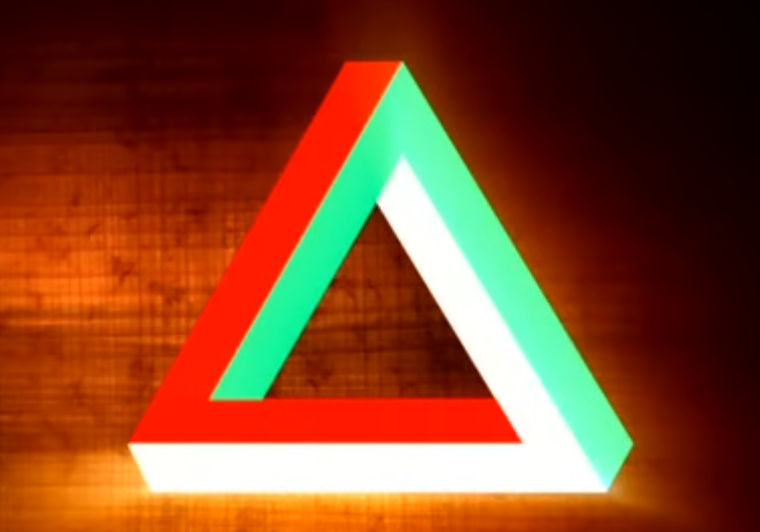
1686: "M.C. Escher"
Interesting Things with JC #1686: "M.C. Escher" – An artist fills a page with shapes that fit perfectly together, then turns them into staircases, waterfalls, and worlds that appear correct while mathematically breaking the rules of reality.
Curriculum - Episode Anchor
Episode Title: M.C. Escher
Episode Number: 1686
Host: JC
Audience: Grades 9–12, Introductory College, Homeschool Learners, Lifelong Learners
Subject Area: Art History, Mathematics, Geometry, Visual Perception, Design, Critical Thinking
Lesson Overview
Objectives:
Analyze how M.C. Escher used artistic techniques to explore mathematical concepts.
Explain the relationship between symmetry, tessellation, infinity, and visual perception in Escher's work.
Evaluate how artistic observation can contribute to scientific and mathematical understanding.
Interpret how impossible constructions challenge assumptions about reality and perception.
Essential Question: How can art help us understand complex mathematical and scientific ideas?
Success Criteria:
Identify major themes in Escher's artwork.
Explain the concept of tessellations and impossible figures.
Analyze the relationship between visual perception and reality.
Support conclusions using evidence from the podcast episode and artwork examples.
Student Relevance Statement: Students encounter patterns, visual design, and spatial reasoning daily through architecture, engineering, digital media, gaming, and technology. Escher's work demonstrates how creativity and logic can work together to solve problems and inspire innovation.
Real-World Connection: Escher's explorations of symmetry, pattern formation, geometry, and perception influenced fields including computer graphics, architecture, crystallography, game design, mathematics, and visual communication.
Workforce Reality: Careers in architecture, engineering, industrial design, animation, data visualization, software development, mathematics, scientific modeling, and graphic design often require recognizing patterns and thinking spatially across disciplines.
Key Vocabulary
Maurits Cornelis Escher (MOW-rits kor-NAY-liss ESH-er): Dutch graphic artist known for mathematically inspired artwork.
Tessellation (tes-uh-LAY-shun): A pattern of shapes that fit together without gaps or overlaps.
Symmetry (SIM-uh-tree): Balanced arrangement of parts around a line, point, or plane.
Lithograph (LITH-uh-graf): A print created using a special printing process involving stone or metal plates.
Metamorphosis (met-uh-MOR-fuh-sis): A transformation from one form into another.
Infinity (in-FIN-uh-tee): A concept describing something without end or limit.
Perception (per-SEP-shun): The process of interpreting information through the senses.
Dimension (duh-MEN-shun): A measurable extent of space.
Crystallographer (kris-tuh-LOG-ruh-fer): A scientist who studies the arrangement of atoms in crystals.
Impossible Figure (im-POS-uh-bul FIG-yer): A drawing that appears realistic but cannot exist in three-dimensional space.
Narrative Core
Open: In 1898, Maurits Cornelis Escher was born in the Netherlands. Decades later, he would create some of the most recognizable and puzzling images in the world.
Info: Although Escher was trained as an artist rather than a mathematician, he became fascinated by geometric patterns, especially after studying the decorative designs of the Alhambra in Spain.
Details: Escher transformed traditional geometric shapes into birds, fish, reptiles, and human forms that fit together perfectly. He later created impossible staircases, endless waterfalls, and scenes that appeared logical while violating the rules of physical reality.
Reflection: Escher's work demonstrates that artists, scientists, and mathematicians often investigate similar questions from different perspectives. His images challenge viewers to reconsider how they perceive space, motion, and reality.
Closing: These are interesting things, with JC.
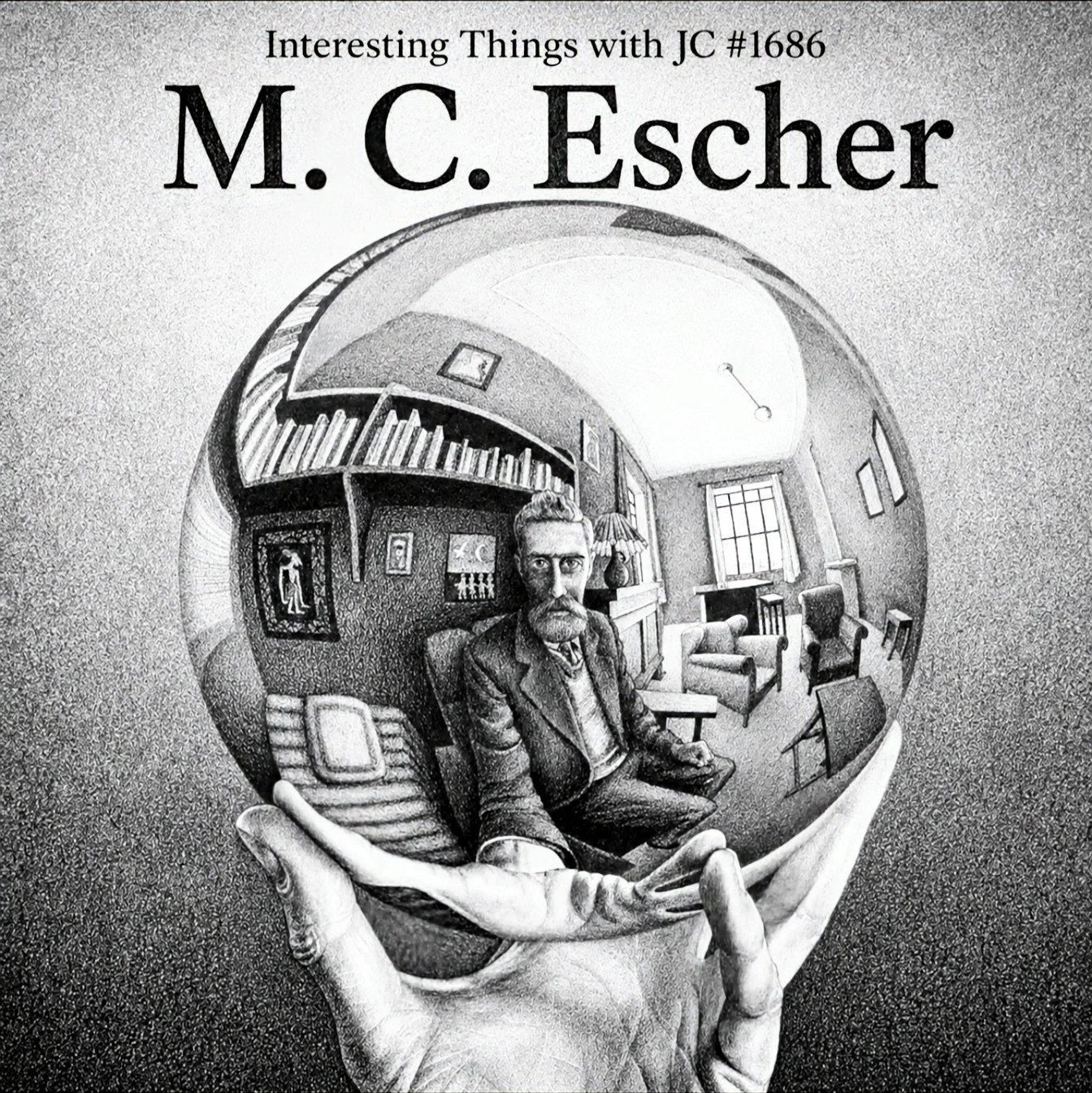
Black-and-white cover image for a podcast episode about Dutch artist M.C. Escher. The artwork shows Escher reflected inside a polished spherical mirror that he holds in his hand. The curved reflection captures an entire room, including bookshelves, chairs, windows, and walls, all warped by the mirror’s surface. The image demonstrates Escher’s fascination with perspective, spatial relationships, mathematical concepts, and optical illusion. Text above the artwork reads “Interesting Things with JC #1686” and “M.C. Escher.”
Transcript
Interesting Things with JC #1686:
M.C. Escher
On June 17, 1898, a boy named Maurits (MOW-rits) Cornelis (kor-NAY-liss) Escher (ESH-er) was born in the Dutch city of Leeuwarden (LAY-oo-WAR-den). Decades later, people would stand in front of his artwork and experience something unusual. The images looked perfectly logical. The longer they looked, the less logical they became.
Escher wasn't a mathematician. He often described himself as someone who struggled with formal mathematics. He trained as a graphic artist and spent his early career sketching landscapes, architecture, and scenes from his travels through Italy and across the Mediterranean. Then he encountered something that would stay with him for the rest of his life.
In Spain, he visited the Alhambra (al-HAM-brah), a palace whose walls were covered with intricate geometric patterns. The designs repeated endlessly, fitting together without gaps or overlaps. Escher became fascinated by the idea that a surface could be completely filled with interlocking shapes. He returned years later to study those patterns again, filling notebooks with sketches and observations. What began as admiration slowly became an obsession.
Back in his studio, those geometric forms began to change. Squares and triangles gave way to birds, fish, reptiles, horses, and human figures. Each shape became the boundary of another. A bird was also part of the bird beside it. A fish helped create the next fish. In works such as Metamorphosis (met-uh-MOR-fuh-sis), one image flowed into another until the viewer could hardly tell where one idea ended and the next began.
Escher carved many of these images into woodblocks and prepared them as painstaking lithographs (LITH-uh-grafs) and prints—a slow, meticulous (muh-TIK-yuh-lus) process that demanded extraordinary precision. The craftsmanship matched the conceptual ambition.
Then Escher pushed further.
His most famous works weren't simply pictures. They were visual problems.
In Relativity (rel-uh-TIV-uh-tee), people walk on staircases that appear ordinary until you notice that different groups are obeying different directions of gravity. What is up for one person is sideways for another. In Ascending and Descending, a staircase loops endlessly back onto itself. In Waterfall, a stream appears to flow downhill while somehow returning to the point where it began.
The remarkable thing isn't that these scenes are impossible.
It's that our minds accept them.
Most people don't look at an Escher print and immediately reject it. They study it. They try to make sense of it. For a few moments, the brain works hard to preserve a reality that cannot exist.
That attracted attention from an unexpected audience. Mathematicians, crystallographers (kris-tuh-LOG-ruh-fers), and scientists recognized explorations of symmetry (SIM-uh-tree), infinity, geometry, and dimensional space. Yet Escher hadn't arrived there through equations. He arrived there through observation, patience, and craft.
In some cases, mathematicians later found formal language for ideas Escher had already made visible.
That left him in an unusual position. Some artists thought his work was too mathematical. Some mathematicians saw him primarily as an artist. Escher spent much of his career in the narrow space between those worlds.
A mathematician explores patterns through proof. A scientist explores patterns through experiment. An artist explores patterns through image. Sometimes they arrive at the same questions from entirely different directions.
More than half a century later, people still stand in front of those impossible staircases, trying to reconcile (REK-un-syle) what their eyes accept with what their minds know cannot be true.
The images looked perfectly logical.
The longer they looked, the less logical they became.
And that's exactly where Escher wanted us to be.
These are interesting things, with JC.
Student Worksheet
Directions: Listen to the episode first. Take notes while listening. Use evidence from the transcript to support your responses.
Comprehension Questions
Where was M.C. Escher born?
What building inspired Escher's interest in geometric patterns?
What is a tessellation?
Why did Escher become interested in repeating shapes?
Name two famous works mentioned in the episode.
Analysis Questions
Why do Escher's impossible images initially appear believable?
How did Escher combine artistic creativity with mathematical concepts?
Why might scientists and mathematicians have been interested in Escher's artwork?
Compare the methods used by artists, scientists, and mathematicians to explore patterns.
Explain how Escher challenged viewers' assumptions about reality.
Reflection Prompt
Describe a time when your eyes or senses seemed to tell you something different from what you knew to be true. How does that experience connect to Escher's work?
Difficulty Scaling
Level 1: Complete comprehension questions.
Level 2: Complete comprehension and analysis questions.
Level 3: Complete all questions and create an original tessellation design with a written explanation.
Advanced: Research one Escher artwork and explain the mathematical concepts represented.
Student Output Expectations
Complete sentences.
Evidence-based responses.
Accurate use of vocabulary.
Clear explanations supported by details from the episode.
Academic Integrity Guidance
Use your own words.
Cite evidence from the transcript when appropriate.
Distinguish personal opinions from factual statements.
Credit outside sources if additional research is conducted.
Teacher Guide
Quick Start: Begin with audio playback. Encourage students to record examples of patterns, geometry, or visual illusions mentioned during the episode.
Pacing Guide (Audio-First):
Bell Ringer (5 minutes)
Vocabulary Preview (5 minutes)
Podcast Listening (8–10 minutes)
Guided Discussion (10 minutes)
Worksheet Completion (15–20 minutes)
Assessment/Exit Ticket (5 minutes)
Bell Ringer: Display an impossible staircase or optical illusion. Ask: "Can something look real while being impossible?"
Audio Guidance: Instruct students to listen for examples of connections between art and mathematics.
Audio Fallback: Read the transcript aloud or assign sections for student reading.
Time on Task: 45–60 minutes.
Materials:
Podcast episode or transcript
Worksheet
Projector or display image
Paper and pencils
Graph paper (optional)
Vocabulary Strategy: Preview tessellation, symmetry, infinity, and perception before listening.
Misconceptions:
Art and mathematics are unrelated fields.
Visual perception always reflects reality accurately.
Creativity and logic are opposites.
Impossible figures are mistakes rather than intentional designs.
Discussion Prompts:
Why do humans seek patterns?
What makes an image appear believable?
Can art contribute to scientific understanding?
Why are visual illusions effective?
How might Escher's work inspire modern technology?
Formative Checkpoints:
Vocabulary understanding
Discussion participation
Evidence-based responses
Accurate identification of concepts
Differentiation:
Provide vocabulary supports.
Use visual examples of Escher's work.
Offer guided notes.
Allow verbal responses when appropriate.
Assessment Differentiation:
Written responses
Oral presentations
Visual design projects
Graphic organizers
Time Flexibility:
One class period: Discussion and worksheet.
Two class periods: Add art and geometry extension activities.
Substitute Readiness: Transcript and worksheet can function independently without audio.
Engagement Strategy: Have students attempt to draw their own impossible object before studying Escher's examples.
Extensions:
Create original tessellations.
Investigate optical illusions.
Explore computer graphics applications.
Research non-Euclidean geometry.
Analyze architecture influenced by geometric design.
Cross-Curricular Connections:
Art
Mathematics
Engineering
Psychology
Computer Science
Architecture
SEL Connection: Encourage intellectual curiosity, persistence, and comfort with ambiguity when confronting complex problems.
Skill Emphasis:
Observation
Pattern recognition
Spatial reasoning
Critical thinking
Visual literacy
Evidence-based analysis
Answer Key:
Comprehension:
Leeuwarden, Netherlands
The Alhambra in Spain
Shapes fitting together without gaps or overlaps
Fascination with filling surfaces completely through repeating forms
Answers may include Relativity, Ascending and Descending, Waterfall, Metamorphosis
Analysis:
The brain seeks logical interpretations of visual information.
He transformed mathematical patterns into artistic imagery.
His work explored geometry, symmetry, infinity, and spatial relationships.
Artists use imagery, scientists use experimentation, mathematicians use proof.
He created images that appear logical but violate physical reality.
Quiz
Which location inspired Escher's study of repeating geometric patterns?
A. The Colosseum
B. The Alhambra
C. Stonehenge
D. The ParthenonWhat is a tessellation?
A. A type of sculpture
B. A style of painting
C. Shapes fitting together without gaps or overlaps
D. A printing machineWhich concept appears frequently in Escher's work?
A. Weather forecasting
B. Ancient warfare
C. Symmetry and infinity
D. Ocean navigationWhy are Escher's impossible figures notable?
A. They are unfinished.
B. They appear realistic despite being impossible.
C. They contain no geometric patterns.
D. They were created by computers.Which field was NOT specifically mentioned as being interested in Escher's work?
A. Mathematics
B. Crystallography
C. Science
D. Marine Biology
Assessment
Open-Ended Questions
Analyze how Escher used artistic techniques to communicate ideas often associated with mathematics and science.
Explain why impossible figures remain compelling to viewers and what they reveal about human perception.
3–2–1 Rubric
3 – Proficient
Accurate understanding of concepts
Strong evidence and reasoning
Effective use of vocabulary
2 – Developing
Mostly accurate understanding
Some supporting evidence
Partial use of vocabulary
1 – Beginning
Limited understanding
Minimal evidence
Inaccurate or missing vocabulary
Exit Ticket
What is one new idea you learned about M.C. Escher?
How did Escher connect art and mathematics?
What question do you still have?
Standards Alignment
NGSS Connections
HS-ETS1-2 Engineering Design: Evaluate and compare solutions to complex problems. Students analyze how Escher used visual design to solve spatial and conceptual challenges.
HS-ETS1-3 Engineering Design: Evaluate solutions based on criteria and trade-offs. Students assess how impossible figures create convincing visual systems.
Science and Engineering Practice: Developing and Using Models: Students interpret visual representations as models of geometric and spatial concepts.
Crosscutting Concept: Patterns: Students identify recurring geometric structures, tessellations, and transformations.
Crosscutting Concept: Systems and System Models: Students evaluate how visual components interact within Escher's compositions.
CCSS English Language Arts
CCSS.ELA-LITERACY.RI.9-10.1: Cite strong textual evidence to support analysis of informational content.
CCSS.ELA-LITERACY.RI.11-12.2: Determine central ideas and analyze development of complex concepts.
CCSS.ELA-LITERACY.SL.9-10.1: Initiate and participate effectively in collaborative discussions.
CCSS.ELA-LITERACY.W.9-10.2: Write informative texts examining complex ideas.
CCSS.ELA-LITERACY.RST.11-12.7: Integrate information presented visually and quantitatively with textual information.
CCSS Mathematics
HSG-CO.A.3: Apply transformations and symmetry concepts to geometric figures.
HSG-MG.A.1: Use geometric modeling to solve design problems.
HSG-GPE.B.7: Explore coordinate and spatial relationships within geometric systems.
C3 Framework
D2.Geo.1.9-12: Use geographic and spatial perspectives to examine environments and structures.
D2.His.14.9-12: Analyze multiple perspectives and historical developments.
D3.1.9-12: Gather and evaluate sources to support claims.
D4.1.9-12: Construct arguments using evidence from disciplinary sources.
ISTE Standards for Students
1.1 Empowered Learner: Use reflection to deepen understanding of interdisciplinary concepts.
1.4 Innovative Designer: Apply design processes to create original tessellations and visual solutions.
1.5 Computational Thinker: Recognize patterns and decompose complex visual systems.
1.6 Creative Communicator: Express complex ideas through visual and written communication.
Career and Technical Education (CTE)
Design and Multimedia Arts: Analyze visual communication strategies.
Architecture and Construction: Apply geometric reasoning to structural design.
Information Technology: Understand pattern recognition and visual systems used in digital environments.
Engineering and Technology: Evaluate spatial models and problem-solving approaches.
UK National Curriculum Alignment
Mathematics: Geometry, transformations, symmetry, and spatial reasoning.
Art and Design: Critical evaluation of artistic techniques and visual communication.
Design and Technology: Application of design thinking and iterative development.
International Baccalaureate (MYP/DP) Alignment
Approaches to Learning: Critical thinking, creative thinking, and research skills.
Individuals and Societies: Understanding historical and cultural influences.
Mathematics: Pattern recognition and spatial relationships.
Arts: Investigating and creating through artistic processes.
Homeschool and Lifelong Learning Alignment
Encourages interdisciplinary learning.
Supports self-directed inquiry.
Develops observation and analytical thinking.
Builds visual literacy and pattern recognition skills.
Connects historical, artistic, mathematical, and scientific perspectives.
Career Readiness Competencies
Critical Thinking
Creativity and Innovation
Problem Solving
Communication
Observation and Analysis
Systems Thinking
Visual Information Processing
Interdisciplinary Collaboration
Show Notes
M.C. Escher created artwork that continues to challenge how people think about reality, space, and perception. This lesson explores how one artist connected visual creativity with mathematical ideas such as symmetry, tessellations, infinity, and impossible figures. Students examine the relationship between observation and knowledge while developing critical thinking, spatial reasoning, and interdisciplinary problem-solving skills that remain valuable across modern academic and professional fields.
References
Encyclopaedia Britannica. (2026, May 28). M. C. Escher: Biography, facts, & tessellation. https://www.britannica.com/biography/M-C-Escher
Christie's. (2025, June 26). M.C. Escher's "impossible" constructions. https://www.christies.com/en/stories/escher-impossible-constructions-digital-art-06828e0cc5d44d59b95b9f94c92e9995
The M.C. Escher Company. (n.d.). Biography. https://www.mcescher.com/about-escher/biography/
The Metropolitan Museum of Art. (n.d.). Works by M.C. Escher in the collection. https://www.metmuseum.org/art/collection/search?artist=M.+C.+Escher
HENI. (n.d.). M.C. Escher news and articles. https://heni.com/news?artist=MC%20Escher
MyArtBroker. (n.d.). Seller's guide to M.C. Escher. https://www.myartbroker.com/artist-maurits-cornelis-escher/guides/sellers-guide-to-mc-escher