1687: "Can Quantum Tunneling be Observed?"
Interesting Things with JC #1687: "Can Quantum Tunneling be Observed?" – Electrons pass through barriers they do not have enough energy to cross, and instruments built around that effect can map individual atoms. The same process continues inside radioactive atoms, semiconductor devices, and the Sun, where particles keep appearing beyond barriers that classical physics says should stop them.
Curriculum - Episode Anchor
Episode Title: Quantum Tunneling
Episode Number: 1687
Host: JC
Audience: Grades 9–12, Introductory College, Homeschool Learners, Lifelong Learners
Subject Area: Physics, Quantum Mechanics, Astronomy, Technology
Lesson Overview
Objectives:
Explain how quantum tunneling differs from classical expectations of particle behavior.
Describe how wave-particle duality enables tunneling.
Identify real-world examples of quantum tunneling in nature and technology.
Evaluate why quantum tunneling is essential to both stellar fusion and modern electronics.
Essential Question:
How can particles cross barriers they do not have enough energy to overcome according to classical physics?
Success Criteria:
Define quantum tunneling accurately.
Explain tunneling using wave behavior.
Identify at least three applications of tunneling.
Connect tunneling to observable phenomena in nature and technology.
Student Relevance:
Many devices students use every day—including computers, smartphones, and flash memory storage—depend on quantum effects such as tunneling.
Real-World Connection:
Quantum tunneling enables atomic imaging, semiconductor technologies, radioactive decay processes, and the nuclear fusion that powers the Sun.
Workforce Reality:
Physicists, engineers, semiconductor designers, medical imaging specialists, and quantum computing researchers all work with technologies that rely on tunneling principles.
Key Vocabulary
Quantum Tunneling (KWON-tum TUN-el-ing) — The quantum phenomenon in which particles pass through an energy barrier without sufficient classical energy.
Wave-Particle Duality (WAYV PAR-ti-kul dy-AL-i-tee) — The principle that particles exhibit both wave-like and particle-like properties.
Barrier (BAIR-ee-er) — An energy obstacle that prevents motion under classical rules.
Electron (ee-LEK-tron) — A negatively charged subatomic particle.
Semiconductor (SEM-ee-kon-DUK-ter) — A material whose electrical conductivity can be controlled.
Scanning Tunneling Microscope (SCAN-ing TUN-el-ing MY-kruh-skohp) — A device that images surfaces by measuring tunneling current.
Alpha Decay (AL-fuh dih-KAY) — A radioactive process involving the emission of alpha particles.
Fusion (FYOO-zhun) — The joining of atomic nuclei that releases energy.
Proton (PROH-ton) — A positively charged particle found in atomic nuclei.
Tunneling Current (TUN-el-ing CUR-rent) — Electrical current produced through quantum tunneling.
Narrative Core
Open:
Imagine rolling a ball toward a hill. If the ball lacks enough energy to reach the top, it rolls back. Classical physics predicts that the barrier wins every time.
Info:
At the quantum level, particles behave differently. They also act like waves, allowing their presence to extend into regions that appear inaccessible under classical rules.
Details:
This wave behavior creates a small probability that a particle can appear beyond a barrier without climbing over it. Experiments by Leo Esaki demonstrated electron tunneling in semiconductors. Later, the Scanning Tunneling Microscope used tunneling to image individual atoms. Tunneling also explains alpha decay and helps power the Sun through nuclear fusion.
Reflection:
Quantum tunneling challenges everyday intuition. Although it appears impossible from a classical perspective, it occurs constantly throughout nature and technology.
Closing:
These are interesting things, with JC.
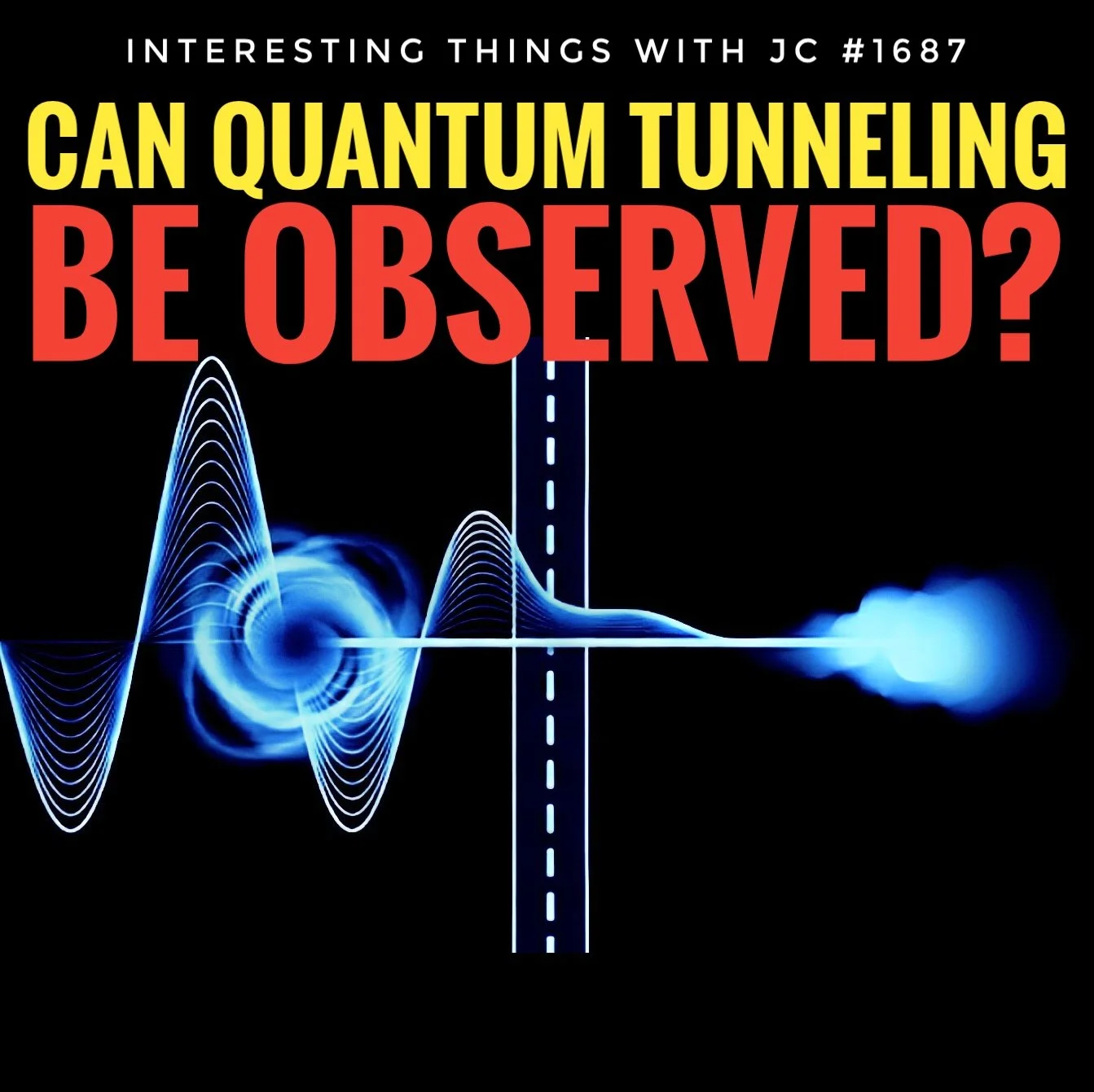
Promotional graphic for “Interesting Things with JC #1687.” Large yellow and red text at the top reads, “Can Quantum Tunneling Be Observed?” Against a black background, a glowing blue wave approaches a vertical barrier in the center of the image. A smaller wave pattern appears on the opposite side of the barrier and continues as a bright blue beam, visually representing quantum tunneling, where a particle can appear beyond a barrier it would not be expected to cross under classical physics. The design uses high contrast and minimal elements to emphasize the concept.
Transcript
Interesting Things with JC #1687:
Can Quantum Tunneling be Observed?
Can something pass through a solid wall without breaking it?
According to classical physics, the answer is no.
If a ball rolls toward a hill and doesn't have enough energy to reach the top, the hill wins. The ball stops, rolls back, and that's the end of the story.
Nature doesn't always follow that rule.
At the quantum level, particles do not behave entirely like tiny balls. They also behave like waves. Those waves can extend into places the particle should never be able to reach, creating a small probability that the particle can appear on the other side of a barrier without ever possessing enough energy to climb over it.
Physicists call this quantum tunneling.
The obvious question is whether it can actually be observed.
The answer is yes.
Quantum tunneling is not a mathematical curiosity or a theoretical convenience. It is one of the most thoroughly measured and repeatedly confirmed phenomena in modern physics.
One of the first major demonstrations came from Leo Esaki (LAY-oh eh-SAH-kee). In 1957, he showed that electrons could tunnel through barriers inside specially designed semiconductors. The effect was measurable, repeatable, and impossible to explain using classical physics alone. The work eventually earned Esaki a share of the 1973 Nobel Prize in Physics.
By then, the question was no longer whether tunneling existed. Scientists were learning how to put it to work.
In 1981, Gerd Binnig (GEHRD BIN-ig) and Heinrich Rohrer (HINE-rikh ROH-rer) introduced the Scanning Tunneling Microscope. The instrument depends entirely on tunneling. Its probe never actually touches the surface being examined. Instead, electrons tunnel across an extraordinarily small gap between the probe and the material.
The gap is so small that changing the distance by the width of a single atom dramatically changes the tunneling current. By measuring those tiny changes while scanning a surface, the instrument can build a map of individual atoms.
For the first time, scientists could routinely examine matter at the atomic scale using a machine built around a phenomenon that should not exist under classical rules.
The effect is not limited to laboratories.
Quantum tunneling helps explain alpha decay inside radioactive atoms. It also operates deep inside the Sun.
Protons repel one another because they carry the same electric charge. Under classical expectations, many of them should never get close enough to fuse. Quantum tunneling provides another path. It allows a small fraction of protons to penetrate the barrier separating them and reach the distances where fusion can occur.
That small fraction is enough.
The Sun's core reaches about 27 million degrees Fahrenheit, or 15 million degrees Celsius. Even at those temperatures, classical physics predicts that fusion should occur far too rarely to power a star like the Sun. Tunneling changes the calculation. It allows an enormous number of otherwise unlikely fusion events to occur every second.
Without quantum tunneling, the Sun would generate only a tiny fraction of its current energy output. The sunlight that warms Earth, drives weather, and supports nearly every ecosystem depends on particles occasionally appearing where classical physics says they should not be.
Today, tunneling appears throughout modern technology. Flash memory, advanced semiconductor devices, superconducting circuits, and quantum computers all rely on it. We see its effects in radioactive decay, in the operation of instruments capable of imaging atoms, and in the sunlight arriving from a star nearly 93 million miles, or about 150 million kilometers, away.
The story begins with a ball and a hill because that is how common sense tells us the universe should work. If something lacks the energy to cross a barrier, it stays where it is.
Yet every day, atoms decay because of tunneling. Every day, the Sun shines because of tunneling. Every day, electronic devices quietly on tunneling.
The barrier remains. The particle lacks the required energy. And still, nature occasionally finds a path through.
These are interesting things, with JC.
Student Worksheet
Comprehension Questions
What is quantum tunneling?
Why does tunneling appear impossible according to classical physics?
What experiment made Leo Esaki famous?
How does a Scanning Tunneling Microscope work?
Why is tunneling important inside the Sun?
Analysis Questions
Compare the ball-and-hill analogy to quantum tunneling.
Why does wave-particle duality make tunneling possible?
How did tunneling change scientific observation at the atomic scale?
Reflection Prompt
Describe a scientific discovery that challenged common sense. How is it similar to quantum tunneling?
Difficulty Scaling
Level 1: Define key terms.
Level 2: Explain tunneling using complete sentences.
Level 3: Connect tunneling to technology and stellar fusion.
Student Output Expectations
Complete all questions.
Use evidence from the transcript.
Write responses in complete sentences.
Academic Integrity Guidance
Use your own words.
Cite transcript evidence when appropriate.
Avoid copying definitions directly without explanation.
Teacher Guide
Quick Start
Bell ringer activity.
Listen to episode.
Complete worksheet.
Facilitate discussion.
Administer quiz or assessment.
Pacing Guide (Audio-First)
Bell Ringer – 5 minutes
Vocabulary Preview – 5 minutes
Podcast Listening – 10 minutes
Worksheet Completion – 15 minutes
Discussion – 10 minutes
Assessment – 10 minutes
Bell Ringer
Can something cross a wall without breaking it?
Why or why not?
Audio Guidance
Encourage students to listen for examples where quantum behavior differs from classical behavior.
Pause after the Esaki section for discussion.
Audio Fallback
Read transcript aloud.
Use vocabulary and discussion prompts as support.
Time-on-Task
Approximately 55 minutes.
Materials
Podcast audio
Transcript
Worksheet
Writing materials
Vocabulary Prep
Review wave-particle duality and fusion before listening.
Misconceptions
Tunneling does not mean particles gain extra energy.
Tunneling does not violate conservation laws.
Particles do not literally drill through barriers.
Discussion Prompts
Why does classical intuition fail at quantum scales?
Why is tunneling considered experimentally verified?
What technologies would be impossible without tunneling?
Formative Checkpoints
Define tunneling.
Explain the STM example.
Explain fusion in the Sun.
Differentiation
Provide vocabulary support sheets.
Allow collaborative discussion before written responses.
Assessment Differentiation
Oral responses may replace written answers when appropriate.
Time Flexibility
Extend discussion or assign reflection as homework.
Substitute Readiness
Lesson can be completed entirely from transcript and worksheet.
Engagement Strategy
Use the wall-crossing thought experiment to spark curiosity.
Extensions
Research quantum computers.
Investigate Nobel Prize-winning tunneling research.
Cross-Curricular Connections
Physics
Engineering
Astronomy
Technology
SEL Connection
Demonstrates the importance of questioning assumptions and remaining open to evidence.
Skill Emphasis
Scientific reasoning
Evidence evaluation
Conceptual modeling
Answer Key
Comprehension answers should reference tunneling, wave behavior, Esaki's semiconductor experiments, STM operation, and solar fusion.
Analysis responses should connect classical and quantum models using evidence from the transcript.
Quiz
Which property makes quantum tunneling possible?
A. Gravity
B. Wave-particle duality
C. Magnetism
D. Friction
Who demonstrated electron tunneling in semiconductors?
A. Albert Einstein
B. Niels Bohr
C. Leo Esaki
D. Richard Feynman
What instrument relies entirely on tunneling?
A. Telescope
B. Scanning Tunneling Microscope
C. Spectrometer
D. Seismograph
Which stellar process depends on quantum tunneling?
A. Evaporation
B. Photosynthesis
C. Fusion
D. Rotation
Which technology commonly relies on tunneling?
A. Flash memory
B. Bicycle gears
C. Steam engines
D. Mechanical clocks
Assessment
Open-Ended Questions
Explain why quantum tunneling is considered evidence that classical physics is incomplete at very small scales.
Describe how tunneling affects both technology on Earth and energy production in the Sun.
3–2–1 Rubric
3: Accurate explanation, multiple examples, strong evidence.
2: Mostly accurate explanation, at least one example, some evidence.
1: Limited understanding, incomplete explanation, little evidence.
Exit Ticket
What is one thing you learned about quantum tunneling?
What question do you still have?
Name one technology or natural process that depends on tunneling.
Standards Alignment
Next Generation Science Standards (NGSS)
HS-PS4-1: Use mathematical representations to support claims regarding relationships among wave properties and energy transfer. Students explain how wave-particle duality contributes to quantum tunneling.
HS-PS1-8: Develop models illustrating changes in nuclear composition and energy release. Students connect tunneling to alpha decay and stellar fusion.
HS-ETS1-2: Design solutions to complex real-world problems by breaking them into manageable components. Students analyze how tunneling enables technologies such as flash memory and scanning tunneling microscopes.
HS-ETS1-3: Evaluate solutions based on criteria and trade-offs. Students examine why quantum-based technologies outperform purely classical approaches in specific applications.
Common Core State Standards (CCSS – Literacy in Science and Technical Subjects)
RST.11-12.1: Cite specific textual evidence to support scientific analysis of the podcast transcript.
RST.11-12.2: Determine central ideas and summarize complex scientific concepts related to quantum mechanics.
RST.11-12.4: Interpret domain-specific vocabulary including quantum tunneling, fusion, semiconductor, and wave-particle duality.
RST.11-12.7: Integrate information from audio, transcript, diagrams, and supplemental resources.
WHST.11-12.2: Write explanatory texts that clearly communicate scientific processes and evidence.
WHST.11-12.9: Draw evidence from informational sources to support analysis and reflection.
C3 Framework (College, Career, and Civic Life)
D1.5.9-12: Determine the kinds of sources that will assist in answering compelling scientific questions.
D2.Sci.1.9-12: Evaluate scientific explanations using evidence, reasoning, and established principles.
D3.1.9-12: Gather and assess relevant information from multiple scientific sources.
D4.1.9-12: Construct arguments using evidence about observed natural phenomena.
ISTE Standards for Students
1.1 Empowered Learner: Use technology and scientific understanding to investigate advanced physical phenomena.
1.3 Knowledge Constructor: Curate information from reliable scientific sources to build understanding of quantum mechanics.
1.4 Innovative Designer: Explore how quantum principles are applied in engineering and technology.
1.7 Global Collaborator: Discuss scientific discoveries and their impact on global technological development.
Career and Technical Education (CTE) Alignment
Engineering & Technology Pathway: Analyze how scientific discoveries move from theoretical research to practical technologies.
Information Technology Pathway: Examine the role of tunneling in semiconductor devices, flash memory, and quantum computing.
Advanced Manufacturing Pathway: Investigate nanoscale measurement tools such as the Scanning Tunneling Microscope.
Research & Development Pathway: Evaluate experimental evidence supporting quantum theories and technological innovation.
College and Career Readiness
Students will:
Interpret evidence that challenges intuitive assumptions.
Distinguish between classical and quantum models.
Analyze how scientific discoveries lead to technological advancement.
Communicate complex scientific ideas using appropriate terminology.
Evaluate empirical evidence supporting modern scientific theories.
Homeschool and Lifelong Learning Alignment
Learners will:
Develop scientific literacy through evidence-based reasoning.
Connect physics, astronomy, engineering, and technology into a unified understanding.
Explore how abstract scientific concepts influence everyday life.
Practice inquiry-based learning through questioning, investigation, and reflection.
Build foundational knowledge useful for future study in STEM fields.
Measurable Learning Outcomes
By the conclusion of this lesson, learners will be able to:
Define quantum tunneling using appropriate scientific terminology.
Explain why tunneling cannot be described solely by classical physics.
Describe how wave-particle duality enables tunneling.
Analyze at least three real-world examples of tunneling.
Explain the role of tunneling in solar fusion.
Evaluate experimental evidence from Esaki's semiconductor research and the Scanning Tunneling Microscope.
Construct a written explanation supported by evidence from the episode.
Connect quantum phenomena to modern technological innovation.
Show Notes
Quantum tunneling is one of the most surprising and important discoveries in modern physics. This lesson explores how particles can cross barriers that appear impossible under classical rules, how scientists proved tunneling exists, and why it is essential to technologies such as flash memory and quantum computers. Students also discover how tunneling helps power the Sun itself, demonstrating how quantum phenomena shape both everyday life and the broader universe.
References
Leo Esaki Esaki, L. (1974). Nobel Prize Biography. https://www.nobelprize.org/prizes/physics/1973/esaki/biographical/
Gerd Binnig Nobel Prize Outreach. (1986). Gerd Binnig Facts. https://www.nobelprize.org/prizes/physics/1986/binnig/facts/
Heinrich Rohrer Nobel Prize Outreach. (1986). Heinrich Rohrer Facts. https://www.nobelprize.org/prizes/physics/1986/rohrer/facts/
NASA Solar Fusion Overview NASA. (2025). Sun Facts. https://science.nasa.gov/sun/facts/