1689: "Mt. Elbrus"
Interesting Things with JC #1689: "Mt. Elbrus" – A mountain once imagined as the center of the cosmos later became a wartime propaganda symbol and is now monitored as its glaciers shrink, while people continue attaching new meanings to the same peak.
Curriculum - Episode Anchor
Episode Title: Mt. Elbrus
Episode Number: 1689
Host: JC
Audience: Grades 9–12, Introductory College, Homeschool, Lifelong Learners
Subject Area: Earth Science, Geography, History, Mythology, Environmental Science
Lesson Overview
Objectives:
Analyze how the meaning of Mount Elbrus has changed across mythology, history, science, and modern environmental studies.
Explain the geological processes responsible for the formation of Mount Elbrus and the Caucasus Mountains.
Evaluate how cultural narratives and scientific explanations can coexist when interpreting natural landmarks.
Examine the relationship between glaciers and climate monitoring.
Essential Question: How can one mountain hold different meanings for different societies across time?
Success Criteria:
Students can describe at least three historical or cultural interpretations of Mount Elbrus.
Students can explain the geological formation of the Caucasus region.
Students can connect glacier retreat to environmental observation and scientific research.
Students can compare mythological and scientific explanations of natural phenomena.
Student Relevance: Students encounter places, events, and symbols that often carry different meanings depending on culture, time period, and perspective.
Real-World Connection: Scientists use mountain glaciers around the world to monitor environmental changes that affect water supplies, ecosystems, and communities.
Workforce Reality: Careers in geology, environmental science, climatology, archaeology, history, and geographic information systems require the ability to analyze evidence from multiple disciplines.
Key Vocabulary
Stratovolcano(STRAT-oh-vol-KAY-noh) — A steep volcanic mountain built from layers of lava and volcanic material.
Dormant(DOR-muhnt) — Not currently active but capable of becoming active again.
Caucasus(KAW-kuh-suhs) — Mountain region located between the Black and Caspian Seas.
Prometheus(pro-MEE-thee-us) — Figure from Greek mythology who stole fire from the gods and gave it to humanity.
Harā Bərəzaitī(hah-RAH beh-reh-ZAH-ee-tee) — Ancient Iranian mythological cosmic mountain.
Glacier(GLAY-sher) — A large, slow-moving mass of ice formed over many years.
Tectonic Plate(tek-TON-ik plate) — Massive section of Earth’s lithosphere that moves slowly over time.
Uplift(UP-lift) — The raising of Earth’s surface due to geological forces.
Propaganda(prop-uh-GAN-duh) — Information used to influence public opinion.
Climate Monitoring(KLY-mit MON-i-ter-ing) — The systematic observation of environmental conditions over time.
Narrative Core
Open:
Few mountains have inspired as many different stories as Mount Elbrus. Rising above the Caucasus Mountains, it has served as a symbol of mythology, science, exploration, war, and environmental change.
Info:
Ancient Greeks associated the Caucasus with the punishment of Prometheus, while Iranian traditions imagined a cosmic mountain called Harā Bərəzaitī at the center of the universe. These stories helped people understand the world before modern science.
Details:
Geologists explain Elbrus differently. The mountain is a dormant stratovolcano formed by tectonic forces generated as the Arabian Plate presses into the Eurasian Plate. Explorers reached its summits during the nineteenth century, and its symbolic importance continued during World War II when German troops briefly planted a flag there during the Caucasus campaign. Today, scientists study its glaciers to measure environmental changes occurring across the region.
Reflection:
Mount Elbrus demonstrates how human understanding evolves. Myths, historical events, and scientific discoveries each reveal what people valued and sought to explain in their own eras.
Closing:
The mountain itself never changed. What changed was what people were searching for when they looked at it.
These are interesting things, with JC.
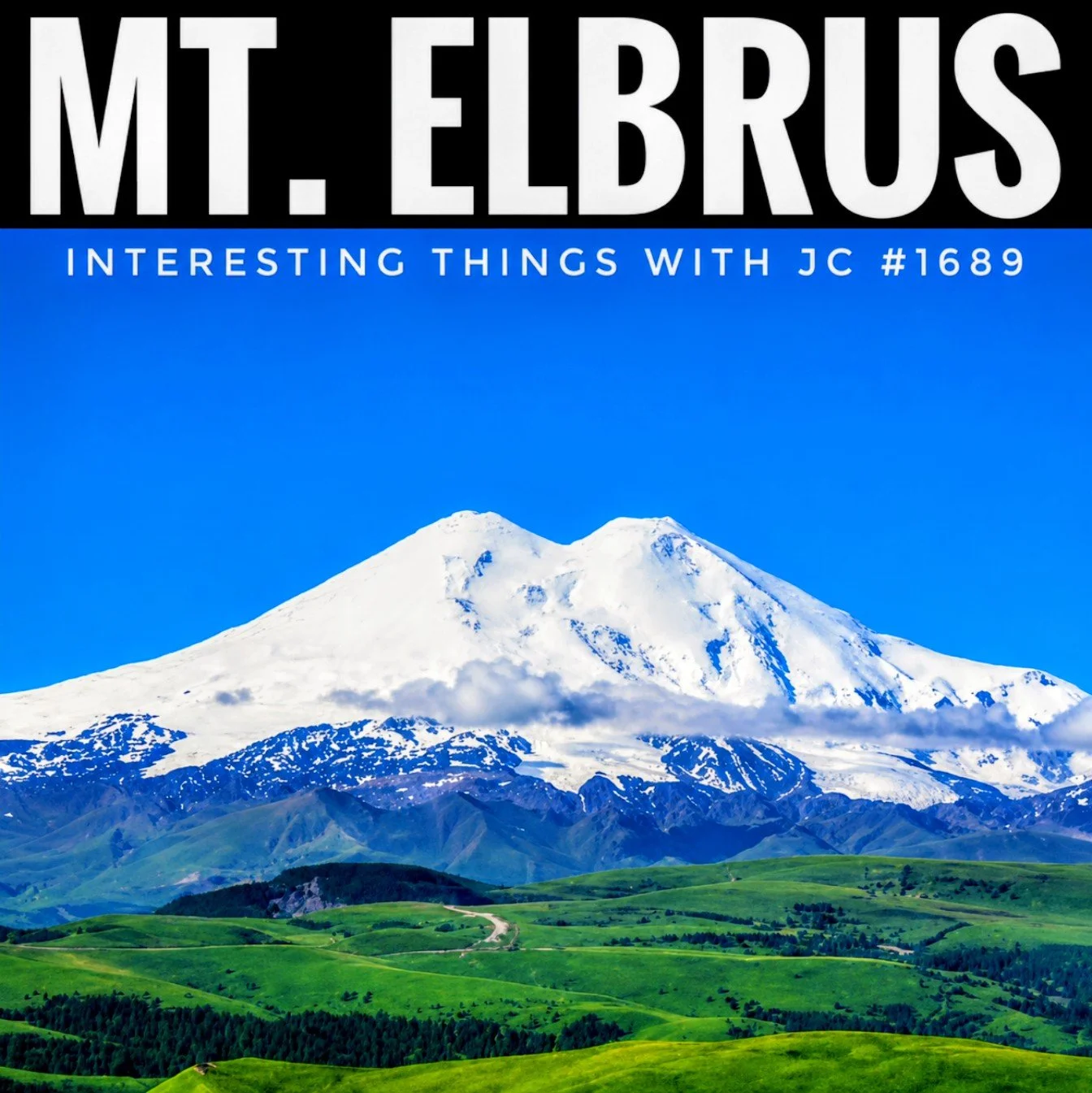
Mount Elbrus, a dormant stratovolcano in the Caucasus Mountains, stands as the highest peak in Europe at 18,510 feet (5,642 meters). This episode explores the mountain’s connections to Greek mythology, ancient Iranian cosmology, geological science, exploration history, World War II, and modern climate research, revealing how a single landscape has inspired dramatically different meanings across cultures and centuries.
Transcript
Interesting Things with JC #1689:
Mt. Elbrus
Mount Elbrus rises 18,510 feet, or 5,642 meters, above the Caucasus Mountains between Europe and Asia. Its twin ice-capped summits dominate the skyline, and for thousands of years people have looked at that mountain and seen far more than rock and snow.
In Greek mythology, the Caucasus was the place where Prometheus was chained after stealing fire from the gods and giving it to humanity. His punishment became one of the most enduring stories of defiance ever told. More than two thousand years later, that same idea found new life in Ridley Scott's 2012 film Prometheus. The film replaces divine fire with the creation of life itself, following humanity's search for its makers and the consequences of seeking answers that may have been meant to remain hidden.
The mountain's name reaches even deeper into the past. Elbrus traces its origins to the ancient Iranian mythological mountain Harā Bərəzaitī (hah-RAH beh-reh-ZAH-ee-tee), later known as Alborz. In those traditions, it was imagined as the cosmic mountain at the center of the world, the great peak around which the heavens revolved. It was less a physical place than a way of understanding how the universe was ordered.
Science tells a different story. Elbrus is a dormant stratovolcano, shaped by the immense geological forces created as the Arabian Plate continues to press into the Eurasian Plate. The collision is still lifting parts of the Caucasus today. What ancient cultures explained through myth, geology explains through pressure, uplift, and millions of years of time.
People eventually climbed the mountain they had long imagined. In 1829, Khillar Khachirov, a local guide working with an Imperial Russian expedition, reached the eastern summit. The higher western summit followed in 1874 when a British climbing party completed the ascent. A place once known through legend became a destination for exploration.
Then came war. In August 1942, German Edelweiss mountain troops climbed Elbrus during the Caucasus campaign and planted a swastika flag on its summit. The act carried little military value but enormous symbolic value. The image was used as propaganda to suggest mastery over the Caucasus. Within months, Soviet forces pushed the Germans back, and the mountain returned to its much older role as a silent witness to events unfolding below.
Today, Elbrus serves another purpose. Scientists closely monitor its glaciers, which have lost more than ten percent of their area in recent decades. The retreat affects rivers and water systems across the region, turning the mountain into one of many places where changes in climate can be measured directly in ice.
What's remarkable is how many different meanings people have attached to the same peak. It has been a prison for a Titan, the center of the cosmos, a scientific puzzle, a wartime symbol, and now a marker of change.
The mountain itself never changed.
What changed was what people were searching for when they looked at it.
These are interesting things, with JC.
Student Worksheet
Comprehension Questions
Where is Mount Elbrus located?
Why is Prometheus connected to the Caucasus Mountains?
What is Harā Bərəzaitī in ancient Iranian tradition?
What type of mountain is Elbrus from a geological perspective?
Why are scientists monitoring Elbrus today?
Analysis Questions
How do mythological explanations differ from scientific explanations of Mount Elbrus?
Why might different societies assign different meanings to the same mountain?
How did World War II change the symbolic significance of Elbrus?
What evidence from the episode demonstrates the interaction between culture and geography?
Reflection Prompt
Think of a landmark that is important in your community. How might historians, scientists, and artists each interpret it differently?
Difficulty Scaling
Emerging: Complete comprehension questions.
Proficient: Complete comprehension and analysis questions.
Advanced: Complete all questions and write a one-page response comparing mythological and scientific worldviews.
Student Output Expectations
Written responses supported by evidence from the transcript.
Complete sentences required.
Analysis responses should include specific examples.
Academic Integrity Guidance
Use your own words.
Cite evidence from the transcript.
Avoid copying responses from classmates or online sources.
Teacher Guide
Quick Start: Begin class by playing the podcast episode. Students listen for examples of mythology, science, history, and environmental observation.
Pacing Guide (Audio-First):
Bell Ringer – 5 minutes
Vocabulary Preview – 5 minutes
Podcast Listening – 8 minutes
Guided Discussion – 10 minutes
Worksheet Completion – 15 minutes
Assessment and Exit Ticket – 7 minutes
Bell Ringer: Ask students: "Can a place be important for more than one reason? Explain."
Audio Guidance: Students should identify at least one mythological, one historical, and one scientific reference while listening.
Audio Fallback: Read the transcript aloud or assign paired reading.
Time-on-Task: Approximately 50 minutes.
Materials:
Podcast audio or transcript
Student worksheet
Map of the Caucasus region
Writing materials
Vocabulary Prep: Review stratovolcano, tectonic plate, glacier, and propaganda before listening.
Misconceptions:
Mythology and science are not the same type of explanation.
A dormant volcano is not extinct.
Historical symbolism is different from military strategy.
Discussion Prompts:
Why do societies create myths?
How does science change our understanding of natural landmarks?
Can a place have both symbolic and scientific importance?
Formative Checks:
Vocabulary check after listening.
Pair-share analysis discussion.
Review worksheet responses.
Differentiation:
Provide vocabulary supports for emerging readers.
Allow verbal responses when appropriate.
Offer graphic organizers for analysis questions.
Assessment Differentiation:
Shortened written responses.
Oral presentation option.
Extended essay option for advanced learners.
Time Flexibility:
One class period or two shorter sessions.
Substitute Readiness: Transcript and worksheet allow independent completion without audio.
Engagement Strategy: Compare Elbrus with other famous mountains students know.
Extensions:
Research another mountain associated with mythology.
Investigate glacier retreat in another region.
Cross-Curricular Connections:
Earth Science
World History
Literature and Mythology
Environmental Studies
SEL Connection: Understanding that people from different cultures may interpret the same place differently promotes perspective-taking.
Skill Emphasis:
Critical thinking
Evidence evaluation
Comparative reasoning
Scientific literacy
Historical analysis
Answer Key:
Comprehension:
Caucasus Mountains between Europe and Asia.
Greek mythology says Prometheus was chained there.
Ancient Iranian cosmic mountain.
Dormant stratovolcano.
To monitor glacier retreat and environmental change.
Analysis:
Myth uses narrative and symbolism; science uses evidence and observation.
Different cultures have different beliefs and needs.
It became a wartime symbol and propaganda image.
Responses should reference mythology, exploration, war, or science.
Quiz
Which mountain is the focus of this lesson?
A. Olympus
B. Kilimanjaro
C. Elbrus
D. Fuji
In Greek mythology, who was chained in the Caucasus?
A. Atlas
B. Prometheus
C. Hercules
D. Perseus
Mount Elbrus is classified as a:
A. Shield volcano
B. Canyon
C. Plateau
D. Stratovolcano
Which tectonic plates contribute to the formation of the Caucasus region?
A. Pacific and North American
B. Arabian and Eurasian
C. African and Antarctic
D. South American and Nazca
Scientists study Elbrus today primarily because of:
A. Gold deposits
B. Earthquakes only
C. Glacier changes
D. Forest growth
Assessment
Open-Ended Questions
Explain how Mount Elbrus illustrates the transition from mythological explanations to scientific understanding.
Analyze why the same geographical feature can hold different meanings across cultures and historical periods.
3–2–1 Rubric
3 – Advanced
Uses multiple examples from the lesson.
Demonstrates strong analysis.
Connects history, science, and culture.
2 – Proficient
Uses relevant evidence.
Shows clear understanding.
Provides adequate explanation.
1 – Developing
Limited evidence.
Partial understanding.
Minimal explanation.
Exit Ticket
Write one sentence explaining how Mount Elbrus connects the study of mythology, science, and history.
Standards Alignment
NGSS HS-ESS2-1: Develop a model illustrating Earth's dynamic systems. Students explain tectonic uplift and mountain formation. Alignment supports geological analysis activities.
NGSS HS-ESS3-5: Analyze geoscience data and environmental impacts. Students examine glacier retreat and environmental monitoring. Alignment supports climate observation discussions.
CCSS.ELA-LITERACY.RH.9-10.2: Determine central ideas of informational texts. Students identify major themes in the transcript and worksheet.
CCSS.ELA-LITERACY.RH.11-12.7: Integrate information from diverse sources. Students connect mythology, history, and scientific evidence.
CCSS.ELA-LITERACY.WHST.9-12.2: Write informative and explanatory texts. Students produce written responses using evidence.
CCSS.ELA-LITERACY.SL.9-10.1: Participate effectively in collaborative discussions. Students engage in guided analysis conversations.
C3 Framework D2.Geo.2.9-12: Use geographic representations and reasoning. Students evaluate the significance of location and physical geography.
C3 Framework D2.His.1.9-12: Evaluate historical sources and developments. Students analyze changing interpretations of Elbrus over time.
ISTE 3 Knowledge Constructor: Critically curate information from multiple sources. Students compare mythological, historical, and scientific explanations.
ISTE 5 Computational Thinker: Analyze data and evidence to understand patterns. Students evaluate glacier monitoring and environmental change.
Career Readiness – Analytical Thinking: Students compare multiple explanations for the same phenomenon using evidence.
Career Readiness – Communication: Students explain complex ideas through discussion and writing.
Career Readiness – Problem Solving: Students evaluate competing interpretations and supporting evidence.
Career Readiness – Adaptability: Students recognize how knowledge evolves over time.
Career Readiness – Professional Judgment: Students distinguish between symbolic narratives and evidence-based conclusions.
Homeschool/Lifelong Learning – Independent Learning: Students investigate geography, science, and history through self-directed inquiry.
Homeschool/Lifelong Learning – Information Literacy: Students assess evidence from multiple disciplines.
Homeschool/Lifelong Learning – Real-World Application: Students connect environmental monitoring to contemporary issues.
Homeschool/Lifelong Learning – Self-Directed Inquiry: Students pursue extension research on related landmarks.
Homeschool/Lifelong Learning – Transferable Life Skills: Students practice critical analysis, reasoning, and communication.
Show Notes
This lesson explores Mount Elbrus as a unique example of how human understanding changes over time. Students examine mythology, geology, exploration, wartime symbolism, and environmental science through the lens of a single mountain. The lesson encourages critical thinking by demonstrating that the same physical place can be interpreted differently depending on cultural beliefs, historical events, and scientific knowledge.
References
Britannica. (n.d.). Mount Elbrus. Encyclopedia Britannica. https://www.britannica.com/place/Mount-Elbrus
Explore-Share. (2018, September 15). Mount Elbrus climb: Facts & information. https://www.explore-share.com/blog/mount-elbrus-climb-facts-and-information/
Holobâcă, I. H., Pop, O. T., Onaca, A., et al. (2016). Recent retreat of the Elbrus glacier system. Journal of Glaciology. https://www.cambridge.org/core/journals/journal-of-glaciology/article/recent-retreat-of-the-elbrus-glacier-system/77F9469788B1D68F3FAA6547CBDDF18A
7 Summits Club. (2013, February 15). How the Soviet Army ousted Nazis from Elbrus. https://7summitsclub.com/news/all/item_3796/
Smithsonian Institution. (2024). Prometheus in Greek Mythology. https://www.si.edu/object/prometheus-sculpture%3Asiris_ari_337387