Interesting Things with JC #1690: "The Legendary Saab Convertible" – Saab engineers were reinforcing a convertible for winter driving while much of the company doubted anyone wanted one. Dealers and customers kept demanding the car, and what began as an unlikely experiment grew into nearly 300,000 convertibles built over twenty-five years. This episode was inspired by our friends at Superior Auto Sales.
Curriculum - Episode Anchor
Episode Title: The Legendary Saab Convertible
Episode Number: 1690
Host: JC
Audience: Grades 9–12, Introductory College, Homeschool Learners, Lifelong Learners
Subject Area: Automotive History, Engineering, Product Design, Business Innovation
Lesson Overview
Objectives:
Analyze how consumer demand can influence product development.
Explain the engineering challenges involved in designing a practical convertible automobile.
Evaluate how innovation sometimes emerges from ideas initially viewed as unlikely or impractical.
Examine the relationship between brand identity and market adaptation.
Essential Question: How can an unconventional idea transform a company's identity and create a lasting legacy?
Success Criteria:
Students can describe the origins of the Saab Convertible.
Students can identify engineering features that distinguished Saab convertibles from competitors.
Students can explain why the vehicle developed a loyal customer base.
Students can connect innovation, market demand, and product success.
Student Relevance: Students encounter innovation daily through technology, transportation, and consumer products. Understanding how ideas move from concept to reality helps develop critical thinking and problem-solving skills.
Real-World Connection: Businesses regularly balance customer demand, engineering limitations, safety requirements, and brand identity when developing new products.
Workforce Reality: Engineers, designers, marketers, and executives often collaborate to determine whether unconventional ideas become successful products.
Key Vocabulary
Convertible (kuhn-VUR-tuh-buhl) – An automobile with a retractable roof.
Prototype (PROH-tuh-type) – An early model used to test a concept.
Turbocharged (TUR-boh-charjd) – An engine system that increases power using compressed air.
Engineering (en-juh-NEER-ing) – The application of science and mathematics to design and build systems.
Durability (door-uh-BIL-uh-tee) – The ability to withstand wear and long-term use.
Insulation (in-suh-LAY-shun) – Material used to reduce heat loss or gain.
Innovation (in-uh-VAY-shun) – The introduction of a new idea, method, or product.
Market Demand (MAR-kit dih-MAND) – Consumer desire for a product or service.
Brand Identity (brand eye-DEN-ti-tee) – The characteristics and image associated with a company.
Legacy (LEG-uh-see) – Something handed down or remembered from the past.
Narrative Core
Open:
In 1983, visitors at the Frankfurt Motor Show encountered something unexpected: a convertible from Saab, a company known for practical, winter-ready automobiles inspired by aviation engineering.
Info:
The idea came from Robert Sinclair, known among enthusiasts as "Uncle Bob." As head of Saab USA, he believed American consumers wanted a practical four-seat convertible that could be used every day.
Details:
Many inside Saab doubted the idea. However, public reaction at the Frankfurt Motor Show was overwhelmingly positive. When production began in 1986, Saab approached the project differently than many competitors. Engineers focused on comfort, safety, and year-round usability. Features included an insulated soft top, heated glass rear window, strong heating systems, and structural engineering designed to maintain durability.
Demand greatly exceeded expectations. Saab initially expected annual sales of around 2,000 units but eventually produced nearly 49,000 first-generation convertibles. The concept continued through multiple generations, eventually reaching nearly 300,000 total Saab convertibles by 2011.
Reflection:
The Saab Convertible demonstrates how innovation sometimes comes from challenging assumptions. An idea that initially appeared inconsistent with a company's identity ultimately became one of its defining products.
Closing:
These are interesting things, with JC.
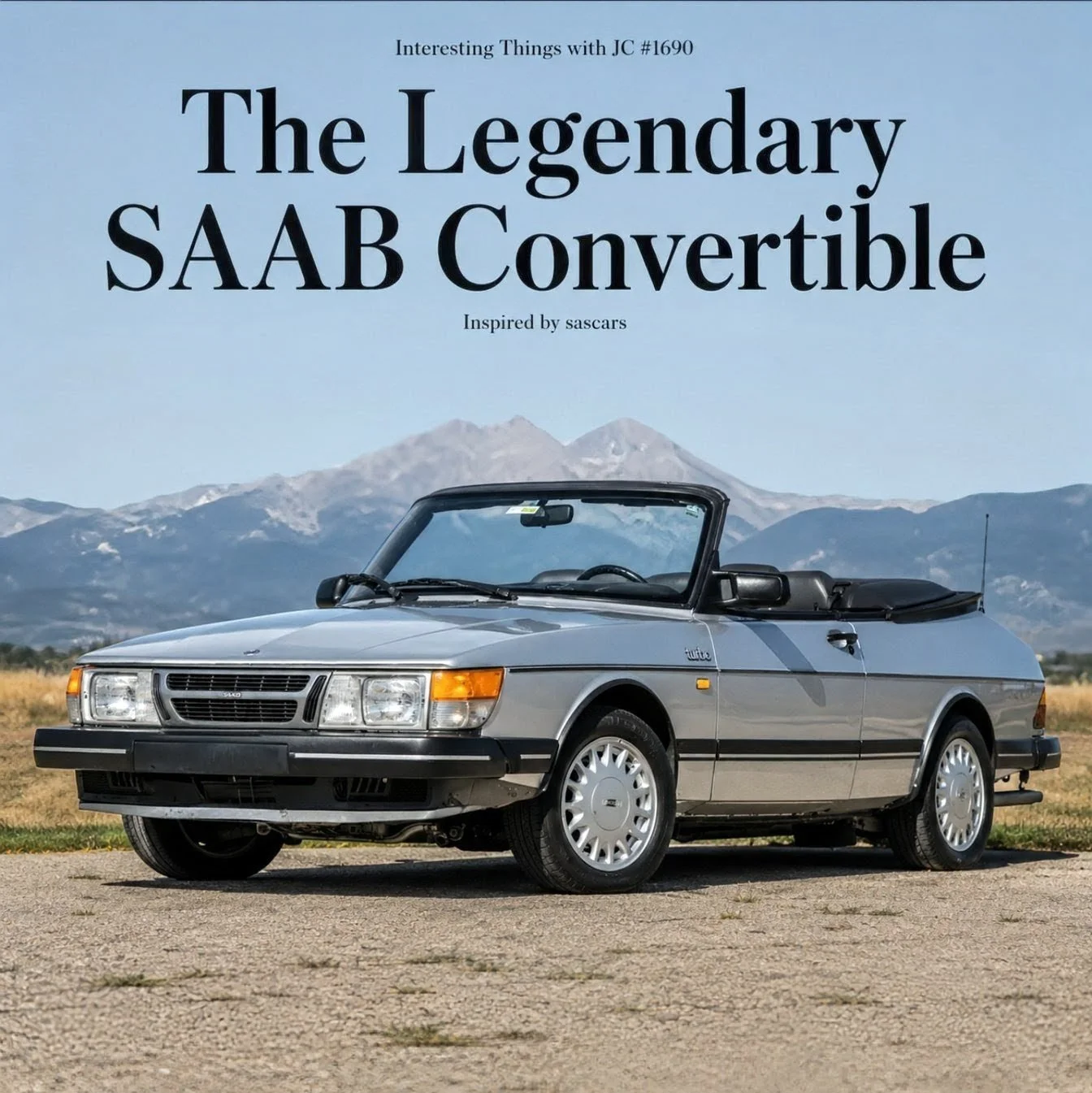
Promotional cover image for Interesting Things with JC #1690: The Legendary SAAB Convertible. A silver Saab 900 Turbo convertible is parked on a paved surface with its top down. Mountain peaks rise in the background beneath a clear blue sky. Large black text at the top reads “The Legendary SAAB Convertible.”
Transcript
Interesting Things with JC #1690:
The Legendary Saab Convertible
In 1983, visitors walking through the Frankfurt Motor Show stopped in front of a Saab that didn't seem to make much sense.
It was a convertible.
This was Saab, aircraft-inspired engineering, turbocharged practicality, and cars built for harsh Scandinavian winters. A fabric roof seemed almost contrary to everything the brand represented.
The man behind the idea was Robert Sinclair, better known to Saab enthusiasts as "Uncle Bob." As head of Saab USA, he believed there was room in the American market for something different: a four-seat convertible people could actually use every day.
Inside Saab, the proposal was met with skepticism.
Outside, people loved it.
When the prototype appeared at Frankfurt, dealers wanted one. Customers wanted one. What had been viewed as an experiment suddenly looked like a real opportunity.
When production began in 1986, Saab approached the project the only way it knew how.
The engineers didn't build a summer toy. They built a Saab that happened to have no fixed roof.
The soft top was heavily insulated. The rear window was real electrically heated glass instead of the flexible plastic used by many convertibles at the time. Powerful heating systems made cold-weather driving comfortable, and engineers worked to preserve Saab's reputation for safety and durability.
In effect, they created a convertible for people who lived where snow existed.
Saab expected to sell about 2,000 a year.
Instead, demand exploded.
Waiting lists stretched for months. By the time the original 900 Convertible ended production in 1993, Saab had built 48,894 examples.
What began as Uncle Bob's unlikely experiment soon became part of Saab itself.
As the lineup evolved from the classic 900 to the new-generation 900 and later the 9-3, the convertible kept coming along for the ride. Names changed, engineering improved, technology advanced, but the original idea remained remarkably consistent: a four-seat, year-round convertible people could actually live with.
Over the next twenty-five years, Saab kept refining the formula. By the time production ended in 2011, nearly 300,000 Saab convertibles had rolled out of the factory.
What's remarkable is that the Saab convertible never became famous for being the fastest or most glamorous car in its class.
Instead, it attracted people who wanted something a little different.
The cars developed an unusually loyal following among professionals, creatives, engineers, and independent thinkers who appreciated Saab's blend of practicality and individuality. The turbocharged models only strengthened that appeal. There was a certain character to a Saab turbo. Power arrived with a smooth surge that felt less like brute force and more like the car had decided to lean into the horizon.
Over time, the convertible became one of the clearest expressions of what made Saab unique. Sensible and unconventional at the same time. Comfortable in bad weather, enjoyable in good weather, and unlike almost anything else on the road.
Even today, long after Saab stopped building cars, owners continue restoring them, driving them, and gathering to celebrate them.
Perhaps that's because the Saab convertible began with an idea that didn't quite fit the company that built it.
A Swedish manufacturer famous for winter-ready practicality was persuaded to build a convertible. An American executive believed customers wanted one. The company took the chance.
Most automotive experiments disappear after a few years.
This one survived model changes, ownership changes, and a quarter century of production.
And long after the company itself was gone, people were still lowering the top and heading down the road.
These are interesting things, with JC.
Student Worksheet
Comprehension Questions
Who proposed the idea of a Saab convertible?
Why was the concept initially viewed skeptically within Saab?
What engineering features made the Saab convertible unusual for its class?
How many original Saab 900 Convertibles were produced by 1993?
Why did the vehicle develop a loyal following?
Analysis Questions
How did customer demand influence Saab's decision-making process?
In what ways did Saab maintain its brand identity while creating a convertible?
Why might practicality have been a competitive advantage in the convertible market?
Reflection Prompt
Describe a product or technology that seemed unusual at first but later became widely accepted. What factors contributed to its success?
Difficulty Scaling
Foundational: Answer comprehension questions using evidence from the transcript.
Intermediate: Complete analysis questions with supporting details.
Advanced: Compare the Saab Convertible's development to another innovative product in automotive history.
Student Output
One-page written response or discussion summary.
Evidence from the transcript required.
Complete sentences expected.
Academic Integrity Guidance
Use evidence from the lesson.
Cite examples accurately.
Present original analysis and reflections.
Teacher Guide
Quick Start: Play the podcast episode, distribute vocabulary list, and complete worksheet activities.
Pacing Guide (Audio-First):
Bell Ringer – 5 minutes
Vocabulary Preview – 5 minutes
Podcast Listening – 8 minutes
Discussion – 10 minutes
Worksheet – 15 minutes
Assessment – 7 minutes
Bell Ringer: Ask students: "Can a product succeed if it seems to contradict a company's identity? Why or why not?"
Audio Guidance: Encourage students to identify examples of innovation, engineering decisions, and market response while listening.
Audio Fallback: Read the transcript aloud or assign silent reading.
Time-on-Task: Approximately 50 minutes.
Materials:
Podcast audio
Transcript
Worksheet
Writing materials
Vocabulary Prep: Review prototype, innovation, turbocharged, durability, and market demand.
Misconceptions:
Convertibles are only designed for warm climates.
Successful products always fit existing company traditions.
Engineering and marketing operate independently.
Discussion Prompts:
Why did consumers react positively to the prototype?
How did Saab balance innovation with practicality?
What risks did Saab face by producing the vehicle?
Formative Checks:
Vocabulary understanding
Discussion participation
Worksheet responses
Differentiation:
Provide guided notes for emerging learners.
Allow verbal responses where appropriate.
Offer extension research for advanced learners.
Assessment Differentiation:
Written, oral, or presentation format options.
Time Flexibility:
Can be shortened to 30 minutes or expanded into a multi-day project.
Substitute Readiness: Transcript and worksheet provide full lesson continuity.
Engagement Strategy: Have students evaluate whether they would have approved the convertible project if they were Saab executives.
Extensions:
Research automotive innovations that initially faced skepticism.
Compare Saab's strategy with another manufacturer.
Cross-Curricular Connections:
Business
Engineering
Economics
Design
SEL Connection: Evaluating risk-taking, persistence, and thoughtful decision-making.
Skill Emphasis:
Critical thinking
Evidence evaluation
Communication
Problem solving
Answer Key:
Robert Sinclair ("Uncle Bob")
It appeared inconsistent with Saab's traditional identity.
Insulated top, heated glass rear window, strong heating systems, durability features.
48,894 examples.
Practicality, individuality, year-round usability, and turbocharged performance.
Quiz
Who was known as "Uncle Bob"?
A. Erik Carlsson
B. Robert Sinclair
C. Gunnar Ljungström
D. Björn Envall
Where was the Saab convertible prototype publicly displayed?
A. Geneva Motor Show
B. Detroit Auto Show
C. Frankfurt Motor Show
D. Paris Motor Show
What feature distinguished Saab's rear window design?
A. Manual operation
B. Heated glass
C. Aluminum frame
D. Folding panel
How many convertibles did Saab initially expect to sell annually?
A. 500
B. 1,000
C. 2,000
D. 10,000
What helped define the Saab convertible's reputation?
A. Racing success
B. Luxury exclusivity
C. Extreme speed
D. Practical year-round usability
Assessment
Open-Ended Questions
Explain how the Saab Convertible balanced innovation with the company's established identity.
Evaluate the role customer demand played in transforming the Saab Convertible from an experiment into a long-term product line.
Rubric (3–2–1)
3: Thorough explanation, accurate evidence, strong analysis.
2: Adequate explanation with some supporting evidence.
1: Limited explanation with minimal supporting details.
Exit Ticket
What is one lesson modern companies can learn from the development of the Saab Convertible?
Standards Alignment
NGSS HS-ETS1-2: Engineering Design
Students evaluate how engineering decisions addressed practical design challenges.
Alignment: Analysis of year-round convertible engineering solutions.
Skill: Design evaluation and problem-solving.
NGSS HS-ETS1-3: Evaluate Solutions
Students assess competing design priorities.
Alignment: Safety, comfort, and practicality considerations.
Skill: Evidence-based evaluation.
CCSS.ELA-LITERACY.RI.9-10.2
Determine central ideas of informational text.
Alignment: Transcript analysis.
Skill: Summarization and interpretation.
CCSS.ELA-LITERACY.RI.11-12.3
Analyze a complex sequence of events.
Alignment: Product development timeline.
Skill: Cause-and-effect reasoning.
CCSS.ELA-LITERACY.W.9-10.1
Write arguments supported by evidence.
Alignment: Assessment responses.
Skill: Written communication.
CCSS.ELA-LITERACY.SL.9-10.1
Participate effectively in collaborative discussions.
Alignment: Class discussions.
Skill: Speaking and listening.
C3 Framework D2.Eco.6.9-12
Analyze economic incentives and decisions.
Alignment: Market demand and production decisions.
Skill: Economic reasoning.
ISTE Standard 1.3 Knowledge Constructor
Evaluate information from multiple sources.
Alignment: Extension research activities.
Skill: Information literacy.
Career Readiness – Analytical Thinking
Examine product development decisions using evidence.
Alignment: Analysis questions and assessments.
Skill: Critical evaluation.
Career Readiness – Communication
Express conclusions through written and verbal responses.
Alignment: Worksheet and discussions.
Skill: Professional communication.
Career Readiness – Problem Solving
Assess engineering challenges and solutions.
Alignment: Engineering-focused analysis.
Skill: Applied reasoning.
Career Readiness – Adaptability
Explore organizational willingness to pursue unconventional ideas.
Alignment: Reflection activities.
Skill: Flexible thinking.
Career Readiness – Professional Judgment
Evaluate risk and opportunity in decision-making.
Alignment: Discussion prompts.
Skill: Decision analysis.
Homeschool / Lifelong Learning Alignment
Supports independent learning, information literacy, self-directed inquiry, real-world application, and transferable life skills through research, reflection, and evidence-based evaluation.
Show Notes
This lesson explores the surprising history of the Saab Convertible, a vehicle that challenged assumptions about both automotive design and corporate identity. Students examine how innovation, engineering, market demand, and leadership combined to transform an unlikely experiment into one of Saab's most enduring products. The episode highlights the importance of creative thinking, practical problem-solving, and the willingness to pursue ideas that initially appear unconventional.
References
National Motor Museum. (n.d.). Saab 900 Convertible history. https://nationalmotormuseum.org.uk
History of the Saab Convertible. Saab Planet https://www.saabplanet.com/
Hagerty Media. (2022). Saab 900 Convertible retrospective. https://www.hagerty.com/media/car-profiles/a-jaded-gearhead-gets-his-kicks-in-a-saab-900-convertible/
Saab vehicle history and development. https://saabcarmuseum.se/en/
Superior Auto Sales. Hamburg NY. https://www.sascars.com/
Autoevolution. (2011, May 11). Saab convertible turns 25. https://www.autoevolution.com/news/saab-convertible-turns-25-35135.html
Hemmings. (2023, October 15). Buyer’s guide: 1986-’94 Saab 900 convertible. https://www.hemmings.com/stories/buyers-guide-1986-94-saab-900-convertible/
Hemmings. (2009, May 12). Remembering Bob Sinclair: Saab USA’s legendary leader. https://www.hemmings.com/stories/remembering-saab-usas-bob-sinclair/
New York Times. (2009, May 17). Robert Sinclair, who found a niche for Saab, dies at 77. https://www.nytimes.com/2009/05/17/business/17sinclair.html
Saab Planet. (2021, June 29). How the cult convertible 900 was born. https://www.saabplanet.com/how-the-cult-convertible-900-was-born/
Swadeology. (2011, May 23). Bob Sinclair on the birth of the Saab Convertible. https://swadeology.com/2011/05/bob-sinclair-on-the-birth-of-the-saab-convertible/
Swadeology. (2011, May 8). Saab Convertible - by the numbers. https://swadeology.com/2011/05/saab-convertible-by-the-numbers/